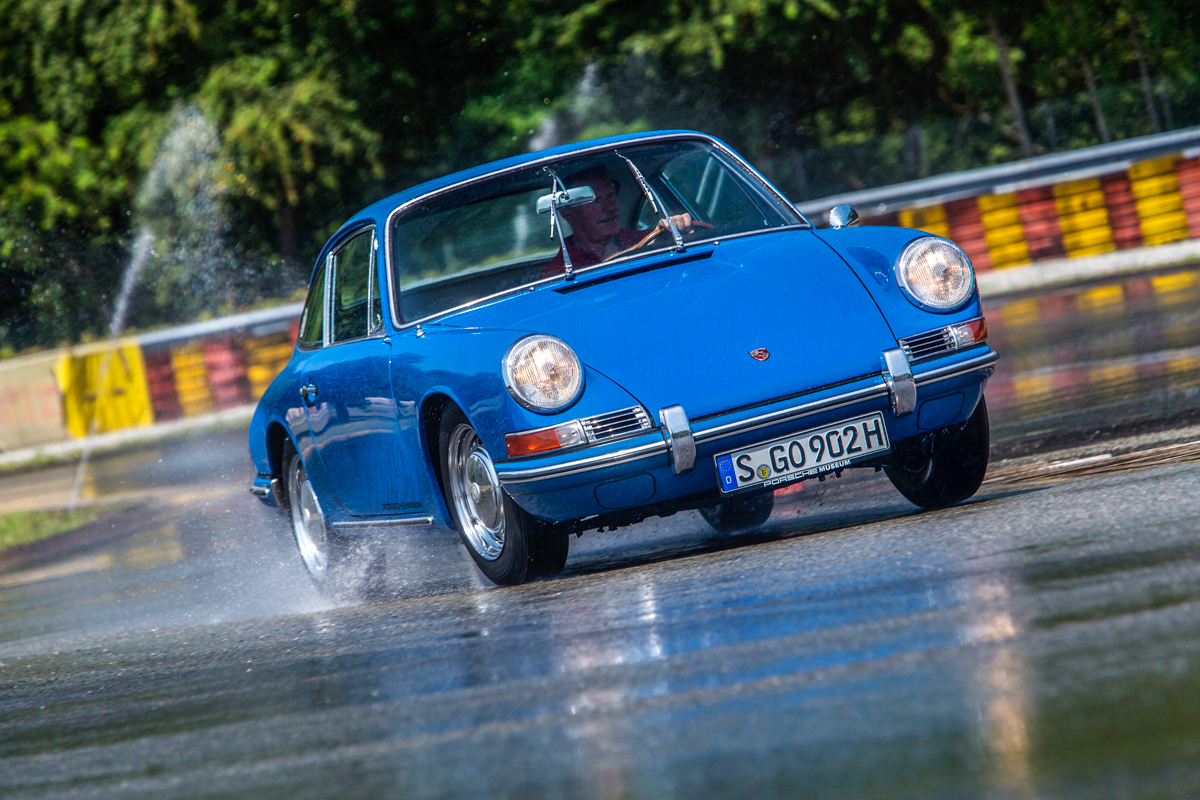
Porsche has just added a bunch of new N-rated tyres to its list of approved rubber for older Porsche sports cars. The fact that Stuttgart’s release considers anything pre-2005 as classic is something we’ll gloss over for now – not going there on a Friday afternoon.
Porsche N-rated Tyres on Classic 911s
The Porsche tyre N-rating system is a subject of much discussion amongst classic 911 owners: probably in the top three conversation starters along with “what oil should I use?” and “I once turned down a 964RS for £20 and a half-eaten steak and kidney pie.” Not fitting N-rated tyres to your old Porsche won’t make it fail the MOT or invalidate your insurance, but there may be some comfort in fitting tyres which Porsche has tested on your classic. It also leaves you with plenty of headspace to worry about the engine going bang or whatever people worry about these days.
Pirelli, Continental, Michelin and Bridgestone all have rubber on the latest classic Porsche N-rated tyre list. As impact bumper 911s are closest to my heart, it’s nice to see that Continental Sport Contact tyres continue to be available in 205/55 and 245/45 ZR16 for 7- and 9-inch Fuchs wheels as fitted to my Carrera 3.0 (albeit the Sport Contacts on my car at present are not N rated). For those who follow a Porsche-approved lifestyle, 959 owners are stuck with Bridgestone RE71s (plenty noisy at 80dB), 964RS drivers have a better choice of Sport Contacts, Michelin Pilot Sport 2, Pirelli P Zero Rosso or Trofeo R compounds, while 924 Turbo drivers have the Sport Contact, Pilot Exalto 2 or P Zero Rosso to choose from.
Porsche Tyre Test Drivers
Porsche invited Walter Röhrl along to help with approvals, the former World Rally champion offering input based on a long history of driving classic Porsche models. Many of the current works drivers also have a classic 911 tucked away somewhere – would be interesting to see one of them drifting a pre-’73, abusing a set of N-rated tyres (Pirelli CN36 or P6000 if you must have the N). It is also interesting to see Walter leaning on a pair of P7Rs (sexiest tread pattern ever IMO) but those tyres are not on the Porsche approved list as far as I can see: P7 Cinturatos yes, but not P7Rs.
“The driving properties in the early years were not as full or balanced as they are today,” says Walter. “The new generation of tyres is more fitting than ever to the driving style of a challenging sports car.” Porsche tyre tester, Dieter Röscheisen, said of the newly-approved tyres: “The new tyre releases will make it possible for classic models to follow the curve into the modern era with exceptionally good and balanced driving properties.” (I imagine it is more likely that a PR person said this. My hope is that Dieter was overexcited after spending an afternoon shredding 993 RS rear tyres and couldn’t elucidate.)
I don’t have N-rated tyres fitted to any of my five old Porsches. It doesn’t bother me in the slightest, as my cars are eternal works-in-progress and only one of the Porsches is currently road legal (a classic 2004 SUV model). I have a set of part-worn 205/55 16 Bridgestones for the 924 Turbo, which will be next to go on the road. I like Sport Contacts on the 911, but tend to lean toward Michelins as my overall tyre brand of choice: they drive so well, right down to the wear bars. All that will go out the window if you can now get P7Rs to fit the 911, as they are soooo s-e-x-y.
Track day fans on my 911 forum at impactbumpers.com use a load of different non-N-rated tyres on long road trips and pretty intense driving conditions and no big problems reported there. Bridgestone S-02s have long been a good choice for spirited ’74-’89 911 driving if you can get a set to suit: you can still buy 205/55 and 225/50 16s in Porsche N3 rating from places like Camskill, but I don’t think 245s are easily available.
My much-loved 2004 Porsche Cayenne S (4.5 V8) behaved itself for most of this winter just gone, apart from a couple of minor hiccups. The first required a battery change, but the other was a little more challenging.
I should have seen it coming when the Cayenne would very occasionally take a few of seconds of cranking to get started when hot. I assumed it was some sort of fuel boil-off to do with the LPG system, but then it was a random occurrence and perhaps also happened when running on petrol.
Porsche Cayenne Poor Running
A few weeks ago, I filled up with LPG and was just driving away when I was forced to do an emergency stop. The hard braking caused the Cayenne to cut out and it was a bit of a pig to get started again. Eventually it did start, but would not pull away from junctions cleanly once I got it going. I thought it might be something to do with the emergency braking system (an Audi I once drove had something like this) so I pulled over, reset the systems and drove off, apparently cured.
The next day, the problem was back, with poor acceleration on the school run. I emailed Chris at JZM and asked what he thought. There were a few suggestions, but he could stick it on their Porsche PIWIS the following day to be sure. Next morning, I dropped the kids to school and headed for Kings Langley, where we plugged it in and read the fault codes.
There were a few things on there (as usual for any Cayenne), but one I had been looking for: crankshaft position sensor fault. The ECU said it had last happened at 41k miles, but first happened at 63k miles even though the car was now on 157k miles. I couldn’t see anything else. Mike had a good look through everything – bit of a pain as the Cayenne takes ages to give up its codes and the PIWIS diagnostic walk-throughs only work on post-2006 cars – before deciding to do a master reset, run it again, then read the codes and see what was showing.
Cayenne Crankshaft Position Sensor Failure
Having done the reset, the Cayenne wouldn’t start. It would crank and crank but no start. Complete failure in the best possible place: a decent independent Porsche workshop! We left it a while and then like magic it started fine. As the last major fault code had been for crankshaft position sensor, we agreed this was the first thing to change. I borrowed a courtesy car and Mike changed the sensor the following day, which seemed to cure the problem.
Thoughts since the change? Wow, what a difference. Things the Cayenne used to do which mildly annoyed me have all disappeared. It starts first time, every time, and pulls cleanly from anywhere in the rev range: easily the smoothest it has been in my 40k miles of ownership. Still needs flicking down a gear when you really want to get moving, but a huge improvement overall.
If you’ve got a 955 Cayenne with 100k miles or more and it’s on the original CPS, get it changed and bring your Cayenne back to full health, before it leaves you stranded. Will be a bit of a nightmare job, as the plug is in quite a tight spot behind the top of the engine, but “it’s not that bad” according to Mike. One tip on where to get the part: as official Bosch agents, JZM bought my crank position sensor straight from Bosch and saved me quite a few quid. Good work!
PS: I collected the Cayenne and brought it home. That night, this happened (above). I was not pleased! Three other cars around it were also keyed so it wasn’t an anti-Porsche thing. My Polo was parked in front of it and that was not keyed, so it wasn’t an anti-me thing either. Such is life.
To read more of my work, commission my valuation expertise or hire my content generation skills, you can:
My 1980 Porsche 924 Turbo restoration has made great progress since I reset my work schedule and committed to spending the weekends working on my own projects rather than sitting behind a laptop. My bank account is slightly less happy about the restoration, but payback will come in due course.
I’ve now clocked up a couple of hundred hours on this car, and poked around most of it. While there is unsurprising evidence of parking dents and other traumas from its former life in Italy, underneath all that it’s a really great example, especially now I have reconditioned most of the moving parts fixed to the bodywork. Dropping all the mechanicals to do a full restoration is very tempting, but I must resist.
Retaining Porsche Patina in Detailed Restoration
Perhaps the most engaging part of the rebuild after the 924 Turbo’s bodywork was so nicely stripped, prepared and repainted by my old friend Rob Campbell at Racing Restorations has been deciding what to keep and what to ditch, in hope of retaining some patina and original character to compliment the delightful new paint.
For example, none of the locks matched, so I junked all of them, pulled the smoothest ignition barrel out of my stash of 924 & 944 parts and then bought a full set of VW tumblers and rebuilt and rekeyed every lock on the car to match. This led to stripping the latch mechanisms and locks, new door seals, new hatch seals – you know how it goes.
The dash was a mass of old alarm wiring and leftover radio installations so all that got junked. The black speedo trim ring was rusty for whatever reason, so I tossed that and stripped another speedo to find one in better condition. That led to stripping all the clocks and cleaning the dials and glass faces so they all look great now.
Porsche 924 Turbo Strip & Rebuild
Everywhere I look on the 924 Turbo now, I see bit that have been stripped and rebuilt. I stripped the electric window regulators including the motors and sorted all those out, bench testing them before refitting to the car. I haven’t done anything about the wiper motors yet but I bet it happens. Having all of the trim out of the inside meant I could clean it up properly and Dynamat quite a bit, so the doors now shut with that satisfying clunk and none of the rattles that used to soundtrack entry and exit.
Having junked so much stuff, I also found a few bits I wanted to keep. The Italian plates are back on the car, just because I love them. I riveted the rear plate together, which is not strictly correct but it means bits of it can’t get stolen! I tossed the LED-infested centre console gauge surround and bought another mint one in black, but kept the slightly crappy cigarette lighter from my old one, as a well-used cigarette lighter in an 1980s Porsche is just so Italian, darling.
I fitted a replacement glass hatch with a good condition spoiler (the original was utterly ruined) and polished all the original glass, refitting it in a mix of new and good used seals. I liked the Italian anti-theft alarm window sticker so I kept that. Under the driver’s seat carpet, I found a 200 Lira coin from 1978, so that is now the keyring. I kept the original dog-leg gearlever but replaced the shift boot and sent the ratty steering wheel off to be restitched – I hope they can retain the original leather. I have a nice three-spoke for the car if not. I ordered a full gear linkage rebuild kit from AutoAtlanta in the US, but that has not yet arrived.
I fitted new rear speakers (long story) and decided not to cut the original front door panels to fit another pair of speakers – the rather spartan black vinyl has survived this long without cutting and deserves to be left alone. I stuck a centre speaker back in the dash to add some noise up front. I decided not to change the cracked dash: you can get new ones but 924 owners are generally well used to cracked dashboards. The original rear view mirror is a non-dipping version and I’m slightly on the fence about keeping or saving. I have a pair of dipping ones with the glass mounts in my stash so I may change that.
Original seat belts are in good condition so still in place: they were likely never used in Sardinia! The car is quite low mileage anyway, so they are fine. Refitted the original roof aerial as, while it is not the shiniest thing ever, it is perfect for the 924. I fitted a new rubber trim to the rear bumper (just squeezed into the Polo in the massive tube it ships in from Porsche) and new seals on the door mirror, door handles and boot lock.
I rebuilt the front bumper light clusters: you’d be surprised how long that took. One indicator reflector was completely rusted out so I stripped the reflector off another one and plastic welded it back together (the fun of playing with £5 parts). I cleaned and refitted the Italian side repeaters as, while they are not very attractive, they are original to the car. Stripped the window switches, sorted them out. All very satisfying. I have been keeping things as tidy as possible, but you’ll see from the photos that it needs a lot of cleaning when it is eventually back together: I am quite looking forward to that.
Classic Porsche Build Quality in spades
So many hours later, with many more left to invest, I continue to have great respect for classic Porsche build quality with the 924. The way it’s built is inspiring to work on when you’re not in a rush; so much intricate detail signposts the hours of highly skilled labour it must have taken to build each one. The assembly is very like my old E28 BMWs and Mk 2 Golf GTis: plated screws and high quality metal clips everywhere. It is time consuming to make things better – stripping the fusebox and wiring out to clean up the corroded earth points behind for example – but once done, you get the feeling it will last forever.
I feel sure I will buy another 924 to work on once this one is sold and I have cleared out a few more cars. The Signal Green 1977 924 we saw at Essen a few years ago is still very strong in my memory – that’s the sort of old-school 924 I would like to do some miles in if Turbo prices have soared out of reach. Small but modern 1.4 engine transplant, little Turbo, careful gearbox build, classic trim.
Watched a cool project in progress at Tuthill Porsche this morning, with my ex-BTCC tech mate Chris Defriez fitting EXE-TC dampers to a Porsche 964 RS track day machine.
EXE-TC suspension is a high-end option for Porsche 911s that has been used to great effect on many Tuthill rally cars over the years, but decent suspension is just as important on road and race cars. EXE-TC kit is now available for most 911s from 1965 onwards. These remote reservoir 964 dampers are beautifully manufactured, featuring mega adjustable billet top mounts, which gave a wide range camber and castor adjustment at the top and bottom of the suspension leg on this particular 964 RS.
The kit being fitted to all four corners of this RS created an interesting challenge for Chris, as he worked out where to site the remote reservoirs. Front is not too bad, as there is a handy strut brace sitting there ready to mount damper reservoirs, but the engine compartment on a 964RS is pretty packed, so not many options in the back. I’ll head back over in a few days to see what he decided.
964RS is still the one for me – they are absolutely fantastic cars. I am another one of those who almost bought a 964RS many years ago when they were circa £30k, but decided against it. I can live with the decision but, every so often, it does niggle me that I will never actually own one of my own. Prices will never return to that sort of level.
Prices for proper Porsche 964 RS models now start circa £120k and rise to much bigger numbers for original, low mileage RHD examples, so this well used LHD track car is still worth serious money by normal standards. There are a few 964 RS models up for sale at the minute, including a 964 Cup Car for sale at just under £200k. I’m not about to remortgage my house for a 964 Cup Car, but how cool to have bought one when they could barely be given away.
Finally resurrected my 1976 Porsche 911 Carrera 3.0 today. As I walked around the car while it warmed up on tickover, I noticed the road tax had run out in July 2011, so it had been parked up for more than four years. On the upside, it is now tax exempt.
Cranking the Carrera 3.0 back to life was easy enough. I had charged the new Odyssey battery up to full strength over a couple of days, swapped the terminals over from the old battery and then stuck the new one into the car, reconnecting the various positive feeds to who knows what (long time since I did all this stuff). Dropping the negative terminal on and reconnecting the battery disconnect made it ready to go.
Ignition on, fuel pump buzz, key turn, oil pressure light off. Then key off and turn – it started on the second attempt and soon filled the garage with smoke. Trying to drive it outside was an issue, as the clutch had seized on. Not ideal. I knocked it off and tried working the clutch a bit but nothing would free it. Cranking it out on the starter in first, the car started and took off for the bins. Brakes wouldn’t stop it on gravel, so I quickly knocked the key off and avoided a crash into the bins and my big trailer.
I rocked it backwards and forwards a bit in gear, wound it backwards on the starter, wound it forwards again, there was a burst of revs and the clutch was free. Saved me having to do anything brutal with a tow rope! Now the car was ready to turn a wheel, I put Ted in the 911 and took it for a quick spin around the village checking for seized brakes. All seems OK: I will book it for an MOT this week and we’ll see what it needs to pass the test and get back out there. Here’s some video:
This website uses cookies to improve your experience. We'll assume you're ok with this, but you can opt-out if you wish.AcceptRead More
Privacy & Cookies Policy
Privacy Overview
This website uses cookies to improve your experience while you navigate through the website. Out of these, the cookies that are categorized as necessary are stored on your browser as they are essential for the working of basic functionalities of the website. We also use third-party cookies that help us analyze and understand how you use this website. These cookies will be stored in your browser only with your consent. You also have the option to opt-out of these cookies. But opting out of some of these cookies may affect your browsing experience.
Necessary cookies are absolutely essential for the website to function properly. This category only includes cookies that ensures basic functionalities and security features of the website. These cookies do not store any personal information.
Any cookies that may not be particularly necessary for the website to function and is used specifically to collect user personal data via analytics, ads, other embedded contents are termed as non-necessary cookies. It is mandatory to procure user consent prior to running these cookies on your website.