No fan of Porsche racing will have enjoyed the recent news that former Porsche R&D supremo, Wolfgang Hatz, had been arrested in connection with ongoing investigations into the Volkswagen diesel emissions cheating scandal.
Hatz’ arrest is not the first in this story and will not be the last. The most detailed piece I have read regarding Hatz was on Arstechnica, in an article which said the former VW and Audi engine chief was the fourth arrest made so far in relation to the dieselgate scandal:
“Hatz, who is reportedly being held without bail, is the fourth VW Group employee to be arrested in connection with the scandal (VW Group as an entity pleaded guilty to violating the Clean Air Act in early 2017). James Liang, a former VW engineer, was arrested in 2016 in the US and sentenced to 40 months in prison; Oliver Schmidt, a German emissions compliance executive who worked in the US, was arrested in Miami in December; and Zaccheo Giovanni Pamio, an Italian citizen who was the former chief of thermodynamics in Audi’s engine development department, was arrested in Germany earlier this year.”
One senses the growing inevitability of further arrests amongst former or current board members. Exactly what punishment might be meted out to directors and board members convicted of wrongdoing is unknown, but the situation continues to be closely monitored by many news outlets. VW’s (presumably vast) media spend to underpin positive public perception of the organisation has not brought the carmaker out of the woods just yet.
Knowing that one of the people at the very top of Porsche Motorsport success has been arrested for allegedly cheating air quality regulations leaves an unpleasant taste. It is also very hard to accept that Volkswagen remains the only car manufacturer that has ever done this sort of thing, so who is investigating the rest of them?
Diesel Emissions effect on Porsche SE
Two years after the emissions scandal broke, Porsche SE continues to feel the pain. When Volkswagen recently announced further “negative special items” (i.e. big numbers in red ink) of more than €2.5 billion due to the ongoing emissions crisis, Porsche SE – which holds more than 30% of VW’s shares – announced that this would inevitably hit its own profits, which were now expected to land somewhere between €2.1 and 3.1 billion.
Summing up SE’s press release in the words of Monty Python’s Black Knight, missing the first arm: “I’ve had worse.”
This Porsche 911 HLS Design Study was one of the more memorable encounters on our recent visit to Techno Classica Essen. These days, it seems any Fred-in-a-shed can stick big wheels, tartan seats and throttle bodies on an old Porsche and market it as reimagined, but, if one really wants to get ‘reimaginative’ with an old 911, then this quirky machine laid down the entry requirements, half a century ago.
Occupying pride of place on the Early 911S stand, amongst the meticulously curated 911 collectables brought to Essen every year by the Dutch specialists, the HLS Designstudie seemed rather ungainly compared to the car its designer destroyed to create it. That said, judging a fifty year-old bespoke GT with hindsight and a modern aesthetic is never going to go well. Car culture has an ingrained affection for better known prototypes of a similar vintage, many of which are nowadays accepted as the most beautiful cars ever made.
Even forgetting that Gandini’s 1965 Miura and early LP400 Countach or the 250 GT Lusso ever existed, this car’s looks are a challenge. While the styling curves of the great GTs flow serenely from one to the next, the awkward shapes of the HLS trip over one another like lumpy shopping. It is vaguely reminiscent of one of those Matchbox fantasy cars which I never wanted to receive as a kid and, in some ways, that’s just what it is.
Taking styling models created by the University of Aachen’s automotive design programme, coachbuilder Hans-Leo Senden (hence HLS) built full-size versions. The work explored the organic and commutable nature of sports cars and created something unique from what, at the time, was regarded as a rather plain-jane production machine. It is not sweet and sexy like a Lambo GT or a Jaguar E-Type, but we can probably all get with the motives behind its creation.
As a Porsche valuations person, I can’t look at any old Porsche without thinking of price, so what is the value of this? Well, it’s rare, built on 1965 Porsche 911 underpinnings and is a proper period piece. Only a handful of these things were ever created. There are better-looking ones on Google images, but what really matters for valuation purposes is whether it was commissioned by Stuttgart or not – and I do not know the answer. Either way it has value, but, if the wheels were set in motion by Stuttgart, then the desirability is greatly increased.
Assuming it was not a Porsche-commissioned creation (and perhaps it was not, as surely it would have gone back to Stuttgart by now), then I guess if you were serious, already had a good 911 collection and were keen to pick up one or two curve balls for interest, one might pay more for this HLS Studie than the price of a nice ’65 911, assuming there was some competition to own it, but that depends on lots of factors including what the rest of it looks like underneath and how much history it has. Or maybe I am greatly underestimating its desirability.
Perhaps what matters is that this spyder-style study on an early 911 still exists, to offer a window into how design students and coachbuilders approached their work fifty years ago. It would make an interesting talking point in an already substantial Porsche 911 collection, but, as a strictly small-scale collector and someone who drives their cars, I’d rather own a standard 911 of the era. Or an LP400.
Mrs G and I recently attended the social event of the historic Porsche motorsport off-season in Yorkshire, where a good weekend was had by all. While up north, we called in to catch up with Mark and James at EB Motorsport in Barnsley, as I heard there was lots going on.
While James has recently been helping with another little addition to the family, Mark’s been holding the fort at EB Engineering by day and spending the evenings knee-deep in Porsche projects. Both have also been working closely with a bunch of new staff including a full-time painter, new fabricator/welder and a machine operator for the three Haas CNC machines now working flat out in Barnsley. But I digress – back to Porsche.
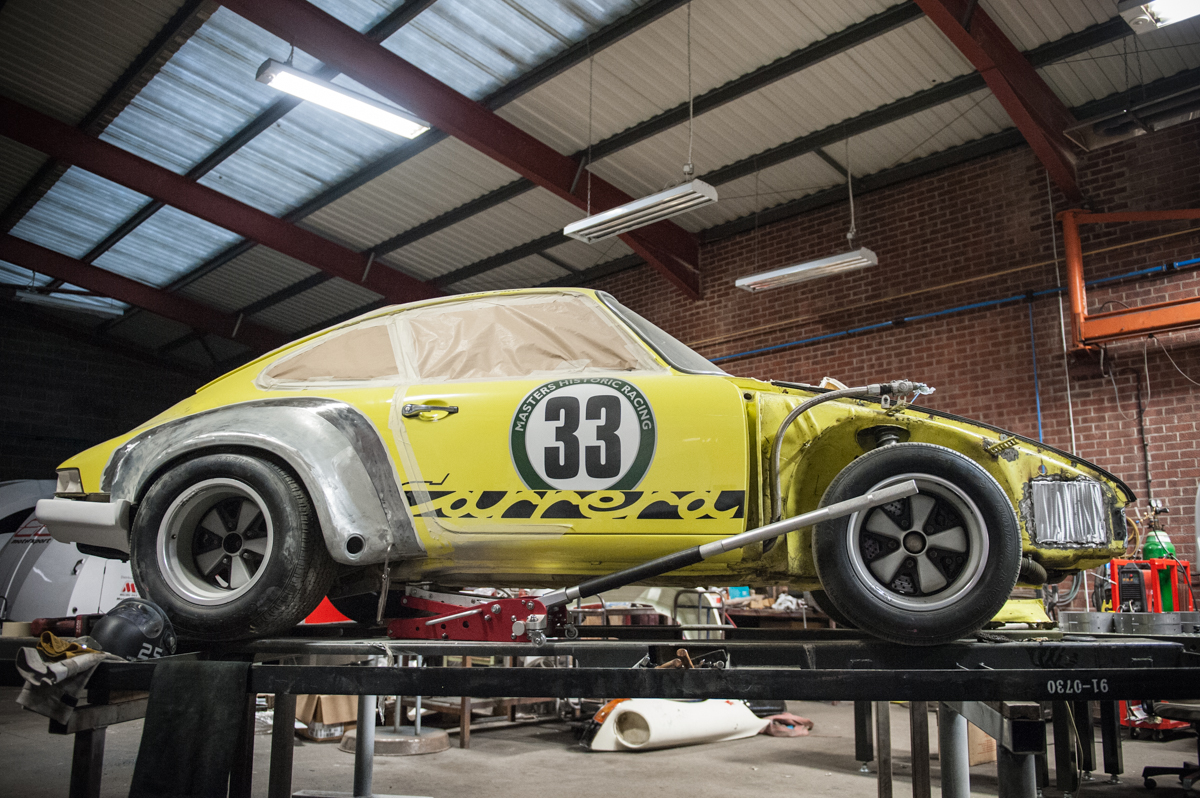
Current EB classic Porsche projects include the 911R build (which I got some good pics of), repairing the ’65 SWB car ahead of this year’s race season (Brands Masters and 6 Hours of Spa are definite), working on the 2.1 RSR Turbo build and fitting the latest EB Motorsport parts to the Light Yellow RSR race car: these superb pressed steel rear arch flares.
Porsche 911 Steel Arch Flares
Well made steel arch flares that fit properly and look right are almost impossible to find, but the new EB flares are a superb piece of work. Requiring no hand finishing around the arch lip or torsion bar hole, they merge to meet the contours of the classic race car in a seamless curve of delight. The tyre-to-arch gap in EB’s fitting is nothing short of perfect; these steel arch flares really are magnificent creations by all concerned.
I love my 911s as narrow-body models, but steel panels of this quality make my wallet itch. The only issue is that, to do them proper justice, you need 300bhp under the decklid and 11-inch rear Fuchs to match. Such champagne tastes are not yet matched by an available budget to go wild in metal. Maybe one day.
Email EB Motorsport to discuss any of their peerless performance parts for Porsche. The brothers are excellent guys: two of my favourite people.
SHARE • EXPLORE • SUPPORT
Ferdinand blogs my freelance adventure with Porsche at the centre. To support the blog or engage with me in other ways, you can:
The Gen 2 991 GT3 PDK has just had its first public hot laps around the Nürburgring and set a time 12 seconds quicker than the outgoing model. 7 mins 12.7 seconds is between 2 and 3 percent quicker than the old car, so will such a modest increase hurt sales of Gen 2s?
Autocar magazine released its first drive of the Gen 2 991 GT3 Manual earlier this week and Greg Kable was quick to point out that the Gen 2 PDK is substantially quicker on track. “But as spectacularly good as the manual version of the new Porsche 911 GT3 is – and it really is stunningly effective – I wouldn’t recommend it to anyone who intends to do an intensive amount of track day running…In ultimate performance terms, the PDK model is king.” This being the case, how much slower than a Gen 1 GT3 PDK would one be around the Nürburgring in a Gen 2 Manual? And would a slower Gen 2 Manual matter?
Manual transmission matters for the emotional response to total control, or so the experts say. But how many cars would one sell with the headline: “the Gen 2 GT3 Manual is ten seconds slower than the old car around the Nürburgring, but you told us you wanted three pedals for those 1500 miles a year, so here you go”?
Manufacturers need to upgrade, renew and keep pace with the competition and find the USPs that set their latest creations apart from the old ones but, at some stage, the actual users of a thing (rather than speculators/investors/collectors or whatever the latest word is) run out of real reasons to ‘upgrade’. A two year-old iPhone 6S Plus does basically the same job as the latest one, a four year-old Macbook Pro does pretty much the same job as a new one and a 17 year-old Volkswagen Polo ticks the same ‘get from A-B’ box as a new one, so why bother with new things at all?
Of course, stuff wears out when it gets used a lot and replacements are then a necessity, but few people are wearing out Gen 1 GT3s. If the upgrade path is all about egos aching for shiny, then Porsche is mining a rich psychological seam. Stuttgart delivered just shy of 60,000 cars in Q1 2017 (another record, one imagines). To make and deliver all of these cars, the company now employs 28,249 people. Profit margins have also risen and are now running at 17.6 percent on a total revenue of €5.5 billion.
No prizes for guessing that 911 GT3s are not top of the sales charts, but they must be pretty close to the top in the league table of press coverage year-on-year. The column inches guarantee all Gen 2 GT3s will be sold, so maybe it makes little difference how quick the car is. Then again, it has to be quicker or the press won’t play ball.
If I didn’t already have a Gen 1 991 GT3 and someone offered me a Gen II build slot, I would buy the manual regardless of whether it was ten or even twenty seconds slower. But, if I already owned a Gen 1 GT3 and had to find a chunk of change to get in a manual that was slower on track? That is a different scenario.
April in Europe means it’s time for Techno Classica Essen. I’ve missed the last couple of years for one reason or another but am back at the 2017 show with Jonny Hart from Classic Retrofit. We’re also meeting Mark and James from EB Motorsport, Marcel from Restoration Design and Jonny will also be catching up with his new friend, Alois Ruf! Love it.
Mention Essen to most UK classic car people and they usually respond by saying they’ve been meaning to go there for years. I was the same until actually going and now it hurts me not to attend. So much goes on here that it is difficult to consider oneself well informed about the European market when you skip a year: you have to witness the prices inside the halls and the numbers on cars offered by traders and private sellers in the external exhibition spaces.
An incredible 1,250 exhibitors from 30 countries show their wares at Essen, with many more sharing stands alongside trading partners. The 2016 Techno Classica was attended by 200,000 people. More than 2,700 cars were on display, with an estimated total value of €350 million.
Manufacturers pull out all the stops and bring a wonderful selection of museum pieces to take us back forty years or more. There is so much Porsche stock on most other stands that it likely would not matter if there was no official Porsche presence: it would still be one of the most popular brands at the show and it is the surprise exhibits that create the biggest buzz.
I am looking forward to being back in Germany. Jonny and I are staying in the centre of Dusseldorf, at the same hotel I use every year. Dusseldorf is a nicer city to stay in than Essen and the trains back and forth are easy to use. We’re around from Thursday AM to Saturday lunchtime, so anyone else in the area can drop me an email, social media message or just post a comment.
This website uses cookies to improve your experience. We'll assume you're ok with this, but you can opt-out if you wish.AcceptRead More
Privacy & Cookies Policy
Privacy Overview
This website uses cookies to improve your experience while you navigate through the website. Out of these, the cookies that are categorized as necessary are stored on your browser as they are essential for the working of basic functionalities of the website. We also use third-party cookies that help us analyze and understand how you use this website. These cookies will be stored in your browser only with your consent. You also have the option to opt-out of these cookies. But opting out of some of these cookies may affect your browsing experience.
Necessary cookies are absolutely essential for the website to function properly. This category only includes cookies that ensures basic functionalities and security features of the website. These cookies do not store any personal information.
Any cookies that may not be particularly necessary for the website to function and is used specifically to collect user personal data via analytics, ads, other embedded contents are termed as non-necessary cookies. It is mandatory to procure user consent prior to running these cookies on your website.