I’m working outside the UK at the minute, catching some winter sun in Fuerteventura. As ever, I’ve brought a few books along in case of long lunches, including ‘We are Porsche’: Ferry Porsche’s first autobiography, written with John Bentley in the early 1970s.
I’ve read this book many times, as Ferry’s words both inspire and encourage. All freelancers face constant changes and challenges, which can often feel insurmountable. Ferry’s story demonstrates that, no matter what life throws in one’s path, patient perseverance will find a solution. Hard work and the occasional retreat to simple pleasures can power body and mind through tough situations.
Ferry Porsche and his BMW Motorcycle
As a young man, one of Ferry’s simplest pleasures was motorcycling. At the age of eighteen, Ferry got his motorcycle licence and shares how the independence of increased mobility brought new opportunities to meet girls. “I no longer had to rely on the family car to get me from one place to another in a hurry,” he recalls. “The motorbike I then used was a 500cc BMW and this proved useful in more ways than one.”
This would have been circa 1927, making Ferry’s bike an R42: Max Fitz’s blueprint for just about every BMW road bike made afterwards. Pristine R42s now sell for big money – £40k or more – so Ferry’s mount was well chosen. Given Doctor Porsche’s interest in BMW motorcycles, I wonder what he’d make of the machine seen here, being offered by Bonhams at its Paris sale on February 4th: a 1952 Sunbeam S8, with Ferry Porsche power.
BSA bought the rights to Sunbeam’s motorcycle business in 1943 and revived the brand after the war, when it was given German motorcycle designs as part of the war reparations. Based on the BMW R75, the Sunbeam S7 had a pre-war-designed inline twin which left it low on power, and its successor, the Sunbeam R8 was apparently not much better.
Porsche Engine in a Motorcycle Frame
In 1969, the then owner of this S8 decided to upgrade the power with a 1200cc motor from a Volkswagen Beetle. This was not the ultimate incarnation, as he subsequently ditched the Beetle engine, replacing it with a 1955 1300cc Porsche motor featuring bespoke cast aluminium bellhousing and rocker covers.
The Sunbeam’s first outing was to the 1972 BMF show, where it caused a sensation. MCN’s John Ebbrell tested the bike for the paper, and the Sunbeam was also shown at Olympia, fitted with Amal concentric carburettors a la Triumph and others. A BMW tank was added later, along with Norton Roadholder forks and some other cool touches, including a Vincent Black Shadow speedometer.
For sale due to the advancing age of its owner, the Sunbeam was offered at Bonhams’ last sale in the RAF Museum at Hendon where it failed to find a new home. Given that the price aspirations seem sensible (£9.5k), I was surprised by this, so I emailed Bill To at Bonhams to get his thoughts on why such an interesting piece failed to sell.”We were a little surprised ourselves, but I guess that’s the nature of public auctions: we just don’t know what to expect on the day,” said Bill.
I’m not the world’s biggest vintage bike fan, but I do like this. If it’s something you are also inspired by, get yourself to Paris on February 4th, or contact Bonhams to register as a bidder. I want a ride if you buy it!
For the first time in its history, Porsche AG has delivered more than 200,000 cars in a single production year with still one full month remaining to the end of 2015.
A total of 209,894 cars were delivered to the end of November 2015: 24% up on the same period last year. Cayenne was November’s big winner: almost 40% on the same month last year with 6,500 models delivered. Cayenne has also beat Macan this year: a total of 68,000 cars delivered between January and November 2015.
China has been the biggest market so far in 2015, no doubt a surprise to those who have been talking that corner down. Chinese Porsche buyers took delivery of 54,302 cars through the first eleven months of 2015: up 34% on the same period last year.
Despite selling almost ten percent more cars than last year, the US continues to trail China’s success by some 6,500 cars: twelve percent of the Chinese total. Europe was up thirty percent for the year, with 70,500 cars sold and delivered.
I love a good art gallery or museum exhibition. Hamburg’s Prototyp Museum has just announced something special for fans of the Porsche 356 and early Porsche heritage: the ‘Very Important Porsche 356’ exhibition from November 13, 2015.
Twelve of the most important Porsche 356s will be shown at the wonderful Hamburg Automuseum, including the oldest-known German manufactured 356. Of course, an Austrian-built Gmünd Coupe also forms part of the exhibition, as well as two early pre-Stuttgart Convertibles: a 1949 356/2 Beutler Convertible and a 356/2 Keibl Convertible from the same year.
Three Gmünd Porsche 356s at Hamburg Prototyp Museum
While the museum has gathered twelve 356s in total for this exhibition, the trio of early Porsche 356s alone should attract a number of visitors, keen to see three early Gmünd-built cars in one place. I can’t think of anywhere these three rare cars would have been gathered together at once in the last five years, so new arrivals to the world of classic Porsche will find these cars fascinating.
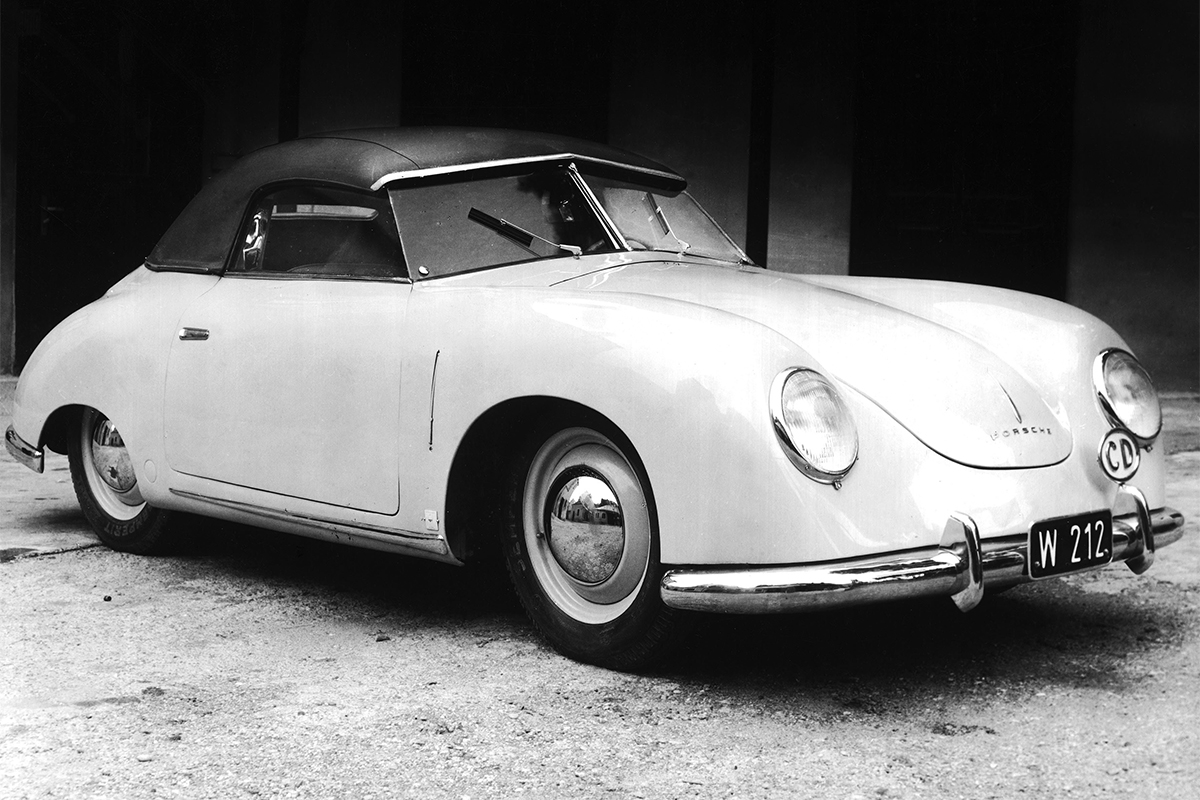
For my money, nothing sings more of undiluted Porsche DNA than these very early 356s, pieced together by hand in a converted Austrian sawmill, nestled in the foothills of the Central Eastern Alps. Ferry Porsche wasted no time after the end of the war in making his dream of Porsche-produced sports cars a reality. Every ounce of Ferry’s passion – a passion that was shared by the great team around him – sings from the aluminium bodywork of each of these cars in a hymn of devout inspiration.
Porsche 356 Gmund Styling
Once Porsche 356 production moved to Stuttgart in 1950, the bodies were stamped out in steel and much of that precious Gmünd styling was lost including the low, narrow roofline and the careful detailing through the front end. Photos never do these cars justice: you have to stand beside a Gmünd car to experience all of what they communicate. To me, the 356/2 Keibl Convertible built by Karosseriefabrik Ferdinand Keibl in Vienna (top pic) is one of the most beautiful road cars ever built: small wonder that Ferry was also a great admirer, and bought the only surviving example back for his personal collection.
Perhaps the most surprising part of this exhibition to those unfamilar with the very first cars produced by the genius Ferry Porsche will be the colour and sharpness of an early 356. We’re so conditioned to seeing these Porsches in grainy old black and white photos, that we expect the reality to be monochrome paintwork and workaday VW plastic on the dashboard, and tend to ignore opportunities to get close to these cars as a result.
I am always quite taken aback by the joy with which these cars were built and finished. Some of the colours are simply incredible and the shapeliness of the early 356s is quite honestly mesmerising from almost every angle. The crispness of a coachbuilt convertible top removes any thought that new cars rule for quality and the elegant palette of colours across bodywork, trim and soft tops is just beautiful. I encourage you to go along to Hamburg for a day while the exhibition is open from November 13 to March 27, 2016. Entry is only €13.50 and the museum is well worth the journey.
The cars of the Very Important Porsche 356 exhibition:
As Volkswagen owners worldwide begin receiving their recall paperwork for the emissions débacle, the new CEO Matthias Müller has given the clearest indication yet of the scale of changes that are coming at Volkswagen. In a speech to 20,000 Volkswagen employees at Wolfsburg’s Hall 11, Müller made it clear that the Volkswagen of the future would be a very different organisation.
“Apart from the enormous financial damage which it is still not possible to quantify as of today,” said the Chairman, “this crisis is first and foremost a crisis of confidence. Our most important task will be to win back the trust we have lost with our customers, partners, investors and the general public. Only when everything has been put on the table, when no single stone has been left unturned, only then will people begin to trust us again.”
Volkswagen shares plummet by $60 Billion
Meanwhile, Volkswagen shares continue to nosedive, with a staggering $60 billion now wiped off the company’s value since the scandal broke. Even more staggering is the number of industry commentators who continue to insist that this is a fuss about nothing – either they have an errant line of code in their programming or this is costing VW PRs more than a few VIP perks. As more than half the value of Volkswagen AG has now evaporated, Müller is right to let his people and the global stock markets know that cuts are coming.
Suzuki Motor Company is the most recent bulk shareholder to abandon ship: Porsche SE buying back a 1.5% Volkswagen shareholding owned by the Japanese firm. As Porsche spends on share buybacks, ex-Porsche CEO Müller looks to slice billions off Volkswagen’s costs. “It is not possible to quantify the commercial and financial implications at present. That is why we have initiated a further critical review of all planned investments. Anything that is not absolutely necessary will be cancelled or postponed. And it is why we will be intensifying the efficiency program. To be perfectly frank: this will not be a painless process.”
A number of analysts have put their best interns on the job that Volkswagen says is currently impossible: quantifying the scale of the financial implications. Possibly the best/worst one was a Credit Suisse report estimating the total cost (not including long term damage to reputation) at somewhere between $25 billion and $87 billion, with shares dropping another 20%. Volkswagen insists the numbers are nonsense, and the top estimate does seem completely ridiculous, but the lowest number is at least what it will run to, including settling the lawsuits and discounting replacement car prices for those affected. This will put a huge strain on Volswagen’s finances.
No doubt the shares will bounce back from wherever they bottom out, but another 20% would take Volkswagen to a third of its pre-dieselgate value. The VW emissions affair is certainly not a fuss over nothing and it is very relevant to the future of Porsche.
Amongst the cool projects I’ve been party to this year is the latest reproduction from EB Motorsport: a flat-fan kit for air-cooled Porsche engines. Under development for the last two years, engineering for a flat fan kit started in the same way as most of the EB Motorsport product range: there was nothing else out there that did the job properly.
Porsche 911 RSR Turbo Replica
I’m not quite sure when EB’s Mark Bates decided he had to have a Porsche 911 RSR Turbo, but we definitely had a conversation about building a 2.1-litre Turbo replica soon after we started working together more than five years ago and the bodywork for the project is well under way (pic below). Since our first conversation, the EB Motorsport product range has expanded to include a lot of products that cross over from RSR to RSR Turbo, but the flat fan is all on its own when it comes to cool Porsche kit.
“If I could have bought a flat fan kit that looked correct and worked well at a sensible price, I wouldn’t have gone down the road of making it myself,” says Mark. “We did buy one kit but it was not what I was looking for, so we ended up doing it the long way.
Mark’s ‘long way’ would be most impossible for most of us, but nothing phases EB Motorsport. When your company has more than sixty years of experience manufacturing food-grade handling plant, including 30-metre-high composite silos that can hold tons upon tons of raw material, the minor details of re-manufacturing unobtainable throttle bodies, complex fuel pressure regulators and flat fan drives are not a big deal.
Flat Fan Components and Testing
That said, all high-end manufacturing takes time to do properly, and this has been done properly. The first step was to find a period composite fan, as making the tooling to replicate an air-cooled flat fan blade is not the work of a moment. That search came up empty handed, so a high-quality carbon fan was obtained that would hold up for testing. “Our own fan is in development, but it involves the most complex tooling we have ever designed,” says Mark. “It will take a while to get this bit right.”
The next step was the fan drive. The obvious way to recreate one of these was to buy an original 935 drive and reverse engineer it, so this is what happened. The process took six months, and the first test device was fitted to a static long block test rig earlier this year, connected to electric motors and tested for hours on end. EB measured details like noise, durability, horsepower consumption, backlash, shim dimensions and airflow with different internal diverters fitted to the custom EB fan shroud.
Flat Fan Horsepower Consumption
Testing revealed lots of interesting data, particularly in the areas of air flow and horsepower. “It’s long been rumoured that the flat fan costs a lot of horsepower due to the convoluted drivetrain, but a vertical fan will also cost horsepower,” says Mark. “Our testing proved that flat fan horsepower consumption was not linear but instead it increased exponentially. At 4k fan rpm, just 1.5 horsepower was lost, but at 12k rpm fan speed which is roughly 8k rpm engine speed, 32 horsepower was lost, mainly due to the volume of air being moved by the fan. Given the increased thermal protection to cylinders 1 and 4 offered by the flat fan installation, we’re comfortable with the test data.”
Tuthill Porsche Flat Fan 911
The video below shows the flat fan fitted to EB’s 2.5-litre ST engine on carbs, in a 911 supplied for road testing by Richard Tuthill. Tuthill Porsche will build the engine for the RSR Turbo replica and there’s even some discussion on building a short run of four RSR Turbo replicas, including EB Motorsport’s own car, all running flat fans and fun-horsepower big turbo engines. Now that would really be cool.
To read more of my work, commission my valuation expertise or hire my content generation skills, you can:
This website uses cookies to improve your experience. We'll assume you're ok with this, but you can opt-out if you wish.AcceptRead More
Privacy & Cookies Policy
Privacy Overview
This website uses cookies to improve your experience while you navigate through the website. Out of these, the cookies that are categorized as necessary are stored on your browser as they are essential for the working of basic functionalities of the website. We also use third-party cookies that help us analyze and understand how you use this website. These cookies will be stored in your browser only with your consent. You also have the option to opt-out of these cookies. But opting out of some of these cookies may affect your browsing experience.
Necessary cookies are absolutely essential for the website to function properly. This category only includes cookies that ensures basic functionalities and security features of the website. These cookies do not store any personal information.
Any cookies that may not be particularly necessary for the website to function and is used specifically to collect user personal data via analytics, ads, other embedded contents are termed as non-necessary cookies. It is mandatory to procure user consent prior to running these cookies on your website.