by John Glynn | May 9, 2015 | Classic Porsche Blog, Race and Rally
Despite the time, money and technology invested in modern Porsche cars, including the Porsche 918 and 919 LPM1 Hybrid, the Porsche 917 is still the model most frequently seen at the top of “ultimate Porsche” lists. But which is the ultimate Porsche 917?
Porsche built circa 60 variations on the 917 theme, including 917/10 and 917/30 Can-Am models. Iconic liveries included Gulf, Martini and Kremer “Hippie” cars, but the most famous 917 must be the red-and-white short-tail painted in the family’s own Porsche Salzburg dealership colours. This is chassis number 917-023: the car that claimed Porsche’s first Le Mans victory in June 1970.

Legend has it that, like all good race cars, the winning Porsche 917 was sold in the car park after the race, to pay for the next round of racing developments. In fact, 917-023 stayed with Porsche for the rest of 1970 before selling to the Martini Racing team, and then on to famous US collector and engineer, Vasek Polak. It passed through the Matsuda collection and also lived with an American doctor before current owner, Carlos Monteverde, bought it for racing. Much of Monteverde’s collection apparently lives quite near my house, but that’s another story.
Richard Attwood Porsche 917 Le Mans 1970
Richard ‘Dickie’ Attwood drove the car to victory in Le Mans 1970 and was never surprised that Porsche sold the car soon after the win. “Le Mans did not have the same cachet in 1970 as it does now,” Dickie explained to his local paper. “There are more significant races for drivers, but it’s tremendously important for manufacturers.

“1970 was a landmark win for Porsche because it was their first, but my win there was lucky. We only qualified fifteenth fastest – it was more a case of other drivers losing rather than my winning. But, having been leading by six laps in the previous year with three and a half hours to go when the transmission broke, I deserved a bit of luck.
“Winning Le Mans unquestionably helped me in later life. The hero worship of sports stars has now reached stratospheric levels and the significance of that victory seems to grow stronger with the passing of time.”

Despite claiming Porsche’s maiden Le Mans win and being one of the few people who have owned a Porsche 917, Attwood was not the Porsche 917’s greatest fan at the time, noting that Porsche would pay double money to convince drivers to race the “no good” 917 rather than the proven 908, which was still well able to claim the winner’s purse at most races. When Porsche asked their driver what format of 917 he wanted to race in June 1970, Attwood chose a slower 4.5-litre, short-tail car with the 4-speed gearbox on the basis of reliability. He adopted a similar approach to his team mate.
Having raced alongside Vic Elford in 1969, Attwood felt his team-mate had cost them a win by driving the car too hard, breaking the gearbox with three hours to go while the car was six laps in front. For 1970, Dickie chose to drive with Hans Herrmann: one of the factory’s most famous drivers, but a man in his early forties who had already decided to retire.

The pair did no testing before the event: Le Mans was Attwood’s first drive in the car. Qualifying way down the field, a win should have been impossible for Porsche 917-023, but then the rain fell and history was made.
The full story of Porsche 917-023 has now been committed to print in a book by former Silverstone press officer, Ian Wagstaff, which will be released on June 1st. The book tells the story of chassis 023, including hundreds of period pictures, interviews with all surviving drivers of 917-023 and input from one of the most experienced 917 mechanics of the era. Pre-order the book here.

by John Glynn | May 3, 2015 | Classic Porsche Blog, Race and Rally
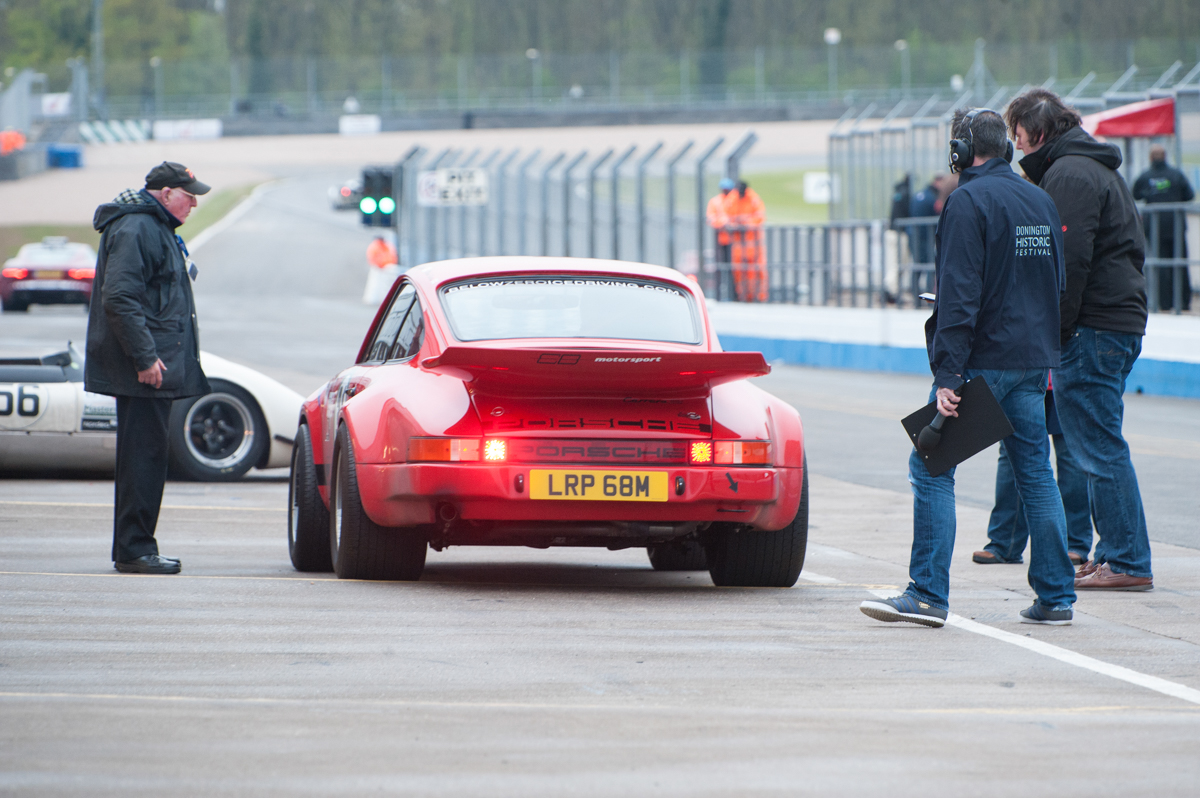
Had a great day at Donington yesterday with Mark and James Bates of EB Motorsport, who were racing their 3.0-litre Porsche 911 RS in the Donington 1000kms event. It was not the best day ever for Porsche motorsport on the whole (Spa 6 Hours thoughts to come), but we did enjoy an exciting, well-organised race at a great venue.

Historic racing is an expensive business. Forget about buying and building the cars for a moment: just to take part in a decent event costs upwards of £1000. This covers the entry fee for a car and one driver, but does not always include a second driver, garage space or catering. It does not cover tyres and fuel, it does not cover insurance and it definitely does not include wear and tear or breakages, which on older cars can be highly significant.

The Donington 1000kms was part of the 2015 Donington Historic Festival. Organised by the Swiss-based Historic Motor Racing, the race is one of a series of endurance events run by the company all over Europe. As the EB brothers are putting in a shorter race season this year due to work commitments, more Porsche projects and a new baby for James, the 1000kms schedule of ‘qualify in the morning, race in the afternoon’ was perfect: they could rock up early, get the car ready, qualify and chill out for a bit, then have two and a half hours of racing before heading home.

First job of the day was to scrutineer the car. Slight issue there, as someone forgot the Porsche 911’s FIA Historic Technical Passport. We had a word with the people in charge and, as the car still had its barcodes from the last event, the engine was FIA sealed and the 911 was running in an invitational class and would not score points, we were allowed to take part.

Porsche 911 3.0 RS vs Prototype Racers
Qualifying went well. On a grid packed with prototypes, the single exception – EB’s 911 – went 14th quickest on new post-historic tyres that have only been tried on the team’s yellow 911 RSR for a couple of races so far. While the compound might be a bit slower than previous rubber, the tyres are huge, so the increased width gave excellent grip. We were still almost ten seconds off the pace of the leading Lola T70.

Racing is a very social affair, so there was plenty of craic in the paddock between quali and the race. Our garage was shared with a Chevron B8, Elva Mk8 and a Lola T70 Mk3B. A Lola T70 for sale must be £750k now, Chevron B8 for sale would probably be £200k and similar money for an Elva. Despite there being well over a million quid parked in our garage, the atmosphere was just the same as if all were in cheap track day specials. People dropping in and chatting, bit of banter from previous track outings and one or two compliments for Mark, following his performance in EB’s SWB car at the 73rd Goodwood members meet. He will henceforth be known as “The Sultan of Slide”.

The race was slightly delayed, which gave time for the weather to change and the rain to move in. The boys split the race into two equal parts: James took the start on a slippery circuit and had brought the car up to seventh by the time of his pitstop. With 100 litres of fuel in the tank at the start and the lack of grip keeping speeds and fuel consumption lower than expected, Mark decided to gamble on that being enough to finish the race, avoiding the mandatory 3-minute minimum time for a fuel stop.
As Mark started his stint, the rain stopped and a dry line began to appear. The pace hotted up: 911 lap times falling from the high 1:30s in the wet to an excellent 1:17.9 at one point: quicker than qualifying. Ambient temperatures were very cold, so the rest of the track stayed damp and slippy, leaving a treacherous no-mans-land for anyone who had to go off line to make progress. After two and a bit hours of racing, Mark had no choice: he pitted for fuel and the three-minute stop to go with it. This cost us the best part of two laps and we were out of the top ten.

As the race entered its final lap, we had news that, while fighting for the lead, our garagemate – the beautiful Lola T70 (above) – had passed a backmarker on the damp part of the track through the fast downhill Craner Curves, lost traction and hit the wall at high speed. When the car was brought back, it was not the best sight, but owner/driver Leo was safe and well. At times like this, no one worries where they’ve finished: it’s just good to get home in one piece and live to fight another day.

by John Glynn | Apr 27, 2015 | Classic Porsche Blog, Market & Prices
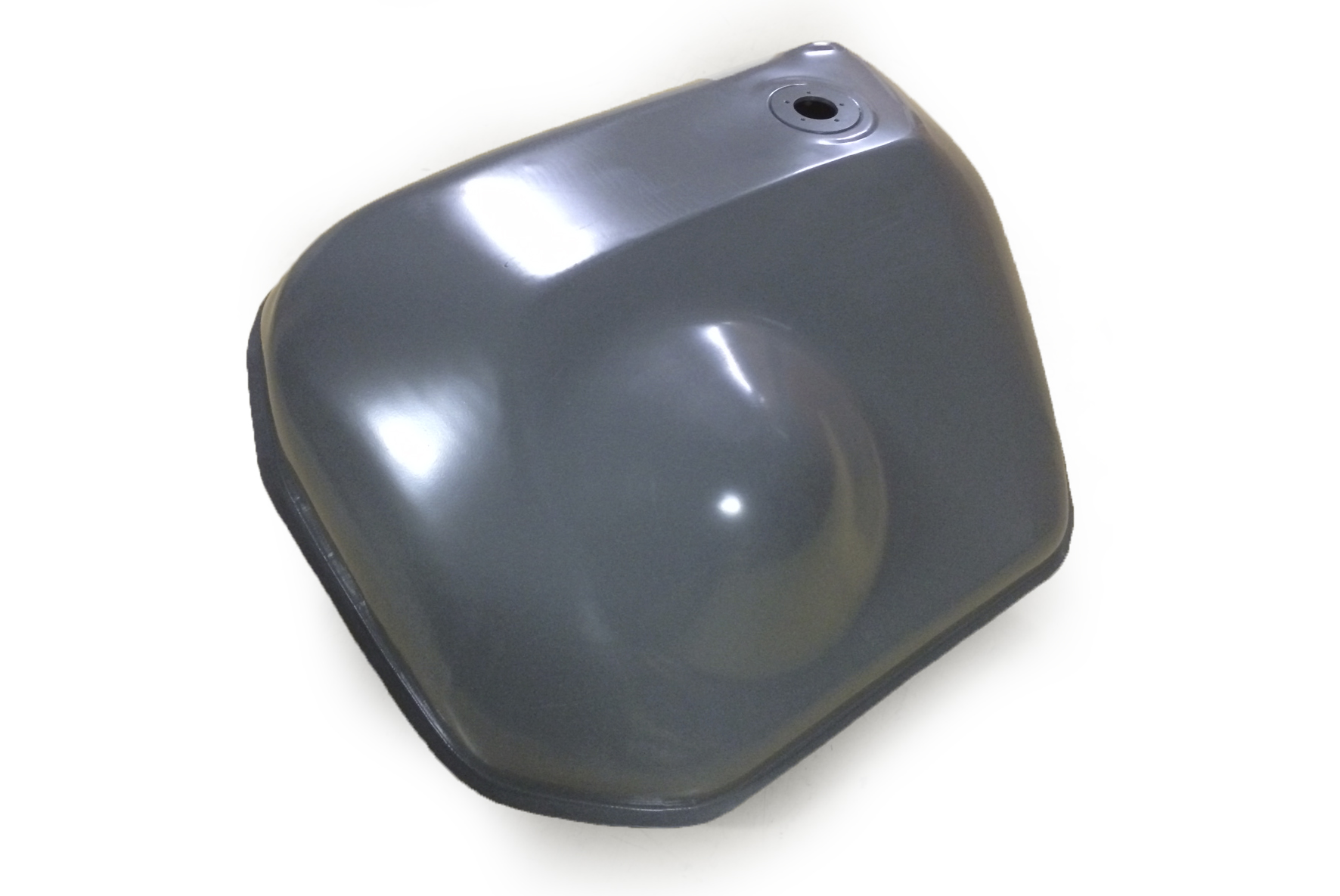
EB Motorsport has just added a 100-litre steel fuel tank to its ever-expanding range of classic Porsche 911 parts.
Recreating the classic 911 sports purpose tank, which was available as a factory option on pre-1973 road and race 911s from the end of 1966, the all-steel fuel tank is internally baffled to keep the contents under control on track or in press-on motoring.
“We’d been looking for a top quality fuel tank for our 1965 SWB 911 race car for a while,” says EB’s Mark Bates, sideways hero of last month’s Goodwood Aldington Trophy. “As with so many Porsche parts nowadays, it’s hard to find something that will last as long as the original parts. After speaking to various people, we found a supplier who could manufacture to our specifications in high grade steel that would not start to rust soon after fitment.”
The 100-litre steel tanks for Porsche 911 were originally available as either side- or centre-fill. Side fill using the standard wing-mounted petrol filler flap was normally used on road cars, but was also seen on a number of ST rally models. Centre fill was more common on racing cars, including the 911R.

EB Motorsport offers both options. The standard tank comes fitted with the side filler neck and is finished in black, ready to fit in the car. The tank can also be supplied with a blank top, finished in grey primer, ready to be fitted with the optional centre filler neck or professional quick release race fittings.
The 100-litre fuel tank with or without side fill costs £2200. The optional centre filler neck and cap are priced at £285. An extended fuel sender, to allow accurate reading of the fuel level in the larger capacity tank, adds £295 to the total.
All prices plus VAT and postage. Contact EB Motorsport for more details via the website at www.eb-motorsport.com.
by John Glynn | Apr 26, 2015 | Classic Porsche Blog, Race and Rally
A Porsche 968 competing in the Britcar 24 Hours of Silverstone has raised thousands of pounds for the Children’s Heart Federation charity. It’s not to late to donate: see below.
Practice lap times placing the Porsche at the back of the field did not tell the full story. Starting towards the back of the grid, the twenty-two year-old Porsche beat faster cars that could not last the distance, eventually coming home twelfth overall and proving the virtue of staying power.
“Beating heart disease is all about teamwork, just like endurance racing,” said Jonathan Evans, a trustee of the Children’s Heart Federation and one of the 968’s four drivers alongside Ben Demetriou, Paul Follett and Alex Eacock.
“This satisfying result is testament to a great team of drivers, pit crew and sponsors. Each team member did their utmost to achieve the best result for a wonderful organisation that supports so many sick children every year. Prepared by EMC Motorsport, the Porsche ran faultlessly throughout the event, outlasting much quicker cars, including two 911s. We have much to be proud of today.”
The team is still taking donations in support of its efforts, with all proceeds going directly to the Children’s Heart Federation. Porsche fans can contribute at www.justgiving.com/team-chf500/. Do it today!
Thanks to GazH Photography for the Porsche 968 picture.
by John Glynn | Apr 26, 2015 | Classic Porsche Blog, Porsche People
It’s now seven hours since Wolfgang Porsche’s official statement following the shock resignation of his older cousin, Ferdinand Piëch, as chairman of Volkswagen’s supervisory board. This is what it said:
Stuttgart, 25 April 2015. Dr. Wolfgang Porsche, chairman of the supervisory board of Porsche Automobil Holding SE, Stuttgart, comments [on] today’s developments at Volkswagen AG as follows:
“We have full confidence in the board of management of Volkswagen Group and we deeply regret the developments of the last few days. We thank Ferdinand Piëch for his decades of extraordinary and highly successful service to the Volkswagen Group. Our great loyalty to the Volkswagen Group and its 600,000 employees remains unchanged and we assume our responsibility as a principal shareholder.”
“Professor Dr. Ferdinand K. Piëch has resigned with immediate effect from his position as Chairman of the Supervisory Board and from all his mandates as a Supervisory Board member within the Volkswagen Group,” said the VW statement. “The members of the Executive Committee have unanimously determined that in view of the background of the last weeks the mutual trust necessary for successful cooperation no longer exists.”
Ferdinand Piëch quits Volkswagen
The VW statement seems to suggest that a vote was taken to oust the good Doctor, and that is how most media outlets are playing it, but those in the know say that no vote was held: 78 year-old Ferdinand walked away of his own accord. Piëch’s deputy, union leader Berthold Huber, will run things while a new chairman is elected.
“Ferdinand Piëch has made an enormous contribution to Volkswagen and the entire automobile industry,” said Huber. “The developments of the last two weeks led to a loss of trust between the supervisory board chairman and the other members, which in recent days has proven to be impossible to resolve. The uncertainty had to be ended today. The committee was and is conscious of its responsibility to Volkswagen and its many thousand staff.”
Following decades controlling Audi and VW, no doubt Piëch is also highly conscious of his responsibility to Volkswagen workers and to his own major VW shareholding. His departure clears the way for a seismic shake-up at Volkswagen, which could see current CEO Winterkorn taking the chairman’s job, with Porsche boss Matthias Müller moving up to head the entire VW group. This would throw a spanner in the works at Stuttgart, which has thrived under Müller’s guidance.
Whatever happens with Volkswagen, Piëch’s move marks the end of an era for Porsche, and the end of an era for Porsche fans. While Ferdinand Piëch is certainly “one of the most important people in the history of German business”, as one supervisory board member put it, he is a pivotal figure in Porsche mythology. Porsche without independence retained some credibility with Piëch at the helm. Porsche without Piëch says something else to enthusiasts of a certain age.
Life without Piëch: The Future
Labelling this as the end of Piëch would be clearly ridiculous. The Porsche-Piëch battle goes back to the start: this is simply the latest installment. Is Ferdinand right about Volkswagen’s problems? The Porsche side of the family doesn’t think so, but then it backed Weideking against Ferdinand Piëch. We all know how that ended up: 10 billion euros of debt, criminal charges and 50 million euros to get rid of Wendelin. And Ferdinand’s Volkswagen bailing them out.

by John Glynn | Apr 18, 2015 | Classic Porsche Blog, Modified Porsche Hot Rods
Watched some Variant 1 KW Suspension going on a Grand Prix White Porsche 964 Targa earlier this week. It was interesting to follow the Porsche project as the rusty old factory dampers came off the 911, to be replaced by KW kit.
When it comes to upgraded Porsche suspension, KW kits are amongst the best available. The German brand with a penchant for finding fine detail on its ex-Formula 1 hydraulic test rig is a favourite of many winning race teams, particularly in the exhilarating VLN championship, so it’s no surprise that KW Suspension Variant 3 kits are common on Porsche cars used for fast road and track days.
The new three-way KW Clubsport adjustable coilover kits are one of my favourites amongst the firm’s 997 GT3 RS track day crowd, but the cheaper V1 and V3 kits are an affordable, quality upgrade for worn-out original suspension.
With prices starting at just over £1,000, the KW Suspension Variant 1 coilover kit is hard to beat. The struts are made from stainless steel, with corrosion resistant springs and bump stops. They also come with the top mounts, which are usually ruined on old 911s. This saves a few quid.
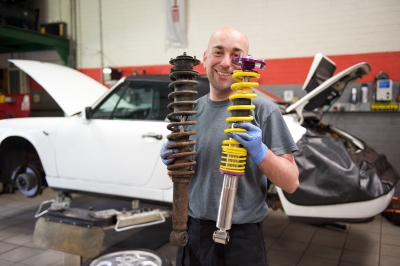
Variant 1 is TUV-approved, so maximum lowering is restricted to no more than 70mm: not that you would want to go quite this low in a classic 911, assuming you were serious about driving. Experienced suspension tech Ricky (above with old and new) carefully set the ride heights before fitting the kit, but the rust-resisting trapezoid thread and composite collar will move freely at any stage in the future, so a new owner could easily raise or lower the car using the supplied KW toolkit.
KW Suspension says that each Porsche suspension kit has been specifically tuned for the car in damper setup and spring rate. The new dampers reduce body roll when the suspension is in compression and give much sharper handling than anything fitted to 911 road cars as standard.

It probably sounds like I have swallowed the KW blurb on this, but I’ve road tested quite a few KW cars and no doubt they feel better to drive. One interesting comparison would be the Bilstein setup fitted to the 964RS I lived with for a few months. That was special, but there seems very little in it when the cars are on track.