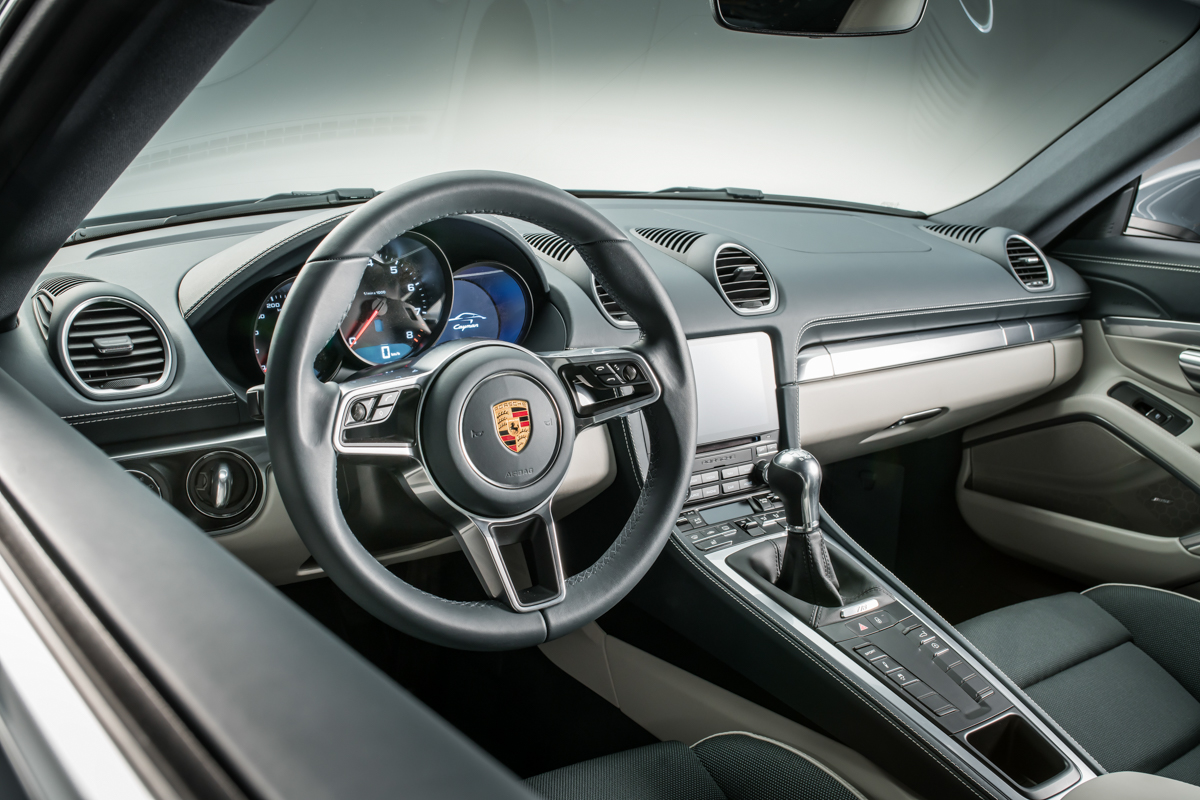
Porsche has launched the new 718 Cayman with four-cylinder turbocharged engines, redesigned dashboards and LED lights setting it apart from the previous model. Basic price for the 2-litre 300 hp Cayman is £39,878, with the basic 2.5-litre, 350 hp Cayman costing from £48,834: a difference of £8956.
Porsche Cayman now cheaper than Boxster
The new list prices position Cayman below its soft-top Boxster sibling, which starts at £41,739.00 for the 2-litre manual. Add £1922 for PDK, taking the pre-options price to £43,661. Boxster S starts at £50695: £8956 more than the 2-litre car: same as the 718 Cayman.
There are subtle differences under the skin, with firmer springs and anti-roll bars and tweaked damper settings. Steering is ten per cent ‘more direct’ and rear wheels are a half inch wider, general increased lateral grip. The Porsche Torque Vectoring (PTV) electronically-controlled rear limited slip differential is an option. Brakes have been upgraded, now with 330mm front discs and 299mm rears. 2-litre Cayman uses the previous Cayman S calipers, while the 718 Cayman S gets 911 Carrera calipers, with 6mm thicker discs.
Outgoing Cayman was quite a pretty car and the new one looks pretty similar to me. Front end is maybe a bit sharper, with bigger intakes and new LED running lights. 918-style LED headlamps with four-point daytime running lights are an option. The rear now has a gloss black badge panel with four brake lights, which Porsche says “appear to float freely”.
The Cayman will need more than floaty brake lights to capture buyers imagination. Porsche sports cars (i.e. sports cars and not sports SUVs) now account for something like 30% of sales and the 911 takes the lion’s share of that. Caymans are hard work in the used market and struggle to find buyers quickly, even when keenly priced, which keeps trade demand and residual values challenging.
Company car users have been known to opt for Caymans and no doubt will continue to do so, but it’s hard not to wonder about the strength of support amongst private buyers for Cayman, given the cost of a reasonably-equipped example and the number of more versatile premium alternatives now available.
Having a relevant, desirable sports car other than the evergreen 911 is important to preserve brand perception/positioning for the SUVs, so the four-cylinder engines and price drop to below the soft top probably make sense. They make much more sense than diluting the 718’s place in history by pimping those numbers on the back of a Cayman, regardless of how floaty the brake lights are.
Porsche is amongst a group of manufacturers who have issued voluntary recalls for a total of 630,000 vehicles across Germany to address irregularities with diesel emissions systems, after being listed as real-world emissions offenders by the German goverment.
Porsche sells a variety of diesel engines in the Macan and Cayenne SUVs: two model lines which now make up 70% of all Porsche sales. The Cayenne Diesel’s 3-litre V6 Turbodiesel produces 262 hp at 4,000 rpm and the Cayenne S Diesel’s 4.2-litre V8 Turbodiesel produces 385 hp at 3,750 rpm. Both are EU6 compliant. The TDI option in the Porsche Macan S Diesel is the 3-litre V6 making 254 hp at 4,250 rpm and a collosal 580Nm of torque from 1,500-2,500 rpm. This Porsche Macan diesel engine is now subject to emissions recall in Germany.
Cayenne Diesel pulled from US sale by Porsche Cars North America
No mention has been made of the Cayenne’s V6 TDI, which achieves the same excellent torque output, but which Porsche Cars North America voluntarily removed from sale at the end of last year, after it received a notice of violation from the United States Environmental Protection Agency (EPA) regarding the 2015 Porsche Cayenne Diesel. Audi declined to follow Porsche’s example and left all of its 3.0 V6 TDI models on sale.
Figures shared by Autocar magazine says that the recall includes 32,000 Macan diesels. As in the case of the VW diesel issue, early murmurs on Macan forums suggest that a number of owners will not have their cars corrected. This is despite a series of tests carried out by ADAC in Germany which show that the Porsche Macan S Diesel emits over four times more NOx in the “real-world” WLTC emissions test versus the the NEDC test used by EU officials.
Australia sues over Porsche 3-litre diesel emissions
Since the dieselgate emissions scandal broke, Volkwagen has repeatedly claimed that its 3-litre V6 TDI engines are clean and compliant, despite the engine’s withdrawal from sale in the US. Despite these assertions, Australian lawyers representing more than 13,000 VW owners in a class action suit covering almost 100,000 VW diesel cars sold in Australia from 2009 to 2016 added the 3.0 V6 TDI to its lawsuit at the end of 2015.
“Volkswagen has made denials that have subsequently proven to be untrue every step of the way,” said class actions lawyer, Jason Geisker. “It denied the initial test results that uncovered this global scandal and also denied that its 3.0-litre vehicles sold in the USA were affected, before later admitting that these engines did have defeat devices fitted.”
NOx Emissions causing 50,000 premature UK deaths per annum
The latest emissions recalls in Germany are based around how emissions outputs are recirculated ‘post-treatment’, with some manufacturer systems venting them to air above a certain ambient temperature, rather than pumping them back into the engine. Manufacturers including Alfa Romeo, Chevrolet, Fiat, Ford, Range Rover, Mercedes-Benz and Renault are also implicated. So far only Audi and Opel/GM have stated that they will apply the updates on every affected car in Europe.
The official line is that no single authority is forcing Porsche and these other manufacturers to bring their most heavily polluting diesels back and sort out their emissions systems, but it is impossible to believe that manufacturers would spend money to do this voluntarily. Given that WHO research data now suggests that NOx emissions cause as many as 50,000 premature deaths per year in the UK alone, there is also a question mark over the actions of VW, Porsche and other marque owners who choose not to have the software corrections applied to reduce the NOx emissions of their vehicles.
Owners opting not to apply emissions-reducing software fixes
Owners who choose not to apply software that reduces poisonous gas emissions from their vehicle tailpipes are breathing the same air as everyone else, but justify overlooking these excessive emissions by claiming that the software updates would make their cars less powerful and damage engine internals. The fact that the recall has been left as voluntary by the German authorities means that the manufacturers can sidestep their legal responsibilties to reducing air pollutants, while also claiming that owners have not been disadvantaged and do not deserve compensation, as they like how their cars work. All that money spent on political lobbyists by car manufacturers across the EU this continues to pay off, but meanwhile, children are forced to breathe highly polluted air.
You may regard this as an overdramatisation, but a 2010 exercise to monitor London’s air pollution illustrated the scale of the emissions problem most effectively, when the UK capital used up its annual allowance for NO2 emissions in the first three weeks of measuring. A 52-week allowance used up in three weeks, and diesel engines that are now an average of nine times more polluting against permitted standards means there is no excuse for owners of affected vehicles to sidestep the emissions fixes.
We are still in the early days of this emissions scandal. There can be no doubt that diesel engines and car manufacturing as a whole will face a lot more scrutiny in the months ahead – unless the industry hires even more lobbyists.
Volkswagen today confirmed an agreement in principle with the US Department of Justice (Environmental Division), the Environment Protection Agency (EPA), and the California Air Resources Board (CARB), with the full involvement of the Federal Trade Commission (FTC) with regard to what it calls “the diesel issue”.
Most reasonable people would likely regard deliberate misrepresentation of the poisonous gas emissions output of 11 million cars sold around the world as rather more than just an “issue”. No doubt the details of the settlement reached in the USA to satisfy the DoJ, EPA and FTC will confirm this when (or if) they are made public. Any settlement will likely be measured in the billions of dollars and outstrip all previous fines for corporate malpractice.
VW US Class Action Lawsuit settlement
The San Francisco district judge overseeing the complex class action lawsuit has gagged all parties regarding the proposed terms of the settlement terms, but auto industry valuation leaders have already estimated the likely cost of buy-backs and/or compensation at something approaching $7 billion in the US, where just half a million from the 11 million cars affected were sold. Other corporate pundits have put possible federal penalties for VW in the US at somewere around $20 billion. Get your head around that one.
Other sources suggest that a proportion of owners will not avail themselves of the Volkswagen offers, with commentators noting that many US VW diesel owners “like their cars and like how they drive – they don’t want to give them up or get them fixed”. Perhaps a mooted $5k cheque per car will bring them to the dealerships.
Zero VW Emissions Compensation in UK and Europe
UK and European owners will not be so fortunate, as VW continues to insist that its customers outside of America have not been disadvantaged by choosing to buy a Volkswagen. This creates a brilliant opportunity for debate, where Volkswagen will surely have its nose rubbed in rather pungent defeat, unless the lobbyists currently pounding EU corridors of power have pulled some almighty strings.
German Economy continues to wobble
Meanwhile, today’s Times reports that German Manufacturing Purchasing Managers’ Index (PMI) has dropped to its lowest since July 2015, which the paper considers to be a strong indication of unwinding eurozone growth. The continued decline in PMI will have considerable political and economic repercussions in a Germany that remains wrapt with right-wing tension.
Shares in Germany’s car manufacturers also fell sharply today, as Daimler (Benz) declared a 32% fall in first-quarter profits and admitted that, following a request from the US Justive Department, it was also conducting an investigation into its emissions testing processes. This follows Mitsubishi’s recent admission that it falsified Japanese emissions test results by overinflating the tyres of cars being tested. I still think we are at the tip of the iceberg – who will be next?
Nick Tandy and Patrick Pilet took the first win of the 2016 IMSA Racing season for the Porsche 911 RSR on Sunday, but only after a move by team mate, Fred Makowiecki, pushed the leading Corvette off the victory trail. This left Corvette driver, Tommy Milner, and a truckload of ‘Vette fans on social media not very happy at all.
‘Vette driver vents
“I just got wrecked basically,” said Milner. “Two Porsches running nose to tail… it is pretty clear what happened there. It is pretty disappointing that this is the kind of racing we have here, where we are better than that for sure.
“[Being taken out] is disappointing but certainly could have been a lot worse. I don’t mind finishing second if it is clean and it happens the right way, but that wasn’t the right way. It hurts a little bit to be second in this case the way it happened, but again, end of the day second place is great points for us. We can hold our heads high that we raced as hard as we could today, the right way.”
The Corvette fan comments on the above Youtube video are not too surprising:
“Seems to be a common occurrence with the Porsche’s “missing” their braking points when the ‘Vettes are around.”
“The Porsche team needs to be disqualified. No words can explain how disgusted I am from seeing this type of dirty racing.”
“First time I saw it I thought maybe I’d have another look and Freddy probably just got excited thought he’d go for the win. But then I watched it again. Looks damn deliberate and looks like Tandy knew it was coming too or he would have been in it.”
“Porsche playing dirty as usual. I expect that from a company that makes cars with IMS design flaws.” (lol)
“It was completely deliberate. When you see it from the overhead view it’s obviously a dick move to get Porsche team the win.”
Fred takes blame: tidy Tandy takes win
“After two third places we finally had every opportunity to win today, but we didn’t use it,” said Fred. “The first blow was the penalty for being too fast in the pit lane. The collision in the penultimate lap was my fault: I was a touch too optimistic heading into the corner.”
“That was a fantastic race,” said Nick Tandy (below). “Despite the minor setbacks, we never gave up, we believed in ourselves, and we fought to the flag. Our victory was well earned. We’ve had so much bad luck this season, so now it was our turn to shine.”
Things happen in the heat of the moment in racing, when drivers are trying to pass the car in front while simultaneously fending off another car jammed up their tailpipes. In this case, the chasing car was a Le Mans winner and team mate in an identical 911, who was in no way inclined to hold station. The notion that Fred crashed into a Corvette to deny himself victory while giving Tandy yet another Porsche win makes no sense. The Porsche claim that Fred thought he saw a split-second gap and pointed his car towards it? More likely and the stewards clearly agreed or he’d have been out. Bad news for the Corvette, but 911s have been denied victory for less many times in the past.
There are plenty of quick Porsche juniors coming through the ranks getting ready to race, and it’s about time Porsche started testing young female drivers, so small wonder that works pilots are pushing hard to shove their cars into every gap possible. Of course we like Porsches to win, but put Tandy, Pilet (above) or Bamber in Corvettes and I’d be happy to see any of them finishing first. They are just racers, plain and simple. Winning by being there, ready to make the most of every opportunity is what matters to these guys.
I know a lot of Porsche fans have Corvettes in the garage (looking at you for one, Mr Gagen) – be interested to get your viewpoint.
The Porsche 919 LMP1 Hybrid was gifted a win at the opening round of the 2016 FIA World Endurance Championship (WEC) season after the actual race winning Audi R18 was excluded in post-race scrutineering due to an excessively worn skidblock.
The skidblock under the front of Audi’s latest WEC challenger was found to be less than 20mm thick, contravening the FIA technical regulations, thereby ruling the car out of the final results. The second-placed Porsche 919 LMP1 of Romain Dumas, Neel Jani and Marc Lieb.
Porsche WEC Crash Video
Jani had set the fastest race lap, with a time of 1:40.303: just six-tenths of a second slower than the 919’s fastest time around Silverstone over the course of last weekend, which was set by Brendon Hartley in Free Practice 2. Hartley came a cropper in the race, however, when contact with the Gulf Racing Porsche 911 of Mike Wainwright on lap 71 led to a huge accident for car number 1, which had built up a comfortable lead in the hands of Mark Webber. Both drivers escaped unharmed, but the damage to the 919 won’t be buffing out. Here’s some video:
Hartley’s post-race statement took no prisoners. “I wanted to get past a GT car on the outside, which is quite normal through there, but the driver didn’t see me and used all of the road. I don’t want to blame anyone, it was a shocking moment and a true shame.” The stewards saw the cause of the crash rather differently, laying the blame with Brendon while noting: “you are reminded that LMP1 drivers are liable for the way they overtake slower cars such as LMP2 and especially LM GTE cars.”
Sixth position in GTE-Pro was the best the 911 RSR could manage after problems with a pit stop. The Ferraris of Rigon/Bird and Bruni/Calado came home first and second, followed by Turner/Sörenson/Thiim in the Aston, with a brace of Ford GTs making up the top five. In six hours of racing, the 911 RSR of reigning GT champions, Michael Christensen and Richard Lietz, clocked up 154 laps versus the wining Ferrari’s 167 laps overall: a sizeable gap to the front. We’ll have to see how the season pans out: Porsche is holding station with customer teams only for the old 991 while the new 911 racecar is in development.
The next race on the 2016 WEC Calendar is the 6 hours of Spa Francorchamps on May 7. The 911 should do well if it rains in Belgium.
Our man in Portugal, José Luis Stock, recently sent me some photos from the official press launch of the Porsche Boxster 718, the turbocharged four-cylinder car which Stuttgart has seen fit to rebrand with the iconic 718 label, presumably to head off criticism that real Porsche sports cars have flat-six engines. Personally, I don’t think anyone would have been that bothered and they could have left it alone, but what do I know.
José is the brother of Fernando Stock, famous Portuguese rally driver of the 1950s who took a Porsche 356 to the Monte Carlo Rally back in the day. José is a man who still loves his Porsches, so it must have been a pretty cool experience to walk into a car park and find the very latest Porsche sports car parked in front of him: yet another upside to living in sunny Southern Europe.
Porsche Boxster 718 reviews
Reviews of the Porsche Boxster 718 have been circulating for a week or so, and the general consensus amongst road test editors is that it’s a reasonable effort. EVO magazine’s Dan Prosser is one of my Porsche road test benchmarks and his review of the new Boxster S was an interesting read, particularly for his robust remarks on the character of Porsche’s new four-cylinder engine.
“Even with the sports exhaust fitted, the new engine is fairly characterless in the way it sounds,” says Prosser. “It doesn’t want for volume at idle and the sound is a dirty, gruff sort of warble with Subaru undertones, but it isn’t tuneful. Unfortunately, it doesn’t improve once on the move and with the roof up it’s actually very droney. The note does harden over the final 1000rpm, but the long and short of it is that the Boxster is no longer a car that can be enjoyed for the way it sounds.”
Not quite what the Doctor would have ordered if he were still with us, and even less so when the price is factored in. The new Boxster S costs a staggering £50,695. Add five grand more for ceramic brakes, a grand for 20″ wheels and £1100 for Sport Chrono Plus. Hard to believe that a new Boxster S is the best thing you can do with £60k of hard-earned, but UK Porsche sales are up year-on-year.
This website uses cookies to improve your experience. We'll assume you're ok with this, but you can opt-out if you wish.AcceptRead More
Privacy & Cookies Policy
Privacy Overview
This website uses cookies to improve your experience while you navigate through the website. Out of these, the cookies that are categorized as necessary are stored on your browser as they are essential for the working of basic functionalities of the website. We also use third-party cookies that help us analyze and understand how you use this website. These cookies will be stored in your browser only with your consent. You also have the option to opt-out of these cookies. But opting out of some of these cookies may affect your browsing experience.
Necessary cookies are absolutely essential for the website to function properly. This category only includes cookies that ensures basic functionalities and security features of the website. These cookies do not store any personal information.
Any cookies that may not be particularly necessary for the website to function and is used specifically to collect user personal data via analytics, ads, other embedded contents are termed as non-necessary cookies. It is mandatory to procure user consent prior to running these cookies on your website.