
by John Glynn | May 1, 2017 | Porsche News, Porsche Cayenne
A Porsche Cayenne S has just entered the Guinness Book of Records for completing the heaviest aircraft pull recorded by a production car. The Cayenne S crossed The English Channel to France and on to Charles de Gaulle airport in Paris, where it pulled an Airbus 380 weighing 285 metric tonnes (630,000 pounds).
I’m not sure what the significance of Air France is in this – maybe the idea came from Porsche Cars GB technician and slammed 964 owner, Rich Payne, who drove the Cayenne, and a French friend of his working on Air France Airbus 380s. Anyway, the Cayenne is said to have been completely standard for the pull, apparently eschewing the usual addition of a tonne of steel ballast as per previous Volkswagen Touareg/Boeing 747 pulls to ensure good traction.

How hard can it be to get 295 tonnes of Airbus moving? I am no physics expert (as may be proved by the following paragraph), but the important factor is probably the friction co-efficient of the A380’s tyres. A NASA study in 2003 calculated a friction co-efficient for modern aircraft tyres of 0.015. Pumping the tyres up to a very high pressure would minimise this figure – perhaps taking it down to 0.01. Times 285 tonnes by 0.01 and you get 2.58 tonnes of weight pull to get this thing moving.
This is a little more than my ageing 955 Cayenne S towing the Tuthill Porsche 997 R-GT rally car on a trailer, which it has managed quite happily done for thousands of miles, so should be pretty straightforward for a modern Cayenne. The towcar challenge comes in controlling and stopping the weight hanging on behind, which of course the Cayenne does not have to do, especially with an airport apron out front for the A380 to roll off into.

Even taking the higher NASA figure of 0.15 gives us a a pulling weight of 4.2 tonnes, which a Cayenne should be able to handle no problem. Some of the big American domestic pickups can get 7 tonnes of trailer weight moving – been there, done that – so the issue would be finding an aircraft weighing 460 tonnes to smash this new record out of the water. Towing the Space Shuttle would be pretty cool, but that was only 74 tonnes: you’d need to link a few together to challenge one of the bigger US pickups, and get NASA to agree to it.
Still it’s well done and the photos are cool. A day messing around in France towing aircraft behind a Cayenne is a nice day at work. I’d like to see what a Macan could pull, weight wise.

by John Glynn | Nov 15, 2016 | Race and Rally, Porsche News
Motorsport.com reports that 2015 Le Mans winner, Nick Tandy, and three-time Audi Le Mans winner, André Lotterer, will join the 2017 Porsche LMP1 works driver lineup. Online reports also claim that Earl Bamber may also be moved to LMP1, with Marc Lieb and Romain Dumas said to look vulnerable amongst the current top flight of works pilots.
André Lotterer: Porsche Works Driver?
André’s arrival at Porsche would be a very interesting development. A long-time Porsche fan, André was born in Duisburg, just north of Dusseldorf, to a German-Peruvian father and Belgian mother, but the family moved to Belgium when Andre was three (hat tip Joe Saward). Andre’s dad, Henri, formed the RAS Sport team, which ran the famous red and white Porsche 911 SC RS Belga cars of Droogmans and co. back in the day and one of Andre’s earliest Porsche memories is a spin in that SC RS. His first full car pic on Instagram was the same SC RS: it clearly had a formative influence.
With a private car collection including a Porsche 964 3.8 RS, 2.7 Carrera RS and a Carrera GT, André has Porsche in his blood, so it’s easy to see how the chance of a Porsche driving WEC title, including perhaps a Porsche Le Mans win, would be irresistible. It may also be an indication of Formula E’s attractions, that such a highly successful single-seat racer and long-time Audi champ would rather stay on in sportscars with Porsche, than switch to full electric with Audi.
Porsche Works Driver Reshuffle
Tandy in the same car as Loterrer is a mouth-watering prospect for Porsche fans. Bamber with Tandy and Lotterer would be the icing on the cake. Given the current works driver lineup of more than sixteen full-time contracted pilots, Porsche has an embarassment of riches. It’s hard to second-guess Weissach driver decisions, but my instinct as a fan says they would probably not lose Bernhard or Hartley, so (assuming motorsport.com is correct) perhaps a sideways jump for Jani to join Timo and Brendon, with the three newbies and former Le Mans winners running together.
This would bring Lieb back to 911s, but the SC owner shouldn’t lose too much sleep about that. Next year sees an all-new RSR on track and Lieb/Lietz/Pilet/Estre would be an awesome 911 works driver lineup.

by John Glynn | Nov 11, 2016 | Classic Porsche Blog, Porsche News
My friend Guy Allen has released a new Porsche print. An atmospheric rendition of the SWB car in flight, it’s another great example of why Guy is one of the UK’s busiest illustrators.
Guy’s previous Porsche work is all over Ferdinand. I’ve commissioned him a few times for impactbumpers t-shirt artwork and we’ve also released prints of this work together. Those prints all sold out long ago, and I would not be surprised to see this one sell out just as quickly.

The SWB 911 has enjoyed a renaissance in recent years. Once ignored as the runt of the litter due to the twitchy handling and smaller engines, contemporary Porsche fans now rightly regard its Germanic purity and unique driving experience as a pivotal step in Porsche history. The SWB cars were the original lightweights and the thread of their lineage must be carefully picked through the model lines – some 911s follow the founding philosophy much closer than others.
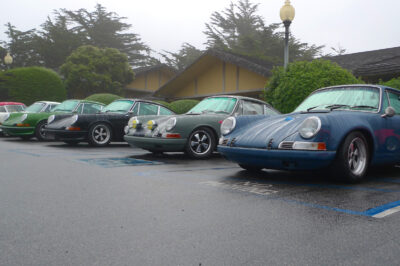
My first proper experience of a SWB car came while I still lived in Ireland. A friend’s dad was a keen rally driver and also owned a garage. He had a SWB car in for some work and I would see that driving around quite a bit. It was LHD and may even have been something famous once upon a time, but I never got close enough for a proper look. Years later, when Jamie and I shot a well-known piece featuring two SWB 911s on our first trip to California (Short but Sweet: read it here), I remembered that early rally car and thought how well it would have slotted in with Bob Tilton and Chris Nielsen’s rally inspired R Gruppe machines. I should have bought a SWB project car then, but I missed that particular boat – they are now well out of my reach.

Experience the SWB cars in depth and you gain a unique understanding of the original 911 ethos, but race a SWB car hard and win with it, and you enter another dimension of 911 folklore. The UK saw a huge jump in SWB enthusiasm when the 73rd Goodwood Members’ Meeting featured the Aldington Trophy: a race for pre-’66 SWB 911s only. Mark Bates raced the EB Motorsport SWB 911 at Goodwood among a select group of its peers and spent most of the lap going sideways in some very close battles. Mark finished on the podium after a great hour of racing and people still talk to me about that mental race – a fine day in the SWB story.
Away from the circuits, SWB 911s make highly prized road cars, but finding original interior parts and trim is now perhaps the hardest part of a SWB restoration. There is plenty of choice as to who restores your SWB car but, with waiting lists as long as they are at the very best workshops, it might be quicker to learn the skills to restore it yourself! Plenty of Porsche fans are doing just that and, as a DIY diehard, I think that is brilliant.
Guy’s SWB Porsche print is produced on archive quality heavyweight paper. It is a limited edition of 200 large-format A2-sized prints (A2 is 420 x 594 mm). The prints are signed and numbered and you can take a closer look at them here.

by John Glynn | Sep 21, 2016 | Classic Porsche Blog, Porsche News
Ferdinand Porsche’s second postwar visit to the USA was in August 1952. The trip was arranged by Max Hoffman, who had visited Austria for a summer vacation and brought news of a possible consultancy opportunity with Studebaker. This gave the Porsche chief a very good reason to travel.
To discuss the Studebaker project and to catch up with what else was going on across the Atlantic, Ferry, Dodo (his wife) and engineer Karl Rabe (pic, left) sailed to America on board the Queen Elizabeth from Cherbourg to New York. The following passage is from “We at Porsche”: Ferry’s autobiography, which was written with the help of John Bentley.
“I went on to Detroit and called on an old friend, Zora Arkus-Duntov, who had transformed the original lifeless Chevrolet Corvette into a world-famous sports car – in fact the only true machine of this type built in the United States. He took me to the Research Centre of General Motors where I met Bill Mitchell, the chief of styling. We talked about new cars and walked through his office where he had some models. He pointed to a particular one and held it up. Here was a typical example of the communications problem between styling and engineering.
“”To get a nice looking front end on this car,” Mitchell said, “the engine must be lowered. I therefore modified the carburetion system to bring it lower and made other changes in the engine.”
“Arkus-Duntov, who was standing beside me, did not react favourably. “What nonsense,” he said. “There is no way to build such an engine.”
“This was all I needed to realise how far apart a stylist was from an engineer. If it was necessary to bring these two minds together, a third person would be needed who had a clear idea of what could and could not be done by both parties. Such an individual need not be either the best stylist or the best engineer, but he must know exactly how to bring about the most effective compromise.”
Given the unique look of the 356 and the first 911s ahead, Ferry’s opinion on the need for compromise between styling and engineering is interesting. One could say that this was the key skill of Erwin Komenda (pic, centre), who brought such life to the early Porsche products. A talented engineer and a great visual artist, Komenda was perhaps the ultimate agent of positive compromise.
The original meaning of ‘compromise’ suggests a joint agreement, from the Latin ‘com’ (together) and ‘promittere’ (promise). The word has taken on a negative aspect in recent times, as in “compromised security”, which is just a soft PR way of saying broken, failed or ineffective. This sense of compromise is not how Porsche would have viewed it, but some of the compromises made on later models could be regarded as counterproductive. There is seldom an upside in compromised principles to reach shallow goals.
However styling and engineering were balanced, durability was never negotiable. Reliability was Ferry’s first priority in all things Porsche. Herr Doctor would sacrifice anything else to ensure Porsches were reliable, as no Porsche should ever be seen broken down. He would not have handled a flat tyre in a car with no spare wheel very well.

by John Glynn | Jun 20, 2016 | Market & Prices, Porsche News
I had an interesting conversation with a well connected dealer friend a few days ago regarding the UK market for RHD Porsche 991 GT3 RS, which suggested that the days of six-figure markups for the latest 911 RS were over and done.
A nice RS had just arrived in stock and was offered to a number of prospects at well below the average market price. Some of his would-be buyers replied with claims of cars being offered behind closed doors for much less than the price my friend offered. Evidence went backwards and forwards until a much lower price was eventually agreed as the RS seller was keen to move on. The seller still cleared the best part of £45k profit out of the deal after paying the dealer’s fixed-price commission.
Average Market Prices for Porsche 991 GT3 RS
Average selling prices for 991 GT3 RS are not easy to calculate without access to accurate transaction data, but the average asking price is pretty straightforward. The premier classified ads site currently has 22 991 GT3 RS models on offer in the UK with prices from £195,000 to £289,995 (22 is not exactly what one might call rare). Average asking price for these cars is a heady £246,000.
This data does not tell the whole story. Amongst these 22 911s are cars with far more than delivery mileage – over 3,000 miles in some cases – and one zero-mileage LHD example. Stripping these cars out and confining data to just RHD cars with fewer than 400 miles on the clock reduces our sample to just twelve cars. Average asking price for these cars jumps to £252,270.
Cost New versus Average Price for 991 GT3 RS
A brand new Porsche 991 GT3 RS bought with no options will set you back £130,296 cost new from Porsche Cars Great Britain, but no one buys a standard RS. A sensible options package of decent paint (£1800), leather trim to the 918 seats (£2k), LED lights (£2k), Front Axle Lift (£2k), PCCB ceramic brakes (£6k), Sport Chrono (£1k) and PCM with Sound Package Plus and phone prep (approx £3k) adds the best part of £20k, which takes the cost new to £149,755.
This £150k list price is for a brand new car with 10 miles or less on delivery, built to your spec and you are the first owner in the log book. The only snag is you cannot order one new: production has been allocated to an oversubscribed list. However, it does indicate what the manufacturer believes their car should be priced at, given the cost to build and their standard margin.
Taking this £150k list price against today’s average UK asking price of £252,270, we see a premium of more than £100k for a car that’s already had one or more owners and may come with up to 400 miles on the clock. If you think that sounds pretty extreme, there is more than one story of a slot on the 991 GT3 RS waiting list being sold for as much as £200k over list at the height of the fever.
Porsche 991 GT3 RS Price Premiums Shrinking
I’ve not driven a 991 GT3 or an RS – these cars simply do not interest me as a driver – but I have looked at plenty up close. The overall impression is of a car that can get away with a £150k price tag, but not a hundred thousand pounds more than that. Lack of supply when the cars were newly-announced sent prices soaring, but now that the RS is two year-old technology and the demand from collectors has likely been satisfied, the low supply premiums are shrinking.
With prices of £190-195k rumoured for cars sold under the radar, that puts the premium closer to £40k for a delivery mileage, one-owner 991 GT3 RS. No doubt some will insist these prices are not happening, but I do trust my source.
Porsche is not building any more 991 GT3 RSs as far as I know, so the chances of these cars – even 10k-mile examples – selling for less than list price in the near future is unlikely, but exactly where over-list premiums will settle is uncertain for now. Will they drop much below £40k? That is entirely possible: premiums usually keep coming down until there is a sudden injection of demand, or supply shrinks as the market soaks up everything available.
Common drivers behind increased demand is a screamingly low price (exchange rate changes for overseas RHD buyers) or a sudden influx of liquidity to the buyer pool, such as city bonuses, pension payouts, capital gains tax breaks or similar. It’s unlikely that a vote against Brexit in this Thursday’s referendum would cause RS prices circa £260k to suddenly look sensible if people are paying less than £200k elsewhere, but there would likely be a lift in demand for sensibly-priced desirable cars like the 991 GT3 RS if economic uncertainty was eased.
Given this prospect, sensible dealers might be considering a reprice right about now. £200k is still £50k profit on list for a well-specced example. Perhaps sellers are not paying attention to the rest of the market, or banking on a big hit to Sterling exchange rates on Thursday. That’s a pretty big gamble if there are only ten buyers out there and they all do deals tomorrow and Wednesday.

by John Glynn | Jun 17, 2016 | Porsche News, Race and Rally
There were highly emotional scenes in the Porsche Le Mans press conference this afternoon, as frustration with ACO’s Balance of Performance rules boiled over for Doctor Frank Walliser, Head of Porsche Motorsport.
The conference began in the usual Porsche way, noting that no other manufacturer has been as successful at Le Mans, where Porsche has claimed seventeen victories. Porsche historical archive boss, Dieter Landenberger, and multiple Le Mans winner, Hans-Joachim Stuck then took to the stage, to discuss Porsche’s early Le Mans racing and how research and development carried out on the racetrack has informed production vehicle technology.
Dr Frank Walliser on Porsche Le Mans BoP
As Dieter and Stuck left the stage, the compere welcomed motorsport bosses, Fritz Enzinger and Frank Walliser, to discuss the state of play with the current Porsche motorsport team. “What are your expectations for the race?” Dr Walliser was asked. “Balance of Performance was the key word in the last two days?”
“Balance of Performance,” he began. “Looking at the expectations, especially in the qualifying result, we had really a perfect car. Feedback from the drivers was tremendously good: the best car they ever received for Le Mans. Balance, tyres, aerodynamics: everything good. And then, if you find yourself in eighth position, 3.8 seconds behind the car with the F, it makes it really difficult.
“For sure you have to come then to a point where are you say it’s definitely not our team, the performance, there is something on BoP. We all know we need BoP: it’s important, it is relevant for the sport, it enables GT racing. But we do not need this kind of BoP; this is definitely not what is expected.
“We trust as we do always that the officials will take the right measures within the next hours to rebalance again, and that we can… there is a chance to have the best GT race ever – as we have five brands and fourteen cars – for the sake of the sport and for the fans.”
At this point, Frank became quite emotional and broke down a little: something not often seen in motorsport press conferences. It was a clear insight into how deep these emotions are felt, and the pressure Frank and his team are under to keep the RSR up to speed against the Ford GTs and Ferraris which many commentators have accused of sandbagging here in Le Mans and also at the recent 6 Hours of Spa.
Racing is not just Machinery
Having spent much of last night in tears, watching news broadcasts and so many tributes to the young mum and Yorkshire MP who was murdered outside her Yorkshire constituency office, I feel Frank’s emotion. These events may have very different significance, but both are all about people and how deeply we feel our strongest convinctions.
World Championship motorsport is not just about the machinery. This is an intensely human contest, in which the extreme highs and lows are amplified by the global stage on which they are fought. I know I’m not alone in having shed many tears over motorsport events – not least the modern-day losses of Joey Dunlop, Allan Simonsen and Jules Bianchi – and that is just as a spectator. Quite how much frustration the boss of a huge motorsport team must feel when the sport’s governing body is blatantly biased against one’s equipe is hard to imagine.
ACO has since looked again at the Balance of Performance and added some weight to the Fords (+5kg) and Ferraris (+25kgs). It has also pulled boost pressure from the turbocharged Ford GTs. The Astons and Corvettes have been gifted slightly bigger air restrictors to increase engine power. As for the Porsche Le Mans 911 RSRs, they now have an extra 8 litres of fuel capacity. It is the worst kind of joke: no wonder Frank is not laughing.


