
by John Glynn | Apr 3, 2017 | Classic Porsche Blog, Road Trips
April in Europe means it’s time for Techno Classica Essen. I’ve missed the last couple of years for one reason or another but am back at the 2017 show with Jonny Hart from Classic Retrofit. We’re also meeting Mark and James from EB Motorsport, Marcel from Restoration Design and Jonny will also be catching up with his new friend, Alois Ruf! Love it.
Mention Essen to most UK classic car people and they usually respond by saying they’ve been meaning to go there for years. I was the same until actually going and now it hurts me not to attend. So much goes on here that it is difficult to consider oneself well informed about the European market when you skip a year: you have to witness the prices inside the halls and the numbers on cars offered by traders and private sellers in the external exhibition spaces.
An incredible 1,250 exhibitors from 30 countries show their wares at Essen, with many more sharing stands alongside trading partners. The 2016 Techno Classica was attended by 200,000 people. More than 2,700 cars were on display, with an estimated total value of €350 million.
Manufacturers pull out all the stops and bring a wonderful selection of museum pieces to take us back forty years or more. There is so much Porsche stock on most other stands that it likely would not matter if there was no official Porsche presence: it would still be one of the most popular brands at the show and it is the surprise exhibits that create the biggest buzz.
I am looking forward to being back in Germany. Jonny and I are staying in the centre of Dusseldorf, at the same hotel I use every year. Dusseldorf is a nicer city to stay in than Essen and the trains back and forth are easy to use. We’re around from Thursday AM to Saturday lunchtime, so anyone else in the area can drop me an email, social media message or just post a comment.

by John Glynn | Mar 3, 2017 | Market & Prices, Classic Porsche Blog
The last few months have seen a slowdown in air-cooled Porsche market activity. Long-time owners who have watched their hobby become a speculator playground may have welcomed the lull, but there’s no guarantee of its permanence.
A seasonal slowdown has always been the way of classic Porsche prices. As the cars get put away through September and October, so the market tends to hibernate, with fewer cars available and buyer attentions elsewhere as Thanksgiving, Christmas and myriad other distractions keep people at home through the snowy winter months (northern hemisphere folks).
As the weather improves and the evenings get lighter, the classic car season starts to pick up. By the time we get to Essen TechnoClassica in late March/early April, the market is getting back up to speed and we begin to see where the haves and have-nots might be found, as record prices for particular makes and models are set in a retail rather than auction context, in front of Europe’s largest single audience of devoted classic car fans. Once Essen has happened, we start to see price trends taking shape for the year ahead and that is always an interesting point.
Falling prices for classic Porsche
A number of recent Porsche insurance valuation customers have asked how the fall in Porsche prices is progressing. Looking at current selling price data and the supply levels for RHD impact bumper cars in particular, I see no sign of falling prices for ‘regular’ 911s. 964RS and Carrera RS have come back a bit from their ultimate highs, but that adjustment happened a while ago and has stabilised since. Demand for ordinary 911s has not melted away and with constrained supply, prices are stable for now.
A market slowdown just means fewer buyers are out there, but when the sale is not an urgent one, you just sit it out and wait for buyer numbers to increase. That is what’s happening now. There has been no obvious fall off in prices for SCs, 3.2 Carreras and 964 Coupes since this time last year.
As an impartial market observer rather than a Porsche dealer, I see no obvious signs of a serious downturn for air-cooled Porsche selling prices. The biggest risk to prices would be a sudden spike in owners wishing to cash in their chips, but I don’t get the feeling that this is imminent.
Long-Time Owners mothball their cars
No doubt many owners have stopped using their 911s in recent years. As one Californian owner of a number of hot rods said to me recently: “my local shop is so busy that I can’t even get a quick re-seal done. It’s good that they’re busy, but an indicator that finding a shop that is both good and relevant is tricky at the moment. I also have to say that I am distancing myself from the early Porsche crowd on the basis that it’s no longer the same demographic. There are plenty of old crowd like me, kind of hiding out now: still with the cars but not out there in the public eye so much.”
I know my friend is busy on exciting new work projects and has less time available to socialise, but I hear the same story from lots of people, not just in CA. I’m in the same boat and I don’t really mind not using my 911, as I have lots of other stuff to get done and twelve other cars to busy myself with.
Despite the palpable changes in demographic and available leisure time, there has been no huge flood of much-loved cars to the market. These 911s form part of the owners’ life stories, they embody a lifelong ambition to own a 911 and of course, they are making money parked up. If the market were to collapse, it would utimately cost the owners nothing. Their 911s are bought and paid for, and a fall in prices and change in the crowd might encourage them to start using the cars again. So they are not coming up for sale.
No big influx of cars and no changes to the external factors = no big drop in price.
2017 Price Predictions
The owner/enthusiast in me hopes that average examples through Europe and the USA being advertised for ridiculous prices will all remain unsold through 2017 and encourage overenthusiastic speculators out of the market. You may think this unlikely and I am inclined to agree. My inner price geek expects realistically priced examples with good history in good condition to continue to sell at the current level, if not a tiny bit more as this year gets started.
The advice to anyone considering an air-cooled Porsche purchase of the common-or-garden variety (SC, standard Carrera etc) who might be waiting to see if prices come down remains as it has been for several years: stop waiting. Buy a good solid car with history and start enjoying it ASAP. That advice has not changed in the decades I have been watching this market and it still holds true today.

by John Glynn | Mar 2, 2017 | Classic Porsche Blog, Market & Prices
My most recent used Porsche Market Report signposted rising demand for water-cooled Porsches: witness the 200-kilometre 996 GT3 RS that sold for £343,000 including premium at the recent RM Paris sale.
Good as this news may be for low-mileage GT3 RS owners, this trend is influenced in no small way by the rabid interest in low-volume, air-cooled collectables, as shown by the £1.8 million Porsche 993 GT2 at Sotheby’s in London last year and the £1.1 million Porsche 993 Turbo S Cabriolet at February’s RM Paris sale.
With prices now off the chart for real air-cooled rarities, prices for rarer water-cooled examples are being boosted with an air of expectation (not that a 200-km 996 GT3 RS is bad value at £340k if you have £5 million to spend on old cars). So while there is a growing respect for the rarer water-cooled models, high prices are linked to the staggering heights reached by air-cooled rarities at auction.
Many amongst Ferdinand’s core audience will disregard these one-off auction results as irrelevant to the market for old-school classic Porsche 911s built in greater numbers. However, where the money-no-object crowd places its bets has a direct effect on the mindset of anyone attempting to gauge where the price trends could take us during the next three to five years, assuming the external economic factors and influences remain broadly consistent.
Strong auction results do of course affect retail asking prices for 964RS, 911 Turbo and filter down to sales of the cheaper 911s. This trend then knocks on to other models, including the 944 Turbo and 968. Private sale asking prices are obviously linked quite closely to what dealers seem to be getting away with, so whatever happens in a showroom eventually makes its way to the classifieds.
Porsche Undesirables
Sadly for classic Porsche buyers, no truly undesirable models exist amongst the ranks of Stuttgart’s finest. Only those with a real taste of Volkswagen are anywhere close to the lower ranks of the pecking order – like the standard 924 and 912E (both of which I own/have owned myself, before you moan about elitism) – but everything else is now priced more than twice what it was a few years ago, such is the interest in classic Porsche product.
I still think the 912E is a great buy at the sort of level seen in RM Paris: £29,400 inc premium was a very good price for a collectable example, as many elements of these cars are unique. I wouldn’t want to be paying much more if buying for investment, but a low mileage minter will certainly cost at least that sort of price nowadays. These were very rare cars in their day and are not easy to find in top condition. That said, mine is destined for 911 power and some hot rod tweakery – I am not hunting for originality in my stable.
by John Glynn | Feb 22, 2017 | Classic Porsche Blog, Project Cars
One of my favourite Porsche projects of the last few years has been working with my friend Jonny Hart on the brand development of his company, Classic Retrofit. Jonny and I became online friends soon after he joined our 1974-1989 Porsche 911 forum at impactbumpers.com and it has been fun to follow his electronics magic on parts for these classic 911s, including the all new Porsche 911 air con system.
The peak of achievement to date is Jonny’s electric air con kit for classic Porsche 911s. Branded ‘Electrocooler’, the full kit is about to be unleashed on the classic Porsche community in its first public showing at the LA Lit Show on March 4.
I shared some pics on Classic Retrofit’s social media pages last week and they went totally ballistic: a most rewarding return for all of Jonny’s hard work. I have just sent more details out and am sure that many of my Ferdinand friends will also be interested in knowing more, so I share them below.
Email Jonny at info@classicretrofit.com to discuss any of his products.
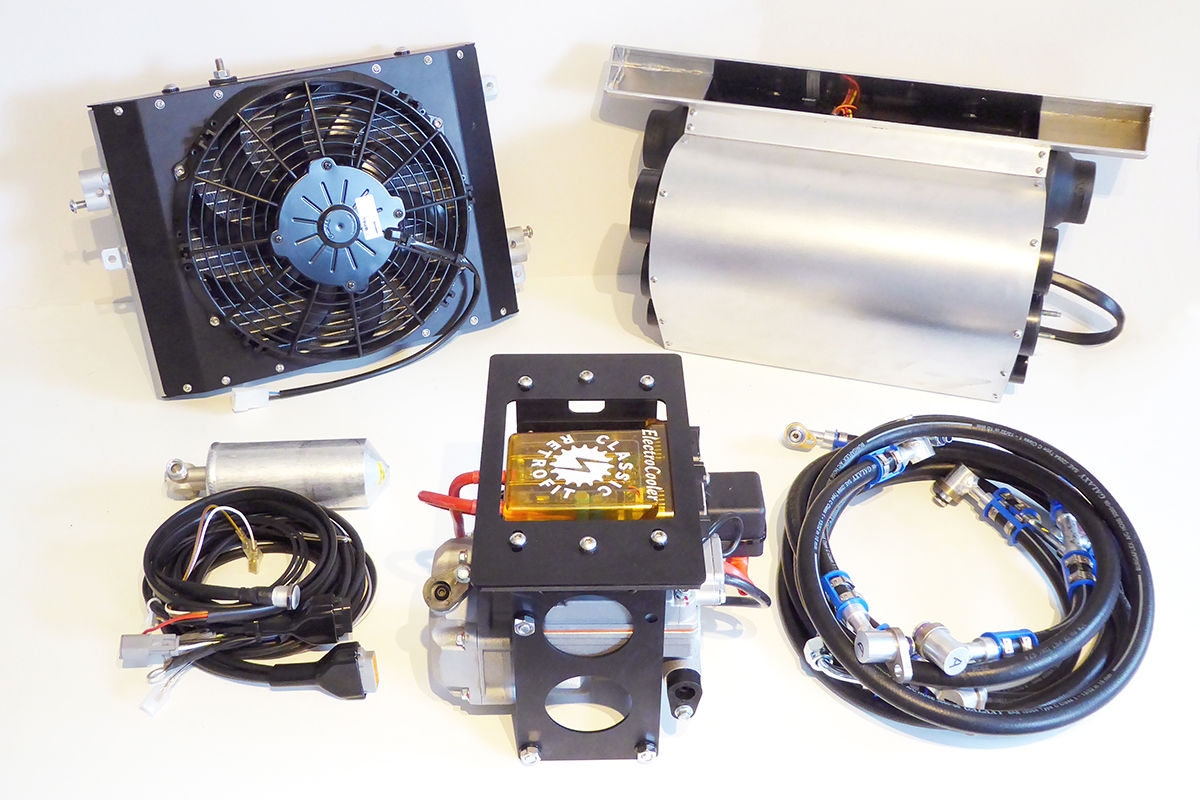
Classic Porsche 911 Electric Air Con: A/C Technical Layout
The compressor module (front centre in the picture) goes in the smuggler’s box on a LHD 911. On a RHD car, the compressor is mounted adjacent to the battery and fits with no modifications to battery or spare wheel arrangements.
The condenser goes under the front wing/fender, in place of the oversized windscreen washer reservoir on an impact-bumper car. The blower unit (top right) contains a modern fan and evaporator. All original non A/C vents now blow A/C air.
The occupants can also enjoy A/C air out of any vent in the car, including warm A/C air for rapid windscreen defogging. Our blower assembly brings recirculation capability to the 911s ventilation system and assists heated air flow for hot air without the need for footwell blowers.
Maintaining the standards of classic Porsche design, the original cabin slider ventilation controls are retained, for maximum discretion. A single pushbutton with indication is the only visible clue that Electrocooler is fitted.
Electrocooler Weight Savings and Performance Benefits
As shown in our photo, the complete kit weighs a shade over 16 kilograms (35 lbs). Combining the fitment of a smaller washer bottle and accounting for removal of the original fresh air blower, installing Classic Retrofit’s Electrocooler kit to a 911 originally supplied without factory air conditioning adds less than 7 kilograms (15 lbs) to overall weight.
For a car originally equipped with factory air conditioning, converting to the Classic Retrofit Electrocooler system results in an overall weight saving of circa 18 kilograms (40 lbs).
There is the added handling benefit of weight loss at the rear of the car by removing the substantial original air-con compressor from its elevated position in the engine bay, not to mention the increased fuel efficiency and engine power, once the crankshaft load inflicted by the archaic belt-driven compressor is removed.
by John Glynn | Feb 20, 2017 | Classic Porsche Blog, Project Cars
The Canary Islands are volcanic isles located off the north-west coast of Africa, just a half-hour flight from the Western Sahara Desert. I first visited the Canaries in 1993 and instantly fell in love with the islands and the people. I have since returned here many times, visiting each of the islands over the years, but Gran Canaria remains my favourite.
The locals say that Gran Canaria is like a mini-continent. Divided by a mountainous centre, the south gets most sunshine, so is where the resorts are. In the north is Las Palmas, Spain’s ninth biggest city and the islands’ governmental centre. 850,000 people live on this island, including many extranjeros (immigrants) from across Europe, Africa and Latin America. This Irish immigrant has spent the last seven days here and as always, it has been a pleasure.

Thanks to beautiful weather all year around, a huge working sea port and a very busy airport, Gran Canaria welcomes hundreds of thousands of visitors each year. The mix of global influences has earned GC a reputation for tolerance and an openness to many cultures. This has certainly been my experience. I have made some good friends in Gran Canaria and am interested in possibly owning a house here, hence my frequent visits in recent months. We will see how that goes.
A Lesson in Spanish Philosophy
Canarian history goes back thousands of years and each island is truly unique in character, but today the Canaries are a part of modern Spain. Here we speak español (small e) and follow the rhythms of Spanish life and culture. There is little point in rushing anywhere, as you will only catch up to the bloke in front. Make time for life and life will make time for you is how things tend to go.

Catching up to slower moving people reminds me of the famous Spanish philosopher, José Ortega y Gasset, who believed that a person was the combination of both life and circumstance. “Yo soy yo y mi circunstancia” as he put it. To Ortega y Gasset, circunstancia meant those things forced upon us. He saw life as a constant tug-of-war between the freedom we were born with and our dictated fate.
In the fight between freedom and fate, Ortega y Gasset’s concept is the start of all art. We accept that fate will befall us but inside that acceptance, we select a destiny. Some become part of what the philosopher’s 1929 essays call “The Mass”, while some select a different path.
“The mass crushes beneath it everything that is different, everything that is excellent, individual, qualified and select. Anybody who is not like everybody, who does not think like everybody, runs the risk of being eliminated.”

To escape this fate, Ortega Y Gasset believed that a person must make an active decision to live a life of effort. “For me, then, nobility is synonymous with a life of effort, ever set on excelling oneself, in passing beyond what one is to what one sets up as a duty and an obligation. In this way, the noble life stands opposed to the common or inert life, which reclines statically upon itself, condemned to perpetual immobility, unless an external force compels it to come out of itself.”
The concepts of Ortega y Gasset and others were at the heart of a lively bilingual conversation I enjoyed with my friends Rafael and Jorge over coffee last night. Rafael – a Doctor of Philosophy – is a former consultant to the Swedish government and has just completed another PhD, pondering the practical applications of preventative psychology. His lifelong friend, Jorge, is a Porsche restorer. Both are living “a noble life” that Ortega y Gasset would be proud of.

Pons Vintage Cars
Based just outside Santa Brigida, here in Gran Canaria, Jorge Pons takes the idea of Porsche restoration to the nth degree. While most of the Porsche restorers I have met and worked with add their own touches, that is not the way of Jorge. Pons Vintage Cars believes that, if it is not in the manual, it is not on the car.
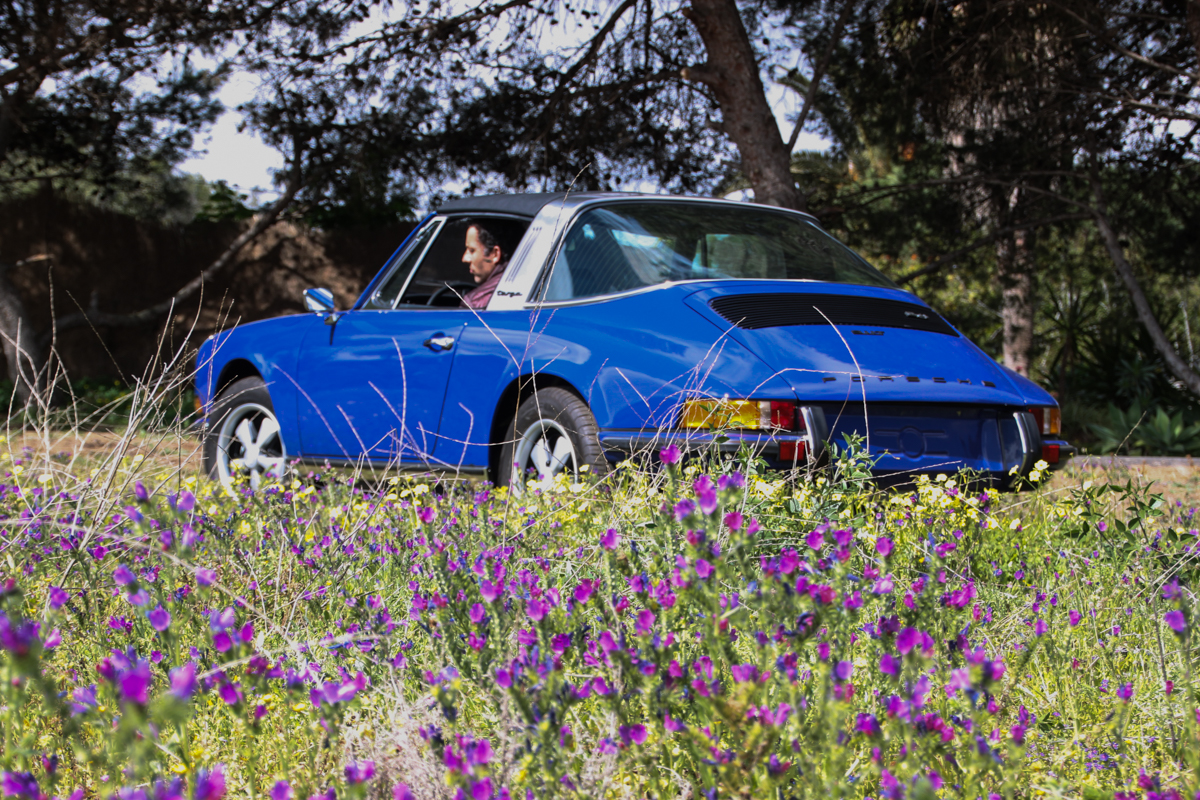
The Dalmatian Blue (Oxford Blue) 1973 Porsche 911 2.4T Targa seen here is a perfect example. And I mean it is a perfect example. Restored over ten months from start to finish, this superb 2.4 T Targa is immaculate inside and out. I had the pleasure of a short drive in this 911 around Jorge’s family estate and it was a delightful experience.

All of Jorge’s 911s are completed to an exacting standard. The ’73 Targa is the seventh car in as many years to come from his wonderfully pastoral workshop. Set amongst the mountains overlooking the wild blue Atlantic and surrounded by palm trees, a group of four much-loved donkeys (burros in Spain) follow progress in the glass-walled garage through wise and appreciative eyes. As a donkey- and a Porsche-lover, I think it is perfect.
Dalmatian Blue Porsche 911 T Targa
Dalmatian Blue is one of my favourite Porsche colours but it is not very common. I have only seen one other 911 in Dalmatian Blue and that was a hot rod built by my friend Gib Bosworth, eventually finished by another good friend. How many Dalmatian/Oxford Blue Targas were ever built in the final year of early 911 production (and how many matching-number examples remain) is anyone’s guess, but it can’t be that many. This could easily be the the best one available.

Anyone seeking a well restored example of classic Porsche engineering should contact Jorge Pons to discuss this car for sale. Gran Canaria is just a plane ride away and shipping is easy. Pons does not ask a fortune for his work – the projects are not about the money – but the prices are not negotiable. This one is up for €125,000, which seems reasonable, given that some dealers in Germany are asking more than €150k for similar cars that will not have taken ten painstaking months to restore. I m back in Essen in april and I have no doubt that cars this good will be into the €160k+ bracket.
Now finished the 911T Targa, Jorge has switched to a superb Irish Green 1970 Porsche 911 T Coupe. This car recently returned from the paint shop following an incredible bare-metal restoration, all recorded on camera. It is beautiful: the paintwork is a joy to behold. I leave Gran Canaria tomorrow, but am very excited to see what progress will have been made when I return to the island in May.


