I was sad to hear of the death of Bob Watson yesterday. As one of the UK’s best-known independent Porsche mechanics, Bob Watson Engineering was for many years based in Middle Aston, which is where I met him and went on to spend quite a bit of time with him.
Born in March 1950, Bob’s Porsche life began in March 1975, when he took a job with Maltin Car Concessionaires in Henley-on-Thames. Owned by Chris Maltin with partners Rod Turner and Charles Holdsworth-Hunt, the business held franchises for Porsche, Ferrari and Lamborghini. I can imagine the twenty-five-year-old Bob rolling up for work at Maltin surrounded by seventies exotica – it must have been fantastic.
Back then, Porsche did all of its training at the factory. Three or four times a year, Bob and his UK colleagues would be sent to Stuttgart for one week studying engines and doing rebuilds, the next week’s visit would cover transmissions, then a week on brakes and suspension and so on. The training continued up to 1982, so it was no surprise to find that Bob was very hot on standard Porsche models from ’75-’82 including the Carrera 3.0, 911 Turbo 3.0/3.3 and, of course, the 3-litre 911 SC. He built some amaing cars, including Steve’s 3.5-litre 930 (below). But I’m jumping ahead of things here.
In September 1984, Bob decided to call it a day with Maltin and headed off to work for John Greasley at Dage Sport in Aylesbury. Greasley’s now famous Blue Coral-sponsored Porsches were a big deal in motorsport and Bob was well into racing. That brought him up the country and also put him at the back end of 935s, as Greasley was running a pair of them: one left hand-drive genuine car and a right-hand drive replica so the real one wouldn’t get damaged.
Porsche racing was a big deal in the mid 1980s. Though the Porsche Club was smaller than it is nowadays, the club was a big force in racing and the Giroflex-sponsored series drew big crowds and big name drivers. Many of the UK’s leading air-cooled specialists made their names around this time: Bob enjoyed a great rivalry with Neil Bainbridge’s cars in the Porsche Club series and other famous races including the Oulton Four-Hour Endurance.
Racing continued to be very important when Bob struck out under his own name. Photos hanging in Bob’s offices showed racing from all over Britain and of course at Le Mans (Bob also raced until the mid 1990s). From his workshop in Bicester and later Middle Aston, Bob Watson Engineering became a big name in UK Porsche. A quick search for Bob online will show just how many 911s he laid hands on: all sellers were delighted when they found Bob Watson history in an air-cooled car.
Bob took to Motec Engine Management early on and used it very successfully on a number of Porsche builds and others: I once watched him tuning a V12 Jaguar E-Type which he had fitted with Motec. The fastest air-cooled Porsche I can remember being driven in was a naturally aspirated 2.8-litre Motec-equipped 911 ST, which Richard Tuthill took me for a run in sometime during 2010/2011. Even on rock hard dampers and tyres, this was absolutely the quickest car: you simply would not believe a 911 could move that fast uphill. Not until I rode in the 997 GT3 Cup R-GT rally car on a wet tarmac stage was I so impressed again, and that’s not rose tinted glasses. Bob also built the famous hillclimb 911 of Roy Lane: another incredible Porsche.
I can’t remember when I first went to Bob’s, but it was early in my Porsche life, as he was only half an hour from my house. Back then, I had a 911 SC Cabriolet and had started writing for various Porsche magazines. I knew Bob had a dyno as Tuthills used it quite regularly: Francis would be clicking fuel pumps up and down notch by notch in typical Francis fashion, while Bob would shout above the fans: “for f**ks sake Francis, give it half a turn”, trying to speed up Fran’s progress. No one has ever succeeded in that, but Bob always gave it a good go. I took my SC down there for Bob to have a look and we spent an hour or more chatting, even though he had plenty of other stuff to do.
There was always a bit of craic going on at Bob’s and I don’t remember one conversation with him where I didn’t learn something. He was a font of knowledge so I organised an ImpactBumpers.com group visit to Bob’s one year – the only Porsche specialist we have ever visited as a group if I remember correctly. We spent so much time talking whenever I saw him, it is only now I need a photo of Bob that I realise I don’t have any: I have used a pic of Alan’s S on Bob’s dyno pending better photos (email me a pic).
Many air-cooled 911 owners were delighted to have Bob fettle their cars on the dyno. Including me, as Bob sorted me out with a run just after I got bought my Carrera 3.0 Coupe in 2007 and did a first dyno run elsewhere which suggested it was lean at the top end. He spent an hour with me on the rollers and wouldn’t take a penny for his trouble. He gave me great advice on what to do next – “just drive the nuts off it” – which of course I followed religiously.
Bob’s dyno was the benchmark for PCGB racing and for years he served as Technical Consultant for the 930 Register. Alan Drayson at Canford Classics was a big fan of Bob’s work and would tune all of his new engine builds on the Bob Watson dyno, including the stunningly restored RHD 911S we did a feature on together. When a partnership at the Middle Aston unit eventually went sour, Bob upped sticks and went to work down south with Alan. After that, we lost touch.
In recent times, he had returned to Oxfordshire and was still booking work until he passed away last weekend. Yesterday, I heard he almost came to build engines at Tuthills last year, but they had just taken a new engine guy on at the time. It would have been good to see Bob over there every week.
People who knew Robert Bailey-Watson much better than I did will write great tributes to Bob in the Porsche press and I urge you to read them. Bob had his detractors (don’t we all), but I always found him excellent company and being around someone with so much Porsche knowledge, shared with unstinting generosity, was a genuine pleasure. He only worked on my cars twice, but he made them better both times. RIP Bob: you will be missed.
My Porsche 924 Turbo restoration project returned home this weekend, more than a year after it was painted by Rob Campbell at Racing Restorations. I had been storing it out in Worcestershire but recently lost the space, so it’s come home to be finished with a view to selling it sometime this summer for cash to plough back into my garage build.
This LHD non-sunroof Turbo is a nice example of the very cool Porsche 924. Having lived most of its life in Sardinia, this one is lower than average mileage, entirely rust free and still remarkably original. Despite being stored for more than twelve months and not being on a battery charger in all of that time, it started easily when the time came to load it on the trailer. It runs pretty well once warm – cold running is not great so will be taking a look at that. Bound to be something simple.
I spent a few hours on the 924 today and made some good progress. A few exterior bits have gone missing since the car was stripped for paint (probably still at Rob’s), so I excavated some of my 924 spares boxes and dragged out some prize pieces, including a brand new boot seal I bought from Porscheshop a few months ago. I put that on and made a little shopping list, which turned out to be quite a long shopping list in the end: more than £500 worth of rubber, including door seals, rear window seals and numerous detail parts including a new Porsche badge.
Other bits which were missing from the 924 when I bought it include the aluminium jack, spare wheel compressor and tool kit. I did find an ally jack and an old Blaupunkt Toronto stereo in my stash, which I need to test. I’ve stripped out the doors so I can clean and regrease the handles and lock mechs and also the electric window motors and regulators, which are notorious for seizing up. I’ll dynamat the doors and fit new membranes at the same time. I found a full lock set to replace all the mismatched keys, but no miracle finds can sort this steering wheel, which desperately needs a retrim, if not just swapping for a Momo Prototipo.
The carpets are quite faded from UV exposure, so I bought a good LHD carpet set last year, but I might try dyeing these carpets first as other 924 boys have had good results with carpet dye. Elsewhere, there’s a set of 205/60 15 Bridgestone tyres to go on and I’ll take some engine bits off for powdercoating to lift the underbonnet presentation.
It’s a good solid car in nice condition, so most of what it needs is simple. The hardest part will be UK registration. It is still Italian registered and I don’t have the Italian registration document, so getting it UK legal will be a bit of a ballache involving waiting for a Porsche Certificate of Authenticity and also getting it through an MOT, which will force me to fit a passenger mirror.
I don’t want to do screw anything into the bodywork permanently, as I like the uninterrupted line down the passenger side, so I’ve been looking at temporary fit mirrors which could be detached once the test has been passed. The single side mirror is an oddball European car throwback, which I have always quite liked. You have to hang on to these details.
I’m working outside the UK at the minute, catching some winter sun in Fuerteventura. As ever, I’ve brought a few books along in case of long lunches, including ‘We are Porsche’: Ferry Porsche’s first autobiography, written with John Bentley in the early 1970s.
I’ve read this book many times, as Ferry’s words both inspire and encourage. All freelancers face constant changes and challenges, which can often feel insurmountable. Ferry’s story demonstrates that, no matter what life throws in one’s path, patient perseverance will find a solution. Hard work and the occasional retreat to simple pleasures can power body and mind through tough situations.
Ferry Porsche and his BMW Motorcycle
As a young man, one of Ferry’s simplest pleasures was motorcycling. At the age of eighteen, Ferry got his motorcycle licence and shares how the independence of increased mobility brought new opportunities to meet girls. “I no longer had to rely on the family car to get me from one place to another in a hurry,” he recalls. “The motorbike I then used was a 500cc BMW and this proved useful in more ways than one.”
This would have been circa 1927, making Ferry’s bike an R42: Max Fitz’s blueprint for just about every BMW road bike made afterwards. Pristine R42s now sell for big money – £40k or more – so Ferry’s mount was well chosen. Given Doctor Porsche’s interest in BMW motorcycles, I wonder what he’d make of the machine seen here, being offered by Bonhams at its Paris sale on February 4th: a 1952 Sunbeam S8, with Ferry Porsche power.
BSA bought the rights to Sunbeam’s motorcycle business in 1943 and revived the brand after the war, when it was given German motorcycle designs as part of the war reparations. Based on the BMW R75, the Sunbeam S7 had a pre-war-designed inline twin which left it low on power, and its successor, the Sunbeam R8 was apparently not much better.
Porsche Engine in a Motorcycle Frame
In 1969, the then owner of this S8 decided to upgrade the power with a 1200cc motor from a Volkswagen Beetle. This was not the ultimate incarnation, as he subsequently ditched the Beetle engine, replacing it with a 1955 1300cc Porsche motor featuring bespoke cast aluminium bellhousing and rocker covers.
The Sunbeam’s first outing was to the 1972 BMF show, where it caused a sensation. MCN’s John Ebbrell tested the bike for the paper, and the Sunbeam was also shown at Olympia, fitted with Amal concentric carburettors a la Triumph and others. A BMW tank was added later, along with Norton Roadholder forks and some other cool touches, including a Vincent Black Shadow speedometer.
For sale due to the advancing age of its owner, the Sunbeam was offered at Bonhams’ last sale in the RAF Museum at Hendon where it failed to find a new home. Given that the price aspirations seem sensible (£9.5k), I was surprised by this, so I emailed Bill To at Bonhams to get his thoughts on why such an interesting piece failed to sell.”We were a little surprised ourselves, but I guess that’s the nature of public auctions: we just don’t know what to expect on the day,” said Bill.
I’m not the world’s biggest vintage bike fan, but I do like this. If it’s something you are also inspired by, get yourself to Paris on February 4th, or contact Bonhams to register as a bidder. I want a ride if you buy it!
It’s now one week since I returned from my first trip to Africa, following the East African Safari Classic Rally with Tuthill Porsche as their photographer/media person. It was a brilliant experience: the team won the rally with Blomqvist, but even better stuff happened en route.
Pre-trip advice from friends who had visited Africa many times before was not positive. Guaranteed to be robbed, suffer food poisoning or worse, heatstroke or worse, malaria or worse, Ebola or worse: bring your own doctor and touch nothing would be a fair summary of their shared insights. Well, we did bring our own doctor (take a bow, paramedic and all-round good bloke, John Jones) but I didn’t require his attention. It was all smooth sailing once we found our rhythm.
I followed the doc’s advice and drank at least two litres of water a day, then added some simple precautions – no salads, kept my mouth closed while showering and brushed my teeth with bottled water, used antiseptic wipes to clean my hands and mouth a few times daily, brought some magic Avon mosquito repellent – and, while some of the guys I was travelling with had problems, I survived mostly intact. I wouldn’t do anything differently next time regarding keeping things clean, but I would look to sleep more, and spend more time talking with locals where possible. The best times in East Africa came from the people.
My ten bits of African travel advice (Kenya & Tanzania) for a first-timer virgin like me are as follows:
It will take you at least three days to get used to the heat, especially in humid parts like Mombasa
You will never get used to the heat, just endure it for longer. More altitude means you burn faster
Sleep is your very best friend. Get sleep and all will be well
Pack half the clothes you think you need, then get rid of half of them and bring a tube of travelwash
Come home with less than you brought (give shoes & clothes away at the end)
Pack plenty of earplugs, a decent sunhat and spare sunglasses
All shorts must have a front zip pocket for your passport: do not let it out of your sight. Be aware of who is around and keep cameras etc on your person
Neutrogena factor 60 sunblock is rubbish. Nivea 50 worked well for this blue-skinned European
Malaria is real. Take the drugs
Make sure your mobile/cellphone can roam in the countries you plan to travel to, and any country on their borders
Say hello to everyone – you will get the biggest smile back
There are eleven bits of advice there. Another tip from Africa is limits are for Westerners. There are mostly no rules: do whatever fits the bill and talk/smile your way out of trouble with officials. If you’re struggling with red tape, directions, airport check-in or whatnot, let a local help you. Even if they are no help (sometimes happens), chances are they will bore whatever officialdom is delaying your progress into returning your paperwork and sending you on your way. But mostly they are helpful, as long as you’re not in a rush. So don’t be in a rush. Also don’t be afraid to gatecrash VIP queues: it usually works.
Everything you carry is currency, be it local money, clothing, US dollars or just a bottle of water, even if it is empty. You will get by quite nicely if you’re ready to spend some time and play the game of “hey boss, take my picture and give me five dollars”. Obviously you’re not giving anyone five dollars to take their picture, but ask for permission to take a pic if that’s what you want. Then ask what people are doing, find out what happens in town, talk to people and soak up the experience. They soon understand there is no money coming and the people I met didn’t mind. That said, I have read a few horror stories so be prepared to make excuses and leave: “let me get you some lunch from my friends over there” or “I’ll just go and talk to my boss and get you something”.
Good advice from Richard was don’t give kids money, or anything else. Giving a kid money just means a bigger kid will beat them up and take it, then someone bigger than him will take it. Donate to community organisations if you feel so inclined – your accomodation manager knows who to talk to. In hotels or lodges, tip the luggage guys a few hundred shillings, buy a drink for the barman (chances are they will drink it and chat for a while), give your hotel chef a t-shirt, do all that stuff. But remember rules are for Westerners, so don’t follow my rules.
I love a good art gallery or museum exhibition. Hamburg’s Prototyp Museum has just announced something special for fans of the Porsche 356 and early Porsche heritage: the ‘Very Important Porsche 356’ exhibition from November 13, 2015.
Twelve of the most important Porsche 356s will be shown at the wonderful Hamburg Automuseum, including the oldest-known German manufactured 356. Of course, an Austrian-built Gmünd Coupe also forms part of the exhibition, as well as two early pre-Stuttgart Convertibles: a 1949 356/2 Beutler Convertible and a 356/2 Keibl Convertible from the same year.
Three Gmünd Porsche 356s at Hamburg Prototyp Museum
While the museum has gathered twelve 356s in total for this exhibition, the trio of early Porsche 356s alone should attract a number of visitors, keen to see three early Gmünd-built cars in one place. I can’t think of anywhere these three rare cars would have been gathered together at once in the last five years, so new arrivals to the world of classic Porsche will find these cars fascinating.
For my money, nothing sings more of undiluted Porsche DNA than these very early 356s, pieced together by hand in a converted Austrian sawmill, nestled in the foothills of the Central Eastern Alps. Ferry Porsche wasted no time after the end of the war in making his dream of Porsche-produced sports cars a reality. Every ounce of Ferry’s passion – a passion that was shared by the great team around him – sings from the aluminium bodywork of each of these cars in a hymn of devout inspiration.
Porsche 356 Gmund Styling
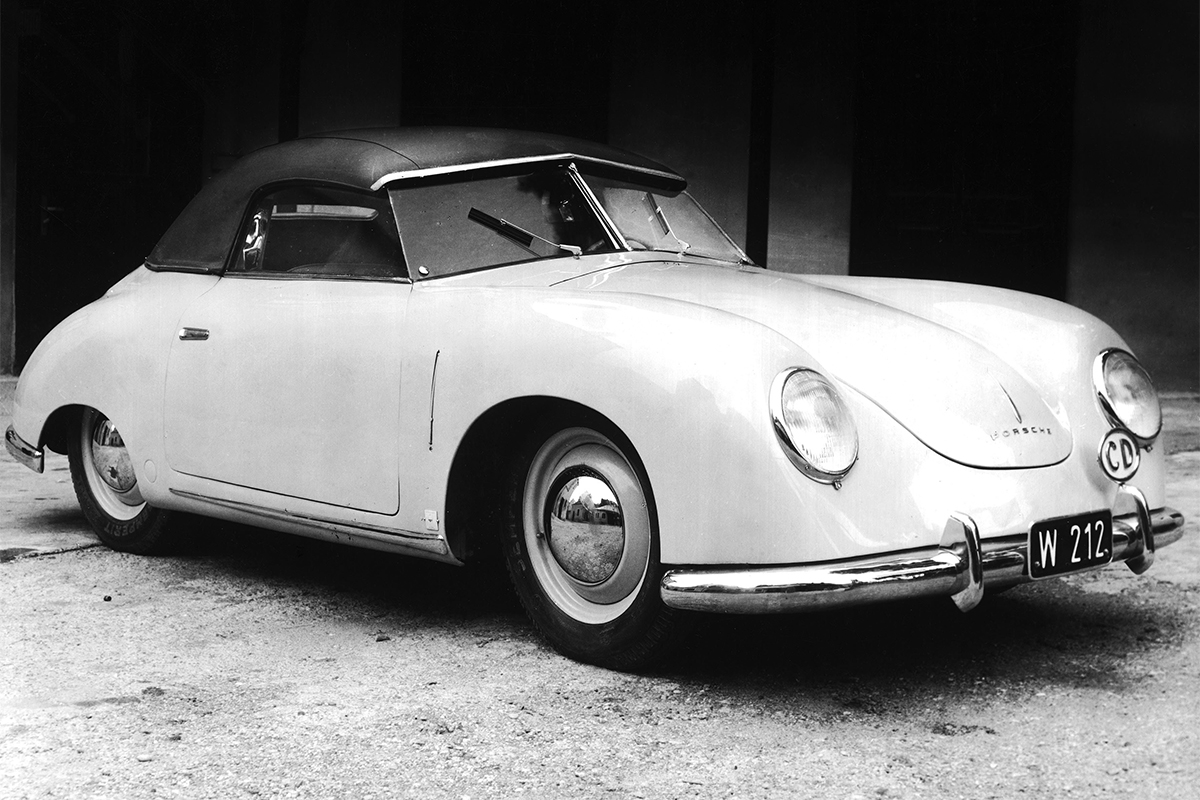
Once Porsche 356 production moved to Stuttgart in 1950, the bodies were stamped out in steel and much of that precious Gmünd styling was lost including the low, narrow roofline and the careful detailing through the front end. Photos never do these cars justice: you have to stand beside a Gmünd car to experience all of what they communicate. To me, the 356/2 Keibl Convertible built by Karosseriefabrik Ferdinand Keibl in Vienna (top pic) is one of the most beautiful road cars ever built: small wonder that Ferry was also a great admirer, and bought the only surviving example back for his personal collection.
Perhaps the most surprising part of this exhibition to those unfamilar with the very first cars produced by the genius Ferry Porsche will be the colour and sharpness of an early 356. We’re so conditioned to seeing these Porsches in grainy old black and white photos, that we expect the reality to be monochrome paintwork and workaday VW plastic on the dashboard, and tend to ignore opportunities to get close to these cars as a result.
I am always quite taken aback by the joy with which these cars were built and finished. Some of the colours are simply incredible and the shapeliness of the early 356s is quite honestly mesmerising from almost every angle. The crispness of a coachbuilt convertible top removes any thought that new cars rule for quality and the elegant palette of colours across bodywork, trim and soft tops is just beautiful. I encourage you to go along to Hamburg for a day while the exhibition is open from November 13 to March 27, 2016. Entry is only €13.50 and the museum is well worth the journey.
The cars of the Very Important Porsche 356 exhibition:
This website uses cookies to improve your experience. We'll assume you're ok with this, but you can opt-out if you wish.AcceptRead More
Privacy & Cookies Policy
Privacy Overview
This website uses cookies to improve your experience while you navigate through the website. Out of these, the cookies that are categorized as necessary are stored on your browser as they are essential for the working of basic functionalities of the website. We also use third-party cookies that help us analyze and understand how you use this website. These cookies will be stored in your browser only with your consent. You also have the option to opt-out of these cookies. But opting out of some of these cookies may affect your browsing experience.
Necessary cookies are absolutely essential for the website to function properly. This category only includes cookies that ensures basic functionalities and security features of the website. These cookies do not store any personal information.
Any cookies that may not be particularly necessary for the website to function and is used specifically to collect user personal data via analytics, ads, other embedded contents are termed as non-necessary cookies. It is mandatory to procure user consent prior to running these cookies on your website.