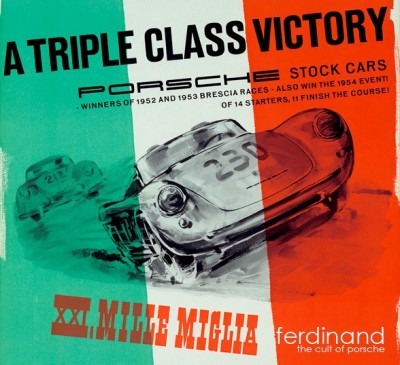
Porsche Classic on the Mille Miglia is rich in shades of 1953’s “downright phalanx”. Mille Miglia – literally a thousand miles – is for cars approved by the FIA or FIVA that would have raced in period, so up to 1957, when the 24th and final Mille was run.
From the press release, it sounds like the Porsche museum is sending two Porsche 550 Spyders, 356 Speedster 1500, 356 Speedster 1600, 356 Speedster 1600 S and 356 Coupé, the so-called “Knickscheibe” (bent windscreen).
Hats off to Stuttgart if it really is sending all that precious metal. Entry fees for the Mille Miglia are €7260 per car, for three nights B&B, some parking and a road book. Single beds, additional stickers or road books for support crew, and parking for transporters while the race is going on are all extra. Times that by six cars, plus drivers and navigators, plus transport, plus support, plus PR, plus staff costs and I guess you are knocking on €200k, for three days driving around Brescia to get some promo pics. Heavy duty!
Of course, for some people, it’s a proper race: 1,600 kms in three days. A few years ago, I pitched a story idea to Porsche, to follow his highness Gijs van Lennep in the State of Art 550 Spyder around the Mille Miglia in a Boxster Spyder. Got big thumbs down on that one, but one of the days I will follow the race in a Boxster: the only modern Porsche worthy of the jaunt.
Before I leave, back to that fabulous word. In ancient Greece, phalanx was a military formation, made up of heavily armed troops in tightly packed ranks. The soldiers stood shoulder-to-shoulder, several rows deep, often with shields interlinked. It was a formidable force that was difficult to match. At the turn of the 20th century, a Munich art cluster including Bauhaus legend-to-be, Wassily Kandinksy, formed a group known as Phalanx “to oppose old-fashioned and conservative viewpoints in art”.
Combining the two interpretations, I doubt there is a better collective noun for racing Porsches than ‘phalanx’. An impenetrable group of conquering soldiers, opposed to old fashioned concepts in art? That’ll do nicely, phalanx.
British law says that cars over three years old must have an annual safety inspection, known here as the MoT (Ministry of Transport) test. Racing Restorations UK recently took our Project 924 Turbo for its test. It’s the first step in registering the Italian-plated Porsche here in England.
The test checks what you’d expect:
Body or vehicle structure free from corrosion or damage, engine mountings secure etc. Fuel system: No leaks. Security and condition of pipes or hoses. Fuel cap fastens and seals securely.
Exhaust emissions: dependent on the age and fuel type. Exhaust system: secure & complete. Catalyst where one was fitted as standard. Without leaks and is not too noisy.
Seat belts: checked for type, condition, operation and security. All seat belts must be in place. Seats: driver’s seat can be adjusted. All seats for security and seat backs can be secured in the upright position. Doors: Latch securely. Front doors open from inside and outside. Hinges and catches for security and condition. Mirrors: minimum number required, condition and security. Load security: boot or tailgate can be secured in the closed position. Bonnet: securely latches in the closed position.
Brakes: condition, inappropriate repairs or modifications, operation and performance. ABS or electronic stability control (ESC) where fitted. Tyres and wheels: condition, security, tyre size and type and tread depth. Spare tyres are not inspected.
Registration plates: Condition, security, colour, characters correctly formed and spaced. Lights: Condition, operation including HID and LED headlamps for cleaning, self levelling and security. Headlamp aim. Main beam warning light.
Wipers and washers: operate to give the driver a clear view ahead. Windscreen: condition and driver’s view of the road. Horn: correct operation and of suitable type. Steering and suspension: condition, steering oil level, operation, a check for inappropriate repairs or modification including corrosion to power steering pipes or hoses. Operation of steering lock mechanism.
After an hour’s worth of checking, the 924 failed, but only on a few things.
First was the headlamps, which are left hand drive and dip to the wrong side. Track rod ends and one rear wheel bearing were past it. There’s a problem with the rear fog light being intermittent, the windscreen washers don’t work and it needs new wiper blades. The tyres passed but they are pretty old, so we’re changing them.
Rob at Racing Restorations will do the track rods and wheel bearing, I’ll swap the lamps and fix the other bits from my stock of 924 and 944 parts and we should be good for a re-test next week. Then I need a letter from Porsche confirming the build date, and we’ll be ready to submit a registration application.
The boys say it drives well: worn second gear synchro being the only real issue. My transmission guy has our spare gearbox apart and apparently it’s not pretty, with worn selectors on 1 through 4. We’re still trying to figure out what bits Porsche and Getrag used in the early 924 Turbo gearbox: must be Mercedes or similar from the period. More news on that as we find it.
As an aside, I’ve just bought a complete 924S back end including the aluminium arms from a mate, so that might come in handy. Aluminium arms will be nice if we go for this Carrera GT idea and try for trick underpinnings – same as fitted to 944 Turbo.
Glenn Janssens leads the Belgian Historic Rally Championship, following victory in a Tuthill Porsche 911 equipped with the all new Tuthill Porsche Dog Box on last weekend’s Wallonie Rally.
Wallonie was the third round of the Belgian Historic Rally Championship. Janssens’ victory is the driver’s second podium this season after finishing second on the opening round.
Janssens and co-driver Tom de Geetere stormed to an early lead in their 3-litre Porsche 911, after posting two fastest stage times on Friday. “Friday evening was wet and the opening cobblestone stage was slippery. We started with a reasonable safety margin, but were surprised to find our pace was quickest,” said Janssens.
Over the next two days, Janssens extended his lead. By Sunday’s chequered flag, he had a winning margin of over two minutes, claiming 17 out of 22 class stage wins.
“Our car has been running extremely well since Tuthill built us a specially developed gearbox at the start of the season,” added Janssens. “On this event, the car was absolutely perfect from start to finish; it couldn’t have run better. I was seventh before Wallonie, so it’s fantastic to leave with a championship lead.
“My goal is to be champion this year. We can drop the results from two events out of six so, if I was to drop my second event, I have actually finished first and second so far. I’ve got some big competitors, but if I keep going like this then my chances are good.”
The fourth round of the Belgian Historic Rally Championship – the Sezoens Rally – will take place on May 19, where Janssens will be joined by his regular co-driver, Stephane Prevot.
Richard Tuthill: “It’s been a very successful weekend for Tuthill Porsche; both at home and abroad. On the Pirelli International Rally, Dessie Nutt (above) and Edmund Peel finished second and fifth in class. It was also a fantastic performance from Glenn over the weekend in Belgium.
“With 90 percent of the Belgian championship run on Tarmac, the Sezoens Rally coming up next is unique, because it will challenge the competitors with mostly gravel roads. Glenn is feeling confident: we have a superb suspension set-up on the car now, with good gravel tyres. Last year we finished second with Glenn, so our sights are set on a repeat podium as a minimum.”
Porsche culture reached the end of an era last Friday, when Ferdinand Alexander Porsche passed away.
Ferdinand ‘Butzi’ was the eldest son of Ferry, son of Ferdinand. Ferry once said: “We all have a desire to create something that will show we were here, and did something of value. To create something timeless.” Fifty years ago, his eldest son fulfilled that ambition.
Butzi’s breakthough was not his favourite: this award went to the 904. It was not the most expensive, nor the most exclusive. But it was the most authentic and engaging of Porsches. Butzi gave the world a Porsche that answered more desires than any before, or since. It was, of course, the 911.
Butzi believed that design was not fashion. Good design was functionality. Functional items fit with our needs: they are relevant.
When relevance touches the soul, the subconscious creates deep, unbreakable connections. When something is irrelevant, our conscious minds disconnect and discard, but such a fate never befell Butzi’s creation. 901, 911, 964, 993, 996, 997, 991: call it what you will, since that first line emerged from the mind of Butzi Porsche, the 911 has been the world’s most relevant sports car.
With so many 911s from the model’s half-century history still used and abused, cherished and adored, the revelance is proven. Almost fifty years after its arrival, the 911 remains the machine most connected to the practice of driving, and most aspired to by those who seek the ultimate driving experience.
Through Ferdinand Alexander, all of us who love the 911 discovered one great thing: an instant route to satisfaction. Sitting in Ferdinand’s 911, surrounded by his vision of perfection, we enjoy a space that is timeless: simultaneously of its time, and of ours. We who cannot imagine life without our 911s know its true purpose: it is a direct connection to three generations of engineering genius, and a vital component in the engine of the super-ego.
It’s tough to say goodbye to friends, even tougher when you’ve never met them. But be sure that if you own and enjoy a 911, F. A. Porsche was a friend: one of your best. Let this be in our minds as we say farewell to our friend and inspiration, Butzi Porsche.
Adieu Ferdinand Alexander, on your journey to the arms of your father. You will never be forgotten by those you have inspired. Rest in peace.
Porsche legend, Hans Herrmann, has been inducted into the Sebring Hall of Fame. Herrmann’s award came this weekend, during the 2012 12 Hours of Sebring.
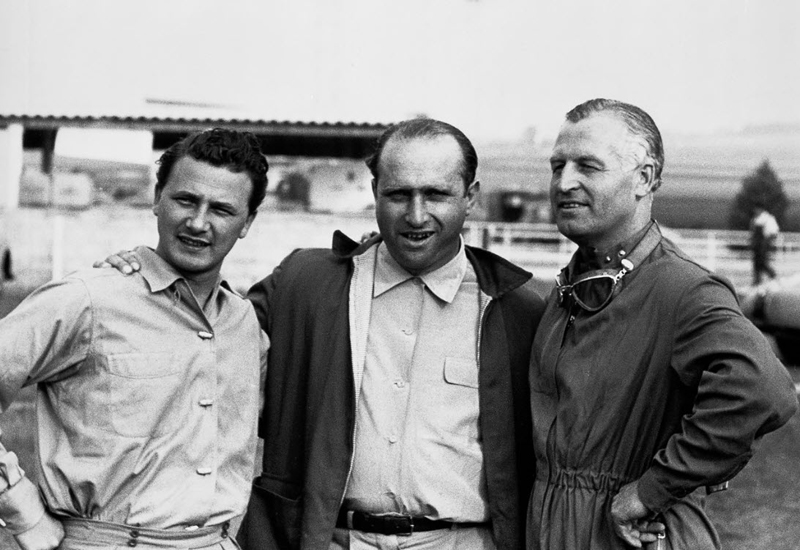
Hans Hermann, Juan Manuel Fangio, Karl Kling
2012 was the 60th running of the historic half-day race, an event Herrmann (seen above with Fangio and Karl Kling) won twice in his career. In 1960, he won at Sebring in a Porsche 718 RS 60 shared with Oliver Gendebien, winning the Targa Florio in the same year. Having raced in F1 with Maserati, Cooper and BRM, Hans also raced F1 for Porsche. Lack of success prompted a move to Abarth.
A few years later, Hans returned to Zuffenhausen. The team struggled with the 906 for a couple of seasons before finding their feet in 1968, with the awesome 908. Hans again won Sebring, this time alongside Jo Siffert.
The following year, Herrmann’s 908 missed a Le Mans win by a very narrow margin. In 1970, the baker from Stuttgart made up for it by clinching the first win for Porsche at Le Mans in the 917, alongside Richard Attwood. The car was one of just seven finishers in a race of total chaos.
Hans Herrmann was 42 when he won Le Mans: an age that many drivers of his era did not live to see. After the event, he retired from racing but continues to attend many European and US events.
Now the grand age of 84, Herrmann’s importance in the history of Porsche should not be underestimated. Nor should the affection he is held in amongst the Porsche cognoscenti: one chat with the major players at the Porsche Museum speaks volumes about how Stuttgart regards one of its all-time favourite racing sons.
Congratulations Hans! Well deserved, and many more besides.
Ferdinand blogs my freelance adventure with Porsche at the centre. To support the blog or engage with me in other ways, you can:
This website uses cookies to improve your experience. We'll assume you're ok with this, but you can opt-out if you wish.AcceptRead More
Privacy & Cookies Policy
Privacy Overview
This website uses cookies to improve your experience while you navigate through the website. Out of these, the cookies that are categorized as necessary are stored on your browser as they are essential for the working of basic functionalities of the website. We also use third-party cookies that help us analyze and understand how you use this website. These cookies will be stored in your browser only with your consent. You also have the option to opt-out of these cookies. But opting out of some of these cookies may affect your browsing experience.
Necessary cookies are absolutely essential for the website to function properly. This category only includes cookies that ensures basic functionalities and security features of the website. These cookies do not store any personal information.
Any cookies that may not be particularly necessary for the website to function and is used specifically to collect user personal data via analytics, ads, other embedded contents are termed as non-necessary cookies. It is mandatory to procure user consent prior to running these cookies on your website.