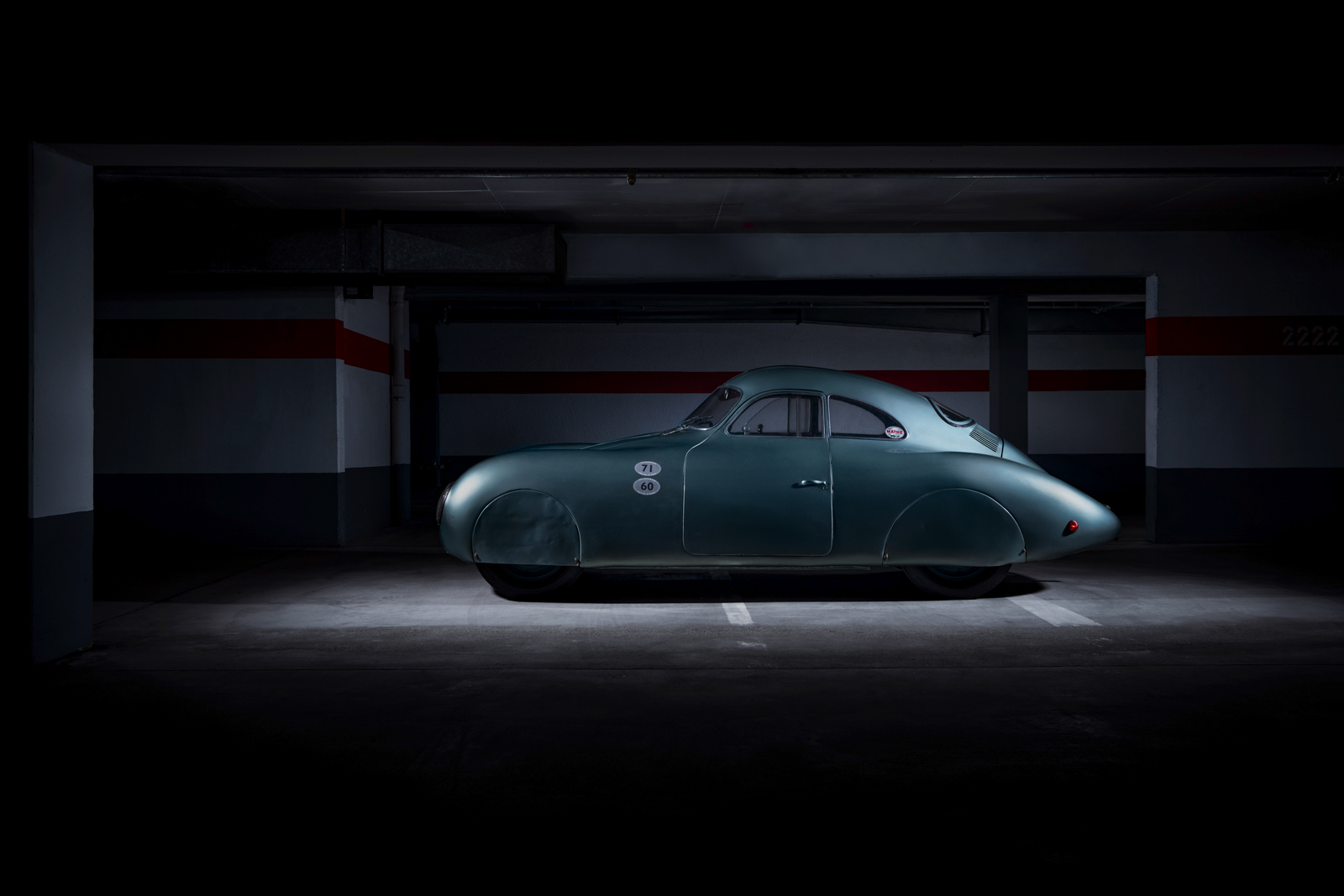
California is set to reassert its credentials as the epicentre of the classic Porsche universe this August, when RM Sotheby’s offers what it is calling the first-ever Porsche for sale at the Monterey weekend.
Sotheby’s refers to the car as “the only surviving example of the Type 64 Porsche and the personal car of both Ferdinand and Ferry Porsche,” but the honorary title is at odds with respected Porsche historian and friend of the Porsche archives, Karl Ludvigsen, who describes this car and its stablemates as Type 60K10s rather than Type 64s. This car is noted by Ludvigsen as one of three 60K10s built in preparation for the Berlin-Rome race, which was planned to run in September 1939. The historian explains things as follows:
“When, in 1941, Porsche compiled a book covering the activities of its first ten years, it conflated the Types 64 and 60K10 under the “Type 64″ heading. Understandably, this has led to confusion for later historians. This author prefers to maintain a clear distance between the two projects, which were in fact distinctly different and played contrasting roles in the Porsche sports-car saga.”
Type 64 Origins
The origin of the Type 64 Volkswagen is well documented. Ludvigsen’s must-have work ‘Origin of the Species‘ describes how, in 1937, “Porsche designers sketched the specifications of another member of the VW family, the Type 64, listed in the Porsche annals as VW-Rekord (Sport)”. However, circumstances surrounding the Type 64 plans were difficult.
Building one-off sports cars didn’t suit the PR tastes of the German Labour Front, overseers of the KdF-Wagen (Volkswagen) project that the Type 64 was based on. Nor would the organisation sell KdF parts to Porsche for the design house to build its own Type 64s. As Porsche could neither obtain the parts or the funding to take the project further, no Type 64s were ever built.
Enter the KdF 60K10
When the first Autobahn was opened from Berlin to Munich, a race was planned for Autumn 1939, to highlight the feat of civil engineering. After sprinting south through Germany along the new highway, the competitors would continue through Austria to the Brenner Pass before racing closed roads, all the way to Rome.
With deliveries of the new Volkswagen/KdF-Wagen scheduled for early 1940, the race was tailor-made for PR. A racing car built on the Volkswagen was now an entirely different proposition, and the Labour Front was now all in favour. Ferdinand Porsche decided that the cars should be built on the standard Type 60 VW chassis with a special aluminium body hand built by Reutter.
Much of the engineering for Type 64 was integrated into the Type 60K10, allowing a short development cycle. The first of three cars was finished in August 1939, with the second completed a month later. The race was officially shelved after Germany invaded Poland the following month, but one more car was finished in June 1940. Based on the damaged chassis of car number one, that is the car being offered for sale.
First-Ever Porsche: The History
Sotheby’s press release tells how “the third Type 64 was retained as a personal family car and driven extensively by Ferry and Ferdinand Porsche. When the company was forced to relocate headquarters to Gmünd, Austria from 1944-1948, it was kept alongside No. 2 at the family estate in the picturesque lakeside town of Zell-am-See. No. 3 was the only example to survive the war, and Ferry Porsche himself applied the raised letters spelling out ‘PORSCHE’ on the nose of the car when he had in registered in Austria under the new company name in 1946.
“In 1947, restoration work was commissioned by Porsche and completed by a young Pinin Farina in Turin, Italy. Nearly one year later, Porsche demonstrated the Type 356 roadster, no. 1, on public roads in Innsbruck, with the Type 64 by its side. Austrian privateer driver Otto Mathé completed demo laps in the Type 64 and fell in love, buying it from Porsche the following year. He enjoyed a successful racing career with the car in the 1950s—the very first to do so in a Porsche product—and kept it for 46 years until his death in 1995.
“In 1997, the Type 64 changed hands for just the second time in six decades and appeared at a handful of vintage racing events with its third owner, Dr. Thomas Gruber of Vienna, including Goodwood and the Austrian Ennstal Classic. Dr. Gruber is the author of the renowned Carrera RS book and one of the most respected Porsche specialists worldwide. Delightfully patinated, the streamlined 1939 Porsche Type 64 is now offered in Monterey from the long-term care of just its fourth owner, who acquired the car more than a decade ago, and is accompanied by many original spare parts, as well as extensive period images and historic documentation.”
Previous efforts to sell the Type 64
Instagram threads on this car throw up a few stories regarding previous efforts to sell it privately. One commenter on the RM thread suggests that Mathé’s guys may have altered a chassis number back in the day (quite common on older Porsches) and classic Porsche dealer, Maurice Felsbourg, commented that “The Otto Mathé car has been for sale by owners for years now. Each time asking price was met, they either raised it or changed their mind. They play golf with Piëch & Porsche, they surely won’t buy it. I hope bidding stalls at €5m.”
Sounds slightly like sour grapes you might think, but it is true that the car has previously been offered to specialists. One contact showed me an email from 2014, when he was offered the car at €12 million. Plenty of people will know about recent efforts to sell and that will influence some bidders. It if often the case that collectors reject the opportunity to buy in open market when the seller has made things difficult behind closed doors.
Whether you call this car a Type 64 or a Type 60K10, assuming the car all checks out, this is the most significant VW-Porsche to come up for sale since the last time it changed hands. Sotheby’s press release says that it could get up to $20 million: we’ll see how that goes.
I first experienced Concorde, the world’s only supersonic passenger plane, while it was training in Ireland. While lunch was in the oven on a Sunday morning, my dad used to take us kids out for a drive. We would usually head for the end of the runway at Shannon Airport, watching Concorde pilots training over the Atlantic west coast and waiting for the 747 EI-104 to come in from New York.
We owned several music shops at the time and also sold TVs, hi-fi and radios. An air-band radio was always in the car, and several friends’ fathers worked at Ballygreen: a big air traffic control centre for the north west of Europe. Hearing familiar voices talking to Concorde pilots as the aircraft flew take off and landing circuits for hours was always entertaining.
In 1978, we flew to Jersey on a family holiday, which involved a flight from Shannon to Heathrow on a BAC-111, then on to Jersey on a Vickers Viscount. The high point of the Viscount flight was when the pilot invited us all to look out the window and watch Concorde take off: the first time I had seen the plane use its afterburners in anger. My dad bought me a copy of the now very collectable Concorde book by F. G. Clarke at the Heathrow shop on the way home: it’s still in the loft at my parents’ house.
In 1989, I left a mechanical apprenticeship in Ireland and returned to London, where I had spent three months working in 1986. I started playing music with bandmates already here and got a job working with a gang of West African car cleaners: they were fun times. My sister and I were drawn back to the airport on weekends, often getting a pizza and parking on the top floor of MSCP 2 in the centre of Heathrow, just to watch planes taking off and landing. I decided that working at the airport might be interesting and came back to the Heathrow job centre on a day off to see what was about. I found a job working with British Airways at Terminal 4 as a valet parker for Concorde passengers.
The job was predictable, with a lot of activity around Concorde’s flight times and quiet periods otherwise. I got to know many interesting customers, who often had time to chat about flying on Concorde. I started clocking up some overtime in the car parks at T4 and was offered a job as a Duty Manager there, running the short and long term car parks for a company owned by an energetic north Londoner. He eventually sold his company to National Car Parks and I was part of the furniture. They gave me an opportunity to move across Heathrow to the long term car parks on the eastern side, by the Concorde maintenance hangars.
Concorde was maintained to a rigorous schedule and the aircraft was frequently moved across the road from the apron to the hangars, so we saw it a lot. The engines were run up into huge concrete diverters, which directed the air upwards over our offices: that was always interesting in the wee small hours of the morning. Eventually I moved again, this time to the central area long terms, alongside runway 27R. My office looked out on the runway, so again Concorde was a big part of life, setting off just about every alarm in our parks when it took off at 10:30AM.
I stayed in long term for a bit and then NCP tendered for the short term car parks in the centre. I ended up running this contract for several years as General Manager and became the first GM to make one million pounds profit for my employers. We built a great team of people, debuted groundbreaking technology and handled some huge operational challenges, but the constant was Concorde: a mad blast of noise at 10:30 every morning for the eight years I spent working at Heathrow.
Having several thousand car parking spaces at my disposal led to buying a lot of cars while I worked at the airport, and it was an easy place to sell cars from also. Heathrow has a huge working population that likes to buy and sell all sorts of items in its spare time, so I built up my trade contacts over three or four years before leaving the airport in 1997 and running my own thing for a while. Sliding into motor trade purchasing in 1998 led down many other trade avenues, eventually exposing me to a rich education in trade valuations: something I am still involved with almost twenty years later.
Concorde stopped flying several years after I left Heathrow, but it remains a big part of my youth. The entire experience of air travel has lost its mystique since the late 1970s and the access to viewing nowadays is a real issue for aviation enthusiasts, but I remember my days around this great aircraft fondly. It was nice to see Porsche sending photographer Justin Leighton down to Concorde with the 917-001, creating some interesting juxtapositions between these two iconic mechanical achievements.
A friend in Ireland has asked me to help find a buyer for his RHD 1971 Porsche 911T, which he has owned since 2013. It is a matching numbers car and has covered an indicated 90,000 miles from new. I have just had the car brought back to England and am offering it for sale on his behalf (now sold – many thanks).
Built in Stuttgart at the end of 1970, the Porsche was sold through AFN and registered as YBH 760J on May 14th, 1971. The history pack for the car shows no details of its early life in the UK, but it ended up having a colour change to red somewhere down the line. In 1999 it was sold by a London garage to an owner in Somerset.
History with that owner shows a series of bills including torsion tube replacement in September 2000, conversion to pressure fed cam chain tensioners in 2001 at 74,500 miles, a new fuel pump and several services. The car covered minimal mileage through to 2003, when it was MOT’d with 75,428 miles on the clock.
The car came back to the market in 2009 and was sold to Brian Kane, a well known air-cooled Porsche specialist at Harmonstown Motors in Dublin. Brian imported the car into the Republic and carried out a detailed restoration, including a conversion to non-sunroof spec using genuine new Porsche parts from the scuttle panel back. There is a huge spread of parts bills right through Brian’s ownership, showing that more than £10,000 was spent on parts alone from 2009 to 2012, with Brian’s labour and other trade services on top.
After several years ownership and enjoyment, the car was seemingly involved in an accident in Ireland at the end of 2012. The parts bill from Porsche Centre Dublin including many genuine panels, a new Porsche oil tank and genuine heat exchangers totalled over €27,000, but an assessor’s report of the time shows the “concours winning car” car had a pre-accident value of €80,000, so the second restoration began on a jig with a Porsche approved repairer. Interestingly, a letter from the insurers in the history shows the damage was not recorded.
This restoration during 2012-2013 put the car back to its original factory silver and into the condition seen here. Bonnet, bumper, front wings, front wing joiners and front pan are all new and rust free. The engine and transmission were rebuilt by a noted Irish specialist in 2017 and prepped for regularity rallying. The car was running on throttle bodies for a time but has now been put back on Webers and runs very well, starting at the first turn of the key. It drove from Dublin to Northamptonshire with no dramas.
The Porsche 911’s rallying history was an important connection for the owner and this car carries a distinct sports purpose theme, with the hood-mounted Cibie Pallas lights painted in body colour over a simple front bumper, the twin-centre exit exhaust and those classic 6 x 15″ anodised Fuchs all round.
The interior was planned as simple T/R spec until the decision came to sell the car, so the interior may be something for the next owner to work on. The leather trimmed steering wheel, dash, seats and door panels are in good order and the seats and original seat belts are as one would expect on an old 911, so they may simply be retained or upgraded. The carpets are original and a new carpet set would give the cabin a lift.
There are a few areas that would yield improvement with a bit of time spent. The engine could do with a new sound pad and detail, a geometry and ride height adjust would be a good idea, I would add an RS bonnet prop as the lights are quite heavy and there is some wiring here and there that could be tidier. But as a vintage Porsche ready to drive, with body restoration and engine and transmission rebuilds all done, it seems a good opportunity to obtain an affordable pre-’73 911 that can be modified and enjoyed.
The car is still registered on Irish plates but it is not a hard job to import to the UK and there should be no duty to pay. Most cars brought back into Britain go back on their original registrations. This one is now MOT and road tax exempt as it is over 40 years old. An MOT may be required as part of the re-importation process. If the car is being exported to further afield, then the paperwork is easily done.
The asking price for this honest 911 is a sensible £54,995 and I am happy to assist potential buyers from the British Isles and beyond. Inspection is recommended and that can be done at the storage facility. The car is stored near Junction 11 of the M40. Drop me an email with any questions.
SHARE • EXPLORE • SUPPORT
Ferdinand blogs my freelance adventure with Porsche at the centre. To support the blog or engage with me in other ways, you can:
The star attraction of the GP Ice Race for air-cooled Porsche enthusiasts will almost certainly be Otto Mathé’s Fetzenflieger single-seat race car with its spiked tyres and succession of Porsche racing engines.
If there was a top ten list of people who embodied the “cult of Porsche” concept, Mathé would be close to the top. His name has popped up on this blog more than once and I never get tired of dipping into Mathé’s history and imagining what life must have been like for this true-blue Porsche enthusiast.
Period photos of Mathé (and his story as a whole) calls the late John Surtees CBE to mind. Surtees was the only man to ever win world championships on both two and four wheels and Mathé’s early life involved racing motorcycles. An accident in 1934 caused the loss of his right arm and motorbikes were out from then on. Rather than being chased away from motorsport, Mathe turned his considerable engineering ability to other forms of racing.
Mathé owned a filling station and was fascinated by lubricant development. As World War 2 drew to a close, Mathé developed an additive that improved the performance of racing engine oils. At a time when Porsche recommended oil changes every 3,000 kms, Mathé is said to have ran his engines for 100,000 kms without changes. Mathé passed his lubricant business on before his death in 1995 and Mathé Universal Lubricant products are still available to buy today.
1952: Fetzenfleiger is born
Switching from two wheels to four after his accident, Mathé’s car racing career went from strength to strength until, in 1952, he unveiled the car which would cement his place in history. Built to Formula Two regulations of the time, the car raced on asphalt circuits, sand and ice, and it was the latter where Mathé truly established his legend. In 1952, Mathé’s special won twenty out of twenty races and he claimed the Austrian championship.
Otto Mathé’s special features handmade bodywork on a tubular frame chassis. Constructed from Porsche, VW and Kubelwagen parts with a super-low centre of gravity, the car weighed less than 400 kilograms. Sources differ on the original power unit: some say 1100cc, others 1500cc, but they agree the engine was Porsche. Mathé mounted the engine in front of the rear axle, fitting a left hand gearshift to overcome his disability, changing gears in corners by moving his body and holding the wheel with his torso.
Fans soon christened the car “Fetzenflieger”. This is hard to translate into English directly, with various attempts relating to Scrap Flyer or Spark Flyer. The nickname comes from the spectacle of the car’s textile side engine covers, which would burn from the flames spitting out of the exhausts, sending sparks and embers flying. It must have been an incredible sight.
Quickly coming to terms with his creation and taking it to win after win, Mathé later upped the ante by fitting a 550 engine with Spyder wheels and brakes in 1955. Some historians believe that this car was subsequently run at Silverstone in 1956 fitted with a JAP engine. Whether or not this is true, it certainly got about, running as an “intertyp” in both Formula and Sport Car events with various parts added or deleted as appropriate.
The Otto Mathé collection at Hamburg Automuseum PROTOTYP
That Mathé managed to race after losing an arm is one thing. That he managed to race and win is another, but to outperform everyone – literally single-handedly – is something truly inspirational. The “Ice King” and his racer went on to win four of the “Prof. H. c. Ferdinand Porsche Memorial Race” events, in 1955, 1956, 1957 and 1959. The car was towed by a spectacular collection of Porsches, many of which were also raced. Mathé’s collection can now be seen in permanent exhibition at the Automuseum PROTOTYP in Hamburg.
The collection includes the MA-01 “Fetzenflieger”, the Cisitalia D46 race car, with which Hans Stuck won the first official German circuit race at the Hockenheimring in 1947, the Delfosse DVD electric racing car, Mathé’s VW T1 “Bulli” as well as the Porsche Type 64 (No. 2) “Berlin-Rome-Wagen”, rebuilt by the Automuseum PROTOTYP on original parts, his DKW Monoposto and his JAP F3 car. Anyone looking for a road trip destination this year would do well to add Hamburg to their list!
photos courtesy of Automuseum PROTOTYP and Porsche AG via GP Ice Race
Flat-out racing on ice and snow returns to Zell am See in Austria this month, when the inaugural GP Ice Race is run on January 19th and 20th. A contemporary re-imagining of the spectacular ice races held in the region from 1937 to 1974, the event is the brainchild of Vinzenz Greger and Ferdinand Porsche, great-grandson of Dr Ferdinand Porsche (1875-1951).
“For more than forty years, spectacular car races on ice as well as skijoring (skiers towed behind cars) fascinated the people at Zell am See,” notes Ferdinand Porsche. “Even before World War I, there was an ice race for motorbikes on the lake. During the 1950s, the event evolved into what we today think about, when we hear about skijoring.
“The first skijoring competition in remembrance of my great-grandfather Dr. Ferdinand Porsche took place on 10 February 1952. Four years later, the event was renamed “In memoriam Prof. Dr. h.c. Ferdinand Porsche”, now featuring ice races for motorbikes and cars. The event was not won by a Porsche – but by a DKW. In a couple of weeks, we will bring back this legendary event from obscurity, newly interpreted as “GP Ice Race”.”
Porsche celebrities from far and wide will attend the event, but, in keeping with the original ice racing ethos, there is no special treatment for the big names. “There are no VIP tickets for paddocks and boxes only for privileged visitors,” said Ice Race ambassador and motorsport legend, Hans-Joachim Stuck. “At our event, the ticket is also really close to the action and the stars.”
Other big names from racing and rallying include Walter Rörhl, Richard Lietz, Marc Lieb, Romain Dumas, Mark Webber, Timo Bernhard and Jochi Kleint. The two-day program features show rides of celebrity riders, traditional skijoring, where skiers are pulled across the snow by racing cars, the competition of current racing and rally vehicles and demo rides of historic motorsport cars such as Otto Mathé’s original Furhmann-engined “Fetzenflieger”, now owned by the Hamburg Automobile Museum PROTOTYP.
Automobile Museum PROTOTYP founder and director, Oliver Schmidt, will be piloting the Fetzenflieger on the demanding track and is already looking forward to the race: “Otto Mathé won this event four times with his famous monoposto in the 1950s, so of course expectations are high! Whether I can equal the performance of the true “Ice King” will be seen at the show rides on Saturday and Sunday afternoon but either way it will be a lot of fun for everyone!”
Zell am See: GP Ice Race Event Schedule
Saturday January 19 2019
11:00 AM Opening event area
12:00 AM Start of the event
1:00 PM GP Ice Karting, Qualification & Day final runs
4:00 PM Show races & specials
4:30 PM Qualification & Day final runs
8:20 PM Show races & specials
8:50 PM GP Charity Ice Karting, Qualification & Day final runs
10:00PM Pit Lane Night
Sunday January 20 2019
7:30 AM Opening event area
8:30 AM GP Charity Ice Karting, Qualification & Day final runs
15:10 PM Show races & specials
15:40 PM Day final runs, Final runs & Award ceremony
This website uses cookies to improve your experience. We'll assume you're ok with this, but you can opt-out if you wish.AcceptRead More
Privacy & Cookies Policy
Privacy Overview
This website uses cookies to improve your experience while you navigate through the website. Out of these, the cookies that are categorized as necessary are stored on your browser as they are essential for the working of basic functionalities of the website. We also use third-party cookies that help us analyze and understand how you use this website. These cookies will be stored in your browser only with your consent. You also have the option to opt-out of these cookies. But opting out of some of these cookies may affect your browsing experience.
Necessary cookies are absolutely essential for the website to function properly. This category only includes cookies that ensures basic functionalities and security features of the website. These cookies do not store any personal information.
Any cookies that may not be particularly necessary for the website to function and is used specifically to collect user personal data via analytics, ads, other embedded contents are termed as non-necessary cookies. It is mandatory to procure user consent prior to running these cookies on your website.