Had an update from my buddy John last week on my California Porsche 911 purchase “The Varmint”: that 1980 Porsche 911 SC I bought off the San Francisco Craigslist. John Holleran had gone over it and decided a few things needed doing to make it ‘basically sound’.
The Turbo tie rods were past it; boots destroyed and binding in lock so they needed changing. The clutch release arm was fouling the SSIs hence the weirdo clutch feeling underfoot, that needed sorting. Most other stuff was OK, all except these oil leaks. Inter shaft gasket looked buggered and the crank seal didn’t seem too happy either, so they both needed doing.
John H estimated 4 hours work, plus parts, plus time to do an alignment which sounded sensible to me so I gave him the go ahead, as well as asking for an oil and trans fluid change. My amigo John also suggested we get some parts to replace some missing interior and sort some door rattles while I am over. That sounds cool to me: there are two great Porsche breakers near him and I am keen to visit both.
The car should be ready some time Monday, so am looking forward to a happy driver’s report next week. I hope the seals fix the oil leak. If not, then it could be the number 8 nose bearing shell/O-ring leaking, which is a different kettle of fish, though the problem often results in just dampness as opposed to a full-blown leak. It’s an engine out & case split job to fix it properly, though I could live with a weep for a few years no problem. Fingers crossed, then.
911 folklore has always claimed that coupes are the only models worthy of the attentions of serious drivers, with Targa and Cabriolet versions simply frivolous range-fillers. I’ve never really bought into this notion, and recently brought an almost-matching pair of Carrera 3.0s together to do a Porsche 911 Coupe vs Targa comparison. Read the full story below!
The Carrera 3 was first introduced for the 1976 model year. While most manufacturers in the mid-70s were still pandering to a chrome-plated public who liked their cars slathered in shiny chrome, Porsche Design unveiled their black-and-colour impact bumper design, which was to prove one of the most enduring styling exercises the automotive world has ever seen.
The understated impact bumper (IB) cars were a Porsche staple for sixteen years, from 1974 to 1989. The durability of the galvanised bodywork introduced in 1976, combined with the sales success of the 911SC, and the 3.2 Carrera, makes the IB style seem almost commonplace these days. But don’t be fooled by the familiar appearance of the pair seen here. Sold for just two seasons, and never exported to the all-important American market, the ’76-’77 Carrera 3.0 is a rare beast, particularly in right hand-drive Targa guise. It’s a privilege to have two such good examples with us today.
In the interest of resetting our current-day complacency with the IB look, let’s put these cars into period perspective. Back then, the average man in the street was driving a Vauxhall Viva or Ford Cortina, so sleek and sexy 911s were unbelievably exotic, costing substantially more than a Ferrari 308. Contemporary supercars, such as the incredible Lamborghini Countach LP400, despatched the dash from 0-60 in about 6.8 seconds; Motor magazine got the Carrera 3 there over a second faster.
The mid ‘70s was a time of great change for Porsche road cars. While the company launched the 924 and 928 models, increasingly tough emissions targets emerged in the critical US market. The new standards meant that, though the less powerful 2.7 911s passed the legislation and could be sold in America, the 2.7 Carrera with its mechanical fuel injection could not, creating a performance gap which did the 911 brand no favours. Keen to wring every last sale out of the 911, but equally keen to keep development costs down on a car that was supposedly coming up for the chop, Porsche began to look at ways of updating the existing range-topper for not a lot of money. The result was the Carrera 3.0.
Porsche 911 Carrera 3.0 explained
For the engine, the lightweight six-bolt 2.7 Carrera crankshaft was retained, carried in an aluminium rather than a magnesium crankcase. Aluminium had been tried and tested on the Turbo, and borne the strain of the bigger 95mm Nikasil-plated cylinders plus boost pressure. So the same case and cylinders were used on the C3, increasing both capacity and economies of scale.
Bosch K-Jetronic injection was chosen to supply the fuel. K-Jet doesn’t like aggressive cams or rorty valve timing, and the intake is restrictive compared to MFI stacks, but it is much more efficient than the mechanical system, an important factor in a world which had not forgotten the 1973 oil crisis. The system was also cheaper than MFI, which greatly appealed to cost-conscious management.
Porsche 911 K-Jet Bosch CIS injection
To counteract the performance downsides of K-Jet, Porsche fitted slightly larger valves and designed a new camshaft that was to last almost 14 years, up to the end of the 3.2 models. These changes brought engine output to 200 bhp, ten short of the outgoing 2.7 Carrera, but with better economy, lower emissions and identical torque peaking lower down, dramatically improving flexibility. The Carrera 3.0 was almost 5 seconds faster from 25 to 50 mph in top gear than the 2.7 Carrera it replaced.
As a low production model, which led the transition from the 210 bhp 2.7 Carreras to the sturdy but slower 3 litre SCs, C3s have always been a little misunderstood; something of an acquired taste. But few cars in this price bracket give anything like the same satisfaction.
Porsche 911 Coupe vs Targa comparison
Porsche racer Carlo Bonetti, owner of the spotless Grand Prix White Targa seen here, is a self-confessed C3 addict. There are five sets of 911 keys hanging up at home, with two fitting the locks of three-litre Carreras. Bonetti began his motor racing on motorbikes, until a series of accidents led wife Toni to insist on something safer. Caterhams beckoned, followed by a short hop into 924 racing. The next season saw him in a 3.2 Carrera, competing in the Porsche Club championship.
Carlo’s opposite number today is Mike Horsburgh, owner of this beautiful 1977 Carrera 3.0 coupe, his first 911. Mike’s car was extensively concoursed for a few years by a previous owner, before a friend managed to prise the cosseted coupe away from its devoted caretaker. Mike came across the car while looking for an unmolested example. Other previous owners include Keith Ripp, of Ripspeed accessories and rallycross championship fame.
Looking at the cars in detail, it is interesting to note the number of features unique to these models. One Carrera 3 engine trademark is the five-blade engine fan, seen on both of these cars. Fitted with a different pulley, it ran the alternator at a slighter higher speed, but the yang to this ying was an adverse effect on outright cooling power in warmer climes. The 11-blade fan would make a comeback on the SC, and switching to the 11-blade model is a popular alteration on ‘76/’77 Carreras.
Other early IB touches on these cars include the lack of side repeaters, giving an uninterrupted sweep down the flanks, and the single side mirror on the coupe, the passenger mirror being an option at the time. The coupe features the very rare C3-only alloy and fibreglass tail, now highly sought after. This Targa runs the purposeful one piece rubber spoiler, fixed to a steel engine cover. The solid chunk of black, with its exaggerated rear lip, sits well against the immaculate Grand Prix White bodywork.
The cars feature quite a few parts no longer available from Porsche, and eye-wateringly expensive from those who still have stock: the classic “periscope” headlamp washers on Mike’s coupe, for example. Later impact bumpers were fitted with flush jets as on the Targa, but the early jets are an age-defining feature. £200 a pair, thanks very much.
Beneath the svelte bodywork, mechanical rarities abound. Early C3s had a now hard-to-find fuel pump, using a side outlet, rather than direct flow. With replacements costing over £700, any fuel pump noise should be regarded with suspicion. Smaller differences include a unique fuel filter arrangement on ’76 Carreras, one of many subtle changes made from ’76 to ’77. Carrera 3.0s also use early-style rear anti-roll bars in 18mm diameter, and these bars remain highly prized.
Some of the interior parts for these cars can also be very difficult to locate. The thick-rimmed steering wheels seen here have long been on the rare side, made even rarer by the fact that the spokes have a habit of cracking at the rim – an expensive repair involving welding and a retrim. Early sports seats as fitted to both these cars are also gaining in appreciation. The correct versions for Carrera 3.0s are identified by a Recaro-logo’d knob controlling backrest angle, as opposed to a turnwheel on later examples. Other rare parts include the Targa sunvisors, which explains the rather puffy appearance of these ones. “They’re certainly original,” says Carlo, “but when I find suitable replacements, I’ll be changing them.”
First keys in my hand are those of the coupe, so I settle in to the supportive driver’s seat and twist the knife of life. The engine fires instantly and we’re off. Mike’s car might be familiar to some readers, as it features in Peter Morgan’s reference book, “Original Porsche 911”. The feel behind the wheel should also be very familiar to anyone who has ever driven an impact bumper; the cockpit and controls are pretty much identical through the years and, whatever old road tests say about the absence of ergonomics, everything falls readily to hand.
A few things jar, though not excessively. The speedometer is rotated anticlockwise, for better visibility of the upper register, something I have never felt the need to do myself. The rev counter is a lower-redlined replacement, and the centre console, introduced for the 1977 model year, frustratingly obfuscates the otherwise flat floor, a mild frustration which continues as the engine warms up, and we go a little faster.
That glorious motor is the whole point of the Carrera 3 – were it not for the engine there would be only detail and weight differences between these and the later SC. Though the identical three-litre displacement suggests similar potential, driving C3 and SC back-to-back reveals quite a different character. The Carrera’s smaller crankshaft, and the lightweight magnesium-cased transmission of early examples, imbues the drivetrain with a zestful zinginess that is somewhat muted on later three litres. That excited energy is all but non-existent in the 3.2 Carrera and, in my opinion, denotes a new paradigm in the flat six ethos. Over three litres, the engines just don’t rev as thrillingly.
Mike’s Carrera 3.0 is equipped with opening rear windows, or ‘pop-outs’ as they are known, in rare and attractive anodised black. Combined with the centre-vent dashboard, they are extremely effective in ventilation, and add immense character to the soundtrack when open. Their deletion on the 911SC was to the coupe’s distinct detriment.
Slicing through the gears, the speedo soon reads a jaunty-angled 90 mph, but the Carrera is not quite as settled as others I have tried. I suspect part of the reason may lie in the car’s concours past. Despite its 116,000 miles, not much has been changed since it left the factory. It also runs Pirelli P600 tyres, which I admit to disliking on 911s, especially in the wet. I get the feeling that a session of corner weighting would make a big difference to the fun offered by this special example, but Mike is loath to tweak the almost time-warp coupe beyond stock. I understand, but still can’t help thinking that a quick corner balance would be money well spent. Having the weights, heights and cambers set properly would get the car working its tyres to best effect, and release ever more of that C3 righteousness.
Though the Targa has covered fewer than 70,000 miles in 32 years, substantial 911 experience on road and track has taught Carlo the importance of fettling in getting the most out of these cars. The Targa is fresh from re-commissioning after many years of covering under 800 miles per annum. As part of the overhaul, Bonetti had the rust-free bodywork repainted by APM Autos in Bradford. The 450-mile round trip demonstrated considerable faith in their workmanship, faith which has been well placed.
Targas are sunshine cars. Even today, when the skies over Silverstone are darker than a David Lynch film festival, unclipping the Targa’s folding roof is like a sun-filled fissure cracking through the clouds. To my eyes, the car’s appearance improves many times over without that slab of flat black vinyl killing the comely curves, the shapely rear glass emphasising the absence of heavy metal.
Lack of torsional rigidity is often cited as a major Targa downside, but this is not as true as some would have us think. Let’s not forget that the very first Porsche was a roadster, so the company knows a thing or two about roofless engineering. No strengthening was required to transform the 911 from roofless coupe to Targa; the hoop and its fixings are the only additional metalwork. Compliance placed in the chassis at source, via softer suspension components, has often been incorrectly credited to the lack of a fixed roof.
When Car and Driver editor David E Davis drove an SC Targa, he memorably said: “There is a hard-to-define “rightness” about this car, inside and out. It’s tight, solid and apparently very well put together.” This low-mile Carrera 3.0 Targa makes me feel the same way. On the road with the roof off, it is solid and squeak free. The chassis feels light and responsive, even on the wider 7 and 8×16-inch Fuchs wheels, shod with chunky Contisports. The senses are assailed through the open top, engine bursting with enthusiasm for the winding Northamptonshire roads.
This Targa inspires confidence, more so than the coupe. Much of this is undoubtedly in the suspension set up, but even with all things equal, the Targa is not the soft option some assume it should be. My own Carrera 3.0 coupe is a great drive, but there is no vast dynamic chasm between it and this Targa on the road.
Bonetti has direct experience of the Targa versus his Copper Brown C3 coupe, and says the only differences are wind noise and weight. “I push my cars in and out of the garage, rather than running the engines for ten seconds a time, and the Targa is a little harder to shift. The additional poundage is evident on the corner balance scales.” The plus side of those few extra kilos is that the roof comes off, giving a fuller sensation of speed, space and inherent eagerness.
The impression of space is not an illusion. Targas benefit from increased headroom, especially in the rear; a boon when carrying older children. The lack of a fixed roof is a plus for taller drivers, when wearing helmets on track, for example. As another Targa fan pointed out, his golf clubs can enter the rear via the open roof, adding to the practicality.
What is ironic is that, when talking to Targa owners, the car’s appearance is rarely mentioned; it is usually coupe owners who make a bit of a song and dance about the Targa’s looks. In a straw poll conducted on the impactbumpers.com forum, most anti-Targa sentiment expressed was on a purely aesthetic basis, perhaps the only possible objection to a well-maintained Targa used in normal, day-to-day pleasure driving.
If the classic coupe roof line is paramount in your passion for the 911, then a tin top is what you must have. However, if your agenda is slightly wider, and involves an entertaining drive which brings the early 911 experience vividly to life, do not deny yourself the opportunity to try the Targa. The decision is not as black and white as one might think.
This piece was a lot of fun to do: two 911-owning brothers from Birmingham, who had developed their cars in tandem but approached from different angles. I think it came out as a good read and the boys love it.
Sibling Rivalry
When car-crazy brothers modify sibling 911s, there’s bound to be some rivalry. Ferdinand Porsche writer, John Glynn, decides whether someone should be sent to their room.
Born in Wolverhampton in the West Midlands, Shirish and Anil Patel are brothers; youngest of five, two years apart. I’ve known both for a few years now, and they are a credit to good parenting: intelligent, well spoken and always immaculately turned out (you can stop reading now, mum).
Like many brothers, it was while they shared a bedroom as kids that their mutual fascination with classic cars kicked off. Also like many brothers, neither will say who started it. “It was always there,” Anil declares. “Dad was a Ford man, devoted to Cortinas. With the blue oval as household badge of choice, we were RS crazy, and the walls were plastered with hot Escorts and Capris. We knew about 911s, but were never Porsche obsessed. The 911 thing didn’t happen until years later.”
Older brother Anil was first to bring a Porsche badge to the party. “I was looking for a classic car up to £10K, and thought an Alfa Romeo might be the way forward. Searching a few dealer websites, I found 911SCs lined up alongside the Alfas. I hadn’t considered 911s affordable, so I started digging about, to see what I could find. The first few trade cars I saw were ropey at best, so I increased the budget and started looking at private examples.”
This 1987 Carrera Coupe in shimmering Diamond Blue is what he ended up with. “The seller was a farmer who’d owned the car for ten years. He loved it but hadn’t really been using it, so the mileage was fairly low. I’d already looked at a 25th Anniversary Carrera in the same blue and liked the colour, so the paint was a plus. The owner had changed the registered colour of this one to grey as he was convinced that, were it ever stolen, the police would never find it if they were looking for a blue one.”
The bizarre logic did Anil a favour. The reluctant seller’s lacklustre ad for an old grey Porsche, being sold due to lack of use, had aroused little interest. Big brother bagged a nice G50 Carrera in his favourite shade for sensible money.
Shirish’s path to Porsche ownership was a direct result of driving the new arrival. “When Anil said he’d bought a 911, I shot straight over for a spin. After I’d had a go, no way was I missing out.” It took almost a year for Shirish to find the right car: a minty fresh Carrera Club Sport. Though the boys were clearly enjoying their shared interest in Stuttgartian sporting elegance, the rest of the clan didn’t quite understand.
“No one else in our family is all that fussed about cars,” says Shirish. “When Anil and I started getting into 911s, the age of our steeds caused some consternation. My mum asked, “why an E reg, why not buy a newer one?” They weren’t aware of how well older Porsches held their value.”
The Club Sport lasted a couple of years, before London life took its toll, and the absence of a garage for the cherished 3.2 forced Shirish to sell. An Audi RS2 filled the vacant parking space. The Polar Silver 4wd estate, a Porsche in all but silhouette, was a blitzkrieg-wagen par excellence, but the lure of the flat six never faded. The RS2 was eventually advertised for sale, only to be stolen the same weekend. It was found crashed and burnt out a few days later.
Losing the RS2 convinced Shirish that, without secure parking at home, another big-money Porsche was not what was called for. Anil had started playing about with his car, taking bits off and trying new stuff, so Shirish followed his older sibling’s example and decided to go for something more affordable, a car that could be customised with a clear conscience.
First registered in August 1987, Shirish’s Granite Green Carrera predates its Diamond Blue brother by eight months and a day. The owner admits the dark metallic shade had sold him on the car before he ever saw it in the metal.
Side by side here on the beautiful Berkshire Downs, the colours of these sibling Carreras compliment the landscape, and each other. The diamond hue harmonises with the hazy purple horizon, while the green melts into the subtle tones of this earthy environment.
Diamond Blue and Granite Green were both introduced with the G50 transmission for the 1987 model year. They stayed on the menu during 1988, before Granite was dropped for 1989, the final year of the impact bumper cars. I confess to being a big Diamond Blue fan. Its silvery sleekness shifts in sunlight to be sometimes sky, sometimes slate but always seductive over the curvaceous flanks of a classic Porsche.
As noted earlier, Diamond Blue was the colour chosen for the Anniversary Carreras, built to celebrate 25 years of the 911. The cars featured ruffled leather seats in purple (in reality more blue than purple), headrests emblazoned with Ferdinand’s signature, and thick Silver Blue carpets throughout. On body-coloured Fuchs, the Anniversary cars are an attractive package, though Anil and I agree it’s a while since either of us has seen one in genuinely nice condition.
The younger car’s bodywork is in good shape, following a bare-metal respray last year. Anil chose a recommended bodyshop in Reading to do the work, but is not best pleased with how it has worked out. One or two spots on the car are showing clear signs of poor preparation – frustrating having spent a substantial chunk of cash. He’d like to take it back and get it sorted, but who wants to send their pride and joy back to the crowd who messed up in the first place? I know where he’s coming from.
Still, the car looks amazing. The silver bonnet badge sets up a smooth theme that flows, through the front fog and headlight washer delete, to the deleted rear wiper and badgeless rear end. The bright-petalled 16-inch Fuchs work well with the colour and the ride height, emphasising this Porsche’s thoroughbred profile. The whale-tailed engine cover cements the flowing motif. This car looks fast, even when parked.
Big brother has made a few changes since buying his Carrera back in 2001. Bilstein HD dampers were one of the first purchases, but the suspension is otherwise pretty stock. New Neatrix bushes sit in the spring plates, with standard torsion bars all round. The front end features turbo tie rods, an ERP bump steer kit to correct steering angle on the lowered ride height and a Steve Wong strut brace, replacing the previous Weltmeister. The car was lowered by Steve Bull in Devizes and aligned by GT One in Chertsey.
Anil believes in evolution not revolution, and changes in the engine compartment are true to that philosophy. The ECU received a custom Steve Wong chip, with Magnecor plug leads taking the sparks to the internally stock powerplant. Drilled airbox, Club Sport engine mounts and a rear heater blower delete pretty much covers it in here.
Underneath, the exhaust has been modified with a H&S crossover, pre-silencer and silencer, but Anil is not convinced that this setup was the right decision. “You can’t do the valves without taking the exhaust off. This adds to the cost of servicing, plus I’m not sure about the additional heat on the heads. Also, we recently discovered the gaskets they fitted were handmade efforts with holes the size of 2p pieces – nowhere near big enough.” The restrictive metal gaskets physically melted under the pressure; factory parts now seal the joints. Finally uncorked, the car runs a lot better, though further engine developments are on the cards when top end rebuild time comes round. A look in the back of baby brother’s motor gives us a clue.
Shirish’s second 911 was sourced through an independent marque specialist. Following a litany of post-purchase issues, he’s been left unimpressed by the dealer experience, but money spent in the right places has since brought the car on leaps and bounds. The main reason for the gaping chasm in SP’s deposit account is hidden from view: an engine rebuild to 3.4 litres that was done by Winter. Steve Winter that is, at Jaz in Wembley.
Soon after taking ownership, the 3.2 was found to be using a litre of oil every 800 miles: time for a top end rebuild. A 3.6 transplant was an option, but that is not so much building as swapping, and the costs only make sense if the 3.6 never goes bang. Shirish took the decision to keep the bombproof 3.2 bottom end, and increase capacity with a big-buck Mahle 3.4 conversion.
Anyone who has ever investigated this upsize knows one thing: it’s not cheap. Consider the cost of putting an upstairs on a bungalow, relative to the value of said bungalow, and you’re in the right ballpark.
Build time for the mega motor was initially estimated at two weeks. The case was leak free, so the decision was taken to leave it together, refurb the heads and assemble the new parts. Two weeks became six and, in hindsight, Shirish would rather have split the case and balanced the bottom end.
Brand spanking Mahle pistons and 98mm barrels were not the only bits little brother bought. A pair of Dougherty Racing DC20 cams were found, and a 3.2 throttle body was bored out 3mm to increase the charge at wide open throttle. A lightweight starter was added, as well as Club Sport mounts and an upgraded K3 alternator. The list goes on.
Smart Racing valve springs, 993 head studs and rod bolts, refurbed injectors, new ICV and crank sensors, gearbox sensor, oil pressure switch, new seals everywhere. The transmission was given a lift with the G50 clutch fork mod, and new master and slave cylinders. The clutch was replaced with a 930 clutch disc, new release bearing and a Kennedy lightweight aluminium pressure plate.
Mothy heat exchangers and crossover pipe were replaced with standard Porsche items, flowing into a Scart pre-silencer and a DP Motorsport muffler. The engine fittings were replated, tinware was replaced and powdercoated, and new rear wheel bearings were the final while-you’re-in-there. Phew!
As the car arrives at our meeting point, the sound is impressive; the engine exudes unadulterated authority through the chunky DP silencer. This muffler is heavy – Shirish reckons 12 kilos – but the noise is anthemic. So it should be: new ones cost circa €1200.
The chorus of both cars on the move is intoxicating. The 3.2 has a lighter tone than its bigger brother; the sweet spot of that air-cooled thrum meets the eardrum lower down the rev range. The 3.4 is understandably louder through its bigger pipe, but volume is not the main ingredient. The DC20s lend a bass heavy burble to the tune played at tickover which carries right through the revs: it’s racecar sound at sensible decibels. At wide open throttle, it rocks the casbah.
Shirish loves the noise it makes, but he has not really heard it yet. Just as an acoustic guitar is never properly heard by the guitarist (the sound exits away from your ears, set behind the sound hole), so the sound of a 911 can only be appreciated when standing behind it. Now curious, he hands me the keys and I take off.
Take off is the right expression; this is a rocketship. I am expecting the bigger capacity to slow the revs down, but the reverse is true. Similar piston area with a slightly lighter rotating mass means the motor spins like a cartoon Tasmanian Devil. Flooring the throttle, I quickly hit the limiter in one and two: it revs that much faster than my Carrera 3.0. What the owner has spent is immediately justified by what has been gained: this missile is ballistic.
In a few seconds, I am knocking on big speeds and wishing Shirish had never swapped the tail for a flat lid. Standard ride height and all-original suspension means this new-found grunt really gives the chassis something to think about, and the underpinnings are the next job on the list. The engine was recently remapped, making 269 flywheel hp, but that’s unlikely to be ultimate power. With the engine and suspension upgrades Shirish has planned, this car will be off the scale.
Anil’s car might have fewer horses pushing it along, but a sharper, lighter chassis and highly effective brakes means that what it loses on the straights, it makes up in the bends. The middle pedal benefits from new calipers and genuine discs front and rear, with Goodridge lines and ATE fluid working Porterfield R4-S pads.
Both cars run Bridgestone SO2s on their 7 and 9 x 16-inch Fuchs, with 225/50s on the rear of the green car as opposed to 245/45s on the blue. On these slightly damp country roads, I can discern no difference.
Driving Anil’s car is a delight: gorgeous red-backed Recaros from a 968 Club Sport and a Martini Racing Momo wheel give the Carrera real sporting comfort. Deleting the electric seats and internal sound deadening removed a lot of weight, and the RS carpet set and door panels are pointers to more purposeful intent. Big brother will receive the same treatment some day soon.
Apart from the Momo steering wheel, the red-piped grey-green sports trim of Shirish’s car has rightly been left unchanged. RGA in Vauxhall recently resprayed one side of the Carrera, partly thanks to an errant Land Rover driver. A new near side wing and fog delete front panel, smooth engine cover, work to the passenger B-post and fresh paint over the lot cleared out what was left in Shirish’s piggy bank. The driver’s side will be done when funds are replenished. “No rush,” says Shirish, “Anil and I have plenty to keep us busy in the meantime.” ‘Us’ is the operative word.
On the subject of rivalry, the great Luciano Pavarotti once wonderfully observed: “The rivalry is with ourself. I try to be better than is possible. I fight against myself, not against the other.” The same can be said of so many of the brothers I know who share this love of classic cars.
My own younger brother lives in another country, but his friendship, support and opinions are very important to me. So it is with Anil and Shirish. If there is rivalry, it is low key and outside the core relationship; differences are accepted with mutual respect. This is brotherly leapfrog; co-dependence based on the realisation that the key to all successful friendships is to keep them moving forward. If there’s a better case to be made for sharing classic Porsche ownership, I’ve not seen it yet.
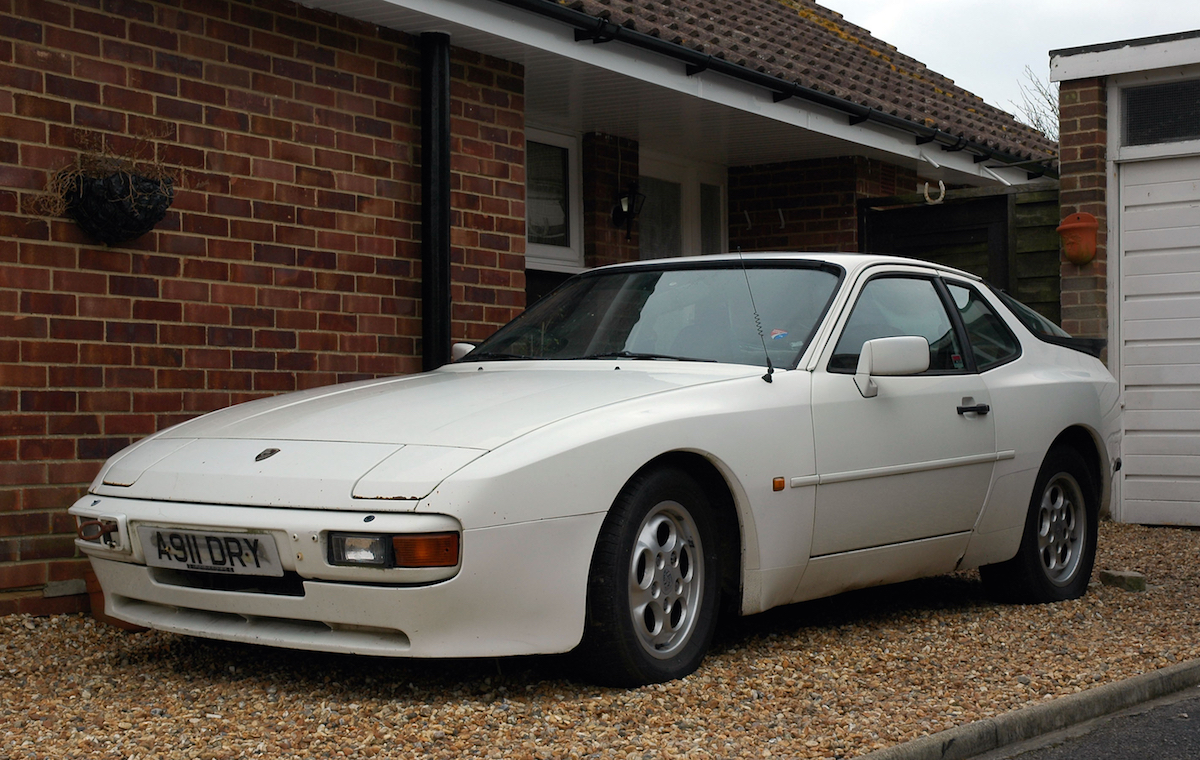
I picked up my latest bargain last weekend: a classic Porsche 944 restoration project. The eBay description was short, sweet and very accurate.
I have owned this car for 15 years. It has not run for 10 years. It has been garaged for 8 years. It needs a total new interior, new tyres, new brakes. We were told by a mechanic that the engine turns over but it needs a new E.C.U. unit. The body is in good condition for the year. It has all original service pack etc. and an excellent number plate: A911 DRY, which I am told is valuable. The car is white. The car will need to be transported by the successful bidder.
I collected the trailer from Rob on Saturday evening and left home, destination Pagham, at 5am on Sunday morning. The M40 and A34 were clear, so 90 minutes later, I stopped for a coffee at Tot Hill services, just south of the M4. Tyre pressures checked and lights cleaned we were back on the road, but I immediately noticed a vibration from the truck that I couldn’t pin down to a corner, and the fuel started to burn faster.
The end of the road was 65 miles away, so I kept going, stopping a couple of times to check my tyres weren’t overheating and/or delaminating. I reached Pagham at 8am and found the house. Passing the car on the way to the front door, I could see the trim was absolutely destroyed. Not a disaster but not too attractive either. The 911 DRY plate looked even better in real life, so there was no doubt that I was taking the car.
Steve (the seller) opened the door and we settled down for one of those conversations that quickly turns into two guys who could have known each other for years – the parallels were amazing. The car was his son’s, but Steve was handling the sale as the owner was abroad most of the time. They had bought the car back in the early ’90s from from Nick Faure, who was a friend of the family. The plate came later.
Steve was a very famous guitar player back in the day, before moving into the motor trade, so we had lots to talk about, and we did. After our tea, we went outside and loaded up. Once A911 DRY was on the trailer, we did the paperwork and I was gone, promising to return when the car was back on the road.
The drive home was laboured. The truck was shaking quite obviously at certain revs and the car was a little far back, so I stopped at Sutton Scotney services, rechecked the tyre pressures on all three units and slid the car up a touch – was much better over 60 after that. A quick look up the skirts of the 4runner revealed that the vibration was the prop UJ failing, causing the prop to bind slightly, dragging the engine down and pushing the fuel consumption up. Another job on the list. As we are stuck for space at home, I dropped the car at the farm, handed the trailer back and came home to finish the deal on a paraffin heater I had sold on eBay.
I hadn’t spent any time looking at the car before I picked it up and, though the inside is beyond distraught, the body looks good. Though it has been parked for 10 years, the car has only done 88K miles from new and there is plenty of service history (the book pack is mint). The brakes are completely seized, but off; not on. The exhaust, tyres and clutch etc are likely to be well past it, but I will buy a good runner with a test and a knackered body and swap what I need over, fitting power steering at the same time.
I am looking forward to getting this on the road, looks great and deserves to be in use – early 944s have to be worth keeping when in this sort of condition.
The impact bumper Porsche 911 model series generated more landmark cars than any Porsche model range before or since. Ferdinand Magazine’s John Glynn gathered ten excellent examples together for a back-to-back test group.
The story of the impact bumper Porsche 911s is often told in derisory tones. Faced with unavoidable new safety and emissions legislation in the critical American market, Porsche apparently ruined its rear-engined rebel by fitting chunky bumpers and clunky fuel injection, exorcising the soul of the machine in the process. Nothing could be further from the truth.
Rather than emasculating the much-revered original, the impact bumper (IB) cars built on the appeal established by their illustrious predecessors, and went on to achieve great things in their 16-year lifespan: spreading the Porsche gospel to a much wider audience, and pulling the 911 back from the brink of extinction. Our journey begins in March 1974, when the immaculate Orange 911S seen here was delivered to its first owner.
From 1974, the standard production line-up went from entry-level 911, to 911S and Carrera, rather than the T, E and S of previous years. All engines on offer for the 1974 model year displaced 2.7 litres, and the increased capacity meant more power. The 150bhp base 911 had 20 more horses than the 911T, the mid-range 911S had 175bhp against the 2.4E’s 165, and the 2.7 Carrera used the same 210bhp 911/83 engine as the classic ‘73 Carrera RS.
Retaining mechanical fuel injection on the 2.7 Carrera meant that, due to stringent new exhaust gas legislation, the car could not be sold in America. Instead, the company were forced to fit pollution-complaint detuned S engines to Carreras sold in the USA, until the model was eventually phased out in 1975.
The new 911 and 911S engines used much cleaner Bosch K-Jetronic fuel injection, but they were not the first 911s to do so. The Continuous Injection System had also been fitted to the last US 911Ts, the so-called 1973.5 cars. K-Jet was a great leap forward, giving better economy and lower emissions and, with the 1973 fuel crisis still fresh in peoples’ minds, K-Jet ensured that the ’74 cars remained an attractive ownership proposition.
Attractive is a word not always used to describe the impact bumper cars, but the clean profile created by the curved aluminium bumpers agrees with me entirely. While most other manufacturers struggled to integrate the new American legislation on minimum bumper heights, Porsche pulled off a design coup that still looks crisp, well over thirty years later.
1976 Porsche 911 Carrera 3.0 Coupe
First-year IBs predate the galvanising introduced during 1975 and 1976, and many have succumbed to the vagaries of rust; historically low values endearing them to precious few saviours. As a result, the 911S is now an increasingly rare and valuable car on this side of the Atlantic. Neil Thackray’s stunning 911S has recently completed a thorough nut-and-bolt restoration. The car also featured on the front cover of the Haynes manual (the blue version), so we are truly in the presence of greatness.
Neil’s 911 is perfectly painted in colour number 156, known simply as ‘Orange’, and the restoration is a work of art. From the orange-edged floor mats, to the rare and unusual right-sided rear wiper linkage, every detail is beautifully measured: clean enough to know it has been attended to, but not coated in overkill. Peter Andrews, here in a lovely Yellow 2.7 Carrera, remarks upon the “earliness” of the pristine Porsche, and the subtle steps involved in the transformation from early to impact are revealed. The same is true behind the wheel. Even with a running-in rev limit, driving the box-fresh ’74 feels very similar to an early car, with one real difference: the seat height.
Popular opinion suggests that the change from early to IB had a substantial impact on weight, turning cream cracker into dumpy doughball. This is not the case. The bumpers and their mounts added modest ballast to the tub, but slimming the battery count, and swapping steel trailing arms for aluminium mitigated the increasing girth. New seats were also responsible for a reduction, at the expense of a slightly higher driving position. Thanks to these weight-saving solutions, the early impacts were only negligibly heavier than their pre-‘73 equivalents.
It’s time for some cornering shots, and top of the list is the exceptionally original Light Yellow Carrera, currently for sale through Peter’s company, Transend in Cambridgeshire. The flat six snaps instantly into life, the exciting pulse of the 2.7 RS engine amplified through a pair of SSI heat exchangers, and a lusciously rakish bark echoes through the woods surrounding us.
The Hairpin Company’s Neil Dickens and I exchange wry smiles as, last time we met, Neil was the proud seller of a Lime Green ’74 Carrera that made the same raucous racket, and he recently filled the space left in his showroom with another 2.7, this time in Black. To say Neil likes these cars is an understatement.
Peter’s wife, Litte, is just as enthusiastic when it comes to the 2.7s, likening the Carrera to her early 356. “They both feel so alive and exciting”, enthuses Litte. “I love driving this 911: it is such a comfortable, usable car but also, just so fast”. I agree it is impossible not to instantly warm to the car’s go-anywhere, race-anyone character, and I briefly daydream a lap around Spa in the custard Carrera.
Jack Wilson jolts me back to reality, with a jangle of the keys to his Carrera 3.0 Targa. Introduced in 1976, the Carrera 3 ran for just two years: two years during which it established quite a reputation. Autocar eulogised its “horizon-grabbing acceleration”, and Auto Motor und Sport found the car notably quicker than the 2.7 Carrera it replaced: a full two seconds faster in the fourth-gear charge from 50-120 km/h.
Fellow C3 owner Jack has enjoyed this gleaming Silver Targa for an amazing 21 years. As with the 2.7, the ride quality is comfortable but not soft, though the Targa feels less direct on turn-in for hard corners, due perhaps to the bigger 16-inch Fuchs on original tyres, the slightly taller ride height and the moderately heavier bodyshell. The rebuilt engine pulls every bit as well as expected, and the familiar forward thrust available under my right foot is absolutely addictive.
In 1977, the normally aspirated 911 range was reduced to one model: the 911SC. Despite glowing reviews, journalists began writing about the 911’s future in distinctly funereal tones. Concurrent to calling the SC “an exercise in driving euphoria”, Car and Driver decided “there can’t be many too years of life left in the 911 series.” Car editor Mel Nichols said “I won’t be among those who mourn when the 911 finally is no more”, and Wheels declared, “the 911 belongs to another era, so let’s put it out to pasture before it breaks down.”
Porsche had made no secret of plans to scuttle the 911 in favour of the 928. But when legions of loyal fans kept SC sales firmly afloat, the company had to concede the error of its ways. Once 911 development was resumed, horsepower began to climb, and when the 204bhp motor was introduced in 1981, the SC finally had more power than its predecessor.
Famous for bulletproof reliability, and exceptional value for money, the SC is a regular route into 911 ownership, and both of our SCs were bought as first 911s. Though SC prices are rising, Marcus Dullea’s Minerva Blue ’79 Coupe is a great example of what can still be found for reasonable money. Marcus bought this left-hand drive non-sunroof coupe a few months ago for just under £8,000, an absolute bargain for such a clean car, albeit with a few small jobs to do. Behind the wheel, the SC is a delight to drive. Though not quite as savage through the gears as the C3, the magical motor is awash with grunt, pulling cleanly from tickover revs in top gear.
Offered for just one year before the 3.2 Carrera replaced the SC, the simple, lightweight SC Cabriolet is a driver’s car par excellence, and the model was sold out two years in advance. The punchy 930/10 engine gives a sub-six second 0-60 time and, as Georg Kacher said when he drove the Cabriolet for Car magazine, the car puts you “at the very core of fast motoring”. Having owned my Grand Prix White example for almost four years now, covering many memorable road trip miles, and even a track day or two, I couldn’t agree more.
IB evolution continued with the introduction of the 3.2 Carrera in 1984. The new car boasted more power, thanks mainly to higher compression and Bosch Motronic engine management, which again upped the bar for emissions and economy. The 3.2 was initially offered with the 915 gearbox, which had been fitted to 911s since the Carrera RS, but 1987 saw the introduction of a new gearbox, the G50.
915 versus G50 is one of the age-old IB debates. Both my cars have reconditioned 915 ‘boxes, and I delight in their use, but there is no doubt that the later transmission offers a slight improvement in shift quality. The G50 is not without its own set of issues: clutch fork problems (for example) have been addressed on some but not all cars, and G50 synchros can wear just like any other gearbox, so buyers should not choose a car based on transmission alone.
Overall condition remains the key to a successful ownership experience, and bodywork is the number one concern when buying an IB. Regardless of the relative benefits of galvanising, make no mistake: impact bumper cars definitely rust and, depending on use in early life, some G50 Carreras can often be worse than well-maintained early cars – age offers no guarantees.
911s normally rust from the inside out, so corrosion visible from above will usually be much worse underneath. Common rot spots include lower windscreen corners, front wings, front pan (floor panel in front of fuel tank), inner wings (both along the upper edge and where the bumper mounts affix to the outside of the panel) and lower front floor corners. Other areas include the rear parcel shelf, rear seat bases, rear inner wings and lower rear corners in the rear quarters, where they meet the lower valance side panels.
The most common corrosion is found in the B-posts: the slam panels just behind the doors. B-post rot is not cheap to repair, particularly when it has spread to the sills. Advanced rust here often spells rot in almost every other spot previously mentioned, so any bubbles spotted in this area should be treated with extreme caution.
Costs for body repair in the UK vary, but done properly, B-post repair with paint, including replacing the kidney bowl reinforcement behind, starts from about £900 per side. If the sills need doing at the same time, they are an additional cost, bearing in mind that some panels are no longer available from Porsche. Genuine front wings have recently come down in price, and are now approximately £700 each, but the cost of fitting and paint, plus inevitable rust repairs to adjacent panels must be factored in also. It is not unusual to find repair bills climbing above £5k in some cases – cheap cars are frequently not cheap enough.
Shiny outsides can hide scary bills, so professional inspection by a 911 specialist must be considered mandatory. With average cars costing £8,000 and upwards, it is very rare that a proper pre-purchase inspection does not immediately save its own cost as a bare minimum.
Bodywork is not an issue on our three spotless 3.2-engined cars, even on Paul Ridgley’s 123k-mile 1986 Turbo-Look Coupe, sold in the UK as the Super Sport. The Turbo-Look 3.2s were powered by the standard drivetrain, but used the body, brakes and suspension of the 930. I admit to preferring my Turbo bodies with their boost intact, but there is no denying that Paul’s Marine Blue Coupe is a beautiful example. Driving the widebody proves it to be a similar beast to little brother, though the increased track and weight does negate some of the narrow-body’s nimbleness.
The 911 received quite a few alterations for the 1986 model year, most noticeably in ventilation. Cabin ventilation was never a 911 strong point, but the bigger dash vents introduced in 1986 make a big difference to airflow through the car. Other modifications for ‘86 included lower seat rails, and bigger torsion and anti-roll bars for the Carreras: all well worth having. These were not the only changes for 1986.
Originally offered as part of Porsche’s Special Wishes programme, the Slant-Nose 911 Turbo SE arrived on the official price list in the same year. C697 VDL was delivered directly to Porsche UK, where it was registered with the famous 911 HUL press demonstrator plate. Steve Cropley of Car magazine was one of the first people to drive it, promptly composing one of the greatest motoring articles of all time. As if to demonstrate how pivotal this piece was to Porsche consciousness, four anoraks (including me) quote Cropley in unison: “Into the red in second, the speedo reads 95”.
The original 1975 911 Turbo, with its 260bhp 3.0 engine, was not much faster than the normally aspirated Carrera of the time, but development was swift, and Porsche successfully mined the car’s immense potential over the life of the model. In 1978, engine size was increased to 3.3 litres and an intercooler was added, which raised power to 300bhp. In 1986, the Turbo was fitted with Bosch Motronic, as used in the 3.2. Peak torque was now 431Nm at 4,000rpm, and the Turbo SE developed a whopping 330bhp.
They say you should never meet your heroes for fear of disappointment, but worshipping this motoring legend, in the comfort of its delicious Can-Can Red leather interior, is food for the soul. The Silver SE has lost none of its visual impact in 20-plus years and almost 60k miles – it remains a feast for the senses. Driving the car leads directly to a whole new world of boost-induced endorphins. Plant the throttle in first, second or third gear on this damp, leaf-strewn surface, and say goodbye to the grip ‘twixt Tarmac and tyres; the turbo’s rush rudely interrupting any communication they might have been enjoying. My time in the beautifully crafted Turbo SE is personally momentous, a realisation of treasured ambition, anticipation and excitement. It’s a joyous event that is over too soon, but I have a feeling I’ll be back.
I have never subscribed to the notion that, with the 3.2 Carreras, Porsche saved the best ‘til last, but the Carrera Club Sport is certainly one of my favourites. Introduced for the 1988 model year, the stripped-out Club Sport was an exercise in simplicity, dropping many of the performance-sapping creature comforts which the Carreras had accumulated over time, and replacing them with an unfettered driving experience, which has made these rare cars the most sought-after 3.2 Coupes ever produced. This immaculate example belongs to Alan Cordery and, despite appearances, the car is driven regularly, which after all is the whole point – why own a 911 you never use?
Driving the Club Sport is quite different to a common-or-garden Carrera of the period, but it is not in total contrast to the feel of the later cars. It is a touch faster but not hugely so, and it does sound a little louder but it is not noisy per se. What is different is that it is sharper: the driving position has more focus, the blueprinted engine revs with greater energy, and the whole car seems to pay slightly more attention to control inputs.
John Lawry is another Club Sport owner with a passion for lightness, as the second car in his garage is this immaculate Red Speedster. Only the Club Sport was lighter than the Speedster, which weighed the same as the standard Carrera Coupe. John’s beautiful soft-top arrives with the roof down, and despite a splash of rain, it stays down all day. “The plan,” explains John, “was to buy a Club Sport and a Speedster, see which one I liked the best and sell the other”. This approach has worked out brilliantly as, in just over four years of ownership, John has clocked up 17k of the Speedster’s 22k miles, with plenty more in the Club Sport, and there is no sign of either making an exit anytime soon.
As a Cabriolet owner, I am completely familiar with open-top 911s, but driving the Speedster is much more civilised than I expect, maybe because of the lowered seats and sleeker ‘screen. Whatever the reason, this may be my favourite application of the 3.2 engine yet. This almost-new car piques my curiosity more than any other, bar perhaps the Turbo SE, and I resolve to come back and learn more.
Everyone has their own idea of the ultimate 911, and for some it is our final car: Darren Edmond’s 1989 911 Turbo LE. This immaculate Slate Grey example has covered only 14k miles from new, and is breathtakingly original in every respect. As the swansong for a design icon, the Turbo LEs were privy to the full contents of the Porsche parts bin, from the 330bhp engine and G50 gearbox, to heated leather sports seats with gold-plated badges. They were stupendously expensive back in the day, and they are still not cheap. As a long-time 930 fan, Darren had to have his ultimate IB, and that passion is what these cars are all about.
Whether your ultimate IB is the simple 911S which got the ball rolling, or the superb Speedster which was one of the last examples delivered, the cars are surrounded with enthusiasts like all those present, who love them for what they are: simple, honest and fun.
When each of our drivers is pushed to pick a favourite, there is no clear winner. For me, that is the real beauty of these cars. Whatever IB you choose to enjoy, it’s a piece of Porsche heritage that helped to keep the 911 alive. That’s reason enough for anyone to want one.
This website uses cookies to improve your experience. We'll assume you're ok with this, but you can opt-out if you wish.AcceptRead More
Privacy & Cookies Policy
Privacy Overview
This website uses cookies to improve your experience while you navigate through the website. Out of these, the cookies that are categorized as necessary are stored on your browser as they are essential for the working of basic functionalities of the website. We also use third-party cookies that help us analyze and understand how you use this website. These cookies will be stored in your browser only with your consent. You also have the option to opt-out of these cookies. But opting out of some of these cookies may affect your browsing experience.
Necessary cookies are absolutely essential for the website to function properly. This category only includes cookies that ensures basic functionalities and security features of the website. These cookies do not store any personal information.
Any cookies that may not be particularly necessary for the website to function and is used specifically to collect user personal data via analytics, ads, other embedded contents are termed as non-necessary cookies. It is mandatory to procure user consent prior to running these cookies on your website.