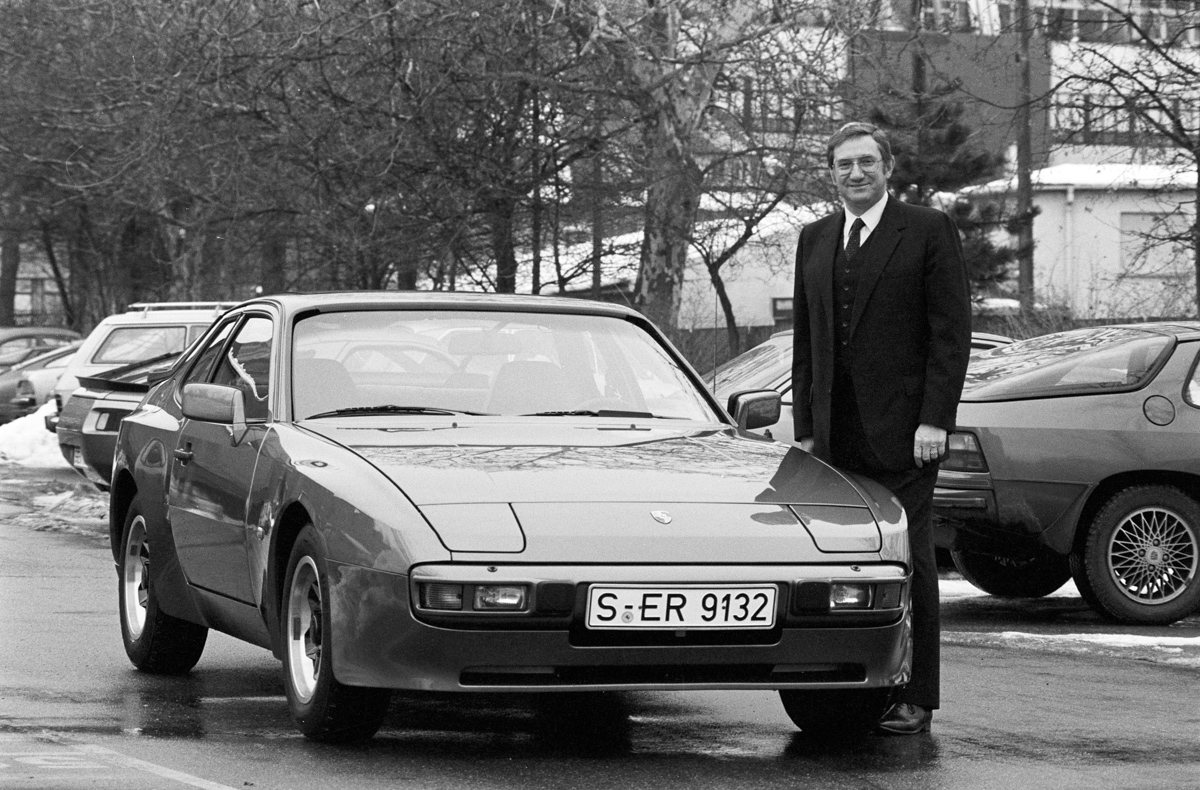
Very sad to hear that Peter Schutz has died. The 911 and its fans have Peter to thank for saving their bacon – he was the man who took over the loss-making Porsche as CEO in 1981 and famously walked into a product meeting where the 911 production graph on the wall stopped the same year. He picked up a marker and continued the line off the chart, over the desk, across the wall and out the door.
“Do we understand?” asked Peter. Those present must have got it, as the 911 subsequently went from strength to strength. The legend that is Ray Shaffer at Porsche Cars North America put some words about Schutz on his Instagram and I share them below. Ray knew Peter personally and he hits the spot nicely.
With his passing this weekend, we’ve lost a dear friend, father, husband, leader and mentor in Peter W. Schutz. He leaves this world a better place than the one he found, with his everlasting legacy and thoughtful teachings.
In the Porsche community, he was the man who invited Ferry Porsche back to his office in Stuttgart. He “saved” the 911 model and helped secure its future by championing the Cabriolet, Speedster and 959 developments and by listening to those around him – people like Porsche, Bott, Falk, Singer, Jantke, to name only a few. Peter also let the people of Porsche know their purpose by famously declaring: “as long as I am in charge of this company, we will never go to any race without the objective of winning.”
Peter was a great friend of the late Bob Snodgrass and the family of Brumos Porsche. When Bob passed in 2007, Peter was the first person to contact me. I will never forget the thoughtful letter of care and concern he wrote about how to keep the Brumos spirit alive. It became my “go to” reference piece that would serve me well during my tenure as general manager. But I was not alone. Peter was a mentor to many personally and through the pages of his excellent book, The Driving Force.
With thoughts and prayers for Sheila, Lori and the entire Schutz family. Godspeed, Peter.
Peter stayed with Porsche until 1987 and was 87 when he passed. From what I have read, he lived a great life and his work certainly had an untold impact on my career, in many ways bested only by Ferry himself. I cannot begin to describe how many lessons from Peter’s career have embedded themselves in my outlook. He was truly a unique individual.
RIP Peter: forever an unforgettable part of Porsche history.
Porsche has unveiled a triptych of new special-edition 911s celebrating three British racing drivers who have taken Porsche to the top step of the podium at the Le Mans 24 Hours. The British Legends series honours Richard Attwood, Nick Tandy and Derek Bell.
British Legends: Richard Attwood
Richard Attwood helped claim Porsche’s first Le Mans victory in 1970. Driving a theoretically outdated 4.5-litre 917 in the Porsche family colours of Salzburg Racing, Attwood and partner, Hans Herrmann, outlasted many other competitors including the newer 4.9-litre 917s to reach the finish first. Just sixteen of the original fifty-one starters took the chequered flag.
Herrmann – a Porsche factory driver from the early 1950s – had promised his wife that a Le Mans win would be his last ever race. After the race, he kept his word and retired, much to the surprise of his Salzburg team bosses. Attwood raced another 917 at Le Mans in 1971, finished second and retired at the end of the season. Attwood currently features in a Porsche 928 racing video.
British Legends: Nick Tandy
After a blistering early career in Ministox and single seaters (Formula Ford and F3), Bedford-born rockstar and Porsche tart extraordinaire, Nick Tandy, first blipped on Weissach’s radar with an exceptional Carrera Cup debut at Dijon for Konrad Motorsport in 2009. Despite no testing beforehand, Tandy finished second in this round of the highly competitive Carrera Cup Germany, so Konrad invited him back for the Abu Dhabi race, where he impressed them again and earned himself a full season Carrera Cup drive for 2010.
Tandy went from strength to strength in 2010, narrowly missing the title to Rene Rast, who was insanely quick: the pair were the class of the field. The championship was Tandy’s in 2011, at which stage he shifted to the world stage, ending up in Porsche’s LMP programme and taking his first Le Mans win for Weissach in 2015 alongside Earl Bamber and Nico Hülkenberg. He continues to be a key part of the Porsche works driver squad.
British Legends: Derek Bell
Born in leafy Pinner in 1941, Derek Reginald Bell went on to claim five wins at Le Mans – four of them with Porsche – and remains Britain’s winningest Le Mans racer.
Bell’s first Le Mans 24 was in 1970: the same race won by Richard Attwood in a Porsche 917. Driving alongside Ronnie Peterson in a works Ferrari 512S, the duo was forced to retire from the race, but Bell stayed on afterwards to help his friend Steve McQueen film the classic: “Le Mans”. The 512 used in the film caught fire with Bell in it, and he narrowly escaped with minor burns.
DB’s most memorable successes at La Sarthe came when teamed with Jacky Ickx. The pair claimed victory for Mirage in 1975 and then for Porsche in 1981 and 1982. Bell’s other Porsche Le Mans wins came in 1986 and 1987, alongside Hans Stuck and Al Holbert.
Carrera GTS ‘British Legends’
The ‘British Legends’ 991s are based on 991 Carrera 4 GTS models and come with options including LED headlights, Sport Design body styling and satin-finish mirrors, lots of carbon and a Union Jack badge on each car with the driver’s signature alongside. Porsche says:
“Using the design of the winning race cars as the starting point of each car, joint workshops between Porsche Cars GB and the drivers ensured their passion was built-in to each 911. The ideas were then taken forward by the design team at Style Porsche in Weissach and the craftsmen at Porsche Exclusive Manufaktur in Stuttgart.
“Each British Legends Edition is finished intricately by hand in the new Porsche Exclusive Manufaktur workshop. Special features such as the Satin finish black door mirrors, carbon floor mats with Alcantara edging and a steering column casing in Alcantara make their first appearance on this 911.”
The 911 Carrera 4 GTS British Legends Edition is on sale from 9 October, priced at £122,376 inc VAT for Attwood Red – add an extra £900 for Tandy White or Bell Blue paint. A bargain! Whatever about the cars, there is no doubt that all three drivers are proper Porsche legends so it’s great to see them get the hat tip of a special edition. Watch the video below – it has some nice archive stuff in it:
I value a few high mileage 3.2 Carreras for Porsche agreed insurance valuation purposes, but none of them come close to the mileage amassed by this beautiful 3.2 with Freisinger restoration which has covered an incredible 680,000 kilometres from new.
I have to say I was a little disappointed by this, as it is not quite enough to go to the moon and back and not quite the million kilometres first believed when it arrived in the workshop for an engine and gearbox refresh. It is still incredible, of course, but a few more weeks clocking up mega miles would have made it really amazing. I’m no 3.2 fan but this car has really fired up my romantic streak – I just love it as a real piece of ownership history. So I was a good choice to write the sales text.
The lion’s share of this mileage was logged by its first owner: a German industrialist who had businesses throughout southern Europe. In 1986, the owner walked into his local Porsche dealership, specced up a Cassis Red coupe with sunroof delete and factory aircon (no point having a sunroof when you clock up hundreds of thousands of Autobahn kms at top speed). Once the car was delivered, he proceeded to run his businesses from the driver’s seat of the Carrera, putting 10-15k kms on the car every four to six weeks, with a full dealer service every couple of months.
As the miles wound on, the Carrera wrapped itself into shape around the driver. Like all great 911s, driving was almost no effort, so more than six hundred thousand kilometres were put on the Porsche before the decision was taken to change it – not to mention the rise of the fax machine and invention of the Internet making big miles slightly irrelevant.
Nowadays, the notion that someone would buy a car and drive 422,000 miles in it is simply unthinkable. Those days have well and truly disappeared. Notwithstanding the months it would take to accomplish this feat in an age of time poverty, the cost in fuel and maintenance would be hundreds of thousands of pounds. But cars like this prove just how the original Porsche sports cars were designed to last. Built by craftsmen from the best parts proven through several evolutions of one bodystyle, it was not unusual for cars to clock up fabulous mileages, helping their owners build empires. Having been under many newer Porsches with reasonable mileages, I’m not so sure that a modern Porsche would make it this far quite so easily.
Anyway, the Carrera’s mileage continued to increase, until one day, the car was replaced by a newer one. At that stage, the owner turned to childhood friend and rare Porsche parts guru, Manfred Freisinger, for some advice on restoration. And that’s where this car’s story gets really interesting.
Just as there are many types of car, there are many types of car restorations. At the lowest end is a quick blow-over in a back-street bodyshop and some folks believe that a factory restoration is the creme de la creme. But the finest attention to restoration detail is guaranteed by using knowledgable specialists like Freisinger or the legends at Ruf. You need deep pockets to send your cars to these boys: I hear a Freisinger restoration starts at €150k for a standard G-model 911 like this and Marcel Ruf told me that any serious SWB Ruf restoration project starts at €300k.
Previous restorations carried out at Freisinger list like a Porsche who’s who: 904s, 906s, 908s and 917s galore with a sprinkling of 962s in there, too. Countless 2.7 Carrera RS Tourings and Lightweights, 934s and four-cam 356s and one high mileage Cassis Red 3.2. When it comes to road car restoration, Freisinger does not take off, make good and refit: the team simply replaces everything with brand new parts. On this car, the list included brand new Fuchs wheels and brand new pinstripe sports trim from a 3.2 Club Sport, a complete set of suspension and brakes and many more bits and pieces.
The entire restoration was documented in a detailed photographic record. Freisinger also converted the car to 3.4-litres using a factory cylinder kit. The engine and transmission were recently rebuilt and both are now in as-new condition. The car has completed 300 running-in miles with 700 more to go and it is a wonderful example of how good classic Porsche can be.
Proper high-mileage Porsches rarely come to market. Cherished by their devoted custodians and handed down as heirlooms, they tend to stay in the family. This rare piece of Porsche motoring history has been fully rebuilt at great expense and is well worth a look. Priced at €79,000, perhaps it only makes sense if you’re a romantic like me – being part of this story would be an experience.
Ferdinand blogs my freelance adventure with Porsche at the centre. To support the blog or engage with me in other ways, you can:
I’m currently back in Gran Canaria (off the coast of Morocco) and recently finished two books by the British adventure traveller and journalist, Chris Scott: Desert Travels and The Street Riding Years: Despatching through 1980s London. Each is an excellent read for bike fans and non-bikers alike, and Chris inevitably and entertainingly wanders off-piste into other areas.
I had just finished reading Street Riding Years, which devotes a good percentage of its pages to discussing the character flaws of the author’s various bikes through the years, when a question arose on a UK forum for BMW GS motorcycle anoraks. The original poster asked this and sparked an interesting thread:
I was chatting at the lights to a chap on a fancy new BMW. He was commenting that he liked his new bike, and it was eye-wateringly fast, but that he missed the character of his old R1150GS. I nodded, sagely, sitting aside my old R1150GS. But when he shot off, I thought – I don’t actually know what that means. Any thoughts on what makes character in a bike, and in a 1150 specifically?
I replied with a quote from Street Riding Years and something I had also read, written by Clarkson:
“In actor Eric Bana’s 2009 film, ‘Love the Beast’, Jeremy Clarkson assures Bana his recently smashed up 2009 Ford GT Falcon Coupe isn’t worth rebuilding because ‘muscle cars are crap’. Then, in one of his occasional spells of profoundness, Clarkson offers to explain ‘character’. ‘The cars we love the best are the ones with human traits, warts and all. Anything else is just a machine’. Jezzer nailed it. Did my repugnant MZs have character? Do bears floss after meals? Proper Brit bikes of the era had the love-hate qualities of character. Many [Italian and US bikes] too. But Jap Crap and Kraut Crates, not so sure.”
Chris is not a BMW fan. I understand the rationale, but do not share his opinion. To me, character involves the consistent delight of rider/driver, mile after mile. On that basis, the low-fi, hand-assembled 850/1100/1150 twins enjoy bags of character. I get the same joy in use from both my twinspark BMW 1150s (a GS Adventure and an RT) and my pre-VTEC VFR800 as I do from older Porsches and lots of my other cars. They are wonderfully built pieces of travelling equipment and their original designers should be proud.
Great Motorcycle Rides: A5 Bangor-Llangollen-Oswestry
I was at home in Ireland on two wheels last month (see above), clocking up 1500 miles in a week. On my way back to the UK, I parked my 2003 1150RT next to a German biker while waiting for the ferry in Dublin. He was reminiscing about his 100,000 kms on an 1150RT before changing it for the new 1200RT he was riding. We stayed together out of Holyhead for a while, before I came off the main drag for the wonderfully twisty A5 at Bangor. I rode this excellent road down to Llangollen in mid Wales and on to Oswestry, just inside the border with England.
Starting the route at 7pm, I basically had the 90-mile road all to myself. It was as close to heaven as I’ve ever been on a bike. When I eventually got to the end of the best bit, the A5 was closed and I was sent on an additional 20-mile diversion in a southbound loop to the M54. I was a bit weary after a late night with my dad the previous evening, but I stayed happy and arrived home content after almost four hours of riding. When you end up being pushed a lot further than planned and can still keep a smile on your face, that probably says something about a machine and its character.
Vintage Porsche Character
Driving my orange 3-litre 911 is a similar experience. It is hot and noisy inside, but I have never been tempted to change much of that – I just take off a few layers once in a while and wear earphones whenever I drive it. God only knows how many delays and diversions I have experienced in that car over ten years of ownership, but there is something about the machine that just clicks. I turn the key, make one gearchange and am instantly reminded just how much I love it.
With many older cars (and bikes), there may even be a sense that the machine has been imbued with some of the spirit of its builders. There is an awareness of the expert human contribution to the creation of a nicely-built older machine, which then deserves a considerate/likely capable user to get the best from it. At the peak, there exists a techno-spiritual connection to the emotional aspects of what is really just a pile of cast metal, moulded rubber and a few bags of bolts. All emotional conjecture projected by the rider/driver, but I am sure some of you will go with the flow on this.
An engineer could probably make a good list of components that help create the impression of mechanical ‘character’ but, to me, the twist of a key, the momentary clack of an oil-filled cam chain tensioner taking up the slack, the snick of a WEVO or BMW shifter and the rising burble of a flat twin or six go some way towards telling me I have a good thing coming.
What does character mean to you? I would be interested to hear your thoughts below.
This Porsche 911 HLS Design Study was one of the more memorable encounters on our recent visit to Techno Classica Essen. These days, it seems any Fred-in-a-shed can stick big wheels, tartan seats and throttle bodies on an old Porsche and market it as reimagined, but, if one really wants to get ‘reimaginative’ with an old 911, then this quirky machine laid down the entry requirements, half a century ago.
Occupying pride of place on the Early 911S stand, amongst the meticulously curated 911 collectables brought to Essen every year by the Dutch specialists, the HLS Designstudie seemed rather ungainly compared to the car its designer destroyed to create it. That said, judging a fifty year-old bespoke GT with hindsight and a modern aesthetic is never going to go well. Car culture has an ingrained affection for better known prototypes of a similar vintage, many of which are nowadays accepted as the most beautiful cars ever made.
Even forgetting that Gandini’s 1965 Miura and early LP400 Countach or the 250 GT Lusso ever existed, this car’s looks are a challenge. While the styling curves of the great GTs flow serenely from one to the next, the awkward shapes of the HLS trip over one another like lumpy shopping. It is vaguely reminiscent of one of those Matchbox fantasy cars which I never wanted to receive as a kid and, in some ways, that’s just what it is.
Taking styling models created by the University of Aachen’s automotive design programme, coachbuilder Hans-Leo Senden (hence HLS) built full-size versions. The work explored the organic and commutable nature of sports cars and created something unique from what, at the time, was regarded as a rather plain-jane production machine. It is not sweet and sexy like a Lambo GT or a Jaguar E-Type, but we can probably all get with the motives behind its creation.
As a Porsche valuations person, I can’t look at any old Porsche without thinking of price, so what is the value of this? Well, it’s rare, built on 1965 Porsche 911 underpinnings and is a proper period piece. Only a handful of these things were ever created. There are better-looking ones on Google images, but what really matters for valuation purposes is whether it was commissioned by Stuttgart or not – and I do not know the answer. Either way it has value, but, if the wheels were set in motion by Stuttgart, then the desirability is greatly increased.
Assuming it was not a Porsche-commissioned creation (and perhaps it was not, as surely it would have gone back to Stuttgart by now), then I guess if you were serious, already had a good 911 collection and were keen to pick up one or two curve balls for interest, one might pay more for this HLS Studie than the price of a nice ’65 911, assuming there was some competition to own it, but that depends on lots of factors including what the rest of it looks like underneath and how much history it has. Or maybe I am greatly underestimating its desirability.
Perhaps what matters is that this spyder-style study on an early 911 still exists, to offer a window into how design students and coachbuilders approached their work fifty years ago. It would make an interesting talking point in an already substantial Porsche 911 collection, but, as a strictly small-scale collector and someone who drives their cars, I’d rather own a standard 911 of the era. Or an LP400.
This website uses cookies to improve your experience. We'll assume you're ok with this, but you can opt-out if you wish.AcceptRead More
Privacy & Cookies Policy
Privacy Overview
This website uses cookies to improve your experience while you navigate through the website. Out of these, the cookies that are categorized as necessary are stored on your browser as they are essential for the working of basic functionalities of the website. We also use third-party cookies that help us analyze and understand how you use this website. These cookies will be stored in your browser only with your consent. You also have the option to opt-out of these cookies. But opting out of some of these cookies may affect your browsing experience.
Necessary cookies are absolutely essential for the website to function properly. This category only includes cookies that ensures basic functionalities and security features of the website. These cookies do not store any personal information.
Any cookies that may not be particularly necessary for the website to function and is used specifically to collect user personal data via analytics, ads, other embedded contents are termed as non-necessary cookies. It is mandatory to procure user consent prior to running these cookies on your website.