
by John Glynn | Jan 21, 2015 | Porsche Cayenne, Porsche News
Missing my Cayenne at the minute. Long story involving many support vehicles sent ice driving in Sweden, but it is down in Monte Carlo with Tuthill Porsche, towing the Porsche 997 R-GT car into places for testing that the big Tuthill rally truck won’t reach easily.
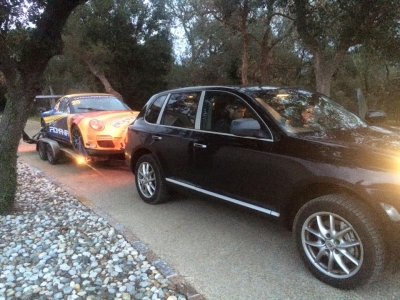
The 955 Porsche Cayenne V8 is a big old girl and it sucks up plenty of fuel, but you do get attached to its sublime waftability. “I had a trouble-free eighteen months with a Cayenne Turbo,” agreed Porsche professional Cris in a daily driver thread on ImpactBumpers.com. “They are nonsense quick for a fat bird, quicker than the contemporary supercharged Range Rover and better on fuel. Although better than very bad is still awful.
“Downside of selling it is now all other cars seem rubbish, including the other half’s newish Golf 1.4 TSi. I’m ruined and am now saving for a Cayenne again: a GTS this time or maybe a diesel V6.”
After a holiday romance in the Canaries last Christmas with a cute little Citröen Berlingo rental, I crunched the numbers and buying a new Berlingo diesel was cheaper than running the Cayenne over the next three years. I looked at maybe changing for a Citröen, but I worried I might miss the Cayenne too much. Then I corrected an omission in my original workings and the man-maths more or less balanced out, as the Big Pig continues to manage the equivalent of 35 mpg while driven hard and running on propane gas. So I forgot my holiday romance.
Cayenne pining reached a peak as I flicked through some unopened mail this evening and found last month’s copy of Panorama. The magazine of the Porsche Club of America ran some great features through 2014, and this latest edition carried another cracker titled Real Genius: an excerpt from Randy Leffingwell’s Illustrated Porsche Buyers Guide, covering the genesis of the original Cayenne.
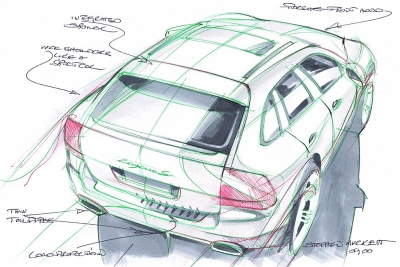
Butzi Porsche helped design the Cayenne
The story confirms our blog from a few months back on how the Porsche Cayenne was originally planned as a Mercedes joint venture, but Randy also learned from Cayenne designer, Steve Murkett, how Ferdinand Alexander ‘Butzi’ Porsche helped shape the 955 Cayenne.
“Butzi had always been an SUV enthusiast,” said Steve. “He said if we were going to design an SUV, he wanted to be directly involved.”

Steve tells how Butzi started coming very month, looking at the models. Eventually, F.A. came straight out and said he would design Porsche’s new vehicle. This did not go down so well with the design department, who had been working for years on the E1 SUV project. A Land Rover Defender would act as peacemaker: a Land Rover that Burkett ended up buying from the extensive fleet of SUVs and 4x4s purchased by Weissach for competitor evaluation.
“The Land Rover has absolutely nothing to do with what a Cayenne is, but for me it is an icon,” says Burkett. “It has character. I developed a pretty good relationship with Butzi, probably because he had a Defender as well. Anytime we got into a stalemate where we couldn’t agree about anything, we started talking about tyres on our Defenders.”
Butzi did work on a Cayenne design and the two concepts eventually went to the management for a final decision. Burkett’s design won, but he is honest about F.A.’s hand in the styling. “There is no doubt about Butzi’s contribution to the simplicity of the Cayenne. It doesn’t have all the little muscles and edges seen on BMW X5 or Mercedes ML, but that was Butzi’s thing: keep it simple.”
The complete feature could transform your opinion of the Cayenne: there is so much Porsche engineering in these cars. It makes me want mine back even more! For less than £10 new and delivered on Amazon UK, the Illustrated Porsche Buyers Guide is worth a read: it’s not the dry buyers’ guide you might expect.

by John Glynn | Jan 11, 2015 | Classic Porsche Blog, Porsche News
Selling prices continue to climb for the best examples of air-cooled Porsche 911, and low mileage water-cooled cars. Looking at the buyers active at the top of the market, no impending disaster looms to their ability to pay the asking prices now commonplace for older Porsche cars. Add that to a burgeoning demand for one of the hottest investment spots of recent classic car sales and it’s small wonder that good cars sell quickly.
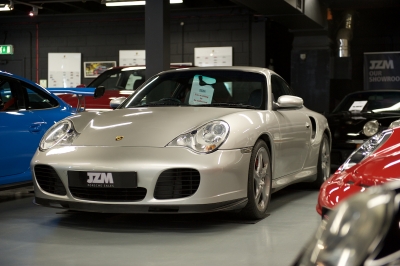
Low-mileage 997 GT3s and 996 Turbos in top class condition continue to do well. A recent 996 Turbo Tiptronic with just 21k miles (above) sold to the first person to view at £39,900: strong money for a 996 Turbo. That said, the car was exceptional and the buyer was sitting on cash, ready to go.
Sitting on cash is a situation many lucky people find themselves in at the minute, whether from bonus, downsizing a property, inheritance or just lots of hard work. Specialist UK dealers have a bundle of air-cooled rarities in their used Porsche for sale stocks, which may do the trick for investors.
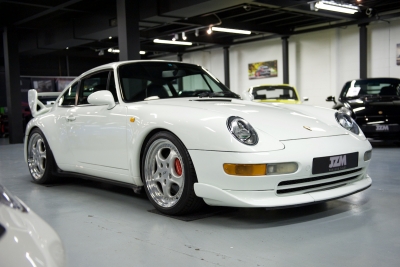
My current favourite is this Porsche 993 RS Lightweight: a one-owner car just arrived from Japan with a paltry mileage on the clock. £270,000 seems about right, given where values have been in the last twelve months. Still a truckload of money, though.
I’ve never been a ’73 RS groupie, but this very nice 1973 Porsche 911 Carrera RS Touring for sale – three owners in Light Yellow and beautifully restored many years ago – for offers around the £650k mark.
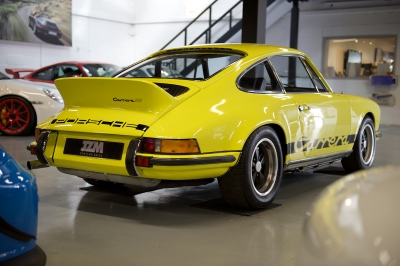
I’ve set eyes on less than pristine examples with nothing like the history of this car elsewhere in the UK, where sellers insist they have turned down bids of £700k+. Not because they don’t want to sell it: they just want more money. I could say that is pushing it, but then I’m not sitting on a proper RS with all that ownership entails.
Away from high-end Porsche metal, some interesting impact-bumper 911 projects sold over Christmas for mid-£20k: about the right price as far as I’m concerned. No shortage of armchair experts around to shout the prices down, but low-priced IBs are becoming harder to find.
by John Glynn | Dec 3, 2014 | New Models, Porsche News
I passed my first Porsche Macan on the road last Monday. Charging around the M42 motorway, a black 14-plate Macan Turbo in spotless condition was besmirched by the dirtiest car on the road: my hard-used 2004 Cayenne S.
I didn’t take much notice until I was pretty close, but Macan shape and style is quite handsome. It looked big enough to be useful as a people mover, but I wonder what condition the Macan will be in five or six years, when cash buyers like me start considering them.
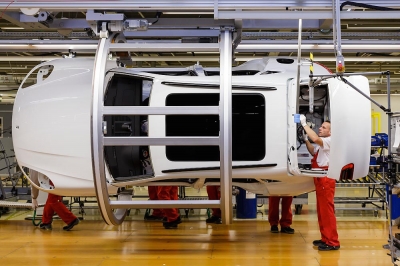
Macan is made in Leipzig, alongside Cayenne and the Panamera. The production process is well worked out, as it should be thanks to Christoph Beerhalter. A name not heard much in public, Beerhalter is one of those engineers who goes methodically about his business, leaving a quiet revolution in his wake.
Porsche and Toyota Production Methods
When Porsche was hampered by high production costs due to inefficiency in the early 1990’s, Beerhalter was at the front line of sorting it out. Taking inspiration from all sorts of industrial production including the much-discussed Toyota school of kaizen, Beerhalter used what he’d learned from efficient organisations and applied it to Porsche production at the new Leipzig factory.

Twenty years later, Beerhalter’s name is on a number of Porsche production patents, and the Macan is built on perhaps the most efficient production line in the world. Everything from where the trains carrying Macans for export should enter the site to where the production line screws should be kept has been optimised. Control of production costs (and charging a whacking great price for new models) means that Porsche margins sit around 18% – almost twice that of some competitors and up to six times what the parent brand claims for Polo and Golf.
Porsche Macan Tested: 190 Prototypes
It’s still early days in the Porsche Macan’s life, but the margins don’t seem to have come at reduced cost of development. Knowing full well that Macan would have to hit the ground running, the company invested heavily in prototype testing, building a staggering 190 prototypes, according to a Christophorus interview with Uwe Schneider, Porsche’s head of overall vehicle development.

“Only in a real prototype do we see how the vehicle reacts under real-life conditions,” said Schneider. “For every Porsche, those real conditions include use at the limits of performance. No simulation, no matter how good, can determine the wear on the vehicle after 150,000 kilometers on real roads and testing grounds.”
Porsche Macan Recall
The first Porsche Macan recall has already been issued for problems with brake servo fitment. As a brand new model, no doubt there’ll be more, but the real test is long term. I’m not the only used Porsche cash buyer waiting to see how quickly used prices drop to affordable levels, and how real-life reliability stands up over time.

by John Glynn | Nov 19, 2014 | Classic Porsche Blog, Porsche News
Superb result on the school run this morning, as a Volkswagen XL1 hybrid swooped in at Orla’s school: moving on a public road right in front of my eyes. Dads love the ultimate school run challenge – what car to take to freak their kids’ friends out – so I’ve seen and employed some cool school run cars in my time, but this was the winner by miles.
330 miles in fact, as that’s what the XL1 can eke from one imperial gallon of diesel. The 795-kilogram carbon-fibre body is beautifully shaped and exceptionally aerodynamic: a drag coefficient of 0.186 is half that of the Porsche 918 Hybrid. The XL1’s low drag means that 62 mph can be maintained on a level road using only 8 horsepower.

Volkswagen XL1 Encounter
I’ve loved the Volkswagen L and XL concept cars since the first one was shown in 2009. They are absolute fantasy cars, so what full-on madness to see one on the road and in the carbon fibre. A tiny machine at less than 4 metres long, it still has more than enough space to do 90% of your motoring.
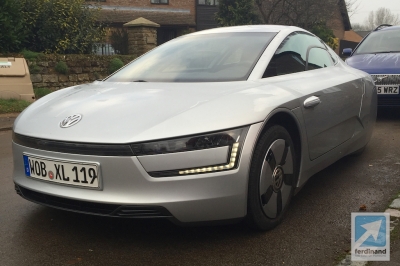
The styling is pure sports car, with the roof just over three feet off the ground. I could not resisting parking up for a chat with the driver, who turned out to be Volkswagen UK ‘s ‘hybridisation’ programme manager. He told me how only 32 examples are coming to the UK from the total production run of 200 vehicles: two will stay on the press and demo fleet while the rest are up for grabs. With names like Peter Gabriel on the customer enquiry list, I have no doubt that the XL1 will sell out pretty sharpish.
The hinged doors are light and easy to operate. Fit and finish across the body is sublime: Volkswagen actually developed and patented a new system for the manufacture of the Carbon Fibre Reinforced Polymer parts on the car called the Resin Transfer Moulding process. A bare chassis weighs just 230 kilograms, the complete interior weighs only 80 kilograms.

Less than one-quarter of the car’s weight is iron or steel: just 184 kilograms. The car saves weight by using magnesium wheels, ceramic brakes and aluminum brake calipers, steering components and suspension.
Sitting in the XL1 is familiar Volkswagen territory, albeit the dash is reduced down to the (very smartly presented) barest essentials. Less familiar are the door mirrors: rear-facing cameras with iPhone 3G-sized screens embedded into the door panels. The seats are comfortable if a little flat and hard – light weight could mean sore arse in the long run – and anyone with bad knees won’t be buying this car: it is super low when getting in and out.

The XL1 has an 800cc two-cylinder common rail TDI diesel engine developing 48 PS, linked to an electric motor producing 27 PS. Total output of 75 PS is well enough in such a light car. XL1 has a seven-speed DSG gearbox. The electric motor can either work independently of the TDI engine or in tandem when accelerating.
Electric range is 50 kms, 0-60 is 11.9 seconds but the effect of seeing it on the road is where the real WOW happens. If I had the £98k required to put this car in my garage, I would be all over it immediately.

by John Glynn | Oct 29, 2014 | Project Cars, Porsche Cayenne
Anyone interested in buying a Porsche Cayenne who’s been researching their purchase via forums is forgiven for massive paranoia regarding propshaft failures. The truth is that propshaft or cardan shaft failure is going to happen to any Cayenne you buy. Propshafts or driveshafts are maintenance items on any vehicle: especially 2-tonne 4wd SUVs.
Porsche Cayenne Centre Bearing Mount
Prime suspect of a Cayenne propshaft issue is the centre bearing mount. The bearing supporting the CV joint in the middle of the two-piece propshaft is mounted in rubber. Like all rubber mountings, it eventually wears out. The vibration from a failing centre CV joint will often kill the bearing. It is under a heavy 4wd car in all weathers, so do not be surprised about this: the part cannot be expected to last indefinitely.
I just had to sort this ‘cardan shaft’ centre bearing mount failure on my Cayenne S. The centre bearing mount failed two weeks ago and I have been driving it around ever since, in the process of sorting it out to my satisfaction. If you’re easy on the throttle you can keep driving it a bit. I am now on my second shaft this week: a brand new OEM GKN Spidan propshaft.
I went a slightly long way around this issue, as the usual suppliers wanted the original prop shaft in exchange and I wanted to keep it for rebuild. I bought a recon propshaft from eBay and fitted that to the car, but as soon as I drove it it was obviously wrong. So I ordered a new shaft and fitted that last Thursday morning. I’ve got a miniscule vibration above 80 mph: more a sound than a sensation, but it still needs sorting out.
Porsche Cayenne Cardan Shaft Propshaft
My old shaft had apparently been on there for 135k miles. The car has been maintained by a Worcester specialist since 60k miles and we know they have never done it. I very much doubt that it had ever been apart: it took me ages to split the shaft off the diff input flange. In the few days I ran it with a less than perfect centre bearing mount, the centre CV joint was seizing until it warmed up, which could easily have caused the rubber mount to fail.
Taking the second (supposedly recon) propshaft off the Cayenne, no doubt the centre bearing has been replaced on this, but the centre CV joint is just like my own one: sticky and recalcitrant. The new shaft feels totally different.
Speaking to a few propshaft experts this week, all agree that the problem is tied to the centre CV joint. The complete shaft has three CV joints for maximum smoothness, but the centre one takes most abuse, is the most exposed and will eventually seize up and fail. That wears out the rubber bearing mount, but most people just swap the bearing and don’t sort the CV, which causes the same problem soon after.
Although I have a new shaft on the Cayenne now, I plan to send my old shaft to a specialist who was very helpful this week and obviously knows his stuff. He will refurbish it before balancing at the highest RPM. I plan to refit that to the vehicle in due course and see where we go from there. This is a key part of the transmission, so I want it perfect.
Cardan Shaft/Propshaft/Driveshaft
A Cardan Shaft is a propshaft is a driveshaft. The original concept to adapt ancient Chinese gimbals into a universal joint to use in transmitting power came from the Italian mathematician, Girolamo Cardano, in 1545. It’s been called a Cardan Shaft in mainland Europe since becoming common in the early 1900s. It’s a prop shaft/propellor shaft here in England, thanks to common use in the industrial revolution. A driveshaft is the same thing, normally smaller.
So, don’t think Cardan Shaft is Porsche’s fancy name for this. Cardan shaft, prop shaft, drive shaft: same thing.
Ferdinand blogs my freelance adventure with Porsche at the centre. To support the blog or engage with me in other ways, you can:


