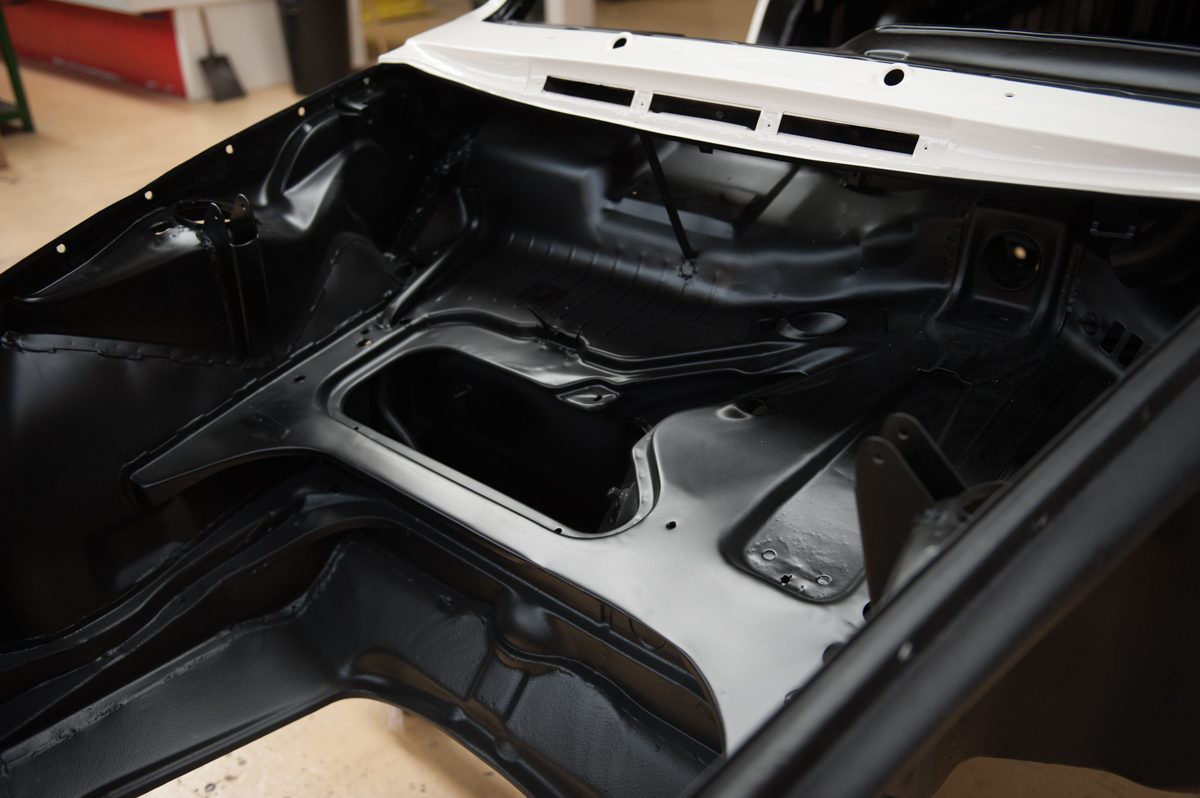
EB Motorsport is now offering a full body preparation and paint service for classic Porsche restorations. With a highly experienced spray painter employed to handle car builds and restorations on its own fleet of classic 911s, the Yorkshire-based classic Porsche parts specialist has the capacity to add paintwork for other Porsche enthusiasts to its list of capabilities.
“With so many Porsche projects in progress and quite a bit of paintwork generated by our engineering services and manufacturing plant, we decided to bring refinishing in-house last year,” says James at EB. “Only the best will do for our cars, so we installed an excellent UK-manufactured Dalby spray booth and use the same Glasurit 22-line paint system specified by Porsche. The results on our latest R build have been stunning and we will use the same materials on our RSR Turbo build when it is ready for paint later this year.”
“With the motorsport season in full swing, we are spending a lot of time out racing, so the EB paint shop has the capacity to take on some work for serious customers looking for the best finish,” notes EB’s Mark. “This might include fitting EB body panels as part of a road or race build, or repainting standard cars. Our painter has a huge amount of experience and of course there is plenty of his work here for potential clients to inspect. Workshop slots are available at very short notice.”
Interested parties can contact EB via their website. I have seen the R up close and it is a very special creation – no complaints on the paintwork either.
I had an interesting visit to Tuthill Porsche at the weekend. Francis took one of his 4-cam 356 Carrera engines out of storage and brought it into the engine workshop for the team to carry out a complete restoration and rebuild, including upgrade to 904 spec (pistons and cams ready and waiting).
The 587/1 GT engine was found sitting in the corner of a garage many years ago. It had been in a fire and done a bit of damage but nothing too serious. Fran took it home and started rebuilding it with the help of a friend who made valve guides for Formula 1 engines and had rebuilt a few race engines also. They rebuilt the bottom end, bought new valves from Porsche and made a full set of valve guides (superb things to look at) but never got around to doing the top end. Now the Tuthill engine builders will get stuck into it as a special project and I am excited to follow the work.
The 4-cam engines are a bit of a minefield, but no doubt when they work they are pretty special. Ferry Porsche had a 4-cam in several road cars and put a fascinating piece about development of the first Fuhrmann 4-cams into his autobiography, which offers an excellent insight into how the factory was operating at this time (late forties).
“For some time, our total work force comprised less than a hundred men, but we made good use of the cramped and limited space (a 600m2 rented workshop in Stuttgart) and even managed to find room for a diminutive test and racing shop, which held just two cars. It was shielded from prying eyes by an ancient closet and a primitive sliding curtain.
“We knew when we started using the Volkswagen engine for our Porsches that the maximum to which we would be able to increase piston displacement would be 1,500cc. The pushrod system of valve actuation, while completely reliable, also placed limits on engine revolutions. But we had foreseen this problem, and already by 1950 Dr Ernst Fuhrmann, an outstanding engineer on our staff, began designing our future Carrera engine.
“Different technical drawings were made which examined the possibilities of driving four overhead camshafts. One method was by chain, another by gear drive and so on. It seemed to us at the time that the best method to use would be a gear train, and that the distributor could also be driven from the end of one of the camshafts; but this arrangement led to difficulties.
“Each of the four camshafts operated two valves, and as the engine gained speed, a vibration began which ended up by destroying the ignition system. We therefore had to make changes in the ignition drive – not too much of a problem. The Carrera engine originally had a piston displacement of 1,500cc but was so designed that could be enlarged to 2 litres. However, we are anticipating a little, since another five years were to pass before we introduced this famous engine into our production line.”
Looking at the myriad parts spread out across the work bench in Tuthills, I simply cannot imagine how much effort went into making this thing work reliably. It is insanely complicated – the camshafts have flywheels and each camshaft is driven by a shaft which needs two position adjustments (one at each end and in opposite directions) to alter the cam timing. Even the flywheel is complex: it is fixed to the crankshaft by two tapered spacers, which interact under torque to lock the flywheel solid, but need huge torques combined with a specific routine of taps with a brass hammer to do their thing properly.
The first Type 547 crankshafts were Hirth roller bearing assemblies that came in separate pieces. Can you imagine starting an engine build by assembling a crankshaft? There is wonderful madness to an engine designed for production that took 120 hours to assemble and up to fifteen hours to set timing on. Compare this to the 41 hours often cited as start-to-finish build time for a complete 996!
Every single piece of it is outrageously complicated, making the flat-four 4-cam engine fascinating but frustrating. It leads me to wonder how much of Fuhrmann’s love of the complex fed into the convoluted, overweight transaxle cars which he had scheduled to replace the 911 before he was eventually replaced as Porsche CEO by Peter Schutz in 1980. An interesting question that would no doubt draw many comments on engineers as MDs, and the eternal battle between technical staff and accountants.
Setting aside my musings on four-cam contribution to Porsche boardroom history, this engine build is a fascinating project and one I am really looking forward to following. For example, valve lift on the 904 spec 587/2 engine is confirmed as 10mm exhaust and 12.5mm inlet. This would be mental enough with small-ish valves, but the 4-cam valves are huge and weigh a shedload. It is simply unbelievable and wondrously exciting!
Working full-time creating content for several independent Porsche specialists has sort of drained my blogging brainpower in recent years. I began the year hoping to get out and about to meet more people and see their cars during 2017, but this has been one of the busiest work years yet, so blogging is running slightly behind schedule. I am working on it…
Anyway, the last few weeks have been pretty good for Porsche travel. I got out to Ireland following the Tuthill RGT Porsche on the Donegal Rally, then cruised down to my home town of Limerick, where another visit to Jon Miller at Classic Carreras was in order (love Jon’s approach to the life and a blog is overdue).
I came home from Ireland through Wales then and instantly headed back into Wales, again with Tuthills, to meet Federico and Lucia on the Nicky Grist Rally. The couple have been rallying air-cooled 911s this year, to earn enough signatures for their International Rally Licences and take on some marathon rallying from next year in something like a Safari car or similar. Their rally journey is super interesting and they are lovely people. That story is coming to a website near you.
These client trips are great for me, as I get to do them on two wheels: my 1150RT for the Donegal trip and the 1150 GS Adventure to Wales. Coming back from Wales, I had enough time to put the bike in the garage, pack a bag and then fire up the Polo for a run down to East Sussex. I stayed the night at Classic Retrofit Jonny’s and we set off early the next morning to catch the Eurotunnel to France and drive on to Germany. I’d planned a three-day road trip to celebrate Jonny’s three-year anniversary in business and the first stop was Bebenhausen, just south of Stuttgart.
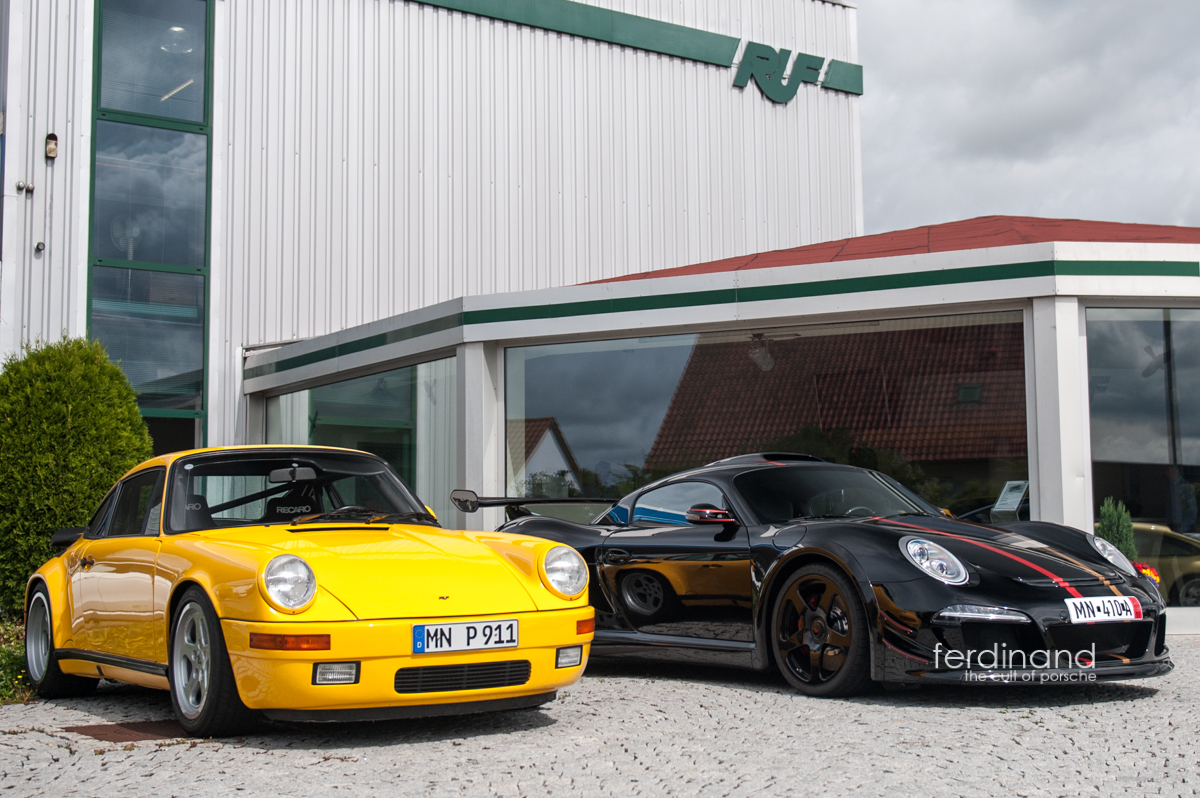
The trip down was fantastic, hotel was amazing and that left us with two hours to cover the next morning to get to Pfaffenhausen, for a day at Ruf Automobile GmbH. The godfather of Porsche tuning has tracked Jonny’s work for many months and Alois even visited the Classic Retrofit workshops to see the research and development process for himself. He extended an invitation for Herr Hart (below with Yellowbird) to visit and discuss engineering collaboration on their new CTR project, so Jonny took me along for the ride.
Many Porsche-owning friends have experienced Ruf as part of Porsche club visits, but I don’t know how many people have ever sat in engineering meetings with Ruf and his technical team: the guys who built the original Yellowbird and who now assemble the spectacular CTR3. Well, thanks to my clever friend, Mr Hart, and his excellent electronic skills, I am delighted to say that I have now sat in one of those meetings and even made a contribution or two. That was pretty cool.
We had a great day at Ruf. I lost count of how many times Jonny and I shot each other a look that said “is this really happening?” but it was a super successful day out. Alois is the perfect gentleman and was very giving of his time. Son Marcel is also great company and a highly trained engineer in his own right. The family business is in good hands and I will share some more stories from our visit.
Once we had finished at Ruf, we had a two-hour drive back to Stuttgart, where we stayed in a nice little hotel around the corner from the Porsche Museum. Next morning, we enjoyed a short visit to the museum and shop before heading home to consider our findings. All in all, it was an excellent trip which left me with plenty of work to do – the vicious circle of non-blog activity continues!
I’m currently back in Gran Canaria (off the coast of Morocco) and recently finished two books by the British adventure traveller and journalist, Chris Scott: Desert Travels and The Street Riding Years: Despatching through 1980s London. Each is an excellent read for bike fans and non-bikers alike, and Chris inevitably and entertainingly wanders off-piste into other areas.
I had just finished reading Street Riding Years, which devotes a good percentage of its pages to discussing the character flaws of the author’s various bikes through the years, when a question arose on a UK forum for BMW GS motorcycle anoraks. The original poster asked this and sparked an interesting thread:
I was chatting at the lights to a chap on a fancy new BMW. He was commenting that he liked his new bike, and it was eye-wateringly fast, but that he missed the character of his old R1150GS. I nodded, sagely, sitting aside my old R1150GS. But when he shot off, I thought – I don’t actually know what that means. Any thoughts on what makes character in a bike, and in a 1150 specifically?
I replied with a quote from Street Riding Years and something I had also read, written by Clarkson:
“In actor Eric Bana’s 2009 film, ‘Love the Beast’, Jeremy Clarkson assures Bana his recently smashed up 2009 Ford GT Falcon Coupe isn’t worth rebuilding because ‘muscle cars are crap’. Then, in one of his occasional spells of profoundness, Clarkson offers to explain ‘character’. ‘The cars we love the best are the ones with human traits, warts and all. Anything else is just a machine’. Jezzer nailed it. Did my repugnant MZs have character? Do bears floss after meals? Proper Brit bikes of the era had the love-hate qualities of character. Many [Italian and US bikes] too. But Jap Crap and Kraut Crates, not so sure.”
Chris is not a BMW fan. I understand the rationale, but do not share his opinion. To me, character involves the consistent delight of rider/driver, mile after mile. On that basis, the low-fi, hand-assembled 850/1100/1150 twins enjoy bags of character. I get the same joy in use from both my twinspark BMW 1150s (a GS Adventure and an RT) and my pre-VTEC VFR800 as I do from older Porsches and lots of my other cars. They are wonderfully built pieces of travelling equipment and their original designers should be proud.
Great Motorcycle Rides: A5 Bangor-Llangollen-Oswestry
I was at home in Ireland on two wheels last month (see above), clocking up 1500 miles in a week. On my way back to the UK, I parked my 2003 1150RT next to a German biker while waiting for the ferry in Dublin. He was reminiscing about his 100,000 kms on an 1150RT before changing it for the new 1200RT he was riding. We stayed together out of Holyhead for a while, before I came off the main drag for the wonderfully twisty A5 at Bangor. I rode this excellent road down to Llangollen in mid Wales and on to Oswestry, just inside the border with England.
Starting the route at 7pm, I basically had the 90-mile road all to myself. It was as close to heaven as I’ve ever been on a bike. When I eventually got to the end of the best bit, the A5 was closed and I was sent on an additional 20-mile diversion in a southbound loop to the M54. I was a bit weary after a late night with my dad the previous evening, but I stayed happy and arrived home content after almost four hours of riding. When you end up being pushed a lot further than planned and can still keep a smile on your face, that probably says something about a machine and its character.
Vintage Porsche Character
Driving my orange 3-litre 911 is a similar experience. It is hot and noisy inside, but I have never been tempted to change much of that – I just take off a few layers once in a while and wear earphones whenever I drive it. God only knows how many delays and diversions I have experienced in that car over ten years of ownership, but there is something about the machine that just clicks. I turn the key, make one gearchange and am instantly reminded just how much I love it.
With many older cars (and bikes), there may even be a sense that the machine has been imbued with some of the spirit of its builders. There is an awareness of the expert human contribution to the creation of a nicely-built older machine, which then deserves a considerate/likely capable user to get the best from it. At the peak, there exists a techno-spiritual connection to the emotional aspects of what is really just a pile of cast metal, moulded rubber and a few bags of bolts. All emotional conjecture projected by the rider/driver, but I am sure some of you will go with the flow on this.
An engineer could probably make a good list of components that help create the impression of mechanical ‘character’ but, to me, the twist of a key, the momentary clack of an oil-filled cam chain tensioner taking up the slack, the snick of a WEVO or BMW shifter and the rising burble of a flat twin or six go some way towards telling me I have a good thing coming.
What does character mean to you? I would be interested to hear your thoughts below.
Contrary to what you may read in today’s press, the UK’s greatest festival of motoring held in the grounds of an old country house doesn’t start for another three weeks. Roll on July 22nd, and the Festival of the Unexceptional at Stowe House in Buckinghamshire.
Keep your manufacturer-sponsored traffic jams and exhibition runs up the garden path for friends of his lordship. Instead, cue the oddball and unloved motors of our youth: the stuff that sensible people scrapped when the repair bills at MOT time topped £100 and were therefore more than the cars were worth, all those years ago.
Festival of the Unexceptional
First held in 2014, the Festival of the Unexceptional is a grand day out for fans of the ordinary. Witness a Light Blue 1.6-litre Honda Quintet and wonder how you ever forgot they existed. Spy a Pale Green 1.3-litre Ford Escort and remember how the neighbours took you and your sister to see Snow White at the cinema in an identical model (No? Just me, then).
Previous winners of the Concours de l’Ordinaire –a competition of fifty of the best examples of unexceptional cars built between 1966 and 1989 – include a Nissan Cherry Europe, a Morris Marina pick-up truck, and a Hillman Avenger Super Estate, all of which get my vote for working class motoring eye candy. I am very excited to see what turns up this year.
Will we find Porsches at the 2017 Festival of the Unexceptional? By rights, yes, we certainly should. Stuttgart made its fair share of unexceptional vehicles to 1990 (the show’s cut-off point) and I have driven a healthy proportion of all those produced. But this could be classed as treasonable talk nowadays, especially in front of potential ‘investors’.
Unexceptional Porsche – Judge’s Choice
My wet-dream Porsche for top honours at Stowe would be the pic at the top: a nice early RHD 924 Lux in Yellow with the basic alloys and a straight, simple spec. A natty little car in anyone’s book but unexceptional in the great scheme of things. However, now that 924s are changing hands for silly money, some 924 folk have sought to rewrite their steeds’ proletarian roots. Perish the thought of putting pop-up Porsche lights to an unexceptional grindstone for these proud PCGB’ers.
I have no such aversions and would happily run any Porsche of mine to this festival long before I ever considered taking one to the Festival of Greed. Mrs G and I have discussed getting the 924 Turbo over to the Stowe car park for a day on the lawns. I’m sure it will make for a grand day out if I can get the water pump back on, timing belt replaced and all the fuel injection shoved back into place in the few days I have free between now and then.
Who needs UK reg plates when it’s back roads to Stowe all the way from here? Famous last words – don’t you just love them…
None of us like hearing about stolen Porsche 911s, so I was sad to get an email from Michele last week sharing news of the theft of his Porsche 911 SC from outside his London home.
It has now been over a week since the car went missing and Michele has heard nothing since that awful discovery. “Unfortunately, there have been no new no leads. Most people seem to think that it will be either abroad already or hiding in a container. Still keeping fingers crossed but it is not looking good.” The worst news of all is that the theft of this 911 will probably not be covered by the insurers.
Stolen Porsche 911 not insured
Most owners state that their cars are garaged at home, and Michele was no exception. This statement effects a policy condition which requires the car to be garaged every night, usually from 10pm to 6am when parked within 500 metres of the home address. Michele’s car was parked on the driveway, as it was leaving on a road trip early the next morning. You can imagine the rest.
The small print covering the garaging condition differs between insurers, but essentially this is the gist of it and fellow bikers will be very aware of what it says. Motorbike forums are full of people who have had their bikes stolen from the back garden or shed in the wee small hours of the morning, when they should have been inside a locked garage to satisfy the terms of their policy. Theft from outside the garage during curfew hours means that the bike is uninsured.
To steal the most sought after motorcycles, bike thieves will sometimes go so far as to remove roof tiles from a garage to drop in through the roof and open the garage from inside, often using tools found in the garage to cut through any security and get the bike out. A stolen bike is worth several thousand pounds, but a stolen Porsche is worth even more, with strong demand for the parts.
Michele’s car was an early SC, so the engine, gearbox, chrome trim, interior, Fuchs wheels, mechanical parts and bodyshell all have a significant value. Replacing the car would cost at least £30k and I would probably have valued it higher for insurance. None of this matters to Michele, who would be happy just to get his car back, but you can see how all Porsches are targets.
Put yourself in his place: impossible to imagine the pain this would cause. I couldn’t afford to get back into a 911 if my car was stolen and the insurance did not pay out, so what can we do to prevent the same thing happening to us? I do a few things to protect my cars and motorcycles, including:
No keys kept at home address
My older cars not stored at home as my address is pretty public
924 is at home but wheels are stored elsewhere!
I rarely expose my cars & bikes during the day
One other car always blocking the garage, 24/7
Steered wheels are locked hard left or right on all cars
911 always wears a Disklok when parked, plus a trailer wheel lock when in storage
I have a very noisy Jack Russell who barks at anyone who breathes over the back gate
Lots of security lights
Garage door is locked to a post concreted into the ground
I don’t declare my motorcycles as garaged – there is no great difference in premium
Nothing is ever totally secure, which is why having an agreed insurance valuation on your cherished classic car or bike is just so important nowadays. I have been providing this service for all classic car and bike models in the UK for more than a decade. But, by making things less attractive for thieves when they come to scope out your property ahead of trying to steal the car or bike, you are reducing the risk of being targeted and of having to claim.
What are your anti-theft devices? I would be interested to hear about your solutions. Any information you might have on the stolen Porsche 911 SC, registration number FUS 656S, would be appreciated by all concerned. No questions asked.
This website uses cookies to improve your experience. We'll assume you're ok with this, but you can opt-out if you wish.AcceptRead More
Privacy & Cookies Policy
Privacy Overview
This website uses cookies to improve your experience while you navigate through the website. Out of these, the cookies that are categorized as necessary are stored on your browser as they are essential for the working of basic functionalities of the website. We also use third-party cookies that help us analyze and understand how you use this website. These cookies will be stored in your browser only with your consent. You also have the option to opt-out of these cookies. But opting out of some of these cookies may affect your browsing experience.
Necessary cookies are absolutely essential for the website to function properly. This category only includes cookies that ensures basic functionalities and security features of the website. These cookies do not store any personal information.
Any cookies that may not be particularly necessary for the website to function and is used specifically to collect user personal data via analytics, ads, other embedded contents are termed as non-necessary cookies. It is mandatory to procure user consent prior to running these cookies on your website.