by John Glynn | Oct 26, 2009 | Classic Porsche Blog, Modified Porsche Hot Rods
Early impact-bumper Carreras – the 1974/75 Porsche 911 2.7 Carrera and 1976/77 Porsche 911 Carrera 3.0 – are some of the most misunderstood 911s ever made. John Glynn looks at two interesting examples, with not a lemon in sight. (First printed in 911 & Porsche World magazine).
Citrus Carreras
The sun finally emerges from behind wispy white clouds and treats our retinas to a cascade of colour. Non-911 people looking at these cars, and their drivers of a certain age, could be forgiven for misguided references to mid-life crises, but there is more to these pukka Porsches than a bit of loud paint.

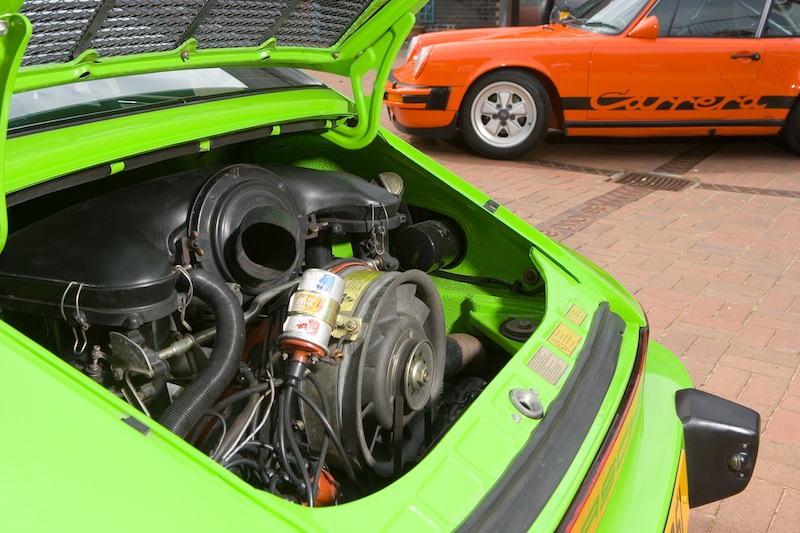
The first impact-bumper 911s arrived in the showrooms in late 1973, ready to appeal to a whole new audience. First registered in November of that year, the Lime Green car seen here is a very early 2.7 Carrera. Both American and Rest-of-World (RoW) Carreras have the same engine capacity, but while the 49-state US versions use an emissions-conscious 165 bhp K-Jetronic version of the 911S engine, RoW 2.7 Carreras feature the 210 bhp mechanically fuel-injected 2.7 engines of the ’73 RS, and are quite a different beast.
Nigel Watkins first spotted this car hidden in an Autofarm barn. Nigel, a long-term 911 enthusiast, immediately recognised race potential in the tired 2.7, and a deal was soon agreed. The colour was then metallic black, but evidence of factory Lime Green paint abounded. Ever keen on detail, Nigel decided to return the car to its original ‘74/’75-only shade.
2.7 Carreras predate the galvanising introduced for the 1976 model year, and many have fallen victim to the ravages of rust. The urge to convert corroded Carrera bodywork to ’73 spec has been too much to resist for some owners, but despite his love of the Carrera RS, Watkins chose not to backdate. A bare-metal respray in January 2006 produced this incredibly vivid vehicle, with impact bumpers intact. Nigel’s commitment to the chunky-cornered look was not in vain, as later that year, the car won a deserving Best of Show at Classic Le Mans.

Participation in the 2006 Curborough Sprint Championship also brought rewards. Following a very competitive season, Limey eventually won the championship outright. The win earned the Carrera further specialist attention, this time at the hands of Bob Watson. Bob is well regarded amongst the 911 cognoscenti, particularly for his in-house chassis dyno and excellent results on tuning MFI-equipped cars. Wrapped up for the winter in Watson’s workshop, Limey’s engine was removed for rebuilding.
A knock from cold was traced to the intermediate gear, so a lighter (drilled) steel unit from a 993 replaced the worn aluminium original. The motor was balanced and blueprinted, with a flowed crankcase, matched combustion chamber capacities and the heads polished, ported and matched to the manifolds. Once reinstalled, the engine was run-in on the dyno and tuning began. MFI pump condition is critical to horsepower, and Limey’s pump turned out to be a cracker. With tweaked fuel rates and ignition timing, the refreshed powerplant produced an excellent 237bhp.
An engine bay refurb and a transmission service, including the addition of a ZF limited slip differential, were completed at the same time. Southbound Trimmers provided the pièce de résistance by retrimming the original sports seats in proper perforated leather, lifting Limey to almost perfect condition. 
The relative rarity of the 2.7-engined IB Carrera, with less than 1,550 road cars produced over two years, has brought renewed interest to the model in the last few years, with a corresponding rise in prices. Nigel’s investment in professional restoration and period detail meant Limey was now a valuable commodity. The double-edged sword of rising prices made racing the rare bird more risk than Watkins could bear. A difficult decision was made to let Limey go, in favour of a more motorsport-focussed 964RS.
Neil Dickens was the man chosen to supply Limey’s replacement. Dickens’ dealership, The Hairpin Company, had the right RS in stock, and soon found an enthusiastic new owner for the 2.7. Neil has sold many noteworthy RSs over the years, and drove the ’74 Carrera daily while the deal was going through, so has some insight on driving the 911 that straddles the line between early and impact bumper.
“The car is entertaining in its own right, and the driving pleasure is readily accessible, but it lacks that iconic effortlessness,” declares Dickens. Serial Porsche owner Vic Cohen agrees. Cohen, who has owned two RS Tourings and currently runs a brace of Blood Orange cars; a 2.4S and a 993 GT2 CS, describes the ’74 as “flat” in comparison to the all-conquering ’73. “The car had an impossible act to follow,” notes Cohen. “Even nowadays, what can match the poise of the Carrera RS?”
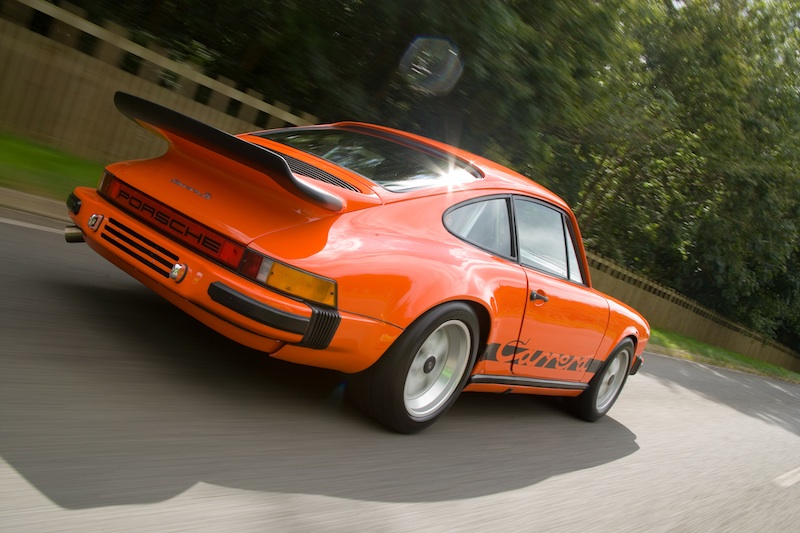
It’s tempting to write off the first IB Carreras as a step backwards in performance, and there’s no doubt that the weight added to IB 911s in order to maintain their marketability created a dynamic divide between old and new. But despite the shared power source, comparing ’73 RS to ’74 Carrera is not comparing apples with apples. The modern equivalent would be like comparing a 996 GT3 RS with a 997 C2: an almost irrelevant head-to-head. A significantly lightened impact-bumper machine would make a much better yardstick. Enter the orange car.
I first encountered this 1976 Carrera 3.0 on the Pelican Parts Porsche forum in 2004. The owner was GeorgeK, a Swiss 911 aficionado who at that time also owned a very nice 930 – and a ’73 RS. George is the anorak’s anorak, combining encyclopaedic 911 knowledge with a heartfelt appreciation of the heritage, and a love of the flat-six driving experience.
George bought his Carrera 3 in 1996, from much-respected Swiss Porsche specialist Alain Pfefferlé, an RS and RSR owner and hillclimb champion in his monster 935. Then finished in Copper Brown, the Carrera was wonderfully period, with two-tone sports leather in black and cream. The car was used daily for 18 months, until medical student George inherited a BMW at a bargain price. This allowed the Carrera to be taken off the road for restoration. The aim of the rebuild was to provide a fun car for use in the Swiss Alps surrounding George’s home. The shell would be repaired where necessary, strengthened where possible and then the car would be rebuilt on a lightweight RS theme.
Space is at a premium in Switzerland, and finding a place to work on the C3 was no easy task. Claudio Ciutto came to the rescue, donating a spot in the corner of his bodyshop, where the Carrera would eventually be painted. Workspace sorted, the car was stripped, and the shell and doors were sent for acid dipping.
First job on the post-dipping list was to protect the bare metal with primer, before repairing the usual IB rust spots: one b-post, windscreen corners and inner wings by bumper mounts. The work was done on a jig, as the car had previously been down the road on its roof, and this was an ideal opportunity to correct some of the lesser-quality repairs following that accident.
Myriad modifications were made to the shell. Strengthening was added to the rear shock towers and front aperture corners, and strut tower brace brackets were fabricated, all the patterns coming from an RSR. Upgraded rear anti-roll bar mounts were fitted, and superfluous holes in the tub were welded shut, including the vents above the rear window. Before a repaint in satin black, the interior was modified with a bulkhead battery master switch, lower seat rails from a late 3.2 Carrera, and welded mounts for an aluminium Heigo roll cage. The front panel was cut and boxed and a custom oil cooler installed, fed by hand-cut slots in the front valance. The rear bumper was slotted and lightened, a fibreglass valance was fitted and the bumperette holes were welded shut, pads replaced by readily available 917 race number lights. The fuel tank was enlarged for extended range and a polished 5.5-inch Fuchs rim was modified for use as a spare.
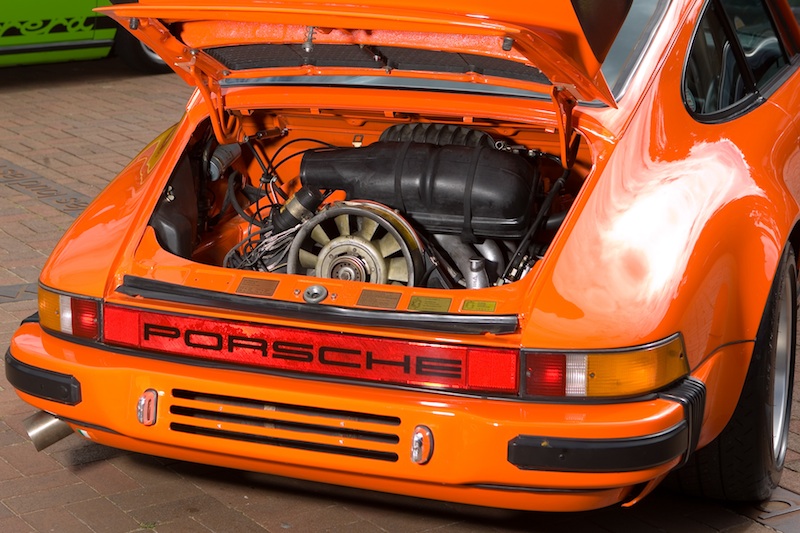
The lightweight parts fest continued. Aluminium was used for the front undertray, torsion bar covers, oil pipe clips, fuse box, smugglers’ box and centre tunnel lids, master cylinder mount, fuel sender cover and luggage compartment heater cover. The front lid is aluminium, from a 993 Supercup racer; Ciutto expertly repairing the bonnet pin and centre filler holes. In these pictures, the car is fitted with a fibreglass rear lid from an early Turbo, but it also variously runs an early fibreglass ducktail, and an aluminium 2.2S engine cover.
When it came to picking a colour, one shade stood out: Continental Orange, available for the ‘76-‘77 model years. The shell was infused with cavity wax, and thin layers of stone chip sealant were used on the underbody and wheel arches before the paint was painstakingly applied. Ten years later, the quality of Claudio’s work remains impeccable, with only a few minor blemishes visible.
Swiss vehicle safety checks are incredibly strict, insisting on cars being presented as type approved and measuring ride heights and exhaust noise levels. The C3’s mechanical parts would therefore be left more or less factory. Suspension is fairly standard: 19 and 26mm torsion bars, with stock anti-roll bars and Koni adjustable dampers. The brakes were uprated, with 964 calipers up front, 3.2 Carrera calipers in the rear and 3.2 discs all around. The magnesium-cased transmission was overhauled, with a shorter 7:31 final drive, new synchro rings and a 40% ZF limited slip diff. The engine had hydraulic tensioners fitted but was otherwise left stock.
The interior picked up a dash retrimmed in leather and a black headliner, both wrought by George’s fair hands. A pair of silly-expensive Recaro A8 lightweight recliners was installed. A Wevo shifter with elevated billet knob went in, along with the Wevo shift coupler. The wheel used here is an ex-race Momo Prototipo. Pedal box, column stalks and so on were stripped, cleaned and rebuilt. The loom was reconstructed minus now-defunct circuits such as electric windows and centre heater controls – backdated manual heat and windows having been fitted. Uprated headlamp relays were wired in. Reap Design in Middlesex rotated the tacho face, and the clock was replaced with an RSR blank. Prototype plastic exterior door handles were fitted, with RS door panels inside. Two years after starting the restoration, ‘The Orange’ was born.
Ownership following the rebuild was challenging to say the least. In September 2002, the original engine blew. C3 engines are rare, using the 6-bolt crank of the ’73 RS and early Turbo, rather than the 9-bolt version fitted to later models, so it took almost two years to find a replacement. In late 2004, an oil line failed on a mountain drive, causing more grief. George then began working overseas, so the car remained in storage. In October 2006, with a burgeoning medical career consuming more time, and a new baby on the way, the car was advertised for sale, quickly finding a new owner. A few weeks after the mountain snow melted in early 2007, The Orange was parked in my garage.
Changes to The Orange in my ownership have been few. The 7 & 9” Fuchs gained grippy 16” Michelin Pilot Sport Cup tyres, Ferodo DS3000 brake pads were fitted all round, and the heavy 18 kg battery was replaced with a lightweight Optima unit, mounted in the smuggler’s box. Seemingly strong dyno runs, showing 202 bhp at 5400 rpm, revealed a fuel pressure problem at high revs, duly rectified. With the marvellous Michelins, bulletproof brakes and a recent fuel and ignition system sort out, this little car now drives like a demon. 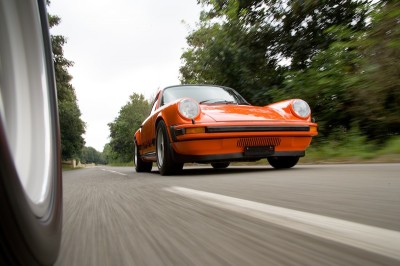
Torque of 255 Nm is identical to the 2.7, but the timing of the softer cams required by the K-Jetronic injection means C3 torque peaks 900 revs lower, at 4200. Combine the low-down torque with light weight, LSD, a shorter final drive and a slick Wevo-assisted shift, and you have a car built for back roads. The Recaros offer total support, and the lower seat height, higher shift knob position and reduced gear lever throw complete the perfect driving position. Stamp on the throttle in a standard C3 at 30 mph in fourth, and you’ll hit 100 almost 8 seconds faster than a 930 of the same vintage. Imagine what a lightweight feels like.
En route to our second location, I check the 2.7 in my 935 door mirror and the mile-wide grin on Dickens’ face is unmissable. Turning on to the beautifully undulating B4100, we open the throttles, our 911s living up to their exuberant exteriors. A little later we swap cars; I slide into the smooth driver’s seat of the 2.7 and prepare to be amazed.
The Orange weighs 960 kilos on an almost-empty tank, so driving the heavier 2.7 is disappointing at first. The bulkier chassis dulls the edge typical of lightweight torsion bar cars like the ’73 RS and the stripped-out C3, but something is still amiss. It is of course my own fault – I have forgotten that with wilder cams and 7300 rpm redline, Limey hides its 237 bhp higher up the range. Double-checking the rev counter and resetting my expectations, we start again. 
Now the unmistakeable gruff howl of SSI heat exchangers penetrates the comfortable cabin, and at 4500 rpm, the car takes off. As the revs tear past 5500, induction and exhaust erupt in tumult, and Porsche pedigree floods through the controls. First gear, second gear, third gear come quickly, showing 40, 70, the magic ton on the speedo. The competition suspension geometry is evident; despite a weight disadvantage, this car on Yokohama A022A rubber is eminently driveable. Limey runs an original ducktail without the chin spoiler introduced in 1975 to balance the bigger tails, but the absence of front aero does not induce a noticeable tailward bias: it feels perfectly solid whatever I try. The brakes are not as sharp as expected, given that the Carrera runs Turbo discs and calipers, but a firm shove on the middle pedal calmly wipes off speed with zero drama.
For a long time, Limey has been one of my very favourite 911s, and driving it today is a very special experience. But my heart belongs to lightweight specials and to The Orange, a car I have dreamed about owning since I bought my first orange 911 on a trip to France at the age of 10. As I leave lovely Limey behind and settle back into my own Carrera, a smile runs through me. The bright C3 is lithe and alive; pulling harder, turning quicker and braking with the bite that only fewer kilograms can give. My R-Gruppe hot rod aches to be driven, and that is just fine by me.
Sandwiched between the increasingly expensive early cars and their more populous IB siblings, the ‘74-‘77 Carreras are still a bit of an unknown quantity, yet when properly set up and driven to their strengths, they inspire like few cars before or since. Good condition examples represent some of the best value for money out there, so if you’re in the market for an interesting 911, don’t be afraid to try one – you just might like it. 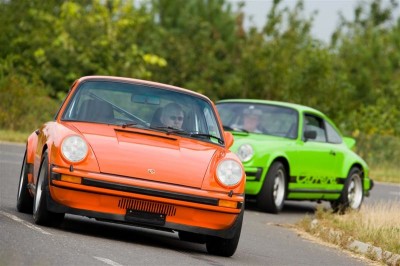
Thanks to:
Nigel Watkins
Bob Watson
Neil Dickens – www.thehairpincompany.co.uk
The Courtyard, Bicester – www.thecourtyard.org.uk

by John Glynn | Sep 17, 2009 | Classic Porsche Blog, Modified Porsche Hot Rods
Sheena Easton had the look back in the day, but this R Gruppe Hot Rod Porsche 911 T has it now. The owner has asked me to keep him out of the limelight, but I can’t resist sharing some pics. This car looks amazing: almost exactly how I want my own longhood, which arrives in the UK in just over 24 hours.
You just can’t beat the look of these custom Minilite equivalents – available through secret channels only heroes know about. I also love the centre filler, the track rubber, the wider front arches, the simple bumper etc. Race numbers are the icing on the cake, and are not for show: the car competes at the hands of both husband and wife.

The power in this one comes from a custom Euro-spec 2.7 built into a ’66 2.0 case. It runs 46mm PMOs, custom cams, a strengthened 901 transmission with 915 LSD and some sweet internals. The front end is Carrera (classic early-car mod) and the exhaust is SSIs with a Monty muffler. The owner did everything himself, including the 8″ flares and the paint. The inside is wicked also but I’ll save those pics for another day.
I’ve put a hat on now, just so I can take it off to the man who built this car. Thanks for the inspiration and for sharing some details. The car is perfect – hope to see it in the metal one day!

by John Glynn | Aug 14, 2009 | Classic Porsche Blog, Modified Porsche Hot Rods
My latest 911 & Porsche World magazine article comparing Porsche 911 3.2 Carrera versus 3.4 engine conversion is below. It’s big air-cooled engine rebuild week!
This piece was a lot of fun to do: two 911-owning brothers from Birmingham, who had developed their cars in tandem but approached from different angles. I think it came out as a good read and the boys love it.
Sibling Rivalry
When car-crazy brothers modify sibling 911s, there’s bound to be some rivalry. Ferdinand Porsche writer, John Glynn, decides whether someone should be sent to their room.
Born in Wolverhampton in the West Midlands, Shirish and Anil Patel are brothers; youngest of five, two years apart. I’ve known both for a few years now, and they are a credit to good parenting: intelligent, well spoken and always immaculately turned out (you can stop reading now, mum).
Like many brothers, it was while they shared a bedroom as kids that their mutual fascination with classic cars kicked off. Also like many brothers, neither will say who started it. “It was always there,” Anil declares. “Dad was a Ford man, devoted to Cortinas. With the blue oval as household badge of choice, we were RS crazy, and the walls were plastered with hot Escorts and Capris. We knew about 911s, but were never Porsche obsessed. The 911 thing didn’t happen until years later.”
Older brother Anil was first to bring a Porsche badge to the party. “I was looking for a classic car up to £10K, and thought an Alfa Romeo might be the way forward. Searching a few dealer websites, I found 911SCs lined up alongside the Alfas. I hadn’t considered 911s affordable, so I started digging about, to see what I could find. The first few trade cars I saw were ropey at best, so I increased the budget and started looking at private examples.”
This 1987 Carrera Coupe in shimmering Diamond Blue is what he ended up with. “The seller was a farmer who’d owned the car for ten years. He loved it but hadn’t really been using it, so the mileage was fairly low. I’d already looked at a 25th Anniversary Carrera in the same blue and liked the colour, so the paint was a plus. The owner had changed the registered colour of this one to grey as he was convinced that, were it ever stolen, the police would never find it if they were looking for a blue one.”
The bizarre logic did Anil a favour. The reluctant seller’s lacklustre ad for an old grey Porsche, being sold due to lack of use, had aroused little interest. Big brother bagged a nice G50 Carrera in his favourite shade for sensible money.
Shirish’s path to Porsche ownership was a direct result of driving the new arrival. “When Anil said he’d bought a 911, I shot straight over for a spin. After I’d had a go, no way was I missing out.” It took almost a year for Shirish to find the right car: a minty fresh Carrera Club Sport. Though the boys were clearly enjoying their shared interest in Stuttgartian sporting elegance, the rest of the clan didn’t quite understand.
“No one else in our family is all that fussed about cars,” says Shirish. “When Anil and I started getting into 911s, the age of our steeds caused some consternation. My mum asked, “why an E reg, why not buy a newer one?” They weren’t aware of how well older Porsches held their value.”
The Club Sport lasted a couple of years, before London life took its toll, and the absence of a garage for the cherished 3.2 forced Shirish to sell. An Audi RS2 filled the vacant parking space. The Polar Silver 4wd estate, a Porsche in all but silhouette, was a blitzkrieg-wagen par excellence, but the lure of the flat six never faded. The RS2 was eventually advertised for sale, only to be stolen the same weekend. It was found crashed and burnt out a few days later.
Losing the RS2 convinced Shirish that, without secure parking at home, another big-money Porsche was not what was called for. Anil had started playing about with his car, taking bits off and trying new stuff, so Shirish followed his older sibling’s example and decided to go for something more affordable, a car that could be customised with a clear conscience.
First registered in August 1987, Shirish’s Granite Green Carrera predates its Diamond Blue brother by eight months and a day. The owner admits the dark metallic shade had sold him on the car before he ever saw it in the metal.
Side by side here on the beautiful Berkshire Downs, the colours of these sibling Carreras compliment the landscape, and each other. The diamond hue harmonises with the hazy purple horizon, while the green melts into the subtle tones of this earthy environment.
Diamond Blue and Granite Green were both introduced with the G50 transmission for the 1987 model year. They stayed on the menu during 1988, before Granite was dropped for 1989, the final year of the impact bumper cars. I confess to being a big Diamond Blue fan. Its silvery sleekness shifts in sunlight to be sometimes sky, sometimes slate but always seductive over the curvaceous flanks of a classic Porsche.
As noted earlier, Diamond Blue was the colour chosen for the Anniversary Carreras, built to celebrate 25 years of the 911. The cars featured ruffled leather seats in purple (in reality more blue than purple), headrests emblazoned with Ferdinand’s signature, and thick Silver Blue carpets throughout. On body-coloured Fuchs, the Anniversary cars are an attractive package, though Anil and I agree it’s a while since either of us has seen one in genuinely nice condition.
The younger car’s bodywork is in good shape, following a bare-metal respray last year. Anil chose a recommended bodyshop in Reading to do the work, but is not best pleased with how it has worked out. One or two spots on the car are showing clear signs of poor preparation – frustrating having spent a substantial chunk of cash. He’d like to take it back and get it sorted, but who wants to send their pride and joy back to the crowd who messed up in the first place? I know where he’s coming from.
Still, the car looks amazing. The silver bonnet badge sets up a smooth theme that flows, through the front fog and headlight washer delete, to the deleted rear wiper and badgeless rear end. The bright-petalled 16-inch Fuchs work well with the colour and the ride height, emphasising this Porsche’s thoroughbred profile. The whale-tailed engine cover cements the flowing motif. This car looks fast, even when parked.
Big brother has made a few changes since buying his Carrera back in 2001. Bilstein HD dampers were one of the first purchases, but the suspension is otherwise pretty stock. New Neatrix bushes sit in the spring plates, with standard torsion bars all round. The front end features turbo tie rods, an ERP bump steer kit to correct steering angle on the lowered ride height and a Steve Wong strut brace, replacing the previous Weltmeister. The car was lowered by Steve Bull in Devizes and aligned by GT One in Chertsey.
Anil believes in evolution not revolution, and changes in the engine compartment are true to that philosophy. The ECU received a custom Steve Wong chip, with Magnecor plug leads taking the sparks to the internally stock powerplant. Drilled airbox, Club Sport engine mounts and a rear heater blower delete pretty much covers it in here.
Underneath, the exhaust has been modified with a H&S crossover, pre-silencer and silencer, but Anil is not convinced that this setup was the right decision. “You can’t do the valves without taking the exhaust off. This adds to the cost of servicing, plus I’m not sure about the additional heat on the heads. Also, we recently discovered the gaskets they fitted were handmade efforts with holes the size of 2p pieces – nowhere near big enough.” The restrictive metal gaskets physically melted under the pressure; factory parts now seal the joints. Finally uncorked, the car runs a lot better, though further engine developments are on the cards when top end rebuild time comes round. A look in the back of baby brother’s motor gives us a clue.
Shirish’s second 911 was sourced through an independent marque specialist. Following a litany of post-purchase issues, he’s been left unimpressed by the dealer experience, but money spent in the right places has since brought the car on leaps and bounds. The main reason for the gaping chasm in SP’s deposit account is hidden from view: an engine rebuild to 3.4 litres that was done by Winter. Steve Winter that is, at Jaz in Wembley.
Soon after taking ownership, the 3.2 was found to be using a litre of oil every 800 miles: time for a top end rebuild. A 3.6 transplant was an option, but that is not so much building as swapping, and the costs only make sense if the 3.6 never goes bang. Shirish took the decision to keep the bombproof 3.2 bottom end, and increase capacity with a big-buck Mahle 3.4 conversion.
Anyone who has ever investigated this upsize knows one thing: it’s not cheap. Consider the cost of putting an upstairs on a bungalow, relative to the value of said bungalow, and you’re in the right ballpark.
Build time for the mega motor was initially estimated at two weeks. The case was leak free, so the decision was taken to leave it together, refurb the heads and assemble the new parts. Two weeks became six and, in hindsight, Shirish would rather have split the case and balanced the bottom end.
Brand spanking Mahle pistons and 98mm barrels were not the only bits little brother bought. A pair of Dougherty Racing DC20 cams were found, and a 3.2 throttle body was bored out 3mm to increase the charge at wide open throttle. A lightweight starter was added, as well as Club Sport mounts and an upgraded K3 alternator. The list goes on.
Smart Racing valve springs, 993 head studs and rod bolts, refurbed injectors, new ICV and crank sensors, gearbox sensor, oil pressure switch, new seals everywhere. The transmission was given a lift with the G50 clutch fork mod, and new master and slave cylinders. The clutch was replaced with a 930 clutch disc, new release bearing and a Kennedy lightweight aluminium pressure plate.
Mothy heat exchangers and crossover pipe were replaced with standard Porsche items, flowing into a Scart pre-silencer and a DP Motorsport muffler. The engine fittings were replated, tinware was replaced and powdercoated, and new rear wheel bearings were the final while-you’re-in-there. Phew!
As the car arrives at our meeting point, the sound is impressive; the engine exudes unadulterated authority through the chunky DP silencer. This muffler is heavy – Shirish reckons 12 kilos – but the noise is anthemic. So it should be: new ones cost circa €1200.
The chorus of both cars on the move is intoxicating. The 3.2 has a lighter tone than its bigger brother; the sweet spot of that air-cooled thrum meets the eardrum lower down the rev range. The 3.4 is understandably louder through its bigger pipe, but volume is not the main ingredient. The DC20s lend a bass heavy burble to the tune played at tickover which carries right through the revs: it’s racecar sound at sensible decibels. At wide open throttle, it rocks the casbah.
Shirish loves the noise it makes, but he has not really heard it yet. Just as an acoustic guitar is never properly heard by the guitarist (the sound exits away from your ears, set behind the sound hole), so the sound of a 911 can only be appreciated when standing behind it. Now curious, he hands me the keys and I take off.
Take off is the right expression; this is a rocketship. I am expecting the bigger capacity to slow the revs down, but the reverse is true. Similar piston area with a slightly lighter rotating mass means the motor spins like a cartoon Tasmanian Devil. Flooring the throttle, I quickly hit the limiter in one and two: it revs that much faster than my Carrera 3.0. What the owner has spent is immediately justified by what has been gained: this missile is ballistic.
In a few seconds, I am knocking on big speeds and wishing Shirish had never swapped the tail for a flat lid. Standard ride height and all-original suspension means this new-found grunt really gives the chassis something to think about, and the underpinnings are the next job on the list. The engine was recently remapped, making 269 flywheel hp, but that’s unlikely to be ultimate power. With the engine and suspension upgrades Shirish has planned, this car will be off the scale.
Anil’s car might have fewer horses pushing it along, but a sharper, lighter chassis and highly effective brakes means that what it loses on the straights, it makes up in the bends. The middle pedal benefits from new calipers and genuine discs front and rear, with Goodridge lines and ATE fluid working Porterfield R4-S pads.
Both cars run Bridgestone SO2s on their 7 and 9 x 16-inch Fuchs, with 225/50s on the rear of the green car as opposed to 245/45s on the blue. On these slightly damp country roads, I can discern no difference.
Driving Anil’s car is a delight: gorgeous red-backed Recaros from a 968 Club Sport and a Martini Racing Momo wheel give the Carrera real sporting comfort. Deleting the electric seats and internal sound deadening removed a lot of weight, and the RS carpet set and door panels are pointers to more purposeful intent. Big brother will receive the same treatment some day soon.
Apart from the Momo steering wheel, the red-piped grey-green sports trim of Shirish’s car has rightly been left unchanged. RGA in Vauxhall recently resprayed one side of the Carrera, partly thanks to an errant Land Rover driver. A new near side wing and fog delete front panel, smooth engine cover, work to the passenger B-post and fresh paint over the lot cleared out what was left in Shirish’s piggy bank. The driver’s side will be done when funds are replenished. “No rush,” says Shirish, “Anil and I have plenty to keep us busy in the meantime.” ‘Us’ is the operative word.
On the subject of rivalry, the great Luciano Pavarotti once wonderfully observed: “The rivalry is with ourself. I try to be better than is possible. I fight against myself, not against the other.” The same can be said of so many of the brothers I know who share this love of classic cars.
My own younger brother lives in another country, but his friendship, support and opinions are very important to me. So it is with Anil and Shirish. If there is rivalry, it is low key and outside the core relationship; differences are accepted with mutual respect. This is brotherly leapfrog; co-dependence based on the realisation that the key to all successful friendships is to keep them moving forward. If there’s a better case to be made for sharing classic Porsche ownership, I’ve not seen it yet.

by John Glynn | Jan 23, 2008 | Classic Porsche Blog, Modified Porsche Hot Rods
Mention carbon fibre to most Porsche fans, and their thoughts turn to prototype racers like the RS Spyder. But Rainer Armitt’s outwardly standard SC hides an enviable selection of secrets up its significantly lightened sleeves. John Glynn reports.
Once upon a time in Leverkusen, Germany (1997 to be precise), an early 911 SC Coupe was bought by one Michael Roock, of Porsche tuners Roock Sportsystem fame. The car was quite superb, with fewer than 50k careful miles covered in 19 years. The initial intention was a simple valet, to bring the car back to showroom condition. But within a few days, the urge to improve had triumphed, and the spotless SC had been stripped for an almost complete rebuild.

Though manufactured in 1978 (the year the SC won the Monte Carlo rally), this 911 is a 1979 model year car, an excellent choice of base vehicle. Firstly, it had a fully galvanised shell, so the bodywork was in great shape. Secondly, it had been delivered without a sunroof, not an easy thing to find post-’78, and a perfect starting point for a lightweight special. Finally, buyers’ guides of the time had short-sightedly labelled the early SCs as ones to avoid, so they were relatively cheap, even in immaculate condition. Anything the Roock brothers did was likely to be regarded as an improvement.
The earliest SCs were down on power compared to later models (180bhp as opposed to 204bhp from the 1981 model year), but the rated output of the first SCs was more political than mechanical. The management of the time had decided to phase out the anachronistic 911 in favour of the 928, and the run-out model could not be seen to be faster than the more expensive V8-engined flagship.
The early SC shares most of its motor with the preceding Carrera 3.0, which produced an easy 200 bhp. The SC engine uses a slightly bigger 9-bolt 3.3 Turbo crankshaft, but almost everything else is the same. Revised cam timing meant power was down against the Carrera, but this somewhat devious device gave the new arrivals better torque lower down the rev range, making them irresistible driving machines. (more…)
by John Glynn | Jan 23, 2008 | Classic Porsche Blog, Modified Porsche Hot Rods
Porsche 930 with Olive Green Leather Interior: A 911 Turbo specially ordered from the factory by a Le Mans Porsche racer could be expected to be a little bit special. It is. Ferdinand Magazine’s John Glynn tells the story.
“Is this the one with the green seats?” asks a fellow 911 owner, as I emerge from the sublime 930 in the paddock at Donington Park circuit, following a spirited drive through the Derbyshire countryside. The ‘love it or hate it‘ leather interior is perhaps the principal reason for this car’s growing notoriety, but there is more to the story than quirky custom trim. JWR 195Y was originally built for a racer who drove his way to the Le Mans podium, in one of the greatest 911s of all time: the Kremer 935. This Turbo has provenance with a capital ‘P’.

When Francois Trisconi signed with the late Erwin Kremer for the 1979 24 Heures du Mans, he had already enjoyed some success at the greatest race in the world. 1976 saw a respectable debut in Georges Morand’s Lola Ford, with fellow Swiss drivers Morand and Andre Chevalley. Following 279 racing laps, the car finished fifteenth, taking a class win. In 1977, an engine failure forced Team Chevalley to retire their BMW-powered Cheetah after nine hours. Twelve months later, the boys were back in town, this time in a Cosworth DFV-powered Inaltera built by Jean Rondeau. The Swiss team again finished the race, reaching a worthy P13.
In 1979, Trisconi jumped ship to Porsche Kremer Racing, settling into a 935/77A, car number 40, alongside Laurent Ferrier and Francois Servanin. Ferrier and Servanin had been partnered at Le Mans twice previously, once in a 934, and Servanin had also completed the previous year’s event in a 911 RSR, taking a GT class win, one place ahead of Trisconi and one behind Ferrier’s Chevron. Here were three evenly matched drivers then, all capable of a class win over a race distance.
Fifty-five cars took the start on Saturday, with Trisconi doing his first stint after two hours. Early on Sunday morning, the heavens opened and a wet race ensued, minimising the performance advantage of the prototypes. Almost 3,000 miles later, the ballistic Kremer 935 K3 was first past the post, driven by Klaus Ludwig and the enigmatic Whittington Brothers. Second was the Barbour Racing 935, Paul Newman sharing driving duties with Dick Barbour and Rolf Stommelen. The final podium place went to Trisconi and friends in a third 935, which had almost been an afterthought for the Kremer team, running as it was in an outdated Vaillant livery from the previous season. This was the first year a 911-based racer had won at Le Mans.
Drivers who have spent 24 hours blasting around Le Mans in a Kremer Racing Porsche 935 are like astronauts – there aren’t that many of them – and most of us can only imagine how visceral the experience of piloting a 600 bhp 911 through the night on closed public roads must be. When Trisconi decided to order a new road car in 1983, it was almost inevitable that he would again become a Porsche customer, and that his order would be something out of the ordinary.
Introduced for the 1975 model year, the 911 Turbo was a milestone in production car history. The original 911 Turbo was developed around the 3.0 Carrera RS engine, using similar aluminium crankcase, cylinders and heads. Compression on the early Turbos was a low 6.5:1, to which boost pressure of just under 12 psi was added, resulting in 260 bhp at 5,500 rpm. 260 bhp may not sound like a lot, but remember this was 1974. Road testers of the time talk of autobahn runs where they found themselves on the brakes as much as the accelerator, rushing up on buzzing little family cars at 155 mph in the Turbo making for some interesting moments with the first cars’ puny brakes.
Updates for the 1978 model year dealt with the brake issue by adding drilled discs and finned calipers, a la 917. It also lifted engine capacity to 3.3 litres, and brought in certain other developments, which fixed the Turbo firmly at the top of Top Trumps wish lists. Gone was the smooth one-piece tail of the original, to be replaced by the Tea Tray, a taller two-piece engine cover with elevated top edges, under which lay something revolutionary for road cars of the late ‘70s: an intercooler.


Nowadays, commonplace turbodiesel technology makes intercoolers sound about as inspiring as belly button fluff, but 30 years ago, the story was completely different. With an intercooler, the additional engine capacity and slightly higher compression, 260 bhp became 300 bhp, and how we schoolboys loved it: bedroom poster manufacturers just couldn’t keep up. Further tweaks for the 1983 model year lifted torque to 318 lb/ft at 4,000rpm. When Motor magazine tested the car’s 0-60 time at 5.1 seconds with top speed 162 mph, Francois Trisconi couldn’t resist.
The 930’s unrivalled ability to cross continents in a single bound had turned the gloriously understated Turbo tail script into a status symbol for wealthy businessmen. This market loves its creature comforts, and consequently the car had piled on the pounds since its inception, the ex-works weight without options rising from 1140 kg in 1975 to 1300 kg in 1983. Still very much a racer at heart, Trisconi knew that on his Turbo, less would undoubtedly be more. He asked for a car without the trimmings, and Porsche were only too happy to oblige.
The first box unticked was the electric sunroof. No self-respecting racing driver would sacrifice structural rigidity for a sunburnt scalp, so the roof remained intact. Air conditioning was also avoided, the heavy compressor and piping adding weight in all the wrong places, obstructing the flow of cool air into the engine compartment and sapping power. The owner decided he would open a window instead, and added a heated windscreen to keep damp mountain air from fogging up the front glass.
As the order was going directly via Weissach rather than the Swiss importer, other alterations were made to enliven the driving experience. Most noticeable was the addition of a limited slip differential, to assist grip through twisty Alpine passes. The car allegedly came with some engine tweaking to lift power to 330 bhp, something the new owner plans to verify on a future dyno run. Dampers and torsion bars were uprated to give a firmer ride, and race pads were fitted to add to braking prowess.
The decision on paint colour was taken solely to satisfy the owner, as it should always be. Far too often in the UK we are confronted with an incredible fixation on colour, the question being “what colour should I buy for best resale values?” This has to be one of the most bizarre car-buying concepts ever, essentially buying a car to appeal to the next owner. Thankfully, our European Porsche brethren do not usually suffer the same concerns and the decision was made to go with Kiln Red, a colour offered for the 1983 model year only.
As previously mentioned, the interior colour is possibly the most distinctive feature of this unique car. Unhappy with the colours available, the new owner commissioned a colour-to-sample interior in Olive Green leather. To my eyes, the shade is reminiscent of the Vaillant Green of the Kremer car that took Trisconi to the podium, but whatever the reasons for this particular selection, the combination is superb. When the car was finally delivered, it weighed less than 1200 kilos with the fuel light on. The buyer was suitably pleased.
In 1997, Swiss Porsche enthusiast GeorgeK got a call from his mechanic, Alain Pfefferle of the renowned Garage Pfefferle in Sion. The Trisconi car, which Pfefferle had maintained for many years, was up for sale. With just 64,000 kms on the clock and a full history from Pfefferle, himself a 935 and RSR owner and racer, the purchase was a no-brainer.
In its new ownership, it gained a few subtle additions. The front Fuchs wheels, originally 7×16, were replaced with 8×16 rims, retaining 205/55 tyres to minimise tramlining. A 934 boost gauge with telltale was fitted in place of the original clock, and a smaller replacement timepiece from a 924 Turbo was slotted into the centre console. A front strut brace was fabricated from part of a Heigo aluminium roll cage, and other small but satisfying jobs were completed: the restoration of an original Hirschmann electric aerial for example.
The car was enjoyed on many driving holidays, getting as far north as John O’ Groats. Autobahn runs revealed a higher-than-standard top speed, at a stopwatch-verified 170 mph. Ten happy years later, an expanding family and the pressures of working overseas for long periods of time meant the 930 was just not being enjoyed as much as George thought appropriate, so in early 2007 it came on the market.
Having just sold an excellent condition 993 C2S for ‘not being classic enough’, Richard Jackson was two weeks into the search for a spotless 930, when the Trisconi car appeared for sale on impactbumpers.com. Some off-forum discussion followed, centring on the pros and cons of LHD in the UK and the costs involved in importing a vehicle from Switzerland, which of course is outside the EU. A few weeks later, Mr Jackson took Mrs Jackson away for their wedding anniversary, coincidentally bumping into GeorgeK at the airport and seeing the car first hand. A deal was sealed and the happy couple celebrated with a romantic weekend on the shores of Lake Geneva. The following month, a 1500 km drive with a good friend ended with the Trisconi 930 safely ensconced in its new North Yorkshire home.
The importation process was straightforward, though it did take a bit of searching to find a garage that would MOT the car on the chassis number. Work pressures have meant that the car has only covered about 500 kms since its arrival in the UK. Jackson plans to use the car much more next year, and is contemplating a low-numbers track day, to allow him to explore the car’s performance in relative safety, logic I wholeheartedly support.
Having known this car online for a few years, seeing it in the metal for the first time is an experience. We meet on a cloudy day in ordinary surroundings, but despite the lack of sunshine, the colour is very much alive; the metallic shifts in the burnished paint emphasising the nuances of the 930’s sinuous bodywork. Some metallics are an on/off switch, the flip of the paint giving a light and dark side and not much else, but Kiln Red has countless shades. There are hints of brown and orange, fleshy pink and gold, it is simultaneously evocative of elegant copper distillery stills, the warm and inviting red brick of an old Victorian house and bubbling fissures in the earth’s crust.
Opening the door on that interior is a moment to cherish, the verdant leather dash top and trim tinting the black headliner a dark evergreen. The cabin is a classy palette of olive, black and light cream, and when the green is viewed against the smouldering red exterior (in the immaculate door shuts for example), the effect is mesmerising.
Sliding into the flat-backed Recaro sports seats with their supportive side bolsters, the most immediate impression is just how clean this car is inside and out – testament to its still-low mileage of under 70K. I start the car before optimising my driving position and am struck by how quiet it is. It’s been a few years since I last drove a 930, and one of the most surprising things initially is how much more silent it is than its normally-aspirated stable mates.
The 930 transmission was designed to handle prodigious pulling power, so the bigger clutch and gear sets take some moving. As an SC and 3.0 Carrera owner, I am used to the more common ‘double-H’ shift pattern of the 915 gearbox, so not finding reverse first time is a wake-up call. To go backwards using a four-speed 930 you push left and forward, where first would be on a 915 transmission. There are only four forward gears on 930s up to the 1989 model year. Clutch in, I shove the lever past its reverse restraint. We escape from our parking space and are away.
I am immediately aware of the heavier rolling mass, but the car soon shrinks around the drivers seat in the same way that a narrow-bodied 911 does. The throttle action is delicate and direct. This car has a rock-solid 950 rpm idle, which it will return to and sit at quite happily whatever the situation. It pulls cleanly, whether trundling through town or at optimum motorway cruising altitude. Lifting off produces the most wonderful flourish of burbling and popping from the twin exhausts – another 911 which may or may not have a working radio.
I drive 911s most weeks but the first few miles in this car take some getting used to, mainly due to the taller gear ratios. We make it to fourth on a couple of memorable occasions, whereupon a wonderfully lazy 220 km/h is no problem, but as my Dad used to say when I was learning the drums, “anyone can play fast, the trick is playing slow”. The same is true of the 930 – the low gears are the ones that count.
Second and third gears in an SC or Carrera are where the fun is. Once the car is moving at anything above walking pace, first gear remains untroubled until a standstill is involved. Not so in a Turbo. First on this car will run up to over 50 mph, so a comprehensive re-education regarding gear ratios is required. The gearshift itself also demands an amount of familiarity. At low speeds or on the motorway it is no trouble, but the torsional forces acting on the engine and gearbox mounts when shifting up under hard acceleration can easily hamper the shift process – practise definitely helps. The same can be said of decelerating.
This car is fitted with the famous 930 brakes as derived from the 917s, but I find them slightly underwhelming. GeorgeK tells me that Ferodo pads are fitted, with a softer compound in the rear, and that the best way to drive them is with a steadfast shove to the middle pedal when the time comes. Were this my car, I would probably experiment with different pad materials and perhaps consider a slightly larger master cylinder to reduce ultimate pedal effort. A good friend who uses his pristine ’84 930 on track, confirms that his rebuilt brakes also require a solid prod, and has only good things to say about a recent upgrade to Pagid fast road pads, with the fronts replaced by Ferodo DS 3000s for track use. I love the DS 3000 pads on my cars and would be inclined towards them also, learning to modulate their impressive initial bite in this application.
No talk of 930s would be complete without mentioning the all-important boost factor. Having owned a fair few turbocharged cars in my time, I confess to being a recovering boost addict, and the push served up by the 930’s compressor is familiar and fantastic. This car has reliably run boost pressure as high as 1 bar – just over 14 psi – but today is putting out around 0.7 bar or 10 psi, quite fast enough for a novice on the damp twisties. The onset of boost is very controllable with this delicate throttle, and the 934 gauge is far superior to the factory item in the bottom of the rev counter, so we play around a bit with throttle and gears to see just how much we can minimise turbo lag.
Floor the loud pedal at 40 mph in second, and you can count to nine elephants before the boost comes rushing out of the scenery. Start the same exercise at 25 mph in first, and only three elephants pass before the pressure is up, and the Kiln Red ball leaves its cannon with a whoosh. Shift quickly into second at 5,500 revs (serious gearshift practise needed), wait a second for the boost to rebuild and you almost immediately hit 85 mph before reaching for the lever once more. It is utterly moreish, so much so that I am making up excuses to ‘just try this’ and ‘just try that’ all the way back to the pits. Told you I was a recovering addict.
I rack up forty miles in the 930, and as we return to the Donington paddock, I can’t help feeling that it would take at least ten times that to feel properly dialled in. My time with the Trisconi 930 ends with a certain amount of disappointment, but only because I know I’m going home in my daily driver, whilst Richard Jackson gets to go home in a car whose DNA can be traced back to a Kremer Porsche on the Mulsanne Straight.
The challenge now facing Jackson is the same one facing any would-be 930 devotee: learn to seamlessly combine throttle, gears, boost and brakes and forge an almost symbiotic relationship with the machine. Once these areas have become second nature, the driver can then begin to concentrate on maximising the car’s prodigious potential, and develop a proper understanding of how the legend should be driven, in the fullest sense of the word.
The 930 hides its best features where casual observers will not trip over them. Only by digging determinedly into this car’s deep seam of inherent ability will a driver discover the secret to really making progress across country. The early Turbo therefore demands huge respect, but not in the way we have traditionally been led to believe by motoring journalists who did not take the time to fully appreciate the car’s character. It demands respect because if it’s under control and pressing on, the person behind the wheel definitely knows what they are doing.
Thanks to: Richard Jackson, GeorgeK, David Moss.