by John Glynn | Jul 7, 2010 | Classic Porsche Blog, Modified Porsche Hot Rods, Road Trips
Today was the last day in Monaco for the 2010 R Gruppe Grand Tour. With no group plan for the day, I was up at 7.30 and out in the Orange 911 Carrera 3.0, to repeat yesterday’s drive up the Col De Turini, and the amazing road from Turini to Sospel.
Col de Turini is the heart of the Monte Carlo Rally. As Monte has been a dream event for me for many years, driving the core stage of this monumental test of man and machine was a must.
At just 1607 metres high, Turini is a relatively low mountain pass, but that does not take away from the sense of occasion one enjoys upon reaching the summit. Once at the top, there was no doubt in my mind: a life goal had been reached.
After driving up the Col, I spent the early part of the morning seeking out locations for a photo shoot planned for later that day. I came up with some places and plans, which ultimately did not work out anything like I’d intended but, regardless of the operational challenges, it was great to spend time with the five faithful Gruppers who returned to the mountains to help me with the work. Many thanks to Leonard, Jan, Guenter, Gerd and Martin.

Tomorrow we drive to Le Mans, for a weekend at the biannual Le Mans Classic. It’s my first time there with press accreditation, so I’m looking forward to the challenge of working at Classic Le Mans, rather than just being there as a Porsche fan and car guy in search of entertainment.
Not that there won’t be entertainment to hand! My fellow Bergmeisters are all coming to Le Mans, where we’ll be joined by the ImpactBumpers.com crowd, and the Dutch R Gruppe posse. The Amsterdam massive includes good buddy Arjen Bosman, who has rented a (British) caravan to camp at the event: bound to be unmerciful fun.
The exception to the attendees will be little brother Sam, who flies back to Dublin from here tomorrow. He has been to every CLM with me so far, so it’s going to be strange not having him with us this time around.
We leave Monte Carlo at 7am. After today’s drive down from the mountains through Castillo and the other lovely villages overlooking the bay, I’m missing it already.

by John Glynn | Apr 15, 2010 | Classic Porsche Blog, Modified Porsche Hot Rods
This pretty little Porsche might look like a factory hot rod, but it hides a guilty secret. John Glynn went to California to find out more.
Engine transplants have been the backbone of hot rodding since Moses was a boy. Nothing is more renegade than running an excessive engine in a chassis that was never designed to handle tons of torque. Overdosing on power-to-weight, and then making that package work is what custom car construction is all about.
When Bob Marx took the temporary motor from his 454 Chevrolet Chevelle SS, to refit the rebuilt original powerplant, he was gifted a great-running V8 with nowhere to go. Later that week, while cruising a friend’s E36 BMW M3 Cabriolet down to a Silicon Valley car show, the thought occurred that building an open-topped European vehicle with all-American power might be kind of fun.
Spotting a Porsche 914 at the show, Marx took a closer look at the engine bay. He was convinced that the spare V8 would fit in the mid-engined location. The hunt began, almost immediately uncovering this car just a few miles from Bob’s home in Pleasant Hill, on the outskirts of San Francisco.

Marx’s machine began life as a 1700cc 1972 914.“A rust-free California car was what I was looking for,” recalls Bob, “and the owner assured me it was exactly that, so I went and had a quick look. I noticed a few things I didn’t like, but we agreed a deal and I brought it home to get to work. As I began stripping back to the bare tub, I uncovered more and more rust, along with some shocking hack jobs on things like the wiring. It was not the best of starts.”
Although classic Teener rot spots, such as the hell hole (the area under the battery tray), front floorpan and rear luggage space needed nothing bar a quick wire brushing, extensive corrosion was uncovered in the sills, floorpans and battery tray. Bob cut out the rust and welded in new repair panels, before taking the exterior down to bare metal and welding on the steel GT arch pack, key to the look of this car.
Sold new with mid-mounted 1.7 or 2.0 litre engines, cooking versions of the 914 were never intended to take the power of a small-block Chevy motor. Strengthening the chassis was essential to deliver a safe, confident drive. To achieve this, Bob welded in the longitudinal and rear arch stiffening kits, to minimise rear flex under power, which would ultimately have cracked the back end. He also ensured that the factory stiffening was still working as it should.
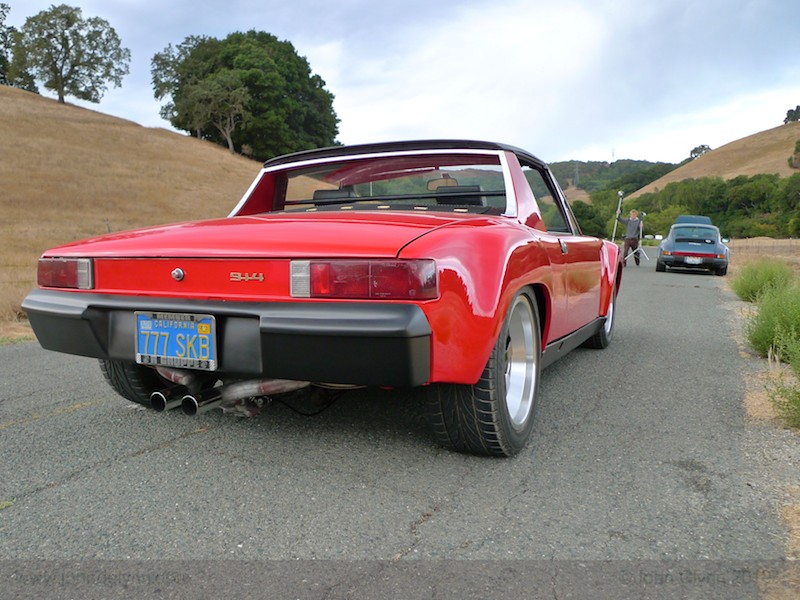
Porsche had only ever fitted air-cooled engines, so work was needed to house the water cooling required by the incoming Chevy. A custom rad was fitted in the nose, with homemade ducting to direct cold air through it. Lightweight Gates hoses carry coolant back and forth. The front valance was modified to let the air in and then painted satin black. At the back, a bi-folding engine grille was built, again for better airflow. Both look great. The reflection of the grille in the rear glass, set between the side buttresses, is a really sweet aspect.

With the chassis work now just about complete, Bob sent his wide-arched shell off to be blasted with baking soda. Once this was done, the attractive bare-metal bodywork was returned to Bob’s workshop, for final parts fit before the whole thing was painted in Porsche Guards Red. The colour looks perfect in this California light: not too brash and not too boring.
The engine is a 1968 327 cubic inch V8, built in Detroit and originally fitted to a Corvette. 327 cubic inches is 5.4 litres: over three times the size of the original. Prior to installation, Bob rebuilt the motor with some trick parts. The block received a light hone before Keith Black 10:1 pistons were slid into the bores. An Edelbrock intake manifold, topped with a 610 cfm carburettor from the same manufacturer was securely fastened to the top end. Stock Chevy headers flow into sexy, GT40-style exhaust pipes. Power is an (under)estimated 345 bhp.
The 901 gearbox is a Porsche classic. Though never built with 350 bhp in mind, it’s a strong, reliable unit which, driven considerately, is nicely suited to the lazy torque of a big V8. The 901 is often seen in historic 911 rally cars, and normally requires no more than a strengthened sideplate and new crown wheel and pinion to make it bulletproof. But that’s with a hundred fewer horses stampeding their way through the transmission. Though this application is more car show and less Tour de Corse, it’s still a big ask.

The 901’s weak point is the dog-leg first gear, located left and back on the shifter. Too much power can twist the separate first gear shaft away from the rest of the internals, so Bob uses the engine’s humungous torque to pull away in second. I do the same in my 911s – it’s no big deal. Thanks to a parts wait, the tail shift mechanism is still fitted to the transmission. Meanwhile, Bob has switched to the slicker side-shift setup, to get the best out of swapping ratios. Future plans feature a more robust 911 Turbo transmission install.
Stance is everything on a hot rod and this one hits the spot. Sports cars sold in the USA have long suffered from vertigo, induced by the towering statutory ride heights that resulted from Ralph Nader’s safety campaigns of the 1960s. Returning the car to European ride height is a popular mod amongst US Porschers.
Tuning the suspension of a chassis that’s had its power tripled overnight is a tricky business, but Bob reckons he’s got things under control. Considering the stock front anti roll bar is thinner than an anorexic stick insect, and there’s no bar fitted to the rear, this sounds hard to believe, but it all looks flat as we follow the car to our photo location. The front is held up by torsion bars and controlled by Bilstein Sport dampers, with Bilstein coilovers and 200 lb springs at the rear.
Hiding behind those 7 and 8” replica Fuchs rims, wrapped in 225 and 245 Fusion ZR1 rubber, are front brakes from a 911 SC, and stock rears. Doesn’t sound like much with the power that’s on tap, but then this car is light, and the brakes have been fully refurbished with a new master cylinder, flexible hoses, caliper seals and the rest. The suspension has also been overhauled, with new bushes and joints all round.

Inside, the classic Porsche-designed cockpit has been left alone, with a three-spoke steering wheel and supplementary gauges the only new additions. Sitting into the car for the first time, I strap the harness tight and brace myself for action; this could be quite a ride.
Turning the key is cause for celebration. The Chevy cranks quickly into life and settles into that classic V8 fast/slow/fast tickover rhythm, which adds a dash of urgency to the low-slung seats and go-faster view along the sleek bonnet. I’m properly excited and we haven’t moved yet. Slipping the lever forward into second, I add a drop of gas and let out the clutch. The car slips from the kerb in a civilised fashion, encouraging me to try another gear.
Rolling on an ocean of torque, the Teener pulls effortlessly; normal speeds in third are a whole heap of fun. As we hit a stretch of smooth dual carriageway, I throw open the throttle and let the V8 sing. The Fabulous Fourteen unleashes like a cartoon Roadrunner, pouring hyperspace between us and the cars behind. This thing is more addictive than chocolate-covered coffee beans.
The direct gearshift and dependable brakes work well together. Thanks to the wider track, the steering feels fantastic. Although the front end ride is perhaps a little stiffer than I would prefer over rough roads, it’s early days for this car’s development: Bob’s only recently got it fully on the road. At the minute, he is concentrating on maximising the miles and just driving. Can’t say I blame him; it’s a wicked little grin machine.
A few days after we arrive back in the UK, I get an email from Bob about the car’s first show appearance. It’s gone down well, with lots of positive comments and face-wide smiles from those who don’t initially spot the V8 in the back. It’s all the validation needed to justify the blood, sweat and tears that went into making it.
My hat comes off to guys like Bob, who can take a concept, add weeks of work and almost single-handedly see it through to completion. This sweet little missile strikes a direct hit for men in sheds everywhere.

by John Glynn | Feb 27, 2010 | Classic Porsche Blog, Modified Porsche Hot Rods
Singer Vehicle Design first showed its restyled 911 at a California concours. Singer’s Rob Dickinson gave the exclusive first full article to Ferdinand Magazine owner, John Glynn. See the behind-the-scenes story of our Singer Porsche feature and read the full article below.
John Glynn meets the Singer Porsche 911 prototype and its English designer, to find out whether the car is the ultimate 911, or the ultimate ego trip.
I remember the summer of 1993. My girlfriend was promotions manager for Warner Bros records, while I played in a band that was doing OK. Travelling to and from gigs, we’d listen to her recent releases. One night, it was ‘Chrome’, by Catherine Wheel. The album’s intense opening track: ‘Kill Rhythm’ is still one of my favourite driving songs. It was a pleasant surprise to learn that songwriter Rob Dickinson had a passion for early 911s.
Seeing Dickinson’s ‘69 911E for the first time was a real eye-opener. The car featured sports purpose references alongside original design ideas, such as a drilled plexiglass engine grille, a sweet mix of tan body, yellow stripes and green graphics, and orange surrounds to 911R rear lights. Throaty tailpipes hung beneath the 69 POR licence plate and screamed rock and roll. Its owner had once again struck exactly the right chord.
It’s been five years since I first saw that E online. Today I’m standing next to it, in a car park off Mulholland Drive: home of the infamous LA street races of the late ‘70s and early ‘80s. It’s just before sunset, and Rob and I are waiting for his latest project to arrive. The Singer Vehicle Design 911 is almost an hour late, but it’s hard to be upset when our Hollywood Hills location offers such an unbeatable view of the city below.
“You have to love this place,” declares Dickinson. “It’s all about positivity and making things happen.” Born in England, Rob came to America in 2000 to make his way in sunnier climes. Though he claims to miss “pubs and cynicism”, it’s clear that California car culture has had a major effect on his mindset. When the trailer bearing Rob’s pride and joy suddenly bursts into view, there is a tiny explosion of joy in our midst.
The Singer incorporates influences from almost every era of air-cooled 911 history: from the earliest factory prototypes through to the most contemporary R Gruppe hot rods: cars such as the trailblazing 3.6-engined early 911s built by Jeff Gamroth at Roth Sport, and Steven Harris’s sublime ‘SHtang’, built by Hayden Burvill at Wevo.
As Singer technician John Bowmanprepares the car for unloading, my eyes gorge themselves on this shape, subtly different from the original in so many places. The custom front bumper and valance are first to catch my eye; deeper and more purposeful than the original, with an additional air dam under the wide central oil cooler intake signifying serious intent.
My eyes skate along the bodywork. Gone are the horn grills and old-style headlamps, replaced by bespoke front light bodies with integrated front fog lights, and clear polycarbonate headlamp lenses over brand new bi-xenon lamp units. The central fuel filler cap is functional sculpture, floating in a pool of liquid bonnet.
The scuttle panel features the 993 wiper arrangement, while inside the ‘screen sits a ‘65 rear view mirror. The parts work well together. The driver’s mirror is a Singer design, mounted through the quarterlight. The custom housing hovers zen-like in its transparent surround, simultaneously suggesting lightness and technical prowess. One look at this car tells you it was not built by an amateur.
Before leaving to become a rock star, Rob spent two years studying vehicle design at the renowned Coventry University. He then worked for a short time at Lotus Cars in his native Norfolk, before emigrating to the USA. Here’s a guy with an eye for detail and an irresistible urge to create.
After such exciting initial impressions, it’s disappointing to discover that the Singer is not yet ready to be driven in anger. As a prototype display model, built to a tight schedule for California’s summer car show season, it’s still very much in development. This is the car’s first trip on a public highway. The engine bay is stunning – tea strainers on Jenvey throttle bodies look superb – so it’s frustrating that we can’t jump in and try the 3.8 Jerry Woods/Colin “Ninemeister” Belton motor, as further fettling is required.
The front compartment is also unfinished, hence the lack of pictures, and there are many other areas still to be sorted, but none of it seems a big deal right now. As every 911 guy knows, you can forgive this shape just about anything. Good job too, as minor mechanical hiccups cause our already late photoshoot to go from bad to worse. In the end, photographic genius, stunning views and this gorgeous car come together to carry the day.
We arrive in California a week before we see the Singer, and our upcoming shoot is a hot topic amongst Porsche guys. One thing many ask is: why? What purpose does this car serve? Do Singer seriously believe they can do a better job than Porsche did over 30-plus years of development? I put the question to Rob.
“This is not about us outdoing the original. Air-cooled cars were perfect for their time, and still work well; I use my ’69 every day and love it. But in today’s environment, they’re a sizeable compromise. There are no creature comforts, and the minimal technology is old hat. There’s a hefty power deficit versus modern sports cars and, even if you freshen the look by adding ST arches and wider Fuchs, it’s still an old car that can be challenging to drive daily.
Our car comes from a different set of wants and needs. It retains that iconic profile, but the rest of the car is painted with modern-day tools; contemporary design containing an elevated degree of sophistication. Every Singer is bespoke, as every owner is unique.”
One thing is likely to be common to most prospective Singer owners: rich in money, poor in time. They will have the financial wherewithal that renders compromise unacceptable, but with a schedule prohibiting the intense process of building the ultimate daily-driving early 911 via a bodyshop or Porsche specialist. They will appreciate the ability to turn up, tick the options boxes and come back to the finished product a few months later, without having to take on a car that will still need development, months after it has been delivered.
This is why some early 911 enthusiasts will view the Singer and its raison d’être as despicable. What is an early 911 without pain? Where are the trials, the hardships, the blood, sweat and tears involved in creating a special early car? You mean they can just turn up and drive it away? That is so not right – all the fun is in making the car happen in the first place!
But should we all find it fun, trawling the forums for factory information, endless early-morning swap meets to find the right mirrors and multiple attempts at remapping new-build engines before the car begins to run right? Why not just bypass all that and jump into the perfect daily-driving early 911, with power and presence right from the word go? I can see where Rob is coming from.
The Singer is not just one man’s work. To realise his dream, Rob assembled a team focussed on delivering a credible, compromise-free classic. Starting with the bodywork, Dickinson spent 9 months at Singer’s Sun Valley HQ with Tesla car designer (and fellow 911 guy) Radu Muntean, developing a fresh, heritage-inspired exterior.
Once the look was set, the car was taken to Aria, a protoyping and design facility in Irvine, where expert clay modeller, David Harris, perfected and balanced the bodywork, and prepared it to take moulds for the production car’s carbon fibre body panels. The Singer retains only the steel doors from the original car; all other body panels are composite.
“Most car manufacturers and vehicle designers have studios in California,” notes Rob, “so the automotive community is well versed in prototyping concept car parts. This vehicle could never have been built in the UK.”
Knowing that the car would run 17” Zuffenhaus forged alloy Fuchs (9” front and 11” rear) and Michelin tyres, most of the work went into perfecting the line of the arches over the wheel and tyre combination, whilst retaining the ideal stance. Singer also experimented with a variety of wheel offsets, courtesy of California Fuchs-meister, Harvey Weidman.
The Pilot Sport Cup rubber currently fitted to the car has a very wide tread, resulting in a sidewall that protrudes well beyond the wheel rim. This is an R-compound rubber cheat, to get the widest contact patch possible on a given rim width. The pro is exceptional mechanical grip, the con is a slightly cartoonish look to the rear end from some angles. This effect will be tempered when the car is fitted with standard Pilot road tyres.
The finished wheel arches are quite different to Porsche’s own. The furthest reaches up front have a distinct flat edge, which runs down through a similar edge on the front bumper and into the ‘chops’: the vertical outer edges of the air dam. Similar treatment occurs at the the rear.
The familiar rear lights are a new part, harking back to the short wheelbase cars, where a plain lens sits in a chrome surround, moulded as part of the light body. The number plate panel is bookended by wider, chrome-plated composite bumper guards. I flick between the Singer and an iPhone picture of the rear of a ‘73 RSR in Signal Orange, with the one-piece rear bumper and black-rimmed light lenses. The Singer rear end treatment seems slightly tidier to my heretical retinas.
The race-inspired side oil filler location has been optimised to suit the aesthetic. The sills are deepened, with an almost imperceptible black strip along the bottom edge, which carries through to and around the rear bumper, invisibly rounding off the rump. Looking closely, I notice that the silencer is the same width as the space between the back lights. Excited, I check the RSR picture. Porsche did it the same. Admiration swings back in favour of the original.
Opening the door, the dark green chosen for the retro trim couldn’t be more perfect. Leather weave covers the door panels, seat and dash centres. The seats are built from 3.2 sports seats (the best chairs Porsche ever put in a car), with low backs and ‘peanut’-style headrests. The interior also features a classic-style roll hoop and, though I like the look, the thought occurs that a Ruf-like cage, tightly fitted and then trimmed over, might have been worth considering.
The rear seat treatment shows real design flair. Leather covers the seat wells, and there’s a pull-down compartment on the firewall housing rolled-up harness straps fixed to the chassis, leaving space for a fire extinguisher and other touring equipment. If imitation is the sincerest form of flattery, this area should prepared to get extremely flattered.
Slipping into the comfortable seats, the dash is an old friend, with the all-important air conditioning controls disguised amidst factory switches. Face vents seem missing, but clicking down on the dashtop speaker grille causes a centre vent from a late 3.2 Carrera to lift into place. If they can get this working in production, I’ll be seriously impressed. A Sirius radio and GPS unit are part of the interior package, as is the delicate three-register clock.
While studying the modified Momo steering wheel, I spy a bit of cheeky English humour. In true Spinal Tap style, the tachometer goes to 11, and there’s a certain singer’s face emblazoned across the dial. I understand the reference, but to me it upsets the authenticity. A self-effacing grin from the designer confirms that the options here are entirely up to the client.
In our two Singer photo sessions, up on Mulholland and on the Malibu stretch of Pacific Coast Highway the following day, countless people stop to take pictures for their loved ones, or to see it for themselves in the heavenly California light. This car has had huge online exposure, and enjoyed an extremely positive reception. I hope the target audience take to it with the same enthusiasm as Joe Public. This will probably depend on the price.
As the Singer is still a prototype in the process of development, official retail prices have not been set, as full build costs are not yet known. Singer expect to start at around $240,000 for the entry-level 300 bhp car, rising up through the 360 bhp model and rounding off with the ‘ultimate’ 425 bhp version at circa $300,000.
The price point is certainly rarified, but the extensive development going into this car is not cheap. The forthcoming power steering, handling and ride quality development programme, to be conducted with with the suspension experts at Smart Racing, is expected to cost over $100,000. Rob believes the prices reflect the work involved.
“One look at the specification shows this is an expensive car to construct. The final price will attempt to strike a balance between making the car attainable and allowing us to recoup some of the enormous development costs.
It became clear very early on that, were we serious about producing our vision of an ultimate 911, price could not be an obstacle. The mantra was, if any car on the planet deserved the highest standards of design, componentry and development, it was the air-cooled Porsche 911. So unfortunately, it’s going to be expensive and not for all.”
As someone who believes everyone should turn their car into whatever they feel is right for them, I find it impossible to bear a grudge against the Singer, the vision that created it, or those who aspire to ownership. That said, were I ever in a position to afford one, I’m not entirely sure I’d write the cheque, as I enjoy the compromises that early 911s force a man to make. This may all change when we return to drive and review the car in more technical detail early next year.
While I sympathise with those who feel Singer money would be better spent on an original early car or two, I believe that, rather than substituting for early 911 ownership, the Singer is likely to complement it. Singer say that most people who have so far expressed an interest in the finished product already own a number of classic 911s. You could say that this car is preaching to the converted.
The development team’s next challenge is to ensure that the driving experience does not fall short of expectations created by the appearance. Knowing the people and the parts involved, I have little doubt that they will succeed in delivering a very special vehicle for those who can afford it.
Thanks to:
John Bowman and Tim Gregorio
Singer Vehicle Design: www.singervehicledesign.com