I passed my first Porsche Macan on the road last Monday. Charging around the M42 motorway, a black 14-plate Macan Turbo in spotless condition was besmirched by the dirtiest car on the road: my hard-used 2004 Cayenne S.
I didn’t take much notice until I was pretty close, but Macan shape and style is quite handsome. It looked big enough to be useful as a people mover, but I wonder what condition the Macan will be in five or six years, when cash buyers like me start considering them.
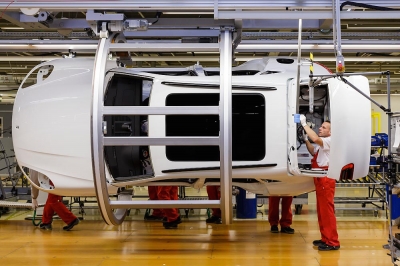
Macan is made in Leipzig, alongside Cayenne and the Panamera. The production process is well worked out, as it should be thanks to Christoph Beerhalter. A name not heard much in public, Beerhalter is one of those engineers who goes methodically about his business, leaving a quiet revolution in his wake.
Porsche and Toyota Production Methods
When Porsche was hampered by high production costs due to inefficiency in the early 1990’s, Beerhalter was at the front line of sorting it out. Taking inspiration from all sorts of industrial production including the much-discussed Toyota school of kaizen, Beerhalter used what he’d learned from efficient organisations and applied it to Porsche production at the new Leipzig factory.
Twenty years later, Beerhalter’s name is on a number of Porsche production patents, and the Macan is built on perhaps the most efficient production line in the world. Everything from where the trains carrying Macans for export should enter the site to where the production line screws should be kept has been optimised. Control of production costs (and charging a whacking great price for new models) means that Porsche margins sit around 18% – almost twice that of some competitors and up to six times what the parent brand claims for Polo and Golf.
Porsche Macan Tested: 190 Prototypes
It’s still early days in the Porsche Macan’s life, but the margins don’t seem to have come at reduced cost of development. Knowing full well that Macan would have to hit the ground running, the company invested heavily in prototype testing, building a staggering 190 prototypes, according to a Christophorus interview with Uwe Schneider, Porsche’s head of overall vehicle development.
“Only in a real prototype do we see how the vehicle reacts under real-life conditions,” said Schneider. “For every Porsche, those real conditions include use at the limits of performance. No simulation, no matter how good, can determine the wear on the vehicle after 150,000 kilometers on real roads and testing grounds.”
Porsche Macan Recall
The first Porsche Macan recall has already been issued for problems with brake servo fitment. As a brand new model, no doubt there’ll be more, but the real test is long term. I’m not the only used Porsche cash buyer waiting to see how quickly used prices drop to affordable levels, and how real-life reliability stands up over time.
Porsche has just announced a third 919 entry for Le Mans 2015. Anyone who has been following the Jenson Button Porsche rumours will be completely unsurprised and hopefully excited by the news of a third LMP1 entry, as it clears the way for a certain could-be ex-F1 driver to join the Porsche Le Mans 2015 team for the 24-Hours and maybe more.
The additional chassis also allows a few of the GT drivers to step up to the big one for the Le Mans 24-Hour, and means Stuttgart will be mob-handed at La Sarthe next year. The pitlane will be a hive of Porsche activity with three Porsche 919 Hybrids and perhaps another eight Porsche 911 RSRs buzzing around the place if 2014 is anything to go by.
Porsche Le Mans 2015
Le Mans 2015 dates are 13-14 June for the main event, with the testing taking place two weeks prior, on Sunday May 31. Scrutineering will be on Sunday/Monday 7-8 June. The schedule allows the teams to set up camp inside the Le Mans circuit, and leave their arenas assembled until the 24-Hour race has finished.
Whoever ends up driving them, three 919 Hybrids racing in France is quite a draw for the fans. No doubt a few convoys will be leaving the UK headed for Le Mans. Could we see new dad Mr Tandy in an LMP1?
Superb result on the school run this morning, as a Volkswagen XL1 hybrid swooped in at Orla’s school: moving on a public road right in front of my eyes. Dads love the ultimate school run challenge – what car to take to freak their kids’ friends out – so I’ve seen and employed some cool school run cars in my time, but this was the winner by miles.
330 miles in fact, as that’s what the XL1 can eke from one imperial gallon of diesel. The 795-kilogram carbon-fibre body is beautifully shaped and exceptionally aerodynamic: a drag coefficient of 0.186 is half that of the Porsche 918 Hybrid. The XL1’s low drag means that 62 mph can be maintained on a level road using only 8 horsepower.
Volkswagen XL1 Encounter
I’ve loved the Volkswagen L and XL concept cars since the first one was shown in 2009. They are absolute fantasy cars, so what full-on madness to see one on the road and in the carbon fibre. A tiny machine at less than 4 metres long, it still has more than enough space to do 90% of your motoring.
The styling is pure sports car, with the roof just over three feet off the ground. I could not resisting parking up for a chat with the driver, who turned out to be Volkswagen UK ‘s ‘hybridisation’ programme manager. He told me how only 32 examples are coming to the UK from the total production run of 200 vehicles: two will stay on the press and demo fleet while the rest are up for grabs. With names like Peter Gabriel on the customer enquiry list, I have no doubt that the XL1 will sell out pretty sharpish.
The hinged doors are light and easy to operate. Fit and finish across the body is sublime: Volkswagen actually developed and patented a new system for the manufacture of the Carbon Fibre Reinforced Polymer parts on the car called the Resin Transfer Moulding process. A bare chassis weighs just 230 kilograms, the complete interior weighs only 80 kilograms.
Less than one-quarter of the car’s weight is iron or steel: just 184 kilograms. The car saves weight by using magnesium wheels, ceramic brakes and aluminum brake calipers, steering components and suspension.
Sitting in the XL1 is familiar Volkswagen territory, albeit the dash is reduced down to the (very smartly presented) barest essentials. Less familiar are the door mirrors: rear-facing cameras with iPhone 3G-sized screens embedded into the door panels. The seats are comfortable if a little flat and hard – light weight could mean sore arse in the long run – and anyone with bad knees won’t be buying this car: it is super low when getting in and out.
The XL1 has an 800cc two-cylinder common rail TDI diesel engine developing 48 PS, linked to an electric motor producing 27 PS. Total output of 75 PS is well enough in such a light car. XL1 has a seven-speed DSG gearbox. The electric motor can either work independently of the TDI engine or in tandem when accelerating.
Electric range is 50 kms, 0-60 is 11.9 seconds but the effect of seeing it on the road is where the real WOW happens. If I had the £98k required to put this car in my garage, I would be all over it immediately.
“I don’t want this to read like some PR whitewash over an error on our part,” Richard Tuthill insists. “We had a fully engineered, production-based solution to take the Porsche 911 RGT into WRC on the FIA’s table in May. We’ve tested the car over 120 kilometres on gravel, absolutely flat out. This car is fantastic on gravel and should be racing in Wales. But it won’t be, and we all know why.”
I understand Richard’s frustration. Less than a week before Tuthill’s R-GT Porsche was due to take the start of Wales Rally GB, the FIA decided to reject the car’s gravel specification for the Oxfordshire team’s home event, despite all of the planned modifications being fully described in plans submitted to Switzerland almost six months ago. Having sucked up a truckload of R-GT red tape already this year, this was one step too far.
Earlier this week, the R-GT was taken to Walters Arena in Wales, home of many gravel test sessions and identical terrain to the Rally GB gravel stages. In-car footage from testing shows the R-GT Porsche’s incredible speed: the 911 pulls two gears higher than Tuthill historic cars on the same stages and easily hits the limiter in sixth on the longest stretches of gravel.
‘The car was born to be driven on gravel,” says Richard. “It is well balanced, amazingly easy to drive and with the wonderful 3.8-litre engine and sequential six-speed gearbox, it is very, very fast. We experimented with the setup up throughout the day and will continue to develop certain areas, but I could not have imagined it could be so good from the very first KM. It’s more than ready to hit the stages, be they gravel or snow.
“Combined with the car’s performance on asphalt, this confirms that it is an all-rounder and can be used across the world in all regional championships, where the regulations follow FIA guidance.”
Tuthill Porsche FIA Rally GB
Lengthy discussions at FIA headquarters in Geneva could not move its technical department to approve the car for use on this weekend’s Rally GB. It’s a blow to Team Tuthill, the rally organisers who have headlined so much promotion with the R-GT Porsche but mainly to the fans; hundreds of whom were looking forward to witnessing the return of a Porsche 911 to WRC gravel stages.
Richard explains the impasse. “Within existing R-GT regulations, there is scope to allow modification to the suspension uprights that are fitted to the chosen base model. However, this only allows the fitment of gravel brakes. In the case of the 997 RGT, the upright is too big to fit within a 15 inch gravel wheel, regardless of the size of caliper and disc fitted. Understandably the FIA needs to review how this issue can be resolved and, not surprisingly, it is unwilling to allow complete freedom for modification on safety grounds.
“We found a solution from Porsche factory parts, which we tested to great effect. That solution, developed by our chief engineer who is one of the most experienced motorsport engineers in the world with thirty years of Le Mans, WRC and Dakar behind him, was still not enough to convince the FIA. While we fully accept that any new category will raise technical challenges that need open discussion and thinking to get around, I cannot hide my frustration at the way this decision has been made, given we started this enquiry in May.”
FIA Leadership through F1 Motorsport Crisis
Lately it seems that the FIA has given up on the ‘sport’ side of motorsport in the vested financial interests of its commercial manufacturer partners. With F1 in crisis and the governing body standing by motionless, will the FIA ever draw back those curtains of red tape and start listening to fans who only care about racing? Or does the inactivity reflect a lack of leadership as the FIA president works his connections to land a plum job at the UN: a theory I read on one of the leading F1 blogs last week? So much for a bright future.
While writing a Porsche Cayenne Buyers Guide for 911 & Porsche World magazine the other day, I came across an interesting story around the genesis of the Porsche Cayenne.
The Cayenne has long been marketed as a Porsche/VW partnership vehicle right from the start, similar to the 914, 924 and more, but the first Porsche SUV was apparently set to be based on the Mercedes ML. When Mercedes asked for shares in Porsche to cement its joint venture, the agreement between the two companies came to an abrupt end.
Porsche was already working on an SUV concept for Volkswagen, so chased the Volkswagen boss – Porsche family member and shareholder, Ferdinand Piëch – for a space alongside Wolfsburg on their posh 4×4 project. Rather than using all-Volkswagen sourced engines, Porsche’s drawing board already had Panamera sketches on it, so Stuttgart decided to build its own V8 to power the SUV plus one other. So much is down to the marketing.
Britain’s Steve Murkett led the Cayenne design team. Early reviewers felt that the reshaped front end on a van-like Touareg bodyshell didn’t communicate much style, but I disagree: I think it’s quite a stylish car nowadays and stands out from the crowd. If they didn’t know that the two were related, a casual observer would be unlikely to draw a line between Cayenne and Touareg.
As for comments that the X5 was more stylish, perhaps the market has the answer with slightly higher residuals for the Porsche. As for what we could have had – a Porsche/Mercedes ML – I am happy with things just as they are.
Porsche Cayenne Buyers Guide
Regarding the Cayenne Buyers Guide, the start points for a 2004 Porsche Cayenne S V8 like mine are quite simple.
Check no engine ticking noises: could be coils, a failing water pump or cylinder scoring
All gearshifts smooth and controlled: no bangs or rattles
Check plastic coolant pipes in the V have been changed for aluminium
Check no wandering steering – front control arms wear out fast
No tired brakes, no past-it tyres
No warning lights from the air suspension if fitted
Check for damp under carpets: leaky sunroof tubes or split rear washer pipe in A-pillar
As for the rest, you’ll have to buy Porsche World next month!
Out looking at Porsche cars for sale with a mate last Sunday, we found ourselves close to Mercedes-Benz World in Weybridge, Surrey and decided to drop in for a coffee. The coffee shop is great and worth a visit on its own.
I used to work around the corner from Mercedes World and the huge facility alongside Brooklands was usually deserted: I could never understand how it paid for itself. On this particular Sunday, the place was absolutely packed. With the queue for coffee more than twenty people deep, we opted for a quick scoot around the exhibits before getting back on the road.
MB world used to house many classic models in its beautiful interior, but there are fewer classics now and plenty of new cars. We had a good look at the SLs on show – of course I thought my SL was nicer than their R129 – and then whipped through the technology part on the top floor. Inside was the 1996 Mercedes F200 concept from 1996 (above). This spellbinding car with double-joystick technology and cutting edge ideas for the time is still a handsome machine: recognisably Mercedes.
Porsche Prototype Exhibition
Seeing the cool Mercedes concept reminded me of an exhibition currently running at the Porsche Museum in Stuttgart. Featuring a number of Porsche development mules and work-in-progress prototypes, the “Project: Top Secret” show running until January 11, 2015 opens a door into the workings of Porsche engineering development.
Sixteen Porsche cars form the core of the exhibition, including concept cars, camouflaged test beds and one-off experimental vehicles. Notably, these are development survivors, as most test cars and working prototypes get scrapped when their work is complete: common practice amongst manufacturers.
Cars I would most like to explore in detail include the 964 Targa, chopped up to disguise the mid-engined chassis layout of the original development Boxster, and the 984 Roadster development car. The display also includes a rear-engined Porsche 965 project, and the four-door 989 family sports car, which set the design tone for later models. The 918 rolling chassis seen in many Youtube videos is also on show.
The Porsche Museum is open from 9am-6pm Tuesday to Sunday. Admission is €8 for adults. More information at www.porsche.de/museum.
This website uses cookies to improve your experience. We'll assume you're ok with this, but you can opt-out if you wish.AcceptRead More
Privacy & Cookies Policy
Privacy Overview
This website uses cookies to improve your experience while you navigate through the website. Out of these, the cookies that are categorized as necessary are stored on your browser as they are essential for the working of basic functionalities of the website. We also use third-party cookies that help us analyze and understand how you use this website. These cookies will be stored in your browser only with your consent. You also have the option to opt-out of these cookies. But opting out of some of these cookies may affect your browsing experience.
Necessary cookies are absolutely essential for the website to function properly. This category only includes cookies that ensures basic functionalities and security features of the website. These cookies do not store any personal information.
Any cookies that may not be particularly necessary for the website to function and is used specifically to collect user personal data via analytics, ads, other embedded contents are termed as non-necessary cookies. It is mandatory to procure user consent prior to running these cookies on your website.