by John Glynn | Jul 14, 2014 | Classic Porsche Blog, Porsche News, Race and Rally
A nail-biting finish on the 2014 Midnight Sun Rally yesterday, as the 911 legends at Tuthill Porsche claimed another European rally victory, this time by just six seconds after three days of hard fought, flat-out rallying.
Even more impressive was that driver, Patrik Sandell, was on his first ever rally in a Porsche 911, and catching some very experienced drivers ahead of him despite zero pace notes, their supreme local knowledge and proven speed as previous winners. Also the fact that he was driving a 3-litre Tuthill 911 normally found on the Below Zero Ice Driving school! Awesome job all round.
Sandell started the day over forty seconds down on the leader, with just forty kilometres of stages remaining. So Sandell needed to take a second a kilometre out of previous rally winner and former WRC driver, Kenneth Bäcklund, in a very quick Escort RS. As anyone who has rallied will tell you, this is almost impossible.

“Second place is infinitely doable, but to win we will need others to face misfortune. However, the completion rate at this level is very high,” said a cautious Richard Tuthill at the start of day three. The Tuthill mechanics had made quite a few setup changes overnight, so would the car be quick enough? We were about to find out.
The first stage of the day was SS13 Ramsjöhult: a nine-kilometre thrasher. Sandell won the stage, finishing 8.8 seconds faster than the leader. The day was off to a proper start. “I’m in love with this car right now! It’s close to perfect,” said Patrik at the end of stage thirteen. Next stage was Vallavägen at 8.8 kilometres. Sandell was five seconds faster than the next quickest Porsche, but only six-tenths up on Bäcklund.

Then came Viggaren: 13 kilometres long. Bäcklund held nothing in reserve, but Sandell was first, six seconds quicker than Kenneth. The next stage was Forssjö, five kilometres long. Sandell took a further eight seconds off the leader and with two stages left was just fourteen seconds down.
Penultimate stage was by far the longest of the two remaining: Härad at 6,240 metres long. Over six kilometres, Sandell stuck to his second-a-kilometre rhythm and finished the stage just under nine seconds down on the Escort. Heading into the last stage, a win was looking unlikely. Semi-resigned to finishing second, which would still have been a great Porsche debut for the Red Bull Global Rallycross winner, Patrik left the start with all guns blazing for the 1.5 kilometre stage.
Then, who knows what happened – a burst of nerves, a slippy clutch foot, a distraction in the corner of his mind – but Bäcklund blew the start. False starts earn a ten second penalty: one more than Sandell needed to win. Bäcklund finished eight seconds down, and Sandell finished on top.

“I had a fantastic weekend with Tuthills and the car was awesome to drive,” said Patrik (above, right) at the finish. “The car gave me great feedback all weekend, and I don’t think people understand the speed you can get from a historic Tuthill Porsche. The team have been so professional the whole race and we have really worked together to get this win!”
I know how delighted everyone in the team is to see a fresh face take to the car and bring it home undamaged, on top of the podium. Tuthill Porsche has a groundbreaking rally project coming out soon – it could be amazing if they can get Sandell in that. I will be there to cover it!
Pics courtesy of Midnattssolsrallyt/Fotogubben

by John Glynn | Jul 8, 2014 | Market & Prices, Porsche News
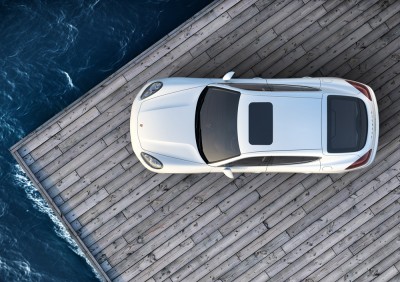
Porsche sales figures for the six months from January to June 2014 reveal some interesting data on demand for Porsche Panamera Hybrid. Year-on-year, Porsche has delivered eight percent more cars than at six months into 2013. Deliveries of new Panamera rose almost thirty percent, with ten percent of customers opting for the plug-in E-Hybrid model.
Porsche Panamera Hybrid Sales
Hybrid is an interesting car. The UK’s company car tax rules are set up to favour hybrid technology, but real world use is probably still not as effective as a decent diesel. Panamera Hybrid’s maximum 20-mile range on electric power mainly benefits urban users in big cities that offer concessions for low-carbon vehicles.

The What Car? Porsche Panamera S E-Hybrid road test applauds the car (which costs almost £90,000 here in the UK) for a monthly liability of just £150 in company car tax for a 40% taxpayer. For those of you living outside the UK, car drivers who receive a car from their employer as part of their salary package pay Benefit-in-Kind tax on the perk, measured in how good the Treasury feels about the carbon emissions of said car. You don’t want to know the likely BIK tax on my Cayenne V8 (not run through a company, for obvious reasons).
Compare this to Texas, where a Panamera Hybrid with 1 mile on the clock will cost you $110,000, or £64,000. This is roughly the same as a Panamera Diesel here in Britain and, according to What Car’s top editor, the Panamera Diesel is the better real-world car. “It’s the best hybrid I’ve ever driven, but I’d rather have the diesel,” said Chas Hallett.

Porsche Panamera E-Hybrid Fuel Economy & Battery Range
Clarifying “best hybrid” as being the best in terms of how it managed the transition between power sources, Hallett noted an average of 32 mpg over 500 miles, while What Car’s testers got 30.7 miles in real world testing. That is per imperial gallon, not US gallon. What Car? data notes that Porsche claims 91 mpg: that gap is something else. What Car also managed just 11 miles on electric power.
Marked down to three out of five stars by What Car? for high running costs, lack of brake feel and overwhelming understeer unbecoming of a Porsche, this has not deterred the 1300 people who picked up plug-ins so far this year. Whether it was private buyers or dealers building up Hybrid stock, one in ten is a reasonable number. I remain a Hybrid fan – when the AC/DC Cayenne gets cheap, I’m there.

by John Glynn | Jun 30, 2014 | Market & Prices, Porsche News
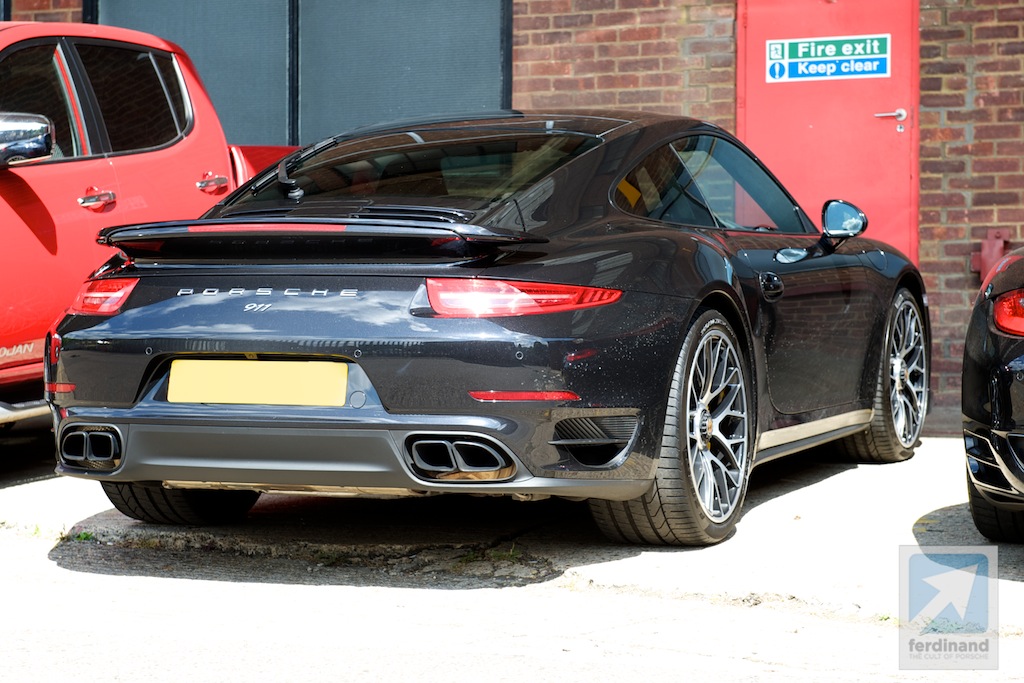
Dropped in to see Jonas Zambakides and a pair of perfect Porsche 911 Turbo S models this morning and catch up on used Porsche sales activity. Some interesting discussions on the state of the market and whether values have indeed peaked: I think we’re on the same page, but that’s a post for another day.
Classic Porsche fans who don’t hang on every detail of newer 911 machinery may be unaware of the 997 & 991 Turbo S. Both of these Weissach-tuned performance Porsche 911 Turbos have just sold, so it’s interesting to compare them in fantasy garage style and wonder what the choice would be if funds allowed.
Porsche 997 Turbo S
Introduced in 2010, the 3.8-litre Porsche 997 Turbo S was developed in response to customer demand for a bit more excitement. How about 523 bhp with 516 lb ft of torque and the sole transmission offering of 7-speed PDK with standard Turbo four-wheel drive. PDK gives launch control, offering 3.3 seconds to 60 mph and a top speed of 196 mph.
Spec includes PCCB (ceramic brakes), dynamic cornering lights, carbon seats, Sport Chrono and centre lock wheels. The Dynamic Engine Mount system is one of my favourite new-Porsche concepts and that is standard on the S. Porsche Torque Vectoring is an active diff that splits power across the rear axle depending on what the car is doing, improving traction and stability.

Porsche 991 Turbo S
New to the market last year, the 2013 Porsche 991 Turbo S beats the 997 in Top Trumps: 552 bhp, 197 mph and the grunt to sprint to 60 in 3.1 seconds. Interestingly, Porsche says it is faster around the Nürburgring than the GT3 RS 4.0, managing a 7:24 on Pilot Sport Cups. Hardly a surprise, but not a point one might expect Stuttgart to make.
Weighing just over 1600 kgs, the 991 Turbo S features the latest active rear wheel steering, active anti-roll bars and active/adaptive aerodynamics. EVO magazine knocked the 991 Turbo for a fuel-saving intermediate PDK gear setup, which shifts the car up a gear earlier than normal. Their tester said it made the car “deeply unresponsive: it feels like it’s on the verge of stalling”. As the latest 911, it is also fresher faced but, parked up side-by-side, all I can think of is how good the 997 still looks.
Brand new, the Porsche 997 Turbo S cost £123,000 from new, which is about £137,500 in today’s money. List price for a Porsche 991 Turbo S is £140,850, so a little bit dearer. The Porsche 991 Turbo S was a pre-owned example with 1,300 miles on the clock and sold for £135,000, while their Porsche 997 Turbo S had less than 25,000 miles and was closer to £75,000. That’s a 60 grand difference for new versus (not so) old.
Not saying the 991 is not worth the money or that the 997 is super cheap but it certainly puts choice and value into perspective. The reality is that someone looking at the 991 Turbo wants a 991 and the real purchase choice is this versus used McLaren, or used Ferrari. In comparison, the 997 Turbo S is a well priced list topper for those in search of the ultimate GT 911.

Given £75k to spend on one 911, would you go for a Porsche 997 Turbo S? Or would it be early 911 – maybe a simple 911T? 930 of some description? I could be tempted to opt for the 997 Turbo S. That shape rings true in my head: more than I remember a 993 or 996 ever doing.

by John Glynn | Jun 29, 2014 | Porsche News, Race and Rally
America’s Connor de Phillippi was denied a decent result at the Norisring this weekend, when chaos on a wet street course stopped the Californian’s Carrera Cup championship challenge in its tracks. De Phillippi was forced out of both races due to contact.
Both Carrera Cup races held on the exciting street circuit through Hitler’s former Nuremberg parade grounds brought the same face to the top step. Lechner Racing‘s Michael Ammermüller took debut back-to-back Carrera Cup wins in grand style, with a huge lead at the chequered flag in race 2.
I say huge: it was five seconds, but five more seconds separated second through to sixth. Carrera Cup Deutschland is the closest Porsche racing anywhere, so to finish five seconds ahead in these conditions with such strong opposition is super impressive.
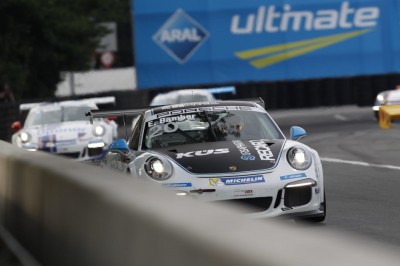
First loser in race 2 was Earl Bamber, but the 23 year-old Kiwi who won a €200,000 Porsche Supercup scholarship at the start of 2014 is proving his massive talent every time he takes to the circuit. Starting seventh on the grid, Bamber had a great start, stayed focused and saved his tyres to pull skillful moves on Christian Engelhart and Porsche Junior, Sven Müller towards the finish, and finish second overall.
“It was like go-karts, battling all the way,” said Bamber. The post race video below shows how true that is, as Bamber, Engelhart, Muller and Ammermüller slip and slide on a greasy track within inches of each other. It is great racing and perhaps slightly worrying for Weissach.

Carrera Cup and Supercup is the breeding ground for future works drivers. If the baby-faced Müller can finish P3 in his first wet Carrera Cup race behind an undeniable 911 expert and the prodigious talent of Bamber, where will he racing in twelve months’ time? Weissach’s works squad had better watch out for these Carrera Cup kids: they are easily good enough to challenge for works drives.
Top of the driver’s table now is Konrad Motorsport’s Christopher Zöchling, another rising star. These are all names you will hear much more about! Zöchling leads by two points from Bamber, with De Phillippi a point down in third. Watch this race video from Porsche AG.

by John Glynn | Jun 17, 2014 | Porsche News, Race and Rally
There was no mistaking the familiar form of Matthias Müller at Le Mans last weekend. While most CEOs and directors sat in air-conditioned marketing suites, entertaining guests and playing with their phones, the Porsche CEO was in the pitlane with the drivers and mechanics, supporting his team and its efforts.
Not only was Matthias in the pitlane, but he was wearing full team garb, right down to the Adidas shoes. Can you imagine the Ferrari chairman in a mechanics outfit? Luca in a Shell-badged workshirt, jumping in and out of the cameras? Not how Herr Müller played it – he was low key all weekend and seemed to spend most of Saturday and early Sunday morning in the pitlane.
Porsche Racing Tradition
This is the Porsche tradition of old: Ferry Porsche sitting amongst drivers, sharing the highs and the lows. No doubt Matthias and Co – including Klaus Bischof and a visit from Norbert Singer – had their share of the lows last weekend, but such is the nature of racing. With five rounds remaining in this year’s WEC series, anything can still happen. Porsche now has ten weeks or so to take the 919 a step further and further develop the areas flagged in last weekend’s racing.

It’s also worth remembering that Le Mans was twenty-four hours on track, while the rest are no more than six at a time. Six hours into Le Mans, Porsche was sitting very pretty. Let’s see where we end up after racing for six hours in Austin.
WEC Race Schedule 2014
Full details of the remaining races in the FIA WEC race calendar can be found at www.fiawec.com. In a nutshell, you should add these to your diary:
- September 20: 6 Hours of Circuit of the Americas
- October 12: 6 Hours of Fuji
- November 2: 6 Hours of Shanghai
- November 15: 6 Hours of Bahrain
- November 30: 6 Hours of Sao Paolo
Circuit of the Americas is on Singapore Grand Prix weekend. Fuji matches the Russian Grand Prix. Shanghai matches the American Grand Prix, but the rest are all on their own. A busy year of motorsport still to come!
Pic credit: Anyone using Twitter should be following @PorscheRaces, the official Porsche motorsport feed. This Le Mans was a mass of content with some great pics shared online. Follow our own @CultofPorsche feed too.

by John Glynn | Jun 15, 2014 | Porsche News, Race and Rally
Porsche was denied a win at the 2014 24 Hours of Mans today, when the leading number 20 919 LMP1 Hybrid retired in the last two hours of the race.
Mark Webber had just taken over the 919 from Timo Bernhard, who was thirty seconds in front of a charging number 2 Audi. TV cameras picked up Webber as the 919 slowed dramatically, stuck at 60 km/h. The former F1 star showed his class in remaining calm under the extreme pressure of the moment, running through a series of checks, but it was obvious this was a serious issue.

“Misfire, misfire, high oil temperature,” was Mark’s message over the radio as he headed for the pit lane. The car came home and was duly dismantled, but slumped shoulders a few minutes later said it all. Webber slapped his crew chief on the back and that was it: number 20 was out of the race. Partners Timo Bernhard and Brendon Hartley could only ponder what might have been.

Number 14 was still running, now in P4 in the LMP1 class. Marc Lieb was putting useful laps together when suddenly he reported gearbox problems. The car came back into pit lane and the engine cover was removed but again the lack of activity suggested something close to terminal. As mechanics polished the number 14, Lieb stood by with his helmet on, clearly hoping to get back on track for a final classification.

The 14 did get back out for photo opportunities with the chequered flag and appears on the final lap timings, but Eurosport claims it was not officially classified, so we wait to confirm that. Audi had the finish line all to themselves, with a 1-2 finish for cars 2 and 1 in that order. The number 92 Porsche 911 RSR of Fred Makowiecki took third place in the GTE-Pro category, behind Bruni’s Ferrari and Garcia’s Corvette.

Le Mans is disappointing for all fans of Porsche, but of course this is only round 3 of the 2014 World Endurance Championship. We now have almost three months to the 6 Hours of Austin at Circuit of the Americas on September 20th, so plenty of time to consider the data, develop the car further and go for the series title.
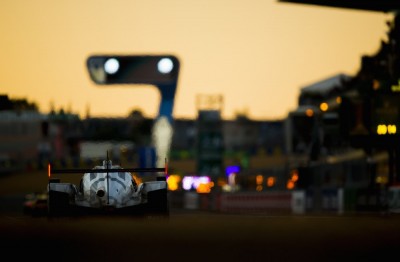
No one will hold this disappointment against the Porsche team. They gave the race everything, and 2014 was a great race for motorsport fans. Kudos to Weissach and on to the next one.