
by John Glynn | Mar 7, 2013 | Porsche News, Race and Rally
Our friends at Falken Tyres have confirmed their driver lineup for the 2013 Nurburgring 24-Hour. The team will also run their Porsche 997 GT3 RSR at a number of VLN events this season.
Sebastian Asch, Peter Dumbreck, Wolf Henzler and Martin Ragginger are all confirmed as Falken Porsche drivers for the year, with the clear aim of a top ten finish in the 24 Hour event. The Porsche 997 GT3 RSR has also received a few upgrades ahead of its first outing: a VLN test on the 16th of March.

Falken Motorsports’ experienced team principal, Sven Schnabl, has upgraded the teams’ RSR with a new aero package of wider wings, new splitter and double canards up front, with a larger rear wing to increase downforce. Cooling vents around both front and rear arches are bigger, and the car can now run 12-inch front wheel rims, half an inch wider than last year. The 997 also now runs four headlamps.

Falken’s Japanese engineers have developed a range of new tyres for this season, which the drivers are keen to explore. “After a really exciting 2012 season, we are hungry for more in 2013,” says former Porsche Junior, Martin Ragginger. “We will give it everything we’ve got for the fans and aim for a top ten place in the 24-Hour Race.”
Falken’s season looks busy, with a race weekend every month bar September:
- 16.03.2013 VLN Set Up Day
- 23.03.2013 ADAC Westfalenfahrt
- 27.04.2013 ADAC ACAS H&R-Cup
- 17-20.05.13 ADAC ZURICH 24h-Rennen Nürburgring
- 22.06.2013 Adenauer ADAC Simfy Trophy
- 20.07.2013 ADAC Reinoldus-Langstreckenrennen
- 24.08.2013 ADAC Ruhr-Pokal-Rennen
- 12.10.2013 ROWE DMV 250-Meilen-Rennen
Chances are we’ll get to at least one of these events: I rarely miss a Nurburgring 24-Hour and am overdue a weekend in the woods. Are you heading out to one or more VLN rounds? Keep in touch if yes – could do with some keen amateur photographers on my side.
Email mail@ferdinandmagazine.com to let me know your plans. See the Falken Tyres site at Falken-Europe.de.

by John Glynn | Mar 5, 2013 | New Models, Porsche News
The new Porsche 911 GT3 is packed with technology, but one of the most interesting aspects is this active rear-wheel steering.
Active rear-wheel steering/four-wheel steering is perhaps best remembered on the Honda Prelude of the late 1980s. In typical Japanese style, the effects were overly obvious, so I remember the Prelude as curious to drive, but the Honda’s mechanical 4WS system (below) was much vaunted by one of my favourite motoring writers (and noted Porsche hater), LJK Setright. BMW used the system on the 850 CSI, and it is still found on current 5-series.
Porsche patented a form of passive rear-steer on the 928, with its famous Weissach Axle, but active is a whole new ball game, made easier by the introduction of electric power steering. Active rear wheel steering has been added “to achieve higher precision and lateral dynamics”. Depending on the speed, the rear steers in the same or opposite direction of the front wheels, improving stability and agility.
Other new modules to improve dynamics on the 991 GT3 include a fully variable electronically-controlled rear diff lock (sounds very very trick), and the dynamic engine mounts. The 20-inch forged alloy wheels with centre locks are also new.
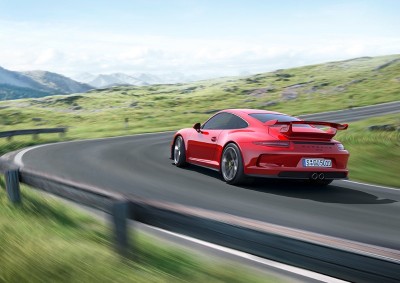
Based on the light, yet stuff aluminium body of the current 911, the 991 GT3 is 44 millimetres wider than a 911 Carrera S across the rear axle. Porsche says that the fixed rear wing makes a decisive contribution to the ‘exemplary’ aerodynamics of the new 911 GT3, which combines low air resistance with even more power.

That’s about as much as I can say on new 991 GT3 tech until we get some cutaway drawings from Stuttgart – normal service is henceforth resumed! I will blog about the 928’s Weissach axle, as that is quite interesting.

by John Glynn | Mar 5, 2013 | New Models, Porsche News
Initial response on the 73,000-likes Ferdinand Facebook page to first official pics of the all-new Porsche 991 GT3 – latest and greatest of the 911 line – can only be described as muted. Unless you want to talk about the lack of a manual transmission option.
I understand the rationale of a PDK-only production choice for the latest supercar, but am predicting a number of implications for the used Porsche market.
- Bragging rights for the “best driver’s 911” will now go to the 997 GT3 RS with ceramics and manual transmission.
- There will be an aftermarket manual transmission kit for the 991 GT3 down the road.
- Cost of PDK repairs on 991 GT3 will feature large in future buyers’ guides.

Regards bragging rights, 997 GT3 RS still has a ton of driving aids, so what negative difference the PDK as standard makes I don’t know. But predictions don’t always have to make sense – ask your man Nostradamus. I predict the debate will be less about outright lap times and more about driving pleasure: the feeling that you actually have input and control over the car. It won’t make sense to the lap time gods, but watch the forums for lift-off.

Aftermarket manual transmission on a 991 GT3 will be a huge headline and someone will definitely sink money into achieving this. The PDK version will still be faster, and the manual conversion is likely to be less than pretty, but someone will do it as there’s a buyer out there. They will need to solve a whole lot of software problems first, though.

PDK is heavy and who knows how reliable in the long run. One look at a technical drawing for the transmission shows what could go wrong with water or a voltage spike frying the gearbox ECU and sending everything moving forward at once. Never say never!
What do you think about the 991 GT3? Looking forward to buying one or not? I know you have an opinion! Mine is that a 1000-kilo 911 with 200 bhp and no aircon is enough for me just now.

by John Glynn | Mar 4, 2013 | New Models, Porsche News
Porsche has just sent out the first official pictures and details of the new 911 GT3: series 991.
Technical highlights are:
- New engine and gearbox, bespoke crank and valve gear helping it to 9,000 rpm, PDK standard
- All new body
- 3.8-litre flat six giving 475 hp, 0-100 km/h in 3.5 seconds, top speed 315 km/h or 195 mph.
- Nurburgring lap time is less than 7:30
- Active rear wheel steering, optional LED headlights

by John Glynn | Mar 2, 2013 | Classic Porsche Blog, Porsche News
Day 17 of the WEVO Porsche 356 South America rally and the boys are driving from Cusco to Arequipa: around 600 kilometres.
Thanks to Yellowbrick GPS technology carried on board the cars, you can track their progress on the rally home page under ‘results‘. Here are a few screen shots demonstrating what is possible.
Time now in Cusco is 08:22, and here is their current position. Untick everything except the Class C box to see the cars in their group.
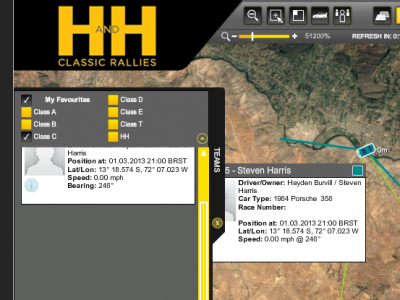
This is a wider view of the route so far plotted by GPS: it likes to use a straight line to minimise data points stored. Bit of a pain when map data is overlaid but not much choice here.


by John Glynn | Feb 20, 2013 | Classic Porsche Blog, Porsche News
We’re following the WEVO Porsche 356 crew of Steven Harris and Hayden Burvill as they rally through South America on the Great South American Challenge 2013.
Yesterday was downtime for the boys in South America. They spent the day visiting the nearby waterfalls, pointing me towards other rally resources – the rally website is getting some routes wrong – and attending to Madam Lola’s every need.
Madam is doing well, which is more than can be said for Hayden. “Picked up a GT (generous traveler) flu on the way down from SF to Rio. I’m into the runny nose and hacking cough day and feeling pretty rough, but some spanner work on Lola will distract me and make me feel better.”
Hayden facebooked the top pic of Lola in bits for obvious servicing checks, carb tweaks and wiring in the Yellowbrick GPS tracker. There’s a good pic of Hayden’s rear end on Chuck Shwagger’s blog, tweaking something in the driver’s footwell: I’m sure he’s not backing out the throttle stop.
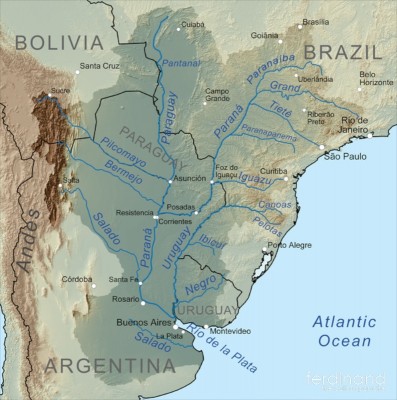
Today is Day 5 of the rally. They start at Foz do Iguacu (NE of the centre of this pic). The route heads north on secondary roads, skirting the Brazil/Paraguay border, formed by the Paraná River. The river is the second longest in South America, and takes its name from local words for “big as the sea”.
Paraná swallows the Paraguay River on its journey south, then merges with the Uruguay River and forms the vast Rio de la Plata before entering the Atlantic. The scale of the river as they travel north alongside it should be an eye-opener for the rallyistes.
The road continues to their overnight in Dourados on the fertile river plain: 503 kms in all today – about 300 miles. I don’t know what the stage plans are, but no doubt H will fill me in later.


