Anyone reading road test reviews of the new Porsche 911 will have noted claims that the longer-wheelbase, wider-track 911 is now more grand tourer than sports car. If the new Cayman will now be Porsche’s truest sports car, why don’t Porsche take it to the max?
Motor Trend Editor Angus MacKenzie recently put this directly to Porsche CEO Matthias Muller. I’m sure he’d considered his response at length: what to do about Cayman must be a hot topic in Stuttgart. The model is the most undermarketed Porsche I’ve ever seen, and yet remains one of the best sports cars the company has built.
Will there never be a Cayman that will outperform a 911? “If I look at pure performance numbers,” says Muller thoughtfully, “then maybe.” But then he quickly adds he believes Porsche’s two sports cars are aimed at two entirely different customers — substitution between the two cars is less than five percent in the United States. And with Turbo and Turbo S versions of the new 911 still to come — as well as GT3 and GT2 variants — you can bet there will always be at least one 911 variant that will be faster than even the hottest Cayman in the future.”
Watching the privateer Caymans circulating at Nurburgring 24, it’s clear that the chassis has plenty of headroom. The cars looked much lighter on their feet compared to heavier GT3 cars in switchback direction changes, making Cayman the perfect base for a good power-to-weight race platform that could be up there on efficency, speed and reliability. Translate that to a road car that wasn’t too stiff and you get something like the Cayman R, but with added marketing mojo.
Boxster Spyder ticked the box for everyone who took it out wanting to drive. James May’s Spyder review (video below) will go down as one of the great Top Gear Porsche product tests. The only downside – certainly for the UK – was that convoluted canvas top. So why not a Cayman R Carrera: same ethos as Boxster Spyder, but with a solid roof? We would finally have a daily drivable Porsche sports car, raceable for not much money, marketed as a drivers piece and sold at a sensible price (we hope).
New Boxster is into UK £60k when specced to the hilt and Cayman is likely to be similar. I guess we’ll see how the Cayman plan works out, but it would be nice to see more on the road, taking it to the Porsche-is-911 brigade and speaking to prospective buyers who view PDK 911 as expensive pipe and slippers.
The interview I recorded in London with BBC Radio 4 airs today at 16:00 hrs UK time.
The piece will appear on Last Word: Radio 4’s obituary show. I think the session went well, but you never know how these things will turn out in the edit. I’m hoping it will come across as interesting, and in honour of the third generation of Porsche car designers: we’ll have to see.
The whole thing was recorded in The Orange: my Carrera 3.0 Coupe. I drove the orange 911 down to London, picked up producer Jane Little and we took a drive around the West End. Tootling around a city centre is not where Orange is happiest, but there were a coupe of spots where it could stretch its legs a bit in second gear. Made both of us laugh.
Jane was quite surprised by the 911’s turn of speed in stripped out guise, with the reduced final drive ratio that Orange runs. The view through that big screen from the low seating position on my car, built to sprint up Swiss Alpine passes, emphasised the amount of glass Ferdinand set into the slim pillars: 60% more glass than the 356. As I say, there were some thrilling turns of speed and Jane asked some interesting questions, so I think it was a fun few hours. Hopefully that will come across on air.
However it turns out, I’m glad to have been asked to contribute by the BBC. I’m sure it will make a reasonable podcast, too. You can hear it at 4pm today and repeated at 8.30 PM on Sunday night. It’ll be on iPlayer once the Friday show has run. Here’s the link to the show again.
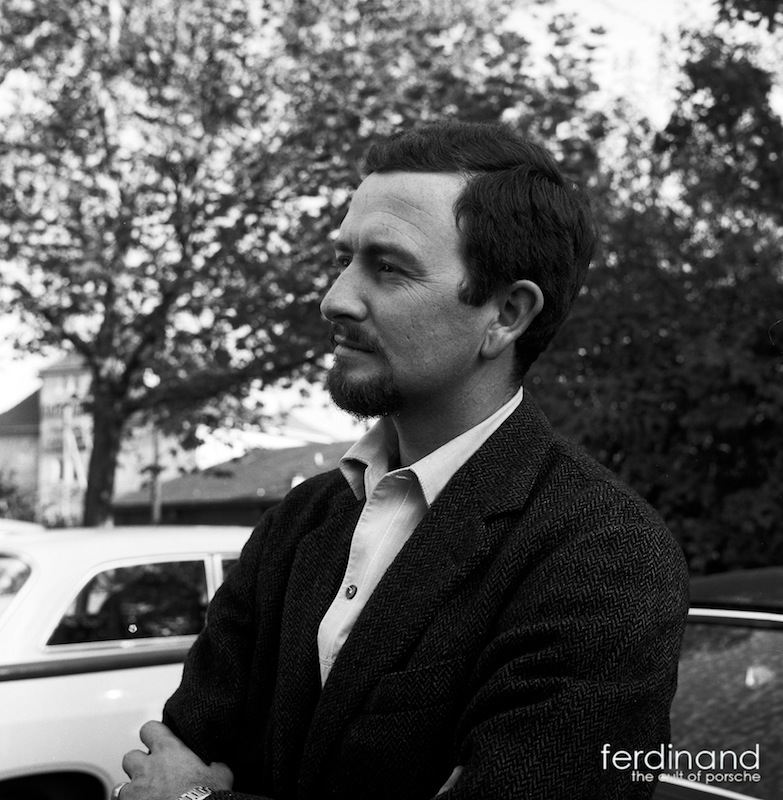
Porsche culture reached the end of an era last Friday, when Ferdinand Alexander Porsche passed away.
Ferdinand ‘Butzi’ was the eldest son of Ferry, son of Ferdinand. Ferry once said: “We all have a desire to create something that will show we were here, and did something of value. To create something timeless.” Fifty years ago, his eldest son fulfilled that ambition.
Butzi’s breakthough was not his favourite: this award went to the 904. It was not the most expensive, nor the most exclusive. But it was the most authentic and engaging of Porsches. Butzi gave the world a Porsche that answered more desires than any before, or since. It was, of course, the 911.
Butzi believed that design was not fashion. Good design was functionality. Functional items fit with our needs: they are relevant.
When relevance touches the soul, the subconscious creates deep, unbreakable connections. When something is irrelevant, our conscious minds disconnect and discard, but such a fate never befell Butzi’s creation. 901, 911, 964, 993, 996, 997, 991: call it what you will, since that first line emerged from the mind of Butzi Porsche, the 911 has been the world’s most relevant sports car.
With so many 911s from the model’s half-century history still used and abused, cherished and adored, the revelance is proven. Almost fifty years after its arrival, the 911 remains the machine most connected to the practice of driving, and most aspired to by those who seek the ultimate driving experience.
Through Ferdinand Alexander, all of us who love the 911 discovered one great thing: an instant route to satisfaction. Sitting in Ferdinand’s 911, surrounded by his vision of perfection, we enjoy a space that is timeless: simultaneously of its time, and of ours. We who cannot imagine life without our 911s know its true purpose: it is a direct connection to three generations of engineering genius, and a vital component in the engine of the super-ego.
It’s tough to say goodbye to friends, even tougher when you’ve never met them. But be sure that if you own and enjoy a 911, F. A. Porsche was a friend: one of your best. Let this be in our minds as we say farewell to our friend and inspiration, Butzi Porsche.
Adieu Ferdinand Alexander, on your journey to the arms of your father. You will never be forgotten by those you have inspired. Rest in peace.
Porsche friend Hans has just shared this video on Facebook. It’s a feature (in German) on the Porsche 956. Non German speakers, don’t let the language put you off – the video contains some great period footage of the 956 in build and at work. Well worth watching!
Derek Bell usually dominates 956 video. While I could listen to DB ’til the cows came home, it’s a nice change to have some new faces. Here we have the great Jürgen Barth,who won the ’76 Le Mans in the 936 with Ickx and Hurley Haywood, and finished third in 1982, sharing a 956 with Hurley and Al Holbert. Also interviewed are Harald Grohs and Hans Heyer.
Born in Essen, Harald is a veteran of fifty endurance races, and a former 935 & Carrera Cup racer. Former European Touring Car Champion, Hans Heyer will be familiar to anyone who followed DRM (Deutsche Rennsport Meisterschaft – German Racing Championship) back in the day, as his racing career throughout Europe was legendary. Hans drove just about every touring and sports car of note, up to his retirement from full-time racing in 1985.
Hans Heyer’s New Man Porsche 956 is above, from Rennsport Reunion IV last year. The interview looks to have been filmed at the Kremer works – rather apt as Heyer drove Kremer RSRs in his early years.
Anyway, enjoy the video. I seem to spending all of this afternoon on Youtube – been too long since I did that. Have discovered many wonderful previously unseen videos there (unseen by me) which I’ll share via the Ferdinand Porsche website and magazine over time.
Porsche has just announced the death of Ferdinand Alexander Porsche and sent this summary of his life and career. The great designer had not been well for some time, but it is still a bit of a shock. Some time to absorb the news is required: more on this sad story later. Rest in Peace, dear Butzi.
Dr. Ing. h.c. F. Porsche AG, Stuttgart, is mourning Professor Ferdinand Alexander Porsche. The Honorary President of the Supervisory Board died on 5 April 2012 in Salzburg, aged 76. Matthias Müller, President and Chief Executive Officer of Porsche AG, paid tribute to Ferdinand Alexander Porsche’s services to the sports car manufacturer: “We mourn the death of our partner, Ferdinand Alexander Porsche. As the creator of the Porsche 911, he established a design culture in our company that has shaped our sports cars to this very day. His philosophy of good design is a legacy to us that we will honour for all time.”
Ferdinand Alexander Porsche was born in Stuttgart on 11 December 1935, the oldest son of Dorothea and Ferry Porsche. Even his childhood was shaped by cars, and he spent much of his time in the engineering offices and development workshops of his grandfather Ferdinand Porsche. In 1943 the family accompanied the Porsche company’s move to Austria, where he went to school in Zell am See. After returning to Stuttgart in 1950, he attended the private Waldorf school. After leaving school, he enrolled at the prestigious Ulm School of Design.
In 1958, F.A. Porsche, as he was known by his colleagues, joined the engineering office of what was then Dr. Ing. h.c. F. Porsche KG. He soon proved his great talent for design by sculpting the first model of a successor to the 356 model line out of plasticine. In 1962 he took over as head of the Porsche design studio, creating a worldwide furore one year later with the Porsche 901 (or 911). With the Porsche 911, F.A. Porsche created a sports car icon whose timeless and classical form survives to this very day in what is now the seventh 911 generation. However, in addition to passenger cars, F.A. Porsche also concerned himself with designing the sports cars of the 1960s. His best-known designs include the Type 804 Formula One racing car or the Porsche 904 Carrera GTS, now considered to be one of the most beautiful racing cars ever.
In the course of the conversion of Porsche KG into a joint-stock corporation in 1971/72, Ferdinand Alexander Porsche, along with all the other family members, stood down from the company’s front-line business operations. In 1972 he founded the “Porsche Design Studio” in Stuttgart, the head office of which was relocated to Zell am See in Austria in 1974. In the decades that followed, he designed numerous classic gentlemen’s accessories such as watches, spectacles and writing implements that achieved global recognition under the “Porsche Design” brand. In parallel, with his team, he designed a plethora of industrial products, household appliances and consumer durables for internationally renowned clients under the brand “Design by F.A. Porsche”. A strong and clear design concept typifies all product designs created in his design studio to date. The credo of his design work was: “Design must be functional and functionality has to be translated visually into aesthetics, w ithout gags that have to be explained first.” F.A. Porsche: “A coherently designed product requires no adornment; it should be enhanced by its form alone.” The design’s appearance should be readily comprehensible and not detract from the product and its function. His conviction was: “Good design should be honest.”
Ferdinand Alexander Porsche received numerous honours and awards both for his work as a designer as well as for individual designs. For example, in 1968 the “Comité Internationale de Promotion et de Prestige” honoured him for the outstanding aesthetic design of the Porsche 911 while the Industrial Forum Design Hannover (iF) voted him “Prizewinner of the Year” in 1992. In 1999, the President of Austria bestowed on him the title of Professor.
Ferdinand Alexander Porsche retained a close lifelong association with Porsche AG as a partner and member of the Supervisory Board. For example, even after stepping down from front-line business operations, he contributed to the design of Porsche’s sports cars over many decades and repeatedly steered the company in the right di-rection. This was especially the case for the difficult period Porsche experienced at the beginning of the 1990s. From 1990 to 1993, F.A. Porsche served as President of the company’s Supervisory Board, thus playing a major role in Porsche A.G’s eco-nomic turnaround. In 2005, he stood down from his Supervisory Board role in favour of his son Oliver and assumed the mantle of Honorary President of the Supervisory Board.
Ferdinand Alexander Porsche will be buried in the family grave at Schüttgut in Zell am See, attended by his immediate family. An official funeral service will be held in Stuttgart at a later date.
Porsche legend, Hans Herrmann, has been inducted into the Sebring Hall of Fame. Herrmann’s award came this weekend, during the 2012 12 Hours of Sebring.
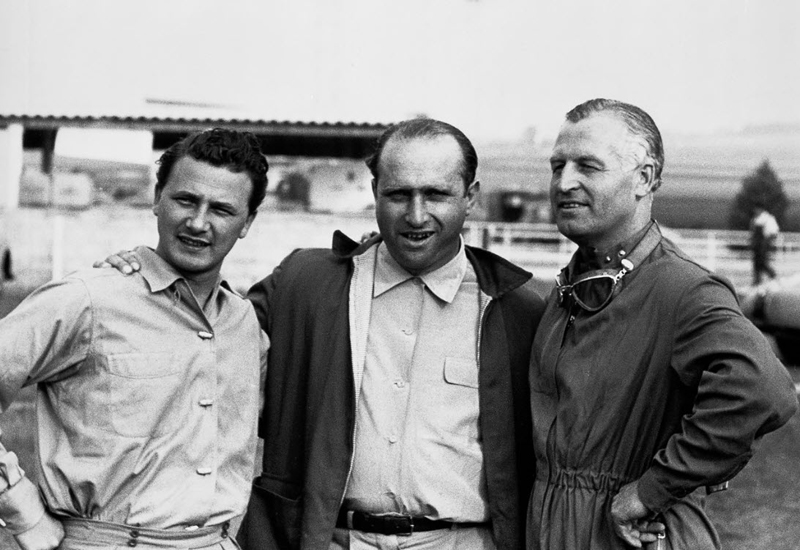
Hans Hermann, Juan Manuel Fangio, Karl Kling
2012 was the 60th running of the historic half-day race, an event Herrmann (seen above with Fangio and Karl Kling) won twice in his career. In 1960, he won at Sebring in a Porsche 718 RS 60 shared with Oliver Gendebien, winning the Targa Florio in the same year. Having raced in F1 with Maserati, Cooper and BRM, Hans also raced F1 for Porsche. Lack of success prompted a move to Abarth.
A few years later, Hans returned to Zuffenhausen. The team struggled with the 906 for a couple of seasons before finding their feet in 1968, with the awesome 908. Hans again won Sebring, this time alongside Jo Siffert.
The following year, Herrmann’s 908 missed a Le Mans win by a very narrow margin. In 1970, the baker from Stuttgart made up for it by clinching the first win for Porsche at Le Mans in the 917, alongside Richard Attwood. The car was one of just seven finishers in a race of total chaos.
Hans Herrmann was 42 when he won Le Mans: an age that many drivers of his era did not live to see. After the event, he retired from racing but continues to attend many European and US events.
Now the grand age of 84, Herrmann’s importance in the history of Porsche should not be underestimated. Nor should the affection he is held in amongst the Porsche cognoscenti: one chat with the major players at the Porsche Museum speaks volumes about how Stuttgart regards one of its all-time favourite racing sons.
Congratulations Hans! Well deserved, and many more besides.
Ferdinand blogs my freelance adventure with Porsche at the centre. To support the blog or engage with me in other ways, you can:
This website uses cookies to improve your experience. We'll assume you're ok with this, but you can opt-out if you wish.AcceptRead More
Privacy & Cookies Policy
Privacy Overview
This website uses cookies to improve your experience while you navigate through the website. Out of these, the cookies that are categorized as necessary are stored on your browser as they are essential for the working of basic functionalities of the website. We also use third-party cookies that help us analyze and understand how you use this website. These cookies will be stored in your browser only with your consent. You also have the option to opt-out of these cookies. But opting out of some of these cookies may affect your browsing experience.
Necessary cookies are absolutely essential for the website to function properly. This category only includes cookies that ensures basic functionalities and security features of the website. These cookies do not store any personal information.
Any cookies that may not be particularly necessary for the website to function and is used specifically to collect user personal data via analytics, ads, other embedded contents are termed as non-necessary cookies. It is mandatory to procure user consent prior to running these cookies on your website.