
by John Glynn | Aug 11, 2015 | Classic Porsche Blog, Project Cars
Not had much time for blogging lately as I’ve been doing more building at home, continuing the office and garage extension (codename Porschehaus) that fell by the wayside when the original Ferdinand owners went bust, owing quite a lot of money to me and many others. It’s taken a while to get finances back up to speed, but lots of good things are now happening and the project is moving again.
I find building very satisfying. My Victorian house was built in the late 19th century, so part of the joy is in chasing materials: architectural salvage from hundreds of years ago. Unearthing a stash of two thousand bricks from the same kiln that fired my own house was a result, as was winning a truckload of blue ridge tiles for just 99p and paying the same for barn skylight windows (for parts).
I cursed a bit (ok, a lot) when I missed a round cast-iron Victorian window on eBay but have found a good skip guy, concrete supplier and source of steel beams not far from my house. Researching the best sources is all part of the fun when putting this stuff together, but it does eat time in the process. All this will sound very familiar to classic Porsche people.
Part of the fun of Porsche ownership has long been finding the parts to go with them, but as prices for cars have all gone through the roof, parts prices have soared, too. Gone are the days when a pair of Fuchs could be bought for £350, or a nice old pair of Recaros snapped up for less than £100. I sold quite a chunk of my parts stash for that sort of money to pay the mortgage when I first went freelance five years ago, but I still have a few bits remaining. Now that the Porschehaus project is back up to speed, I’m excited to plan for my parts to come home, as well as the cars, of course.
While dreaming of where this stuff will go, I had an email about a new Porsche-inspired lifestyle brand someone wanted me to look at. It made me wonder where the line was between gathering Porsche cars and parts with the odd bit of memorabilia, and adhering to the doctrine of a Porsche “lifestyle brand”?

I’ve made a few runs of Porsche-themed t-shirts and the odd grille badge over the years, but all that stops well short of defining a lifestyle. Friends often say my lifestyle is more pikey* than Porsche, which is probably fair enough, given the brick dust, Jack Russell Terrier, Irish accent and their lack of imagination (you know who you are).
I understand the attraction to branding, but the idea that people would define their whole lifestyle by the car they drive seems quite restrictive. I doubt that a majority of my classic Porsche friends would call their car a lifestyle choice: it is not about ticking each box in a catalogue.
Old-school Porsche boys got by without worrying too much about what t-shirts to wear when driving their cars. No doubt we are all bound by this cult, but don’t get bogged down in where “people like us” go or what we should be wearing. There are more books to read, more bricks to lay and many more cars to enjoy before our time here expires. Keep the faith, but don’t do it blindly.
* US readers, I don’t know what your equivalent of a pikey would be: perhaps a wheeler-dealer crossed with a hobo. Submit your definitions!

by John Glynn | Jul 4, 2015 | Classic Porsche Blog, Porsche News
Good friend Justin just sent me this interesting slide from Australia, showing the first RHD Porsche 911 Targa being produced. Here’s the story behind it:
“I found a whole lot of my late father’s slides that I had digitally scanned a few years ago. This one is the first RHD targa going down the production line in September 1972.
“As my father told it, we were on the factory tour and the tour guide was talking about Targas. Knowing there were some English and Australians on the tour, it was mentioned that there were no RHD 911 Targas until the following year (i.e. 1973).
“You were still able to take your camera back then and Dad saw a Targa shell being rolled towards us that looked somehow different: initially, he wasn’t sure how. He took a shot of it quickly and then walked past it. On the build sheet of the car, he saw erste rechts (1st right), so we can assume it was the first production RHD Targa for the 73MY. It was mid-September 1972 my parents tell me.
“The tour guide realised and, rather than seizing Dad’s camera, asked him not to do anything with the picture until after the official embargo (which was early 1973). I assume the car was being shown somewhere – Earl’s Court , Birmingham, South Africa, Hong Kong? Dad complied with Porsche’s request, which was perfectly reasonable. I wonder where the car is now – or if indeed it still survives?
“As a side note, there are 2 73S Targas (both RHD, and both English) awaiting restorations in Sydney (where my green L was done) – one Sepia, and the other Signal Yellow. They’ll be done in about two years.”
Love getting presents from overseas and this was a really good one! Thanks, Justin 😉

by John Glynn | Jun 10, 2015 | Classic Porsche Blog, Race and Rally
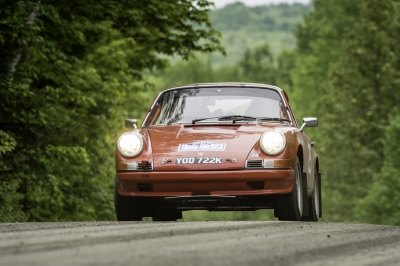
A pair of Tuthill-built Porsche 911s is competing in the 2015 Trans-America Challenge: the SWB 1965 Porsche 911 of Gavin and Diana Henderson (above) and the LWB 1973 2.5-litre car of Peter and Zoe Lovett (below).
Rally news updates paint a promising picture. The Road to Mandalay Rally-winning Lovetts are in the top three, while the experienced Hendersons have already claimed their first regularity challenge win. Both cars are running reliably.
Also in the rally is a Tuthill joint project: the Porsche 912 of Mark and Colin Winkelman. The body and interior was built by Tuthills, with the drivetrain and final assembly put together by Hayden Burvill at WEVO in San Francisco.

I haven’t shared the cars here as yet, as my ear gets bent if I put all the good workshop stories on Ferdinand, but all three are perfect examples of the ox-strong resto-rally 911s with creature comforts that Tuthill Porsche puts together so well. I’ll sort some pictures out and share them here later.
2015 Trans-America Rally
Organised by the Endurance Rally Association, the Trans-America Challenge takes place from June 7-28, 2015. It is the second running of the Trans America enduro, following the inaugural rally in 2012. Today was a rest day after three days of driving that has taken the entrants as far as Quebec.

The route for the three-week event runs across North America. Starting from Nova Scotia on the Atlantic coast, forty five entrants from all over the world travel through Eastern Canada before crossing the US border and driving through Vermont, New Hampshire and upstate New York.
Once in NY, they approach the Great Lakes, briefly returning to Canada just south of Toronto before hitting Michigan, Wisconsin and Minnesota. The vast Dakotas are next (North and South), then the teams take in Wyoming, Idaho and sunny Nevada before landing in California, en route to the finish in San Francisco.
Porsche Trans-America Road Trip
I’ve done a Porsche road trip through New York, Vermont and New Hampshire. Our Rolling Stone Targa feature on Karl Donoghue’s cool R Gruppe Porsche 911 Targa and the Bethlehem Porsche 911 ST backdate story both came from that trip. The roads in this part of America are good fun to drive on, especially with mates alongside, and there is great character in the landscape. I’m interested to hear what the competitors say at the end, as it seems an interesting route across the continent: a journey I hope to make myself in a Porsche 911 on my half-century (not long now).
Game Girls Galore in Trans-Am
One other friend on this event is former McLaren team boss, Alastair Caldwell, of Porsche 912 on London-Cape Town rally fame. I recently bumped into Alastair at the Tuthill Porsche workshop with his SWB 912 rally car, but he decided against shipping the 912 to Canada. Instead, he’s running a beautiful 1963 Rolls Royce Silver Cloud II across America, with mum Dorothy as navigator.
Now a spritely 97 years old, Dorothy has competed in a number of previous rallies and thoroughly enjoys the experience: no doubt the craic is good in Canada tonight. AC reckons she has the best room at the palatial hotel they’re staying in for the rest day. Rightly so: she deserves it!
Pictures courtesy of Gerard Brown/Endurance Rally Association

by John Glynn | May 9, 2015 | Art and Books, Classic Porsche Blog
A Porsche 928 art car painted by eminent German artist, Heinz Mack, will be auctioned at the Lempertz Contemporary Art sale in Cologne on May 30, 2015. Though classic Porsche 928 values are rising along with prices for all other older Porsche models, the likely value of this car is more closely linked to its artistic connections.
Heinz Mack and ZERO
Born in Lollar near Frankfurt in 1931, Heinz Mack attended the Düsseldorf Academy of Arts during the 1950s, also attaining a philosophy degree at the University of Cologne. In 1957, Mack started an art magazine ‘ZERO’, which ran for a decade and gave rise to the eponymous ZERO art movement.
ZERO held to the notion that art should be void of colour, emotion and individual expression. Founded by a trio of German artists including Mack, Otto Piene and Günther Uecker, ZERO later encompassed a wider group of primarily European artists including the Swiss Jean Tinguely and Argentinian-born Italian, Lucio Fontana.
The central theme of Heinz Mack’s art is light. His ideas have been expressed through sculptures and pictures in a hugely diverse range of materials and locations. Often working in open spaces ‘untouched by the fingerprint of civilisation’, Mack’s most recent project, Nine Columns under Sky, was created on the beautiful Island of San Giorgio Maggiore in my favourite city of Venice. Nine seven-metre columns covered in more than 800,000 gold-plated mosaic tiles inspired by the Sahara Desert invite reflection upon this long-term epicentre of Mediterranean art.
Porsche 928 Art Car & Value
While Mack is reputedly a passionate collector of cars, his tastes lean more toward British machinery. Preferring Aston Martins and Jaguars, Mack was asked to paint the Porsche 928S by a friend in 1984.
The Porsche is a 1978 4.4-litre 928S manual with TUV approval to August 2015. The odometer reading shows unknown kilometres but the car is said to display signs of its age. Signed by the artist on both doors and taking some inspiration from period aero tests, the design is said to “accentuate the aerodynamic silhouette of the sports car with small triangles on both sides and a colour spectrum that morphs from white into black”.

Porsche Museum 928 provenance
Previously exhibited at the Porsche Museum, auction estimates for the car run from €40-€45k. Given current prices for standard Porsche 928s of similar vintage, this seems ridiculously low for a bona-fide art car.
The most recent large scale auction of ZERO artist output came at Sotheby’s in 2010, where a catalogue of of 49 paintings and drawings sold for more than four times the original auction estimates, to hit a total of more than £54 million.
Mindful of where the art market has soared to in the five years since, current interest in the unique early 928 and the parallels between classic Porsche and modern art collecting, I can see this car outperforming all expectations at auction. I am excited to see how it goes.

by John Glynn | May 9, 2015 | Classic Porsche Blog, Race and Rally
Despite the time, money and technology invested in modern Porsche cars, including the Porsche 918 and 919 LPM1 Hybrid, the Porsche 917 is still the model most frequently seen at the top of “ultimate Porsche” lists. But which is the ultimate Porsche 917?
Porsche built circa 60 variations on the 917 theme, including 917/10 and 917/30 Can-Am models. Iconic liveries included Gulf, Martini and Kremer “Hippie” cars, but the most famous 917 must be the red-and-white short-tail painted in the family’s own Porsche Salzburg dealership colours. This is chassis number 917-023: the car that claimed Porsche’s first Le Mans victory in June 1970.

Legend has it that, like all good race cars, the winning Porsche 917 was sold in the car park after the race, to pay for the next round of racing developments. In fact, 917-023 stayed with Porsche for the rest of 1970 before selling to the Martini Racing team, and then on to famous US collector and engineer, Vasek Polak. It passed through the Matsuda collection and also lived with an American doctor before current owner, Carlos Monteverde, bought it for racing. Much of Monteverde’s collection apparently lives quite near my house, but that’s another story.
Richard Attwood Porsche 917 Le Mans 1970
Richard ‘Dickie’ Attwood drove the car to victory in Le Mans 1970 and was never surprised that Porsche sold the car soon after the win. “Le Mans did not have the same cachet in 1970 as it does now,” Dickie explained to his local paper. “There are more significant races for drivers, but it’s tremendously important for manufacturers.

“1970 was a landmark win for Porsche because it was their first, but my win there was lucky. We only qualified fifteenth fastest – it was more a case of other drivers losing rather than my winning. But, having been leading by six laps in the previous year with three and a half hours to go when the transmission broke, I deserved a bit of luck.
“Winning Le Mans unquestionably helped me in later life. The hero worship of sports stars has now reached stratospheric levels and the significance of that victory seems to grow stronger with the passing of time.”

Despite claiming Porsche’s maiden Le Mans win and being one of the few people who have owned a Porsche 917, Attwood was not the Porsche 917’s greatest fan at the time, noting that Porsche would pay double money to convince drivers to race the “no good” 917 rather than the proven 908, which was still well able to claim the winner’s purse at most races. When Porsche asked their driver what format of 917 he wanted to race in June 1970, Attwood chose a slower 4.5-litre, short-tail car with the 4-speed gearbox on the basis of reliability. He adopted a similar approach to his team mate.
Having raced alongside Vic Elford in 1969, Attwood felt his team-mate had cost them a win by driving the car too hard, breaking the gearbox with three hours to go while the car was six laps in front. For 1970, Dickie chose to drive with Hans Herrmann: one of the factory’s most famous drivers, but a man in his early forties who had already decided to retire.

The pair did no testing before the event: Le Mans was Attwood’s first drive in the car. Qualifying way down the field, a win should have been impossible for Porsche 917-023, but then the rain fell and history was made.
The full story of Porsche 917-023 has now been committed to print in a book by former Silverstone press officer, Ian Wagstaff, which will be released on June 1st. The book tells the story of chassis 023, including hundreds of period pictures, interviews with all surviving drivers of 917-023 and input from one of the most experienced 917 mechanics of the era. Pre-order the book here.


