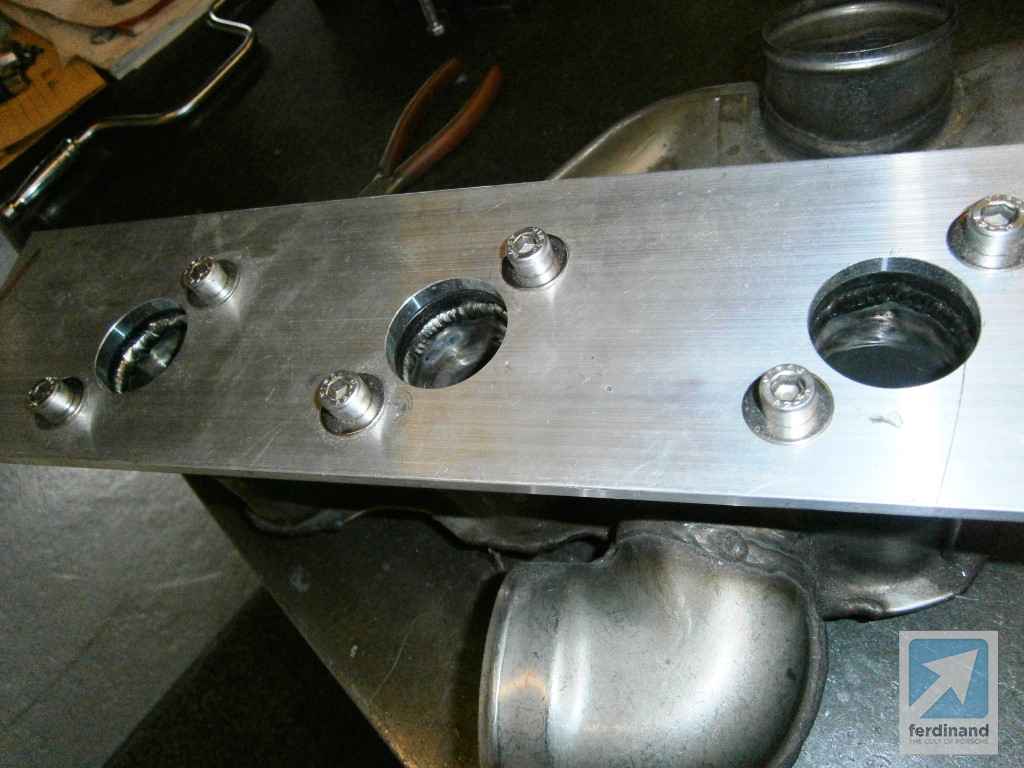
by John Glynn | Sep 14, 2014 | Modified Porsche Hot Rods, Project Cars
Caught up with fellow ImpactBumpers.com forum member Alex this week, to discuss an agreed insurance valuation for his Porsche 911. Alex’s car is a 911 3.2 Carrera, but runs a 3.6-litre engine transplant: a 964 engine, rebuilt with some 993RS trickness. The car is light, so performance is “adequate”:

One issue with the 3.6 transplant cars is the exhaust: what do you do with heat and silencer under the rear of an impact-bumper car, a chassis that has less space available than the later models? Alex’s solution is the best I’ve seen yet: all titanium and all home/hand made. Alex explains:
“I liked the first version transplant exhaust on my car: a cheap, simple set up that worked well but with a few limitations that were increasingly bugging me.
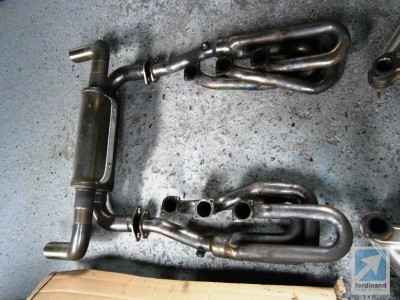
“The first system used reasonably priced 1.75″ dia headers going into a 14” Magnaflow rear box. It sounded great if a little on the noisy side, particularly on a long run, so I made up some inserts, which made it quieter without costing power. This made me wonder why I didn’t just use smaller tubes in the first place.
“The lack of heat, low ground clearance and drone over long journeys sent me back to the drawing board. I decided to follow other transplanters down the 993 heat exchanger route, then build a similar system to 993 Cup cars off the 993 exchangers.
Titanium Exhaust Porsche 911: Akrapovic GT2
“My first system followed a few tuners to through-the-bumper exhaust outlets. I was undecided before doing it, and it was interesting when done, but the novelty wore off. Eventually, finding a titanium Akrapovic exhaust silencer/muffler on eBay from a 997 GT2 sent me down a route I thought would be more in keeping – albeit lots trickier.

“One question was X-pipe or not. Some silencers are x-pipe inside and don’t seem to hurt the 911’s power, but others believed more power would come from a non-X-pipe system. I had already manufactured quite a complex system using the X-pipe idea, but the muffler also had an internal X arrangement so we decided against using two crossovers.

“The first work on version two was to finish my cheapie 993 heat exchangers. With the flanges cut off and jig made, they needed rotating, welding back on and linishing flat. The other side needed patching and a new pipe cobbled together. The steel on these is very thin and although stainless, it’s not the best grade so can corrode.

“Then it was a case of making jigs, which other transplanters were a great help with. Twisting these tight-fitting pipes can be tricky, but a fellow IB’er helped with a fitment guide that worked really well. I bought some more titanium tube, including many bends and had quite a bit prepared by a local water-cutting firm, before my welder friend came around to do the final assembly on the car.
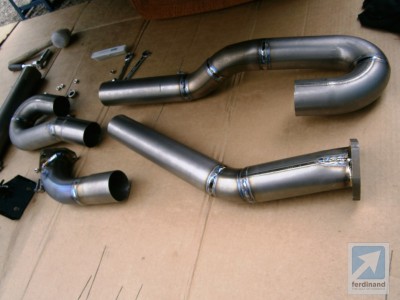
“There’s always a few bits you think I could have done better and there’s still some finishing to do – I may do double slip joints in two places and the tailpipes are just bits of tube at the moment – but it’s on and sounds good. It’s still quite loud, although much quieter than the Magnaflow, but it now has a real rasp to it and makes a racket on overrun.

“With the new exhaust I think the car is now running a bit richer but haven’t done enough miles to really get to know it. Fingers crossed the bumper doesn’t catch fire!”

Awesome work by Alex – so many hours and for sure a pricey system, but if you’re going to think outside the box, then expect some of the costs to live there too. Read more about Alex’s car and many other Porsche 911 hot rods on the Impact Bumper Porsche 911 hot rod forum.
by John Glynn | Sep 10, 2014 | Classic Porsche Blog, Project Cars
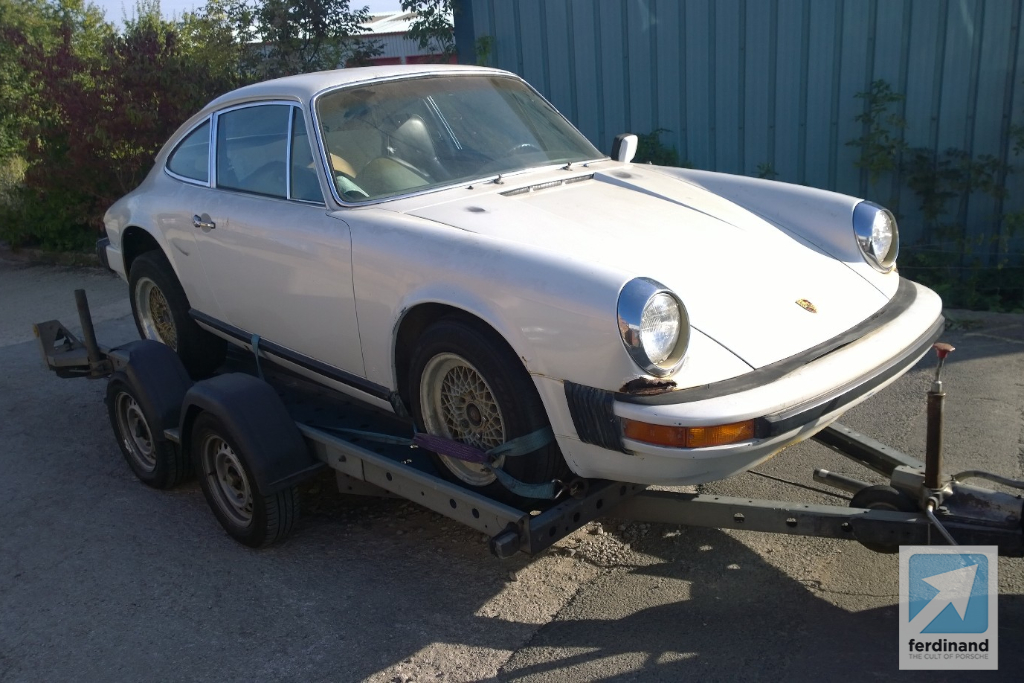
So my 912E has finally arrived in the UK. Bought unseen from San Francisco Craigslist, the car was also advertised on Pelican and a few other places frequented by Porsche fans, but no one wanted it. I did a good deal with Bob the seller and had it trailered away by a good friend out there.

It lived with some friends in SF for almost a year, before it was trucked down to Long Beach to sail with a Tuthill 356 and a collector friend’s 911s. The container cleared customs on Monday, got trucked up to the West Mids and was unpacked on Tuesday morning. I had notice of the unboxing at 9am. By 10am, I’d arranged a car transporter on Shiply to same-day trailer it to my classic Porsche home-from-home: Rob Campbell’s Racing Restorations in Pershore near Worcester. It arrived there later that afternoon.

I am tied up on other stuff all this week, so I won’t get to see it until the weekend, but Robert’s had a good look this morning and says the shell looks pretty solid. It’s had a really rough paint job in the past, but that will blast off easily enough and reveal the original Arrow Blue.

1976 Porsche 912E Project
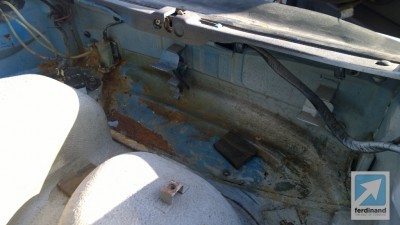
I purposely bought a 911/912 with no sunroof, as roof panels on pre-galv cars can go nasty, not to mention floors soaked by leaking roof seals. Seems the floors are solid so that is good. Little bit of rust in the front and rear window apertures, spot of surface rust under the parcel shelf. The kidney bowls look OK, but the latch panels are messy. The front wings are rough, but there’s a pair of good ones in the car – not that I am using either. The rest looks reasonable apart from a holed front pan, but that would be coming out anyway as they love to rust: an easy repair job for Mr. Rob Campbell.
What is the plan? Currently aiming to backdate it, keep it simple maybe run it kinda ratty for a while. Not easy to run something with no engine in it, so I plan to fit the classic Subaru Turbo transplant with a flipped R&P and the WRX 5-speed. Still flat four and I’m a Subaru guy. I’ve got a set of Subaru workshop manuals, am not into Beetles and who can be doing with the price of flat sixes these days! 😉
by John Glynn | Aug 30, 2014 | Classic Porsche Blog
I never met Björn Waldegård, but we spoke on the phone once. It was a memorable experience: everything you wish from your heroes.
“Luck plays a part in all of life,” Björn told me. “Not a great percentage, but it is there. Luck is not just your good luck, sometimes it is other people’s bad luck. How you prepare can lead to your luck.” Making one’s luck is the mark of a champion: the first-ever World Rally Champion.
Björn Waldegård and Porsche
Born into a farming family, Björn began winning rallies in his privately-run Volkswagen at the age of 19. Noting his ability, the Swedish Volkswagen importers put him in a professionally-built VW rally car, which he used to claim a few podiums.
Things hotted up when a Porsche 911 was purchased. Björn took second place on the 1967 Gulf London Rally and performed well elsewhere. 1968 brought a win on the Swedish Rally, almost half an hour ahead of second place. Monte Carlo brought a top ten finish: the following year, Björn won the race, and then won in Sweden again.
When the ST arrived at the start of 1970, Waldegård exploited its potential, repeating his wins from the previous year and adding the Alpine Rally. The list continues: let’s just say that he knew the 911.
Swedish Sixth Sense
More than the secret of 911 speed, Björn had a sixth sense of how much life was in a car. “A car is like a fuel tank,” he said. “You use its life up through the length of a rally. The perfect rally car falls apart as soon as you cross the finish line: nothing is left.”
Francis Tuthill once told me exactly the same thing about sitting next to Björn on a pre-Safari test in Morocco. “He has two sets of instruments: one set on the dashboard and one set in his head. His internal gauges clock up how much of the car he has used, where he can push and where he should hold off.” Francis co-drove for Björn on a rally one year – it may have been the Eifel Rally – and, while setting pace notes, Bjorn told Francis to mark one corner as “caution: keep to the inside”.
“I didn’t see it like that: it looked a fast corner to me,” said Francis. “But you always pay attention to Björn, so I did put it down on the notes. In the heat of the event I neglected to call it, but Björn was a wily old fox. Remembering the bend, he slowed down anyway and sure enough there was a group of cars off, stuck in the ditch on the outside. The road had frozen overnight and failed to thaw: he spotted it would on the recce. That was just what he was like: incredible intelligence and ability. Driving slowly was part of his secret.”
Laid Back, Straight Talking Björn
We have family in Sweden, so I have travelled all over that country. The Swedish are easy-going, straight talking people, and Björn was a perfect example. “I’m just a simple Swedish farmer”, is how he described himself to me, but we all know he was much more.
“When I retired, I thought my driving was over,” Björn told me. “But the energy of rally fans kept it alive. Soon historic rallies began to come up and my phone was ringing. But it was not manufacturers taking millions of pounds in promotional value from winning a rally, it was just rally fans, doing it for the passion. The events were no slower – Safari now is still just as fast as it was in 1970, and the roads are just as deadly. But when you know you are racing for passion, it is a very satisfying way to use a talent.”
Waldegård: Make Your Mark
We were working together on the Race4Change team, so I asked Björn about strategy: how would he approach the impending Safari? “Same as any Safari,” he said. “We will start by looking at the others: how ready they are, how hard they will start, how much confidence they have. Then we settle in and choose when to lay down our mark. And then we will see who is ready to rally.”
Lessons learned on Safari always transfer to life. Bjorn won the 2011 Safari in a Porsche 911: in total he won six Safari Rallies and the hearts and minds of rally fans everywhere. After an hour on the phone with him, I had a different perspective on my work. He was a great competitor and a true Porsche hero. I will miss typing his name, seeing more new pictures of that face and wondering what he is thinking.
RIP Björn Waldegård. Here’s to fast, flowing stages and the memories of genius.

by John Glynn | Aug 29, 2014 | Classic Porsche Blog, Project Cars
My US-purchased 1976 Porsche 912E roller is about to land on UK soil. The car is coming in alongside some imports by a collector friend of mine, so he emailed me the customs forms today to get the clearance put through ASAP.
Tuthills are shipping a really beautiful 356 Roadster in the same bundle as mine and they want to take that to Goodwood Revival next weekend, so while I have no clear date on landing, I expect to be unloading it by this day next week and sharing pictures on the blog soon after.
Plans for the 912: we’ll trailer it to Rob Campbell’s Racing Restorations, have a poke around on the ramps, see what the body looks like and decide what parts can go on eBay as surplus to requirements. I’m sure I’ll at least be listing some impact bumper front wings, as my plan is to backdate it – most likely in steel. More 912 news later.
I still have my 1976 911 Carrera 3.0, the 924 Turbo and all my other cars. Buried in a variety of projects lately has left little time for project fun, but I have been busy on eBay, buying stuff under the duvet late at night. Many website building projects and delays to our long-standing building programme here at home left me with a bit of spare cash, so as I’ve always had a soft spot for Merc SLs, I started looking at those again.

I’ve owned four different Mercedes models, and always enjoyed their solidity. My last experience with a Mercedes SL was to help shift a friend’s R107 SL (chrome bumper one above) from the South of France to the UK and then on to Croatia. That was a 560SL: the US-Canada smog beater. Utterly beautiful, but I’ve always preferred driving the later R129 models.
Good job too, as my £3k in spare cash wasn’t going to buy much of a 107, but it would buy a together example of my target car: a 300SL-24 from 1990-1993 in a good colour with low-ish mileage and big history file. I was OK without a V8, as the Cayenne ticks all my 8-cylinder boxes and the 300 is a nice grand tourer for weekends away with Mrs G. I was not looking for another sports car.
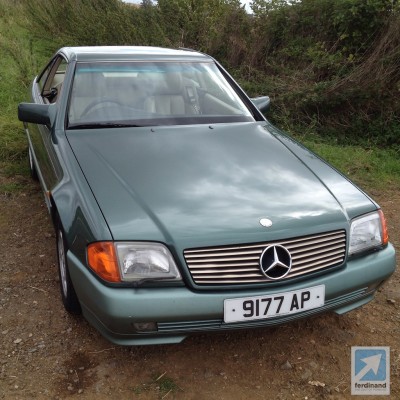
I’m fine with doing a little bit of work as long as the pricey stuff works: i.e. central locking, air con and the electro-hydraulic convertible roof, so I set up an eBay search for SLs under £4k, and bid on a few six-cylinders. A few days into the process, up popped a 500SL that caught my eye just minutes after listing.
£3995 asking price for this very tidy 68k-mile 1992 V8 SL was an excellent price versus my research: being sold cheap for a quick sale. Malachite Green with beige leather was not my first choice, but not too unattractive: I quite like green cars. I rang the number in the ad, spoke to the interior designer owner, she had owned it for four years, mileage supported by MOTs and everything worked fine. Ten minutes later, she had my Paypal deposit on the full asking price and I was arranging insurance.
I collected the car last Friday and all is good: I’ve been doing some more research since. Mercedes built 200,000 R129 SLs from 1989 to 2002, but less than 800 V8s of this generation are still known to the UK registration authorities. Numbers have been falling since the start of the century, so nice to save one from destruction.
A plate transfer has held up the registration transfer, and I have bought another private plate for it, so it will be an extra week or so until it is taxed and ready to use on the road. First impressions: it’s had some paint while it lived in London, needs some help on trim and we got a few quid off for cracks in the plastic soft top windows, but it drives very nicely: exactly as I remember them.
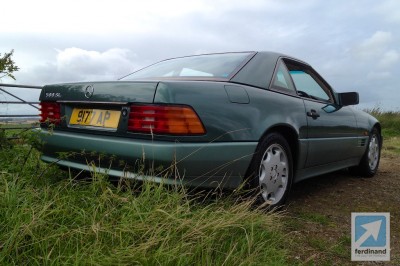
Superbly comfortable seats, beautiful M119 V8 as fitted to the Porsche-fettled Mercedes 500E, the earlier and much maligned 4-speed transmission is still a joy to use and pre-93 has none of the aggro that goes with the later electrical looms or transmission fluid wicking up the wiring harness. I love the gentle styling, that classic front end and the hardtop that transforms the car into a beautifully together sports coupe.
A comparable 911 of the same vintage – so a 964 Carrera 2 Cabriolet – would be over £30k now, and is it ten times what I bought? Ask me in ten years.
by John Glynn | Jul 28, 2014 | Classic Porsche Blog, Race and Rally
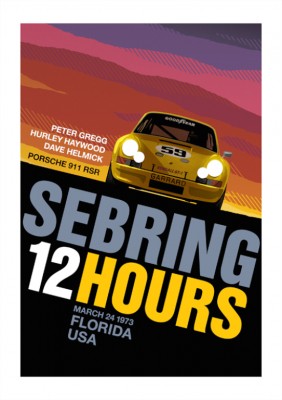
Ferdinand Magazine’s favourite digital artist, Guy Allen, has just released a new print for summer 2014. Celebrating a famous 911 win at the 1973 Daytona 12 Hours, Guy has created a striking Porsche 911 artwork that does justice to the hard-fought Sebring showdown.
Porsche 911 RSR Sebring 1973
Veteran race fans may recall how, in 1972, the Sebring 12 Hours was struck off the World Sportscar Championship calendar due to the state of the track. IMSA decided to include the circuit on its 1973 GT racing calendar and set the stage for a brutal test of survival.
A pair of Corvettes led from the start, but an unmerciful race pace around the airfield circuit took its toll. On lap 86, Porsche seized the lead. The Porsche 911 RSRs of Haywood/Gregg/Helmick and Minter/Keyser did battle to the flag, with Dave Helmick’s Light Yellow RSR coming home first.
Those lovely people at Gunnar Racing carried out a full restoration on the original RSR back in 2000 – see the Gunnar Racing 911 RSR restoration thread. At the time, it was owned by a gentleman living in Oxford, just down the road from here. No doubt this is an important 911: great to see it on a Guy Allen print.
Produced on archive quality heavyweight paper and available in a strictly limited edition of 100 prints, this is a large format A2 print: 594 x 420 mm. Each print is signed and numbered. Mine is number two – not sure where I’ll hang it yet, but it’s a really nice piece of work.
How Sebring Changed the Face of Racing
What I like about this story of the 1973 12 Hours of Sebring is how it changed the face of US racing. Gunnar’s website quotes Sebring historian Ken Breslauer’s summary of events around that time, following the FIA’s refusal to certify the circuit for 1973.
“For 1973, an upstart group known as IMSA added Sebring to its Camel GT series, and the race lived on, though radically different in appearance. The entire event was more informal, but no less competitive than previous years. In retrospect,the 1973 race was one of the finest gatherings of GT production race cars ever in North America. Entries totalled the second largest ever at Sebring.
“There was no race the next year, 1974, due to the OPEC oil embargo and resulting fuel crisis. Nevertheless, on the third weekend of March ’74, about 2,000 race fans showed up anyway. The Sebring tradition simply would not die.”
No race and a fuel crisis, but two thousand race fans “turned up anyway.” Way to go, America!