by John Glynn | Nov 12, 2009 | Classic Porsche Blog, Project Cars
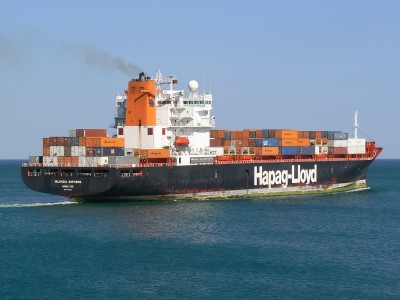
I’m currently shipping my third Porsche 911 to the UK from the USA (West Coast/California). The first leg of the Porsche’s voyage is aboard the container ship Valencia Express, which is taking it from LA to Caucedo in the Dominican Republic. After unloading the Porsche 911’s shipping container and who knows what else, Valencia Express will then head across the Atlantic and down towards Spain, while another ship, the Sormiou, currently en route from Valparaiso, will pick up the UK shipping freight, including my classic Porsche 911 SC. Once loaded, it will set sail for London, via Rotterdam.
Shipping a Porsche 911 from California to UK: Vessel Tracking
Knowing the ships that are bringing Varmint home is pretty cool. You can track them using Hapag Lloyd’s site, which I had been doing in the evenings since it left LA.
According to the Hapag site, Valencia Express was due in Manzanillo, Panama yesterday, which Google Maps told me was on the Pacific, like Manzanillo in Mexico. Finding out that the ship was late, I had a little search and learned that Manzanillo port is actually on the Atlantic: it is the port just by the mouth of the canal. Google Maps is properly sketchy about Panama but this seems a bit of an obvious mistake.
Anyway, as it hadn’t arrived, I surmised that it might still be in the canal. I googled for some real-time Panama Canal update sites and found the live webcams at the Canal Authority’s website late this afternoon.
There are two cameras at Gatun Locks: the locks where the canal meets the Atlantic. I couldn’t see much from the seaward one, as it was covered in rainwater, which eventually knocked it off line. Judging by the other camera, facing back up towards the lakes, there didn’t seem to be much going on in any case, so I gave up and got back to work. After dinner, I logged in again and immediately spotted a Hapag Lloyd vessel queuing up to get into the locks behind something else. Turns out it was the Valencia Express – what a fluke!


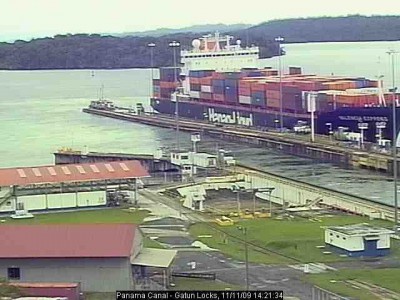

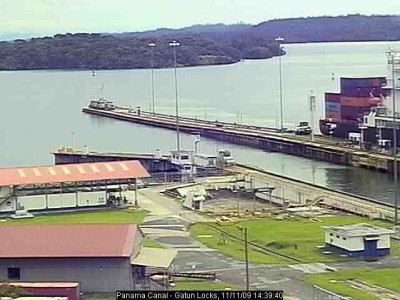
If I need to tell you how toe-curlingly geekish and outrageously brilliant this is, then you’re not one of us! Very cool to be watching the ship carrying your little sweetheart 911 back from the USA live via the Internet – especially as it was so totally random.
Keeping my inner nerd in motion, I’m considering getting in touch with Hapag and Tilbury docks, to see if I can blag my way in to the harbour and watch the thing arrive in London. I’ve taken all that week off, so I have the time. You never know, they might just let me do it.
As for those who wonder “where is she now?”, the Valencia got to Manzanillo at 6.30 their time on Wednesday: a day late!

by John Glynn | Oct 26, 2009 | Classic Porsche Blog, Modified Porsche Hot Rods
Early impact-bumper Carreras – the 1974/75 Porsche 911 2.7 Carrera and 1976/77 Porsche 911 Carrera 3.0 – are some of the most misunderstood 911s ever made. John Glynn looks at two interesting examples, with not a lemon in sight. (First printed in 911 & Porsche World magazine).
Citrus Carreras
The sun finally emerges from behind wispy white clouds and treats our retinas to a cascade of colour. Non-911 people looking at these cars, and their drivers of a certain age, could be forgiven for misguided references to mid-life crises, but there is more to these pukka Porsches than a bit of loud paint.

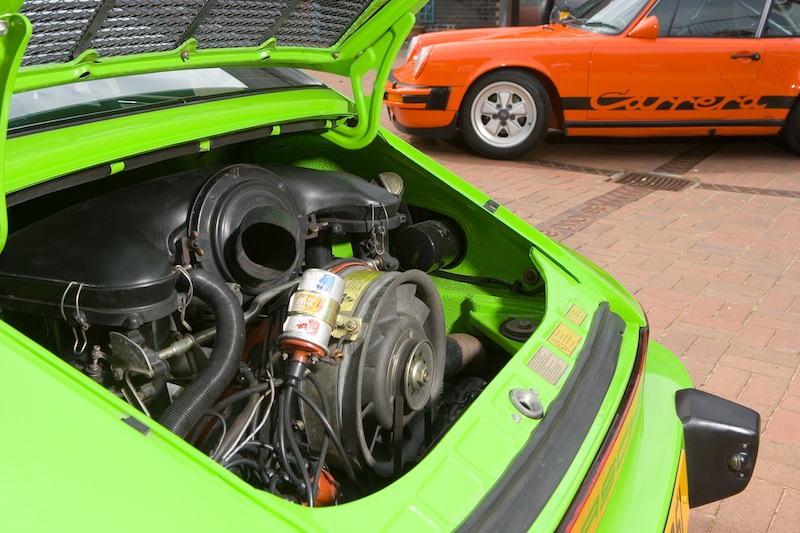
The first impact-bumper 911s arrived in the showrooms in late 1973, ready to appeal to a whole new audience. First registered in November of that year, the Lime Green car seen here is a very early 2.7 Carrera. Both American and Rest-of-World (RoW) Carreras have the same engine capacity, but while the 49-state US versions use an emissions-conscious 165 bhp K-Jetronic version of the 911S engine, RoW 2.7 Carreras feature the 210 bhp mechanically fuel-injected 2.7 engines of the ’73 RS, and are quite a different beast.
Nigel Watkins first spotted this car hidden in an Autofarm barn. Nigel, a long-term 911 enthusiast, immediately recognised race potential in the tired 2.7, and a deal was soon agreed. The colour was then metallic black, but evidence of factory Lime Green paint abounded. Ever keen on detail, Nigel decided to return the car to its original ‘74/’75-only shade.
2.7 Carreras predate the galvanising introduced for the 1976 model year, and many have fallen victim to the ravages of rust. The urge to convert corroded Carrera bodywork to ’73 spec has been too much to resist for some owners, but despite his love of the Carrera RS, Watkins chose not to backdate. A bare-metal respray in January 2006 produced this incredibly vivid vehicle, with impact bumpers intact. Nigel’s commitment to the chunky-cornered look was not in vain, as later that year, the car won a deserving Best of Show at Classic Le Mans.

Participation in the 2006 Curborough Sprint Championship also brought rewards. Following a very competitive season, Limey eventually won the championship outright. The win earned the Carrera further specialist attention, this time at the hands of Bob Watson. Bob is well regarded amongst the 911 cognoscenti, particularly for his in-house chassis dyno and excellent results on tuning MFI-equipped cars. Wrapped up for the winter in Watson’s workshop, Limey’s engine was removed for rebuilding.
A knock from cold was traced to the intermediate gear, so a lighter (drilled) steel unit from a 993 replaced the worn aluminium original. The motor was balanced and blueprinted, with a flowed crankcase, matched combustion chamber capacities and the heads polished, ported and matched to the manifolds. Once reinstalled, the engine was run-in on the dyno and tuning began. MFI pump condition is critical to horsepower, and Limey’s pump turned out to be a cracker. With tweaked fuel rates and ignition timing, the refreshed powerplant produced an excellent 237bhp.
An engine bay refurb and a transmission service, including the addition of a ZF limited slip differential, were completed at the same time. Southbound Trimmers provided the pièce de résistance by retrimming the original sports seats in proper perforated leather, lifting Limey to almost perfect condition. 
The relative rarity of the 2.7-engined IB Carrera, with less than 1,550 road cars produced over two years, has brought renewed interest to the model in the last few years, with a corresponding rise in prices. Nigel’s investment in professional restoration and period detail meant Limey was now a valuable commodity. The double-edged sword of rising prices made racing the rare bird more risk than Watkins could bear. A difficult decision was made to let Limey go, in favour of a more motorsport-focussed 964RS.
Neil Dickens was the man chosen to supply Limey’s replacement. Dickens’ dealership, The Hairpin Company, had the right RS in stock, and soon found an enthusiastic new owner for the 2.7. Neil has sold many noteworthy RSs over the years, and drove the ’74 Carrera daily while the deal was going through, so has some insight on driving the 911 that straddles the line between early and impact bumper.
“The car is entertaining in its own right, and the driving pleasure is readily accessible, but it lacks that iconic effortlessness,” declares Dickens. Serial Porsche owner Vic Cohen agrees. Cohen, who has owned two RS Tourings and currently runs a brace of Blood Orange cars; a 2.4S and a 993 GT2 CS, describes the ’74 as “flat” in comparison to the all-conquering ’73. “The car had an impossible act to follow,” notes Cohen. “Even nowadays, what can match the poise of the Carrera RS?”
It’s tempting to write off the first IB Carreras as a step backwards in performance, and there’s no doubt that the weight added to IB 911s in order to maintain their marketability created a dynamic divide between old and new. But despite the shared power source, comparing ’73 RS to ’74 Carrera is not comparing apples with apples. The modern equivalent would be like comparing a 996 GT3 RS with a 997 C2: an almost irrelevant head-to-head. A significantly lightened impact-bumper machine would make a much better yardstick. Enter the orange car.
I first encountered this 1976 Carrera 3.0 on the Pelican Parts Porsche forum in 2004. The owner was GeorgeK, a Swiss 911 aficionado who at that time also owned a very nice 930 – and a ’73 RS. George is the anorak’s anorak, combining encyclopaedic 911 knowledge with a heartfelt appreciation of the heritage, and a love of the flat-six driving experience.
George bought his Carrera 3 in 1996, from much-respected Swiss Porsche specialist Alain Pfefferlé, an RS and RSR owner and hillclimb champion in his monster 935. Then finished in Copper Brown, the Carrera was wonderfully period, with two-tone sports leather in black and cream. The car was used daily for 18 months, until medical student George inherited a BMW at a bargain price. This allowed the Carrera to be taken off the road for restoration. The aim of the rebuild was to provide a fun car for use in the Swiss Alps surrounding George’s home. The shell would be repaired where necessary, strengthened where possible and then the car would be rebuilt on a lightweight RS theme.
Space is at a premium in Switzerland, and finding a place to work on the C3 was no easy task. Claudio Ciutto came to the rescue, donating a spot in the corner of his bodyshop, where the Carrera would eventually be painted. Workspace sorted, the car was stripped, and the shell and doors were sent for acid dipping.
First job on the post-dipping list was to protect the bare metal with primer, before repairing the usual IB rust spots: one b-post, windscreen corners and inner wings by bumper mounts. The work was done on a jig, as the car had previously been down the road on its roof, and this was an ideal opportunity to correct some of the lesser-quality repairs following that accident.
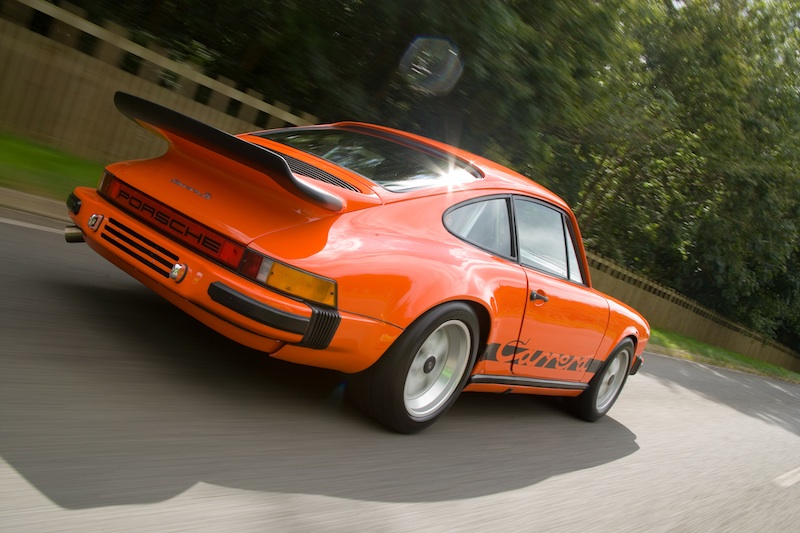
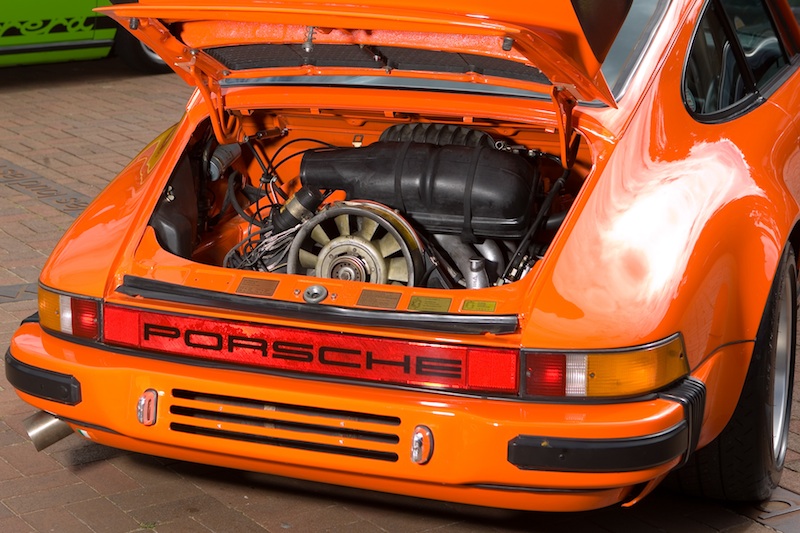
Myriad modifications were made to the shell. Strengthening was added to the rear shock towers and front aperture corners, and strut tower brace brackets were fabricated, all the patterns coming from an RSR. Upgraded rear anti-roll bar mounts were fitted, and superfluous holes in the tub were welded shut, including the vents above the rear window. Before a repaint in satin black, the interior was modified with a bulkhead battery master switch, lower seat rails from a late 3.2 Carrera, and welded mounts for an aluminium Heigo roll cage. The front panel was cut and boxed and a custom oil cooler installed, fed by hand-cut slots in the front valance. The rear bumper was slotted and lightened, a fibreglass valance was fitted and the bumperette holes were welded shut, pads replaced by readily available 917 race number lights. The fuel tank was enlarged for extended range and a polished 5.5-inch Fuchs rim was modified for use as a spare.
The lightweight parts fest continued. Aluminium was used for the front undertray, torsion bar covers, oil pipe clips, fuse box, smugglers’ box and centre tunnel lids, master cylinder mount, fuel sender cover and luggage compartment heater cover. The front lid is aluminium, from a 993 Supercup racer; Ciutto expertly repairing the bonnet pin and centre filler holes. In these pictures, the car is fitted with a fibreglass rear lid from an early Turbo, but it also variously runs an early fibreglass ducktail, and an aluminium 2.2S engine cover.
When it came to picking a colour, one shade stood out: Continental Orange, available for the ‘76-‘77 model years. The shell was infused with cavity wax, and thin layers of stone chip sealant were used on the underbody and wheel arches before the paint was painstakingly applied. Ten years later, the quality of Claudio’s work remains impeccable, with only a few minor blemishes visible.
Swiss vehicle safety checks are incredibly strict, insisting on cars being presented as type approved and measuring ride heights and exhaust noise levels. The C3’s mechanical parts would therefore be left more or less factory. Suspension is fairly standard: 19 and 26mm torsion bars, with stock anti-roll bars and Koni adjustable dampers. The brakes were uprated, with 964 calipers up front, 3.2 Carrera calipers in the rear and 3.2 discs all around. The magnesium-cased transmission was overhauled, with a shorter 7:31 final drive, new synchro rings and a 40% ZF limited slip diff. The engine had hydraulic tensioners fitted but was otherwise left stock.
The interior picked up a dash retrimmed in leather and a black headliner, both wrought by George’s fair hands. A pair of silly-expensive Recaro A8 lightweight recliners was installed. A Wevo shifter with elevated billet knob went in, along with the Wevo shift coupler. The wheel used here is an ex-race Momo Prototipo. Pedal box, column stalks and so on were stripped, cleaned and rebuilt. The loom was reconstructed minus now-defunct circuits such as electric windows and centre heater controls – backdated manual heat and windows having been fitted. Uprated headlamp relays were wired in. Reap Design in Middlesex rotated the tacho face, and the clock was replaced with an RSR blank. Prototype plastic exterior door handles were fitted, with RS door panels inside. Two years after starting the restoration, ‘The Orange’ was born.
Ownership following the rebuild was challenging to say the least. In September 2002, the original engine blew. C3 engines are rare, using the 6-bolt crank of the ’73 RS and early Turbo, rather than the 9-bolt version fitted to later models, so it took almost two years to find a replacement. In late 2004, an oil line failed on a mountain drive, causing more grief. George then began working overseas, so the car remained in storage. In October 2006, with a burgeoning medical career consuming more time, and a new baby on the way, the car was advertised for sale, quickly finding a new owner. A few weeks after the mountain snow melted in early 2007, The Orange was parked in my garage.
Changes to The Orange in my ownership have been few. The 7 & 9” Fuchs gained grippy 16” Michelin Pilot Sport Cup tyres, Ferodo DS3000 brake pads were fitted all round, and the heavy 18 kg battery was replaced with a lightweight Optima unit, mounted in the smuggler’s box. Seemingly strong dyno runs, showing 202 bhp at 5400 rpm, revealed a fuel pressure problem at high revs, duly rectified. With the marvellous Michelins, bulletproof brakes and a recent fuel and ignition system sort out, this little car now drives like a demon. 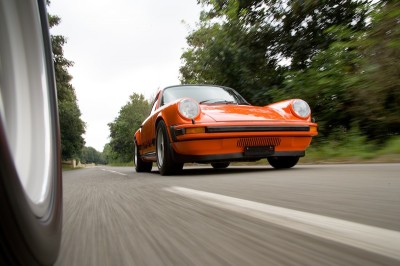
Torque of 255 Nm is identical to the 2.7, but the timing of the softer cams required by the K-Jetronic injection means C3 torque peaks 900 revs lower, at 4200. Combine the low-down torque with light weight, LSD, a shorter final drive and a slick Wevo-assisted shift, and you have a car built for back roads. The Recaros offer total support, and the lower seat height, higher shift knob position and reduced gear lever throw complete the perfect driving position. Stamp on the throttle in a standard C3 at 30 mph in fourth, and you’ll hit 100 almost 8 seconds faster than a 930 of the same vintage. Imagine what a lightweight feels like.
En route to our second location, I check the 2.7 in my 935 door mirror and the mile-wide grin on Dickens’ face is unmissable. Turning on to the beautifully undulating B4100, we open the throttles, our 911s living up to their exuberant exteriors. A little later we swap cars; I slide into the smooth driver’s seat of the 2.7 and prepare to be amazed.
The Orange weighs 960 kilos on an almost-empty tank, so driving the heavier 2.7 is disappointing at first. The bulkier chassis dulls the edge typical of lightweight torsion bar cars like the ’73 RS and the stripped-out C3, but something is still amiss. It is of course my own fault – I have forgotten that with wilder cams and 7300 rpm redline, Limey hides its 237 bhp higher up the range. Double-checking the rev counter and resetting my expectations, we start again. 
Now the unmistakeable gruff howl of SSI heat exchangers penetrates the comfortable cabin, and at 4500 rpm, the car takes off. As the revs tear past 5500, induction and exhaust erupt in tumult, and Porsche pedigree floods through the controls. First gear, second gear, third gear come quickly, showing 40, 70, the magic ton on the speedo. The competition suspension geometry is evident; despite a weight disadvantage, this car on Yokohama A022A rubber is eminently driveable. Limey runs an original ducktail without the chin spoiler introduced in 1975 to balance the bigger tails, but the absence of front aero does not induce a noticeable tailward bias: it feels perfectly solid whatever I try. The brakes are not as sharp as expected, given that the Carrera runs Turbo discs and calipers, but a firm shove on the middle pedal calmly wipes off speed with zero drama.
For a long time, Limey has been one of my very favourite 911s, and driving it today is a very special experience. But my heart belongs to lightweight specials and to The Orange, a car I have dreamed about owning since I bought my first orange 911 on a trip to France at the age of 10. As I leave lovely Limey behind and settle back into my own Carrera, a smile runs through me. The bright C3 is lithe and alive; pulling harder, turning quicker and braking with the bite that only fewer kilograms can give. My R-Gruppe hot rod aches to be driven, and that is just fine by me.
Sandwiched between the increasingly expensive early cars and their more populous IB siblings, the ‘74-‘77 Carreras are still a bit of an unknown quantity, yet when properly set up and driven to their strengths, they inspire like few cars before or since. Good condition examples represent some of the best value for money out there, so if you’re in the market for an interesting 911, don’t be afraid to try one – you just might like it. 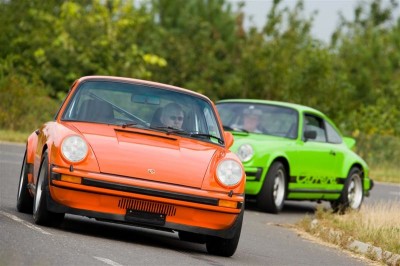
Thanks to:
Nigel Watkins
Bob Watson
Neil Dickens – www.thehairpincompany.co.uk
The Courtyard, Bicester – www.thecourtyard.org.uk

by John Glynn | Oct 16, 2009 | Classic Porsche Blog, Road Trips
Sunday had been all about enjoying the cream of US muscle car action, so Monday was back to Stuttgart’s finest. We wanted to get down town and see what was going on, plus I had some bits to find for the Varmint, so after a quick liaison with the following day’s shoot subject, we downloaded directions for the famous Porsche parts specialists at EASY San Francisco (European Auto Salvage Yard) and headed towards Emeryville.
I’d be lying if I said that we got there first time – we never get there first time. Put both of us in one method of transportation together and it is guaranteed to go tits up. Just check our flight history: 3 flights together and all either cancelled or delayed. So it was a roundabout trip with many laughs, but we arrived in the end. Took some great pics en route also: the shot of a battered-to-near-death Alfa Spider, scorching across the Bay Bridge with the SF skyline in the background, was one of the best ‘Go USA’ shots Jamie got all trip.
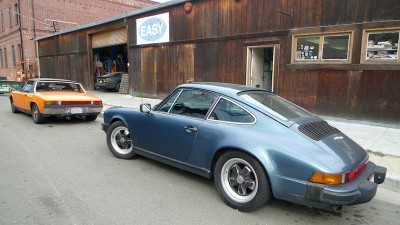
We arrived at EASY and pulled up behind a well-worn orange 914. Looked good to me in that CA way that the Varmint appeals: honest, done its fair share of work, now just getting driven hard for fun and loving it. We walked in and were greeted by the orange car’s owner, Rich Breazeale, son of owner Jim. A good chat ensued with Rich, and John, who is on the tools there. Jim was away in Maui, which was a shame as I had a great line to use on him: “Hey, I love what you’ve done with the place, Jim.” OK not great, but I would have laughed regardless. They didn’t have what I was looking for, but they let us have an interesting wander, and we spoke about how business was doing.
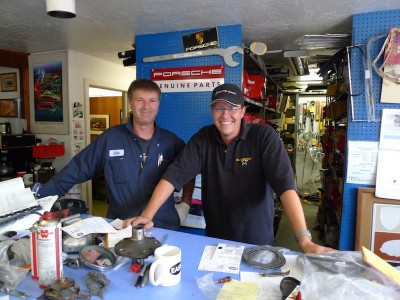
While we were there, two guys came in trying to sell cars/find buyers. One was a guy with a shoddy 944 Turbo on 19s that swore he had a trick top end on his car, and Cosworth pistons (stick-on Cossie badge near the VIN plate). He took some abuse from a regular, while the rest of us were quite nice to him in that “we’re way too nice for you, sod off you maniac” kind of way. Made no difference.

The other guy was a nice bloke with a clean 3.2 Carrera – a Cali car all its life. The car was not bad, and had a G50. It was painted in some Special Wishes custom colour that looked like Penske Blue, but was identified as Doom Blue when the guy started talking. How he was struggling to get $15K for this car was initially beyond me, as he’d advertised it “everywhere”, but I guessed he must have had fairly dull phone patter, as the car sold itself to me while I was standing there.
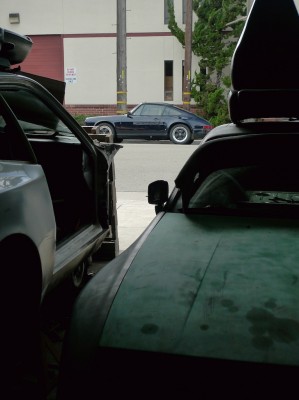
It was way past lunchtime, so we said our goodbyes and shot around to Rudy’s Can’t Fail Cafe. This is owned by Mike Dirnt of Green Day – felt cool eating at the bar in a bona fide rock joint. The food was OK, not amazing but it was great to get a picture of Varmint outside. Seemed like a good omen. I had a few other SF errands to do that didn’t quite come off, so we avoided failure by heading up to the mall at Dublin to get our hostess a present.
We took a wrong turn leaving the place, then swung a U- turn, flew towards an unseen stop sign, locked the fronts at the last minute and sailed right through with huge screeching and tyre smoke filling the air. Spotting a cop about 200 metres further down, we made ourselves scarce using an iPhone escape route, all at the 30 speed limit, and managed to escape without a tug. Happy days – we were delirious laughing about that one.


by John Glynn | Oct 12, 2009 | Classic Porsche Blog, Project Cars, Road Trips
It was Saturday. We were headed back to Sears Point for the CSRG races and perhaps a feature shoot if we found the right car. First things first: coffee. We followed John Gray up 680 to Peets in Pleasant Hill, and met up with Mr Bob Tilton.

Suitably re-caffeined, we fuelled up around the corner (my first time sticking fuel in the SC) and headed north. Our three-car convoy to the track was good fun. There we said hello to Cary Noel, a fellow Grupper who owns a super Silver and Blue Carrera RS rep. The weather was glorious but that is one unmercifully hot sun, so sunscreen was the order of the day. I use factor 50+: translucent-skinned Irish people are always better off playing it very safe! 40 degree heat certainly takes it out of a body.
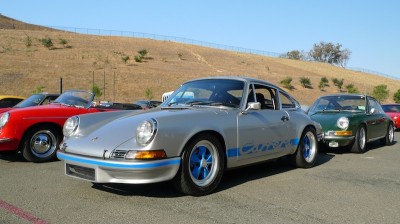
We had our wristband press photo passes so could go wherever. We did some paddock shots just in case we decided to sell an events piece to Classic Cars magazine (decided not to bother in the end) and I ended up at the pit lane exit, about 6 feet away from Can Am cars doing 150mph+ on the entry to turn 1. Never been so dumbstruck by fear and excitement in my life; I couldn’t quite believe they had let me take pics from there. But then the camera couldn’t cope and I was only slightly better! Here’s a pic (imagine insane amounts of noise and speed):

Back in the paddock, things were really hotting up, with temps soaring way past 40 degrees. We took a load off at John Thornton’s racebox, chatted with John, Fuchs-meister Harvey Weidman and Gray for a while before he and Tilton could stand it no more and shot off for lunch at an air-conditioned pizza shack.
Sears Point Porsche
We stayed for the wicked BBQ, before deciding to try and nail some pics of John T’s very groovy Emory-built 912 racer. We gave it our best, but had left some gear in the Martimobile from the day before, and John had to go get ready to race, so we left it for another day. It’s a great car though, and was worth the effort to get the few shots Jamie did.

Lesson learnt number three: Empty all gear into the works van once back at base camp.
While Jamie went to get some tracking shots up at the top of the circuit, I headed for the grandstand to watched some racing. I came down after the Jags had finished – just before I started to melt. Sadly, one of J’s lenses had not been so lucky.
Expanded by the unmerciful heat, it had taken a minor bump while mounted to the camera body and pulled the screws out of the mount, breaking its electrical contact ring. Hard to believe, but there we were: down one lens and fading fast. We decide to say our goodbyes, head for the ranch and try a few things to re-equip ourselves for our Mopar shoot the following day. Varmint had been sitting in the sun all day so was nicely warmed up…


by John Glynn | Oct 8, 2009 | Classic Porsche Blog, Project Cars
I’ve now been back from the USA for 36 hours. Our trip took us to lots of really great locations, so there are some fascinating features to write up over the next few weeks. Not everything will make it into a magazine though, so I thought I’d tell the story of the trip via a few blog installments.
My flight over on Virgin Atlantic was great. Arriving at my buddy John Gray’s house late at night meant I didn’t get to see much of my new 911 until the next day. In daylight, there was a bit more sun damage to the paint than I had been expecting, but I wasn’t that bothered: it still looked like good value for money. Driving it was initially a little weird, as the clutch had a slight on/off action that I think has since calmed down. We soon got the hang of it, and it was an entertaining daily driver while out there.
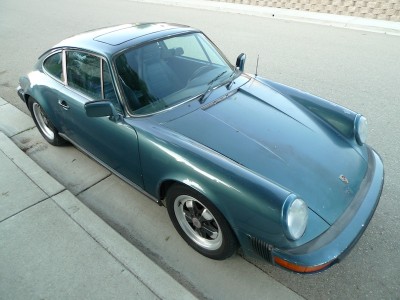
Buying a ride rather than renting is definitely something I will do again. There were a few minor jobs we had to do to the SC while in CA, but I’ll detail that stuff in a later post.
Our first full day was a mix of settling-in stuff. After picking up some coffee at Peets, we took a spin out to Sears Point raceway, where the CSRG race weekend was taking place. Jamie and I got some press wristbands and bought our tickets (it’s a charity do, after all). The weather was properly hot – about 110 degrees – so we came back in the early afternoon and played with the Lipmobile: a Honda Cub which had just been ridden 3,800 miles from Chicago to California, by my erstwhile photographer friend and colleague. Here’s a pic:

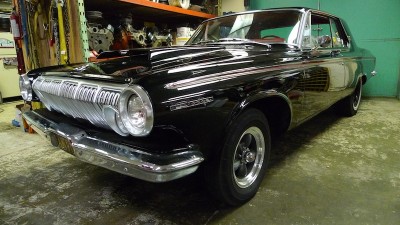
Later on, we took a trip to the unit our host rents with a couple of other petrolhead buddies. They have some very impressive stuff there! Roommate Alex is restoring a pair of Road Runners, and was working on a ’63 Dodge Polara owned by a drummer with a successful local rockabilly band. The Polara was originally a 440, but it now had the 426 Hemi motor fitted. Talk about sweet! I could just imagine the shoot, so I pitched it via email to a UK magazine who never came back to me, which was a bit disappointing.
Here’s a pic of the Polara in the workshop. It is inch-perfect sixties drag nostalgia, with slicks on the back and a Hemi in front, all wrapped up in black with hot red trim – pretty cool! An evening in the company of big block hot rods could only be followed by dinner at Max’s Diner, with a pint of Coke float, curly fries and a world-class burger. Heaven!
That was day one, and there’s plenty more to share. I’m keeping clear of jet lag so, as it’s 1 am here, I’m hitting the sack – will continue this tomorrow.