by John Glynn | Sep 12, 2009 | Classic Porsche Blog, Project Cars
As the 944 Turbo is sold, I was keen to move my other 944 project along; get it MOTed and then either start using it or get shot of it. It has to be MOTed to get the number plate off, so that’s a no choice thing.
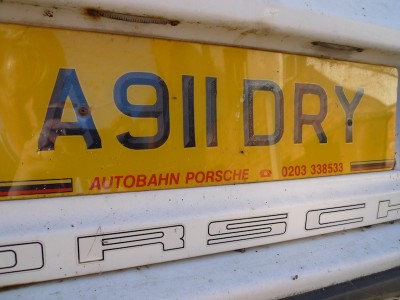
Anyway, I collected the Porsche 944 from Midlands Car Storage and hooked up the A-frame. Towing with the Landcruiser is a dream, so we had a good run home, where I put the kettle on and wondered what to do next. I decided to start by getting the boot open.
The way a 944 tailgate works is it has a pin in each rear corner which locks into a recessed latch. To open, the key pulls rods inwards to slide the latch plates and release the pins. There are sponges (I kid you not) between the car body and the latch recesses and then the latch bodies have little reservoirs underneath, which collect the water which runs down the pins, and drains it out through the boot floor. It is convoluted but I think fairly clever. However, it is a bugger if the latches are not used regularly.

I bought the white car knowing it had sat unused for ten years in a leaky car port in Chichester, right by the sea – the house was a street away from the Channel. Imagine the steel pins and steel latches submerged in a salt bath for ten years: they seize solid and need smashing off. Smashing off window locks in a cramped greenhouse, in 26 degree heat, while lying on a floor and working over your head (in a car thick with mould) is a lovely job. I eventually got it all apart, opened the lid and checked out the boot. Dry and healthy and no rot anywhere, except the locks and the number plate lights. I have new ones of these so they’ll go on tomorrow.

I’d stuck the battery on a boost charge, so decided to try some electrics next. The door mirrors worked in 2 out of 4 directions – nice. The pop-up lights did pop up and made me want to keep the car. I love pop ups! The rest is fairly basic: this is mostly a manual car, which is great. The carpets on the drivers side seemed not too damp but the other side was soaked. I pulled the bonnet catch and noticed a lot of rust on the fusebox, the sort of rust that doesn’t happen with leaky rear window seals which is what I though I had. This had to be a hole in the battery tray over the fusebox pouring water straight down.
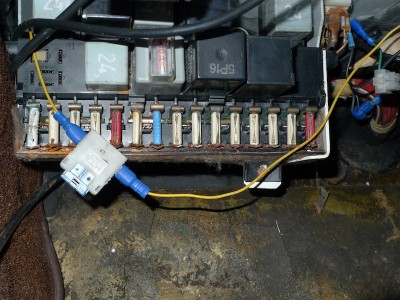
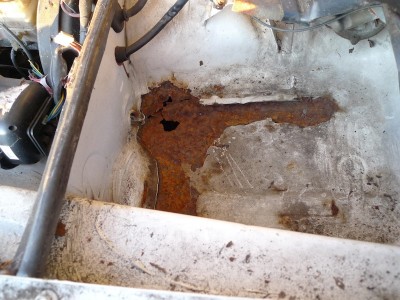
Battery out and project brakes on! A huge hole right across the front of the battery tray is just pouring buckets of water into the car, every time it rains. That has to go off and be fixed before we do anything else – have booked it in with Rob Campbell at Racing Restorations for some TLC next week. I’ll get the bit on the sill done done at the same time.
Getting the rest of the trim out should be fun – the front seats are seized on the runners which makes removal a job and a half. Will do what I can before the GP tomorrow.

by John Glynn | Sep 6, 2009 | Classic Porsche Blog, Project Cars
Ahead of starting the 911 engine strip down today, I had a major tidy-up in my little garage, which had turned into one of those places where you can get both feet in the door and no further. Five hours later I had floor space and could work on the motor right next to the toolbox. I call that a success.
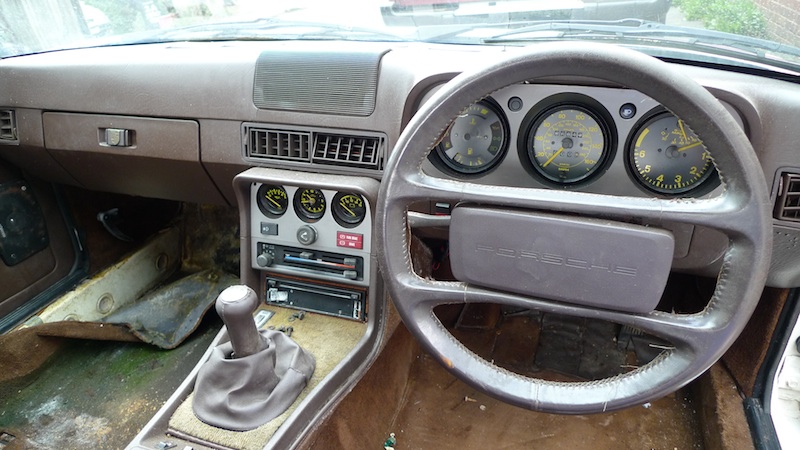
Most of what is in my garage is parts and trim for my white Porsche 944 project – that bargain eBay purchase from last year (at least I hope it was last year). I look forward to starting the job of taking the 1983 944 Lux apart and putting it back together as soon as my little Landcruiser is finished.

Upgrade parts include full Porsche Recaro sports leather in black, fresh carpets and headlining etc, power steering, new engine mounts, new window and rear glass seals, Weltmeister throttle cam upgrade, decent tyres and so on.
This Porsche 944 project is a fairly low mile, two or three owner car, so I am hoping to use it quite a bit when it is back on the road and fitted with the all-important PAS and leather. Think it will look great in Grand Prix White with black hide, plus clearing out all that 944 stuff will give me my garage back.
Was using the parts washer for much of today – did a lovely job on 944 hubs, struts and crank sensors etc. Found the new ECU for it too. Sorting through some more bits tomorrow. I took so many usable parts off the two I broke last year and have such a lot of stuff in the garage. I’m not sure that it’s all going to be required: eBay beckons.

by John Glynn | Aug 20, 2009 | Classic Porsche Blog, Market & Prices
911 folklore has always claimed that coupes are the only models worthy of the attentions of serious drivers, with Targa and Cabriolet versions simply frivolous range-fillers. I’ve never really bought into this notion, and recently brought an almost-matching pair of Carrera 3.0s together to do a Porsche 911 Coupe vs Targa comparison. Read the full story below!
The Carrera 3 was first introduced for the 1976 model year. While most manufacturers in the mid-70s were still pandering to a chrome-plated public who liked their cars slathered in shiny chrome, Porsche Design unveiled their black-and-colour impact bumper design, which was to prove one of the most enduring styling exercises the automotive world has ever seen.
The understated impact bumper (IB) cars were a Porsche staple for sixteen years, from 1974 to 1989. The durability of the galvanised bodywork introduced in 1976, combined with the sales success of the 911SC, and the 3.2 Carrera, makes the IB style seem almost commonplace these days. But don’t be fooled by the familiar appearance of the pair seen here. Sold for just two seasons, and never exported to the all-important American market, the ’76-’77 Carrera 3.0 is a rare beast, particularly in right hand-drive Targa guise. It’s a privilege to have two such good examples with us today.
In the interest of resetting our current-day complacency with the IB look, let’s put these cars into period perspective. Back then, the average man in the street was driving a Vauxhall Viva or Ford Cortina, so sleek and sexy 911s were unbelievably exotic, costing substantially more than a Ferrari 308. Contemporary supercars, such as the incredible Lamborghini Countach LP400, despatched the dash from 0-60 in about 6.8 seconds; Motor magazine got the Carrera 3 there over a second faster.
The mid ‘70s was a time of great change for Porsche road cars. While the company launched the 924 and 928 models, increasingly tough emissions targets emerged in the critical US market. The new standards meant that, though the less powerful 2.7 911s passed the legislation and could be sold in America, the 2.7 Carrera with its mechanical fuel injection could not, creating a performance gap which did the 911 brand no favours. Keen to wring every last sale out of the 911, but equally keen to keep development costs down on a car that was supposedly coming up for the chop, Porsche began to look at ways of updating the existing range-topper for not a lot of money. The result was the Carrera 3.0.
Porsche 911 Carrera 3.0 explained
For the engine, the lightweight six-bolt 2.7 Carrera crankshaft was retained, carried in an aluminium rather than a magnesium crankcase. Aluminium had been tried and tested on the Turbo, and borne the strain of the bigger 95mm Nikasil-plated cylinders plus boost pressure. So the same case and cylinders were used on the C3, increasing both capacity and economies of scale.
Bosch K-Jetronic injection was chosen to supply the fuel. K-Jet doesn’t like aggressive cams or rorty valve timing, and the intake is restrictive compared to MFI stacks, but it is much more efficient than the mechanical system, an important factor in a world which had not forgotten the 1973 oil crisis. The system was also cheaper than MFI, which greatly appealed to cost-conscious management.
Porsche 911 K-Jet Bosch CIS injection
To counteract the performance downsides of K-Jet, Porsche fitted slightly larger valves and designed a new camshaft that was to last almost 14 years, up to the end of the 3.2 models. These changes brought engine output to 200 bhp, ten short of the outgoing 2.7 Carrera, but with better economy, lower emissions and identical torque peaking lower down, dramatically improving flexibility. The Carrera 3.0 was almost 5 seconds faster from 25 to 50 mph in top gear than the 2.7 Carrera it replaced.
As a low production model, which led the transition from the 210 bhp 2.7 Carreras to the sturdy but slower 3 litre SCs, C3s have always been a little misunderstood; something of an acquired taste. But few cars in this price bracket give anything like the same satisfaction.
Porsche 911 Coupe vs Targa comparison
Porsche racer Carlo Bonetti, owner of the spotless Grand Prix White Targa seen here, is a self-confessed C3 addict. There are five sets of 911 keys hanging up at home, with two fitting the locks of three-litre Carreras. Bonetti began his motor racing on motorbikes, until a series of accidents led wife Toni to insist on something safer. Caterhams beckoned, followed by a short hop into 924 racing. The next season saw him in a 3.2 Carrera, competing in the Porsche Club championship.
Carlo’s opposite number today is Mike Horsburgh, owner of this beautiful 1977 Carrera 3.0 coupe, his first 911. Mike’s car was extensively concoursed for a few years by a previous owner, before a friend managed to prise the cosseted coupe away from its devoted caretaker. Mike came across the car while looking for an unmolested example. Other previous owners include Keith Ripp, of Ripspeed accessories and rallycross championship fame.
Looking at the cars in detail, it is interesting to note the number of features unique to these models. One Carrera 3 engine trademark is the five-blade engine fan, seen on both of these cars. Fitted with a different pulley, it ran the alternator at a slighter higher speed, but the yang to this ying was an adverse effect on outright cooling power in warmer climes. The 11-blade fan would make a comeback on the SC, and switching to the 11-blade model is a popular alteration on ‘76/’77 Carreras.
Other early IB touches on these cars include the lack of side repeaters, giving an uninterrupted sweep down the flanks, and the single side mirror on the coupe, the passenger mirror being an option at the time. The coupe features the very rare C3-only alloy and fibreglass tail, now highly sought after. This Targa runs the purposeful one piece rubber spoiler, fixed to a steel engine cover. The solid chunk of black, with its exaggerated rear lip, sits well against the immaculate Grand Prix White bodywork.
The cars feature quite a few parts no longer available from Porsche, and eye-wateringly expensive from those who still have stock: the classic “periscope” headlamp washers on Mike’s coupe, for example. Later impact bumpers were fitted with flush jets as on the Targa, but the early jets are an age-defining feature. £200 a pair, thanks very much.
Beneath the svelte bodywork, mechanical rarities abound. Early C3s had a now hard-to-find fuel pump, using a side outlet, rather than direct flow. With replacements costing over £700, any fuel pump noise should be regarded with suspicion. Smaller differences include a unique fuel filter arrangement on ’76 Carreras, one of many subtle changes made from ’76 to ’77. Carrera 3.0s also use early-style rear anti-roll bars in 18mm diameter, and these bars remain highly prized.
Some of the interior parts for these cars can also be very difficult to locate. The thick-rimmed steering wheels seen here have long been on the rare side, made even rarer by the fact that the spokes have a habit of cracking at the rim – an expensive repair involving welding and a retrim. Early sports seats as fitted to both these cars are also gaining in appreciation. The correct versions for Carrera 3.0s are identified by a Recaro-logo’d knob controlling backrest angle, as opposed to a turnwheel on later examples. Other rare parts include the Targa sunvisors, which explains the rather puffy appearance of these ones. “They’re certainly original,” says Carlo, “but when I find suitable replacements, I’ll be changing them.”
First keys in my hand are those of the coupe, so I settle in to the supportive driver’s seat and twist the knife of life. The engine fires instantly and we’re off. Mike’s car might be familiar to some readers, as it features in Peter Morgan’s reference book, “Original Porsche 911”. The feel behind the wheel should also be very familiar to anyone who has ever driven an impact bumper; the cockpit and controls are pretty much identical through the years and, whatever old road tests say about the absence of ergonomics, everything falls readily to hand.
A few things jar, though not excessively. The speedometer is rotated anticlockwise, for better visibility of the upper register, something I have never felt the need to do myself. The rev counter is a lower-redlined replacement, and the centre console, introduced for the 1977 model year, frustratingly obfuscates the otherwise flat floor, a mild frustration which continues as the engine warms up, and we go a little faster.
That glorious motor is the whole point of the Carrera 3 – were it not for the engine there would be only detail and weight differences between these and the later SC. Though the identical three-litre displacement suggests similar potential, driving C3 and SC back-to-back reveals quite a different character. The Carrera’s smaller crankshaft, and the lightweight magnesium-cased transmission of early examples, imbues the drivetrain with a zestful zinginess that is somewhat muted on later three litres. That excited energy is all but non-existent in the 3.2 Carrera and, in my opinion, denotes a new paradigm in the flat six ethos. Over three litres, the engines just don’t rev as thrillingly.
Mike’s Carrera 3.0 is equipped with opening rear windows, or ‘pop-outs’ as they are known, in rare and attractive anodised black. Combined with the centre-vent dashboard, they are extremely effective in ventilation, and add immense character to the soundtrack when open. Their deletion on the 911SC was to the coupe’s distinct detriment.
Slicing through the gears, the speedo soon reads a jaunty-angled 90 mph, but the Carrera is not quite as settled as others I have tried. I suspect part of the reason may lie in the car’s concours past. Despite its 116,000 miles, not much has been changed since it left the factory. It also runs Pirelli P600 tyres, which I admit to disliking on 911s, especially in the wet. I get the feeling that a session of corner weighting would make a big difference to the fun offered by this special example, but Mike is loath to tweak the almost time-warp coupe beyond stock. I understand, but still can’t help thinking that a quick corner balance would be money well spent. Having the weights, heights and cambers set properly would get the car working its tyres to best effect, and release ever more of that C3 righteousness.
Though the Targa has covered fewer than 70,000 miles in 32 years, substantial 911 experience on road and track has taught Carlo the importance of fettling in getting the most out of these cars. The Targa is fresh from re-commissioning after many years of covering under 800 miles per annum. As part of the overhaul, Bonetti had the rust-free bodywork repainted by APM Autos in Bradford. The 450-mile round trip demonstrated considerable faith in their workmanship, faith which has been well placed.
Targas are sunshine cars. Even today, when the skies over Silverstone are darker than a David Lynch film festival, unclipping the Targa’s folding roof is like a sun-filled fissure cracking through the clouds. To my eyes, the car’s appearance improves many times over without that slab of flat black vinyl killing the comely curves, the shapely rear glass emphasising the absence of heavy metal.
Lack of torsional rigidity is often cited as a major Targa downside, but this is not as true as some would have us think. Let’s not forget that the very first Porsche was a roadster, so the company knows a thing or two about roofless engineering. No strengthening was required to transform the 911 from roofless coupe to Targa; the hoop and its fixings are the only additional metalwork. Compliance placed in the chassis at source, via softer suspension components, has often been incorrectly credited to the lack of a fixed roof.
When Car and Driver editor David E Davis drove an SC Targa, he memorably said: “There is a hard-to-define “rightness” about this car, inside and out. It’s tight, solid and apparently very well put together.” This low-mile Carrera 3.0 Targa makes me feel the same way. On the road with the roof off, it is solid and squeak free. The chassis feels light and responsive, even on the wider 7 and 8×16-inch Fuchs wheels, shod with chunky Contisports. The senses are assailed through the open top, engine bursting with enthusiasm for the winding Northamptonshire roads.
This Targa inspires confidence, more so than the coupe. Much of this is undoubtedly in the suspension set up, but even with all things equal, the Targa is not the soft option some assume it should be. My own Carrera 3.0 coupe is a great drive, but there is no vast dynamic chasm between it and this Targa on the road.
Bonetti has direct experience of the Targa versus his Copper Brown C3 coupe, and says the only differences are wind noise and weight. “I push my cars in and out of the garage, rather than running the engines for ten seconds a time, and the Targa is a little harder to shift. The additional poundage is evident on the corner balance scales.” The plus side of those few extra kilos is that the roof comes off, giving a fuller sensation of speed, space and inherent eagerness.
The impression of space is not an illusion. Targas benefit from increased headroom, especially in the rear; a boon when carrying older children. The lack of a fixed roof is a plus for taller drivers, when wearing helmets on track, for example. As another Targa fan pointed out, his golf clubs can enter the rear via the open roof, adding to the practicality.
What is ironic is that, when talking to Targa owners, the car’s appearance is rarely mentioned; it is usually coupe owners who make a bit of a song and dance about the Targa’s looks. In a straw poll conducted on the impactbumpers.com forum, most anti-Targa sentiment expressed was on a purely aesthetic basis, perhaps the only possible objection to a well-maintained Targa used in normal, day-to-day pleasure driving.
If the classic coupe roof line is paramount in your passion for the 911, then a tin top is what you must have. However, if your agenda is slightly wider, and involves an entertaining drive which brings the early 911 experience vividly to life, do not deny yourself the opportunity to try the Targa. The decision is not as black and white as one might think.