by John Glynn | Apr 10, 2018 | Porsche News, Race and Rally
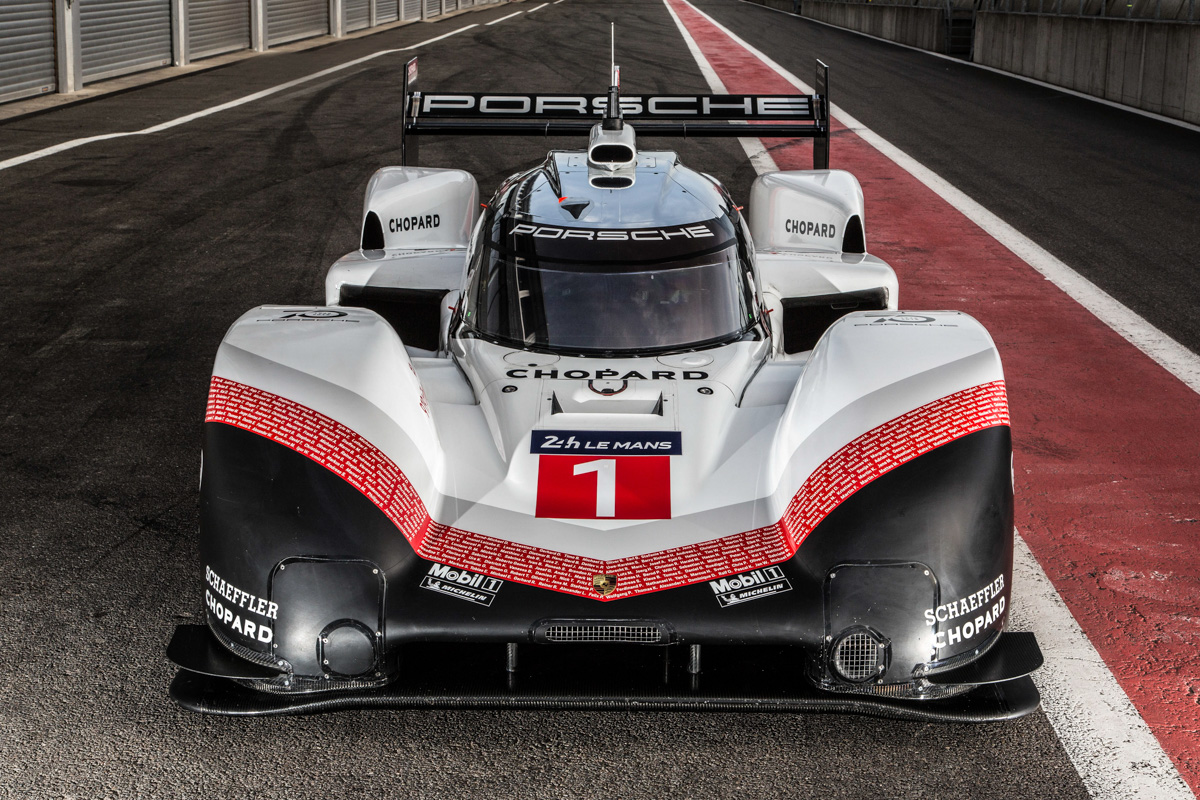
In an interesting PR move, timed to make the monthly motoring press just as its former WEC rivals take to the track at Spa Francorchamps for the first race of the 2018 World Endurance Championship on May 3-6, Porsche has run a modified version of its lightened 919 Hybrid with over 50% more downforce around the Spa Francorchamps circuit, setting a time twelve seconds quicker than the WEC pole position lap from last year’s Spa Six Hours.
Porsche took 39 kilos off the 919 LMP1’s dry weight in race trim by losing the 919 race car’s air jacks, lights, air conditioning, windscreen wiper, race control trackers and other parts, allowing the car to top the scales a smidge under 850 kilos. The maths here are a little strange, as the minimum dry weight allowed under LMP1 regs is 875 kilos, so you would think it might have been lighter, but anyway.
The car was then fitted with a much-improved aero package, including a larger front wing and a massive rear wing, both fitted with hydraulically controlled drag reduction systems (DRS) to strip away downforce on Spa’s long Kemmel Straight. Together with changes to the floor and turning vanes, the downforce produced by this tweaked 919 was 53% higher than the WEC-legal 919 LMP1 that took pole at Spa in 2017.

The real benefit of the improved downforce at this particular track is that the driver can run the car absolutely flat out from the exit of the La Source hairpin, through Eau Rouge and Radillion and the Kemmel Straight up to the braking for Les Combes: a distance of more than 2 kilometres. We don’t know the top speed difference with the higher entry speed and DRS being used, but I guess that it’s not a small number.
The lighter weight and higher downforce was pushed along by more horsepower from the 2-litre V4 Turbo engine, which enjoyed substantial improvements when freed from the fuel consumption limits imposed as part of the endurance racing regs, where the fuel usage at Spa was capped at just under 2.5 litres per lap. Set to use as much fuel as the engine could handle, power from the V4 rose from 500 bhp to over 720 horsepower – approaching 50% more. The hybrid systems were tweaked to add ten percent more power, so 440 horsepower.
With 440hp driving the front wheels and 720 bhp driving the rear wheels, Weissach added reinforced wishbones to all four corners, added an “actively controlled lockout system” (whatever this does, it was not fitted to the WEC compliant 919) and a new brake-by-wire system to limit yaw as the car piled through Spa’s twists and turns. With so much more power, downforce and electronic controls, the car set a lap time some three quarters of a second quicker than Lewis Hamilton’s F1 pole position lap from 2017.
Obviously there is some satisfaction for Porsche in demonstrating the potential of an unleashed 919, but it is hardly a like-for-like comparison with cars running in a fully FIA compliant form in higher ambient temperatures later in the year, so what the exercise actually tells us is hard to say. However, there can be no doubting the intention of the timing of this release, which will definitely be a talking point at next month’s Spa 6 Hours and will also form part of the chatter all the way through the 2018 season.
WEC mandarins might be pretty cross at Porsche’s timing, but spectators have every right to feel equally annoyed that the governing body won’t let manufacturers spending millions of Euros in race car development run these cars at their full potential, all of the time. Instead, WEC (and F1) fans are challenged to follow quieter racing with arbitrary fuel economy targets. Obviously endurance is partly about deploying energy with intelligence but capping the engines at less than two-thirds of their potential is a huge downside: a 2-litre engine making 720 bhp is something quite special and worth shouting about.
I like the 919 hot rod story, but am not sure what to take away from it other than Volkswagen is pretty unhappy with the handicaps applied to its prototypes and wants to make a point right at the start of the first season it won’t be running with Porsche or Audi in LMP1. The other big stone flipped over by this is that, if an F1 car was allowed to pick a time and date to run at its full potential with unhindered engine power, full electronics and optimum aero around Spa Francorchamps, then a tweaked 850-kilo LMP1 car probably wouldn’t see it for very long. Whether that matters or not is another story. Pretty sure I know which of my race friends will squeak the loudest.

by John Glynn | Jan 22, 2018 | Classic Porsche Blog, Porsche People
Confirmation of Singer Vehicle Design’s partnership with Williams Advanced Engineering became public several weeks ago, when computer mockups of the latest Singer Porsche DLS (Dynamics and Lightweighting Study), were shared on social media.
Some of my friends have been involved in the project since its earliest days, so I’ve been following progress from the sidelines for months. It is a interesting collaboration. Now that the bodyshells have entered production, Singer has started advertising for people to help assemble these cars in the UK. The jobs are here in sunny Northamptonshire and the accompanying text from the Singer website is below. You can also download the full Singer Porsche jobs PDF.
About Singer
Singer Vehicle Design was formed in 2009 to explore the creative possibilities within the vibrant world of the classic automobile. Singer is dedicated to the passionate study, preservation and optimisation of the world’s most respected high-performance vehicles. Our focus – indeed obsession – has been the pursuit of a meticulously restored and reimagined air-cooled Porsche 911. Our lofty objective is to distill, enhance and recombine the strands of greatness that have long marked the Porsche 911 as iconic. Today, the cars we restore to bespoke commission for our global clientele appear in the world’s most prestigious global automotive shows and publications.
Singer Porsche UK Jobs
Our latest endeavour on behalf of our clients is a Dynamics and Lightweighting Study “DLS” undertaken with Williams Advanced Engineering – part of the Williams Grand Prix Engineering Group. DLS encompasses a selection of restoration and modification services strongly oriented toward lightweighting and dynamic gains.
The restoration of cars for owners who select the Dynamics and Lightweighting Study will be carried out in the UK. As a result, we are looking for talented individuals to join our UK-based operations.
Job opportunities available Singer GB, a subsidiary of Singer Vehicle Design, will commence operations in February 2018 in Northamptonshire and is currently looking for:
- Painters
- Fabricators
- Mechanics
If you are interested in finding out more about the Singer GB team and these positions please contact us: email info@singergb.co.uk

by John Glynn | Jan 21, 2018 | Porsche Cayenne, Market & Prices, Project Cars
One thing I won’t be doing on my upcoming fiftieth birthday is driving a Porsche, as I recently sold the Cayenne. It was just at that point where the condition was still pretty good, mileage was highish but not unacceptable, there were few good examples available to buy and I was satisfied that my Cayenne itch had been scratched.
As the snow fell across England, I put it on eBay as a ten-day sale with a set of good pics and a decent description, including the long list of all the things I had done to it in my five years of ownership. The ad generated an excellent response and brought in good interest from genuine buyers, which reached a crescendo as the end of sale approached.
A local motorsport specialist came round to see it on the final morning, we had a good drive and he placed a strong bid in the final minutes of the sale. However, the auction ended with a buyer in Essex claiming the Cayenne for just over £6k. I had quite a lot of spares and accessories that I planned to offer the buyer first refusal on, but the final price was the most I have seen an ’04 with similar mileage sell for on eBay, so I just put everything in the boot and sent the new owner off delighted.
A few friends who I spoke with after the sale end seemed to have the impression that I regarded the Cayenne as some sort of burden, with parts being changed on a monthly basis and me basically rebuilding the truck while I had it. This is not the case. I did have to go through a long-winded gearbox rebuild, but that would have been sorted much quicker and less painfully had I just taken it to a decent gearbox specialist right from the start.
Elsewhere, there were new parts for the heating and fuel supply systems, a crank position sensor change, bits and pieces for various MOTs and so on but, other that that, it was relatively easy company over five years and 50k miles, with no particular appetite for oil, tyres or brakes. Would I recommend a Cayenne as a used purchase? For sure. I particularly like the later 957 GTS models, but they are still big money, so an upgrade was never on the cards for me. I wouldn’t go into debt for a car that was still depreciating and I have better things to spend money on than a luxury daily driver.
A fortnight after the Cayenne’s departure, I don’t miss it too much, but there is nothing that can really hope to replace it. I’ve been looking for another Subaru Legacy estate, but my ideal spec is a needle in a haystack that has not come on the market in the last twelve months. So I’ve bitten the bullet and switched back to my 2006 Honda CRV: a good example with all the toys and one previous owner that’s been more bulletproof than a riot van over the two years I’ve owned it. It’s comfortable to drive and easy on the back, so I’ve added a Stag Q-Next LPG conversion to bring the fuel costs down to acceptable levels, which essentially bolts me into the CRV for the next three years.
Gas will save at least £1000 a year in running costs on this car – it saved twice that per year on the Cayenne – so is a no brainer. The main downside of the (grey) CRV is the absolute blandness of the exterior: it won’t upset anyone and that is one thing I will really miss about the curvy Cayenne. There’s also an hint of “I’m borrowing my wife’s car” about using the CRV, but passing fifty allows one to be increasingly less concerned about this stuff.
Ferdinand blogs my freelance adventure with Porsche at the centre. To support the blog or engage with me in other ways, you can:
by John Glynn | Dec 15, 2017 | Classic Porsche Blog, Modified Porsche Hot Rods, Road Trips
I went back to doing some magazine work earlier this year, with my friend Simon Jackson at GT Porsche magazine. Having run a few of my features through 2017, Simon asked if I fancied writing another regular column and I was happy to say yes, so the January 2018 issue has at least one page written by me.
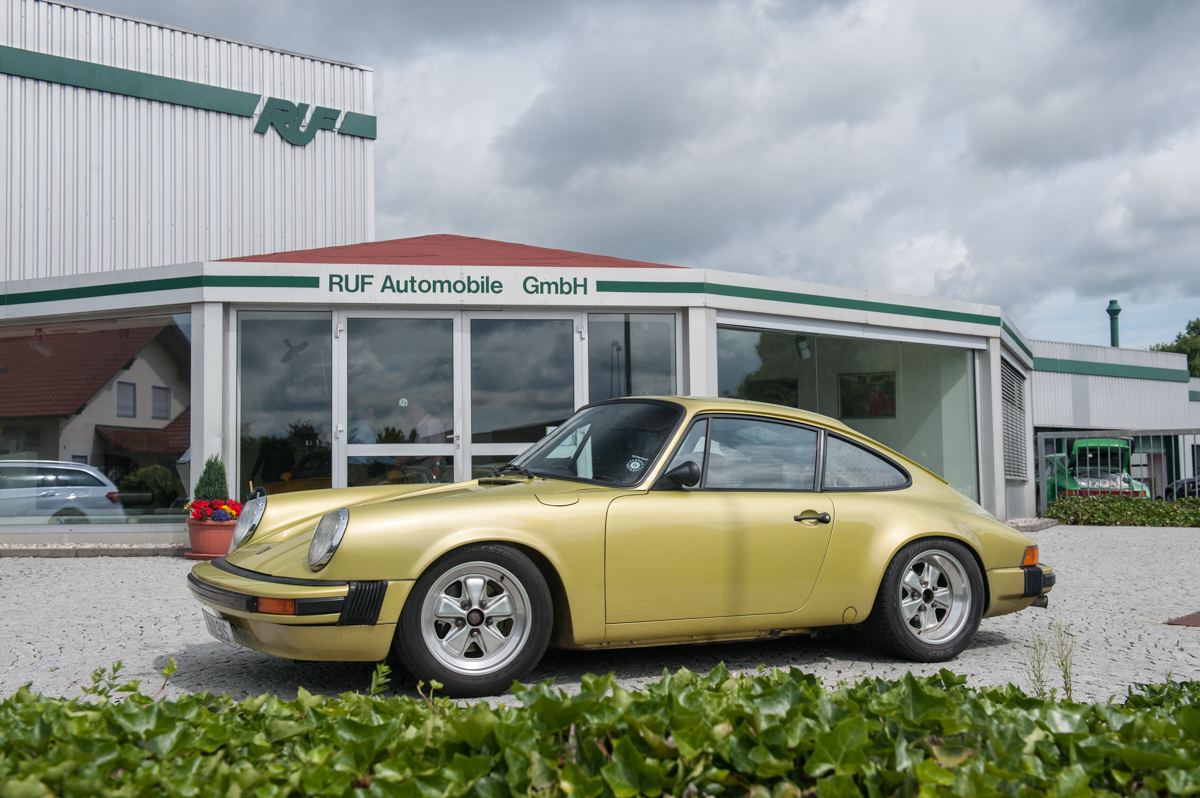
Elsewhere in the latest issue is the story of my road trip to Ruf Automobile Gmbh last July. I made the trip as a passenger in Jonny Hart’s Delphi Green 911 SC, to demo the Classic Retrofit air conditioning system and give Alois and team a tour of the other Classic Retrofit products. The visit was a great success: so much so that the stop-off at the Porsche Museum the following day was a slight anticlimax. When a genuine Porsche hero takes you to lunch, the experience is hard to beat.
Ruf CTR versus Singer/Williams
After our trip, Jonny became part of the project team on the new Ruf CTR and has been working away on the development of the heating and ventilation system for this incredible car. I’ve seen lots of progress photos and they are pretty exciting – such a brave project from Ruf. No chance to share anything for the minute, but they will all come out eventually.
Jonny is also working on the new Singer, as are a few more of my friends, and that is another quite interesting project. Comparing the two from a static driver’s seat is interesting. The Ruf is built on a completely new body shell, all in carbon and with slightly bigger dimensions from the original, while the Singer retains much of the 964 floorpan with additional composite elements. Having seen both up close and sat in the Ruf, the slight shifts in scale give a different feeling from one driver’s seat to the other and that will be interesting to compare on the road. I probably won’t get to drive either of them, but no doubt the big boys will have much to discuss.
GT Porsche: my Tyre Kicker column
I first started working with GT Porsche editor, Simon Jackson, back in 2009. At the time, Simon was running Retro Cars magazine and my creative partner of the time, James Lipman, had already done a few features with him. The three of us went on to do a few bits together and I really enjoyed being in that magazine.
Like all good editors, Simon is easy to work for: he is not shy about speaking his mind on certain contradictions in the world of classic Porsche and is happy to let his contributors just go and get on with it. I like what he is doing at GT Porsche, especially given the operational pressures all magazines face nowadays. Check out the latest issue if you run across it.
Ferdinand blogs my freelance adventure with Porsche at the centre. To support the blog or engage with me in other ways, you can:

by John Glynn | Nov 18, 2017 | Race and Rally, Porsche News
The Porsche team literally went balls-out from pole position in the final race of the 2017 World Endurance Championship season (see Neel Jani’s photo below), but even that was not enough to stop Toyota Gazoo Racing from taking its fifth win of the year.

At the chequered flag in Bahrain, the number eight Toyota of Sébastien Buemi, Kazuki Nakajima and Anthony Davidson claimed victory ahead of the two Porsche 919 Hybrids, but that was only after the number 1 919 had a collision with the number 86 Gulf Porsche while leading the race. Tandy was forced into the pits, Davidson took over the lead and built a 70-second cushion ahead of the number 2 919, which had pitted for fresh front bodywork during hour one.
That was pretty much all she wrote on positions, and the top three LMP1 cars finished in this order. Toyota’s win made the TS050 Hybrid the first car in WEC or the old World Sportscar Championship to win five races in a single season: well done to all the Toyota team on a terrific battle. I also liked what Akio Toyoda, President of the Toyoda Motor Corporation had to say after the race:
“What I thought anew following our last three races with Porsche, starting with the Fuji round, was that I wanted to compete in a race that would make Porsche want to take on Toyota again. That is one of the reasons we approached Fuji, Shanghai, and, then, Bahrain determined to win, and, this time, we were able to do just that.
“It was determined at the previous race in Shanghai that Porsche would be this year’s champion. To Porsche, please let me once again offer my congratulations. Although we experienced our share of regret this year, if this final race leaves Porsche feeling it would like another chance to take on Toyota, our team would be able to end the season with a bit of pride. To all those at Porsche, by all means, someday, on some road, for our mutual making of ever-better cars, please let us compete with you again.”
Porsche had to win the GTE Pro race to claim the GT crown for 2017, but it was not to be. The Ferrari came home in front and took that title, while Aston Martin claimed honours in GTE Am. “We did a lot of things right in this first season with the new 911 RSR,” said Richard Lietz. “Ultimately, we were in a position to fight for the drivers’ world championship. In today’s race, we tried several courageous measures and learned a lot, albeit a little too late. Nevertheless, I take my hat off to the team for being so brave. We were beaten by a very strong opponent.”

Alonso takes Pole Position for Le Mans attention
Toyota also scored a huge PR win post-race by announcing that every deck chair’s favourite driver, Fernando Alonso, would test for the team in Bahrain next week, with a view to competing at Le Mans in 2018. Next year may be Alonso’s best chance to take the win en route to his dream “Triple Crown” – winning the Monaco Grand Prix, Le Mans 24 and Indy 500 – but he has a few talented team mates and the usual roll of the motorsport dice to beat first.
So we reach the end of the road for the 919 Hybrid, although it might not be the Porsche WEC team’s last hurrah. Rumours of upcoming regulation changes in the not too distant future to bring road car styling back to the top WEC category has got McLaren and Aston looking at projects. Staying at home while supercar competitors steal the marketing gold at La Sarthe would be rather un-Porschelike.
