
by John Glynn | May 4, 2017 | New Models, Porsche News
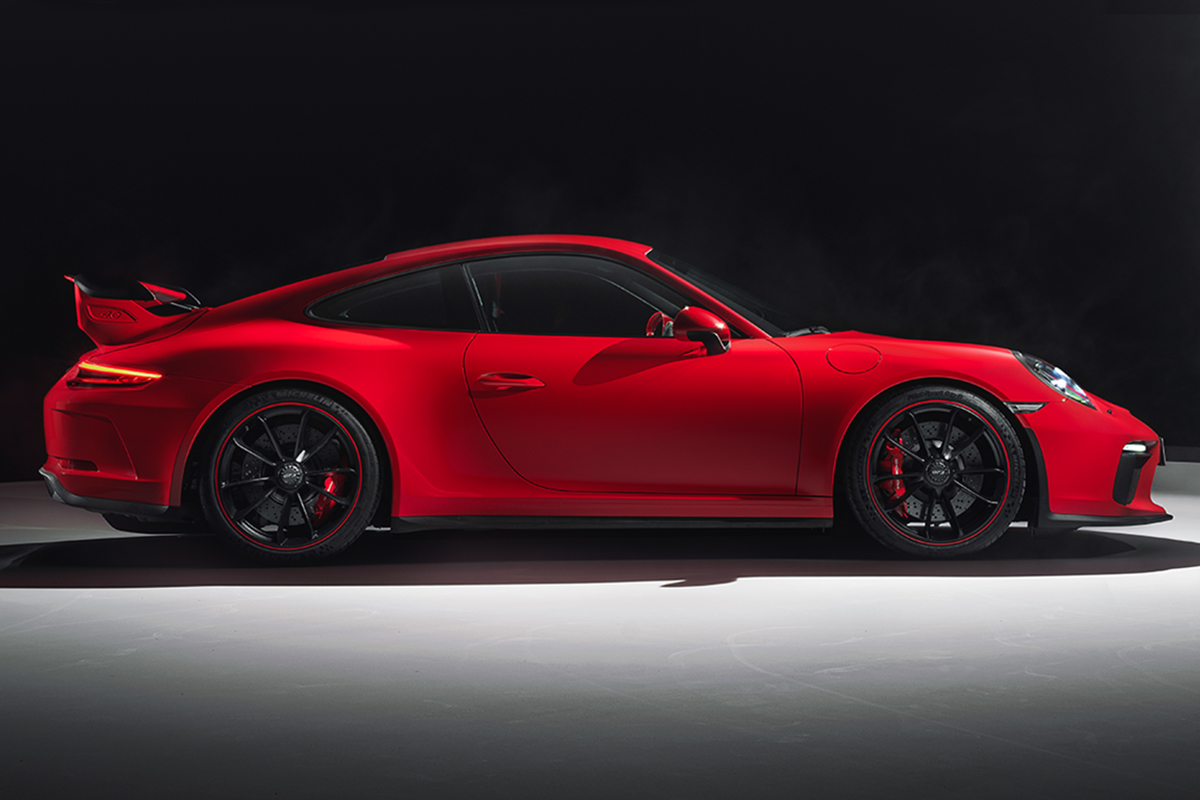
The Gen 2 991 GT3 PDK has just had its first public hot laps around the Nürburgring and set a time 12 seconds quicker than the outgoing model. 7 mins 12.7 seconds is between 2 and 3 percent quicker than the old car, so will such a modest increase hurt sales of Gen 2s?
Autocar magazine released its first drive of the Gen 2 991 GT3 Manual earlier this week and Greg Kable was quick to point out that the Gen 2 PDK is substantially quicker on track. “But as spectacularly good as the manual version of the new Porsche 911 GT3 is – and it really is stunningly effective – I wouldn’t recommend it to anyone who intends to do an intensive amount of track day running…In ultimate performance terms, the PDK model is king.” This being the case, how much slower than a Gen 1 GT3 PDK would one be around the Nürburgring in a Gen 2 Manual? And would a slower Gen 2 Manual matter?
Manual transmission matters for the emotional response to total control, or so the experts say. But how many cars would one sell with the headline: “the Gen 2 GT3 Manual is ten seconds slower than the old car around the Nürburgring, but you told us you wanted three pedals for those 1500 miles a year, so here you go”?
Manufacturers need to upgrade, renew and keep pace with the competition and find the USPs that set their latest creations apart from the old ones but, at some stage, the actual users of a thing (rather than speculators/investors/collectors or whatever the latest word is) run out of real reasons to ‘upgrade’. A two year-old iPhone 6S Plus does basically the same job as the latest one, a four year-old Macbook Pro does pretty much the same job as a new one and a 17 year-old Volkswagen Polo ticks the same ‘get from A-B’ box as a new one, so why bother with new things at all?
Of course, stuff wears out when it gets used a lot and replacements are then a necessity, but few people are wearing out Gen 1 GT3s. If the upgrade path is all about egos aching for shiny, then Porsche is mining a rich psychological seam. Stuttgart delivered just shy of 60,000 cars in Q1 2017 (another record, one imagines). To make and deliver all of these cars, the company now employs 28,249 people. Profit margins have also risen and are now running at 17.6 percent on a total revenue of €5.5 billion.
No prizes for guessing that 911 GT3s are not top of the sales charts, but they must be pretty close to the top in the league table of press coverage year-on-year. The column inches guarantee all Gen 2 GT3s will be sold, so maybe it makes little difference how quick the car is. Then again, it has to be quicker or the press won’t play ball.
If I didn’t already have a Gen 1 991 GT3 and someone offered me a Gen II build slot, I would buy the manual regardless of whether it was ten or even twenty seconds slower. But, if I already owned a Gen 1 GT3 and had to find a chunk of change to get in a manual that was slower on track? That is a different scenario.
by John Glynn | Mar 7, 2017 | New Models, Market & Prices
The new Porsche 991 GT3 was launched today at Geneva in a supersized Internet love-in. If you like massive sportscars weighing 1500 kilos then you are probably all over it: I hope you will pardon the rest of us for a certain lack of euphoria. It is nothing personal.
The new GT3 looks almost exactly the same as the old one, with the one big change of manual transmission. It is a small but very satisfying detail. When the 991 GT3 was first launched with PDK only, there was uproar online, but it didn’t hurt the showroom one bit. Despite the early cars catching fire when con rod bolts snapped, causing boiling oil to pour onto hot exhausts and send the cars up in smoke, Porsche sold every single 991 GT3 it could build.
And Stuttgart built lots of them: estimates suggest more than 6k cars, which is far more than any previous 911 GT3. Magazines were rinsed and repeated in PR about how PDK was the gold standard in race cars and how it was faster around the blah blah blah etc, and they all lapped it up. Driving a Gen I Porsche 911 GT3 around a car park was enough to put me off and visiting a PDK repair shop just confirmed the position. Anyone with an ounce of 911 soul might have seen the writing on the wall for the PDK-only plan, as the cars were not that nice to drive ‘normally’.
Despite the PDK-only thing and a non-stop production line, used GT3s soon hit 50% over list. Many 991 GT3ers cashed out, switching back to the Gen II 997 GT3 and RS with manual transmission and sending prices for those cars through the roof. The switch did not escape Stuttgart’s product chiefs, who then announced a limited edition 911R with manual shift, allowing them to test latent demand. When that model was oversubscribed several times over (the eternal new-Porsche battle of drivers vs sellers), it was obvious that 911R development was not money wasted. All the PDK spiel was deleted from memory and the stick shift was on its way back to GT3 land.
Now the Gen II 991 GT3 with manual transmission has been announced and I have already had calls from price-conscious insurance valuation customers, asking what various GT Porsches might be worth in part exchange: a topic for another time. More interesting is what a 911R is now worth.
We have all seen 911Rs listed anything up to £500k. The most recent car sold in public was the Slate Grey McQueen one in Paris, which went for £451,000 ($553,000) including premium. However, if you’ve spent enough money with your local Porsche dealer in the last few months, you can now order a 490bhp/197mph 911 GT3 with manual transmission for prices starting at £112k: essentially what a nice-spec used LHD Gen 1 991 GT3 example costs in the UK .
No doubt 911R is still a major collectable, but the £400k prices may have just left the building. As for 997.2 GT3 RS and 4-litre RS, we will see what happens. Maybe nothing – probably not very much.

by John Glynn | Mar 2, 2017 | Classic Porsche Blog, Market & Prices
My most recent used Porsche Market Report signposted rising demand for water-cooled Porsches: witness the 200-kilometre 996 GT3 RS that sold for £343,000 including premium at the recent RM Paris sale.
Good as this news may be for low-mileage GT3 RS owners, this trend is influenced in no small way by the rabid interest in low-volume, air-cooled collectables, as shown by the £1.8 million Porsche 993 GT2 at Sotheby’s in London last year and the £1.1 million Porsche 993 Turbo S Cabriolet at February’s RM Paris sale.
With prices now off the chart for real air-cooled rarities, prices for rarer water-cooled examples are being boosted with an air of expectation (not that a 200-km 996 GT3 RS is bad value at £340k if you have £5 million to spend on old cars). So while there is a growing respect for the rarer water-cooled models, high prices are linked to the staggering heights reached by air-cooled rarities at auction.
Many amongst Ferdinand’s core audience will disregard these one-off auction results as irrelevant to the market for old-school classic Porsche 911s built in greater numbers. However, where the money-no-object crowd places its bets has a direct effect on the mindset of anyone attempting to gauge where the price trends could take us during the next three to five years, assuming the external economic factors and influences remain broadly consistent.
Strong auction results do of course affect retail asking prices for 964RS, 911 Turbo and filter down to sales of the cheaper 911s. This trend then knocks on to other models, including the 944 Turbo and 968. Private sale asking prices are obviously linked quite closely to what dealers seem to be getting away with, so whatever happens in a showroom eventually makes its way to the classifieds.
Porsche Undesirables
Sadly for classic Porsche buyers, no truly undesirable models exist amongst the ranks of Stuttgart’s finest. Only those with a real taste of Volkswagen are anywhere close to the lower ranks of the pecking order – like the standard 924 and 912E (both of which I own/have owned myself, before you moan about elitism) – but everything else is now priced more than twice what it was a few years ago, such is the interest in classic Porsche product.
I still think the 912E is a great buy at the sort of level seen in RM Paris: £29,400 inc premium was a very good price for a collectable example, as many elements of these cars are unique. I wouldn’t want to be paying much more if buying for investment, but a low mileage minter will certainly cost at least that sort of price nowadays. These were very rare cars in their day and are not easy to find in top condition. That said, mine is destined for 911 power and some hot rod tweakery – I am not hunting for originality in my stable.

by John Glynn | Jun 26, 2016 | Market & Prices, Classic Porsche Blog
Britain has voted to leave the EU and the pound has taken the first of what is likely to be a series of nosedives, as the implications of the vote and the political fallout play through the stock markets.
Economic uncertainty is now a major talking point and consumer confidence has been hit, with a couple of Porsche dealers I spoke to on Friday reporting cancelled deals in the Brexit vote aftermath. Buying a £70k Porsche for weekends seems superfluous for some given the unknown future that British workers are facing, not to mention the enhanced investment oportunities that became available on the FTSE 100 after the vote, where shares in banks, airlines and UK housebuilders fell by up to 40%.
The strongest enquiries on Friday came from buyers with Euros to spend. Some dealers had stockpiled LHD Porsches ready to list, which may have been a canny play, most effective on rarer Porsche models with a high ticket price: GT3 RS 4.0s, Carrera GTs and the like. But cheaper classic Porsches also look slighty better value, with a £50k Porsche costing $68,520 or €61,919 on June 26 compared to $73,463 or €65,110 on June 22nd, the day before the UK referendum*.
(Update July 1: £50k has now slipped to $67,162/€60,496)
Porsche prices down 7% (for US buyers)
Falls of 7% in the dollar price or 5% in euros over four days may be just the start. At the time of the referendum, many dealers had still not corrected asking prices for softening classic car sentiment seen since the start of 2016, so that has yet to be implemented. Dealers now also face falling domestic demand from uncertain consumers, who will likely avoid big-ticket purchases until they know what the future of UK plc holds for them.
What could happen next? One scenario (and one that played out in the 2008 crash) is that, as the consequences of the referendum vote and EU exit begin to take hold and luxury car sales tail off, there will be casualties. Traders holding stock by means of a bank stocking loan or private investment will come under pressure should they be unable to make their repayment schedules. Repossessed stock would likely end up at auction, selling for knock-down prices, which will further undermine public confidence. This is not going to happen immediately, but the likelihood of recession grows with every day there is instability at the top of UK governance.
Second Referendum
Alternative scenarios currently doing the rounds include the possibility of a second referendum to head off the disintegration of the United Kingdom, as Scotland voted to stay in the EU and the winning margin for Leave was less than 2% on a turnout of less than 75%. A second referendum seems unlikely at the minute, but as the original referendum was not legally binding and an online petition called for a second vote captured 3 million signatures in less than three days, who knows what might happen next.
Another possibility is that it will all be fine, with the UK economy entering a period of prolonged expansion, jobs for all and revitalised public services. However likely one feels this may be, it’s not going to happen next week, so the short term outlook is less positive. Prices will feel some effect.
*source: fxtop.com

by John Glynn | Jun 20, 2016 | Market & Prices, Porsche News
I had an interesting conversation with a well connected dealer friend a few days ago regarding the UK market for RHD Porsche 991 GT3 RS, which suggested that the days of six-figure markups for the latest 911 RS were over and done.
A nice RS had just arrived in stock and was offered to a number of prospects at well below the average market price. Some of his would-be buyers replied with claims of cars being offered behind closed doors for much less than the price my friend offered. Evidence went backwards and forwards until a much lower price was eventually agreed as the RS seller was keen to move on. The seller still cleared the best part of £45k profit out of the deal after paying the dealer’s fixed-price commission.
Average Market Prices for Porsche 991 GT3 RS
Average selling prices for 991 GT3 RS are not easy to calculate without access to accurate transaction data, but the average asking price is pretty straightforward. The premier classified ads site currently has 22 991 GT3 RS models on offer in the UK with prices from £195,000 to £289,995 (22 is not exactly what one might call rare). Average asking price for these cars is a heady £246,000.
This data does not tell the whole story. Amongst these 22 911s are cars with far more than delivery mileage – over 3,000 miles in some cases – and one zero-mileage LHD example. Stripping these cars out and confining data to just RHD cars with fewer than 400 miles on the clock reduces our sample to just twelve cars. Average asking price for these cars jumps to £252,270.
Cost New versus Average Price for 991 GT3 RS
A brand new Porsche 991 GT3 RS bought with no options will set you back £130,296 cost new from Porsche Cars Great Britain, but no one buys a standard RS. A sensible options package of decent paint (£1800), leather trim to the 918 seats (£2k), LED lights (£2k), Front Axle Lift (£2k), PCCB ceramic brakes (£6k), Sport Chrono (£1k) and PCM with Sound Package Plus and phone prep (approx £3k) adds the best part of £20k, which takes the cost new to £149,755.
This £150k list price is for a brand new car with 10 miles or less on delivery, built to your spec and you are the first owner in the log book. The only snag is you cannot order one new: production has been allocated to an oversubscribed list. However, it does indicate what the manufacturer believes their car should be priced at, given the cost to build and their standard margin.
Taking this £150k list price against today’s average UK asking price of £252,270, we see a premium of more than £100k for a car that’s already had one or more owners and may come with up to 400 miles on the clock. If you think that sounds pretty extreme, there is more than one story of a slot on the 991 GT3 RS waiting list being sold for as much as £200k over list at the height of the fever.
Porsche 991 GT3 RS Price Premiums Shrinking
I’ve not driven a 991 GT3 or an RS – these cars simply do not interest me as a driver – but I have looked at plenty up close. The overall impression is of a car that can get away with a £150k price tag, but not a hundred thousand pounds more than that. Lack of supply when the cars were newly-announced sent prices soaring, but now that the RS is two year-old technology and the demand from collectors has likely been satisfied, the low supply premiums are shrinking.
With prices of £190-195k rumoured for cars sold under the radar, that puts the premium closer to £40k for a delivery mileage, one-owner 991 GT3 RS. No doubt some will insist these prices are not happening, but I do trust my source.
Porsche is not building any more 991 GT3 RSs as far as I know, so the chances of these cars – even 10k-mile examples – selling for less than list price in the near future is unlikely, but exactly where over-list premiums will settle is uncertain for now. Will they drop much below £40k? That is entirely possible: premiums usually keep coming down until there is a sudden injection of demand, or supply shrinks as the market soaks up everything available.
Common drivers behind increased demand is a screamingly low price (exchange rate changes for overseas RHD buyers) or a sudden influx of liquidity to the buyer pool, such as city bonuses, pension payouts, capital gains tax breaks or similar. It’s unlikely that a vote against Brexit in this Thursday’s referendum would cause RS prices circa £260k to suddenly look sensible if people are paying less than £200k elsewhere, but there would likely be a lift in demand for sensibly-priced desirable cars like the 991 GT3 RS if economic uncertainty was eased.
Given this prospect, sensible dealers might be considering a reprice right about now. £200k is still £50k profit on list for a well-specced example. Perhaps sellers are not paying attention to the rest of the market, or banking on a big hit to Sterling exchange rates on Thursday. That’s a pretty big gamble if there are only ten buyers out there and they all do deals tomorrow and Wednesday.
