
by John Glynn | May 9, 2016 | Classic Porsche Blog, Race and Rally
The latest Tuthill Porsche 1965 911 2-litre racer had a successful debut at the recent Donington Historic Festival, coming home second in class in the GT & Sports Car Cup race.
Classic Porsche reliability was a factor in the race result. Unable to match the ultimate pace of lighter class competitor machinery including more powerful TVR Granturas weighing 720 kilos versus the 1000-kilo 911s, drivers Ross McEwen and Colin Paton clocked up consistently quick lap times and stayed the course, while their more fragile rivals fell out of contention.
“We were clocking up 1.31s while the TVR that won our class was doing 1:25s – not even Lewis Hamilton could bridge that gap,” said Colin, who also races in the GT Cup season, sharing an ex-Dino Zamparelli 991 GT3 Cup car with McEwen. This is Paton’s second full season of racing: his rookie year in a 997 GT3 Cup resulted in a fourth place in the GTB Championship. Donington was a good finish for Paton’s first race in a classic 911.

“Pitting these pretty early 911s against powerful fibreglass-bodied cars – which are permitted to run a lower minimum weight – is always going to be a challenge,” said Richard Tuthill. “Racing to the classic Porsche strengths of speed, traction and reliability offers good drivers a fighting chance. Well done to Ross and Colin for seizing the opportunity and making the most of it.”
Tuthill-built 911s have raced and won on track for decades, in events including Tour Auto, Tour Britannia, FIA Masters Historic and Silverstone Classic. Silverstone is the next outing for the Tuthill 911s, with another new 2-litre joining the team at the International Trophy weekend on May 21-22 and more 2-litre builds on the way.

“We’re not just rally boys and this is not overnight success,” says Richard Tuthill of the 2-litre trend. Richard recently updated his ARDS en route to an FIA International Race Licence and is threatening a track assault later this year. “We’ve been building winning Porsche race cars for years and our team personnel includes touring car mechanics and GT engineers. Development of so many very quick 911s, including fast road, tarmac and marathon rally cars, has led to substantial expertise in quick air-cooled 911s. If your ambitions involve a 911 going quickly, we can contribute.”
My Tuthill Safari book, created as a memento of the team’s 2015 Safari Rally win for team members and clients has just gone to press. It came out very well – I wonder if we’ll ever do a 2-litre version. Also been talking to Francis about writing a book together: he’s a man with many stories to tell.

by John Glynn | Apr 20, 2016 | Classic Porsche Blog, Race and Rally
Opened my emails yesterday morning to find a late-night message from the Yorkshire Bullet: Mark Bates from EB Motorsport. “Testing at Silverstone with Tuthills tomorrow, come over for a catch up if you’re free.” Five minutes later, I had thrown on a Tuthill top and was in the Cayenne, en route to Silverstone.
After eleven sunny Northamptonshire miles, I arrived at the circuit and found the garage but no sign of Tuthills. Instead, Mark was there with top man Neil Bainbridge from BS Motorsport and a smart RSR in Brumos colours. Tuthills had asked Mark to come down and test drive the RSR with the owner (who also owns a few Tuthill-built cars), trying the setup and suggesting some tweaks ahead of the car’s first outing this year for the CER race at Spa Francorchamps.
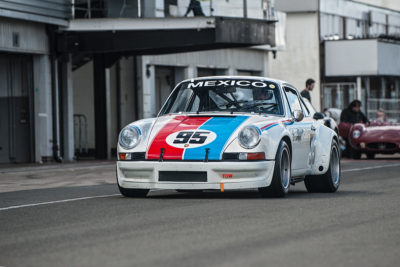
After many race miles in the two EB 3-litre racecars and the super 1965 911 that did so well at Goodwood last year, Mark is an excellent 911 test driver and has previously set up a number of non-EB 911 race cars, for circuits in the UK and Europe. He jumped at the chance to try an original RSR, making a five-hour round trip to have a go. The great weather was a real bonus.
Having already made a few misguided assumptions that morning, why hold back and break the habit of a lifetime, so I shot straight into another one, assuming this was the replica Brumos car built by Tuthills a few years ago, now fitted with BS Motorsport 3-litre power. Asking the owner about the new engine’s recipe, he smiled and put me straight. “This is the RSR that won the 1973 Mexico 1000 kms.”
Brumos Porsche 911 RSR 911 360 0865
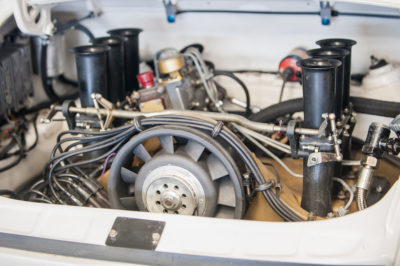
Chassis number 911 360 0865 was delivered to Peter Gregg at Brumos in April 1973 (happy 43rd birthday). Fitted with the 911/72 engine – a naturally aspirated 2808cc flat six making 308 bhp at 8k rpm – the car was sold to Mexico’s Hector Rebaque, who owned it until mid 1977. In the years he had the car, Hector took three wins in Mexico City, twice on the famous 1000 kms race.
After Hector, the car went to Guatemala for a while, eventually ending up with our friends at the Blackhawk Collection, who sold it back to Europe: first living an Italian collector for twenty years, and then to another Porsche collector in Monaco, who had it restored by the now-defunct Scuderia Classica at the start of this decade. I don’t yet have the full story of how the current owner came to possess it, but watch this space.
The track day was organised by my next-village neighbours at Goldtrack, who run a tight ship and bring in some very nice cars as a result. Parked up amongst the latest supercars and plenty of race machinery, this air-cooled classic Porsche turned few heads beyond the cognoscenti, until Bates turned the key and got the engine started.

Porsche 911 Track Day Noise
Even with tailpipe extensions, intended to mute the exhaust a touch for track day dB meters, this Porsche has a proper bark on startup. The engine has a tight, pursed tickover that is so much sweeter than the all-bass soundtracks of later Porsches sporting exhaust systems apparently designed originally for industrial chimneys. I feel an audiophile comparison of most attractive tickovers coming on.
Rolling out into the pitlane, the roofline of the tall RSR runs well above the massed Radicals, Ginettas and Scuderia Ferraris that dominate Silverstone’s start-of-race-season track days. But with 300 bhp pushing less than 1000 kilos along, it goes down the road rather nicely.
“I’ve already spun it once,” Bates confesses. “Fourth lap, pushed a bit too hard and the back just came around. It’s not what our car would have done.” I asked him what else felt different to his own 3.0 RSR build, which has proved so successful in historic racing in the seven years he’s been racing it, winning back-to-back Masters Historic titles and last year’s Nürburgring Trophy race (rumour has it that Germany’s cancelled the race now the English have won it).

Porsche 911 RSR 2.8 vs 3.0-litre
“They are quite different cars. Ours feels sharper after so many years of development. It’s lighter – closer to 920 kilos than the 970 or so of this one – so our brakes bite harder and suspension has a bit less to do. It’s not quite surgical in its precision, as no air-cooled car could ever be surgically precise, but our car is very sharp and reactive to drive. This one feels authentic to the period: very 1970s.”
Testing went well, with the RSR showing a clean pair of heels to most modern machinery. It flew past me on the old pit straight, holding its own against a featherweight Radical and shrugging off modern 991 GT3 RS and new BMW M3s. The delight in seeing real RSRs used with such glorious abandon – the owner encouraging Mark to thrash it and see what it is utimately capable of – was a joyous experience. Ultimately, it was left to Mark to decide how hard he drove it.
“It’s not my car and we’ve already been ticked off for noise and told to keep it under 7k rpm, but there’s enough going on to see what could be looked at. Our car runs lower gear ratios, which offer more opportunies to exploit the engine’s torque. We have some suspension tweaks specific to our car and this year we also have our own dyno-developed exhaust system coming. That makes a difference to the power on tap.”
“It’s been a good morning and we’ve learned quite a bit, changing tyre pressures and moving some ballast around,” said Neil, who has extensive personal experience of racing 2.8 and 3.0-litre RSRs. When I suggested that he may have been one of the last people to race a proper 2.8 RSR around Silverstone in period (not including club races and historics since then), he had a think before sharing a great story of racing a non-turbo RSR against an Autofarm 934 back in the day. But that’s a tale for another time.
by John Glynn | Apr 3, 2016 | New Models, Classic Porsche Blog
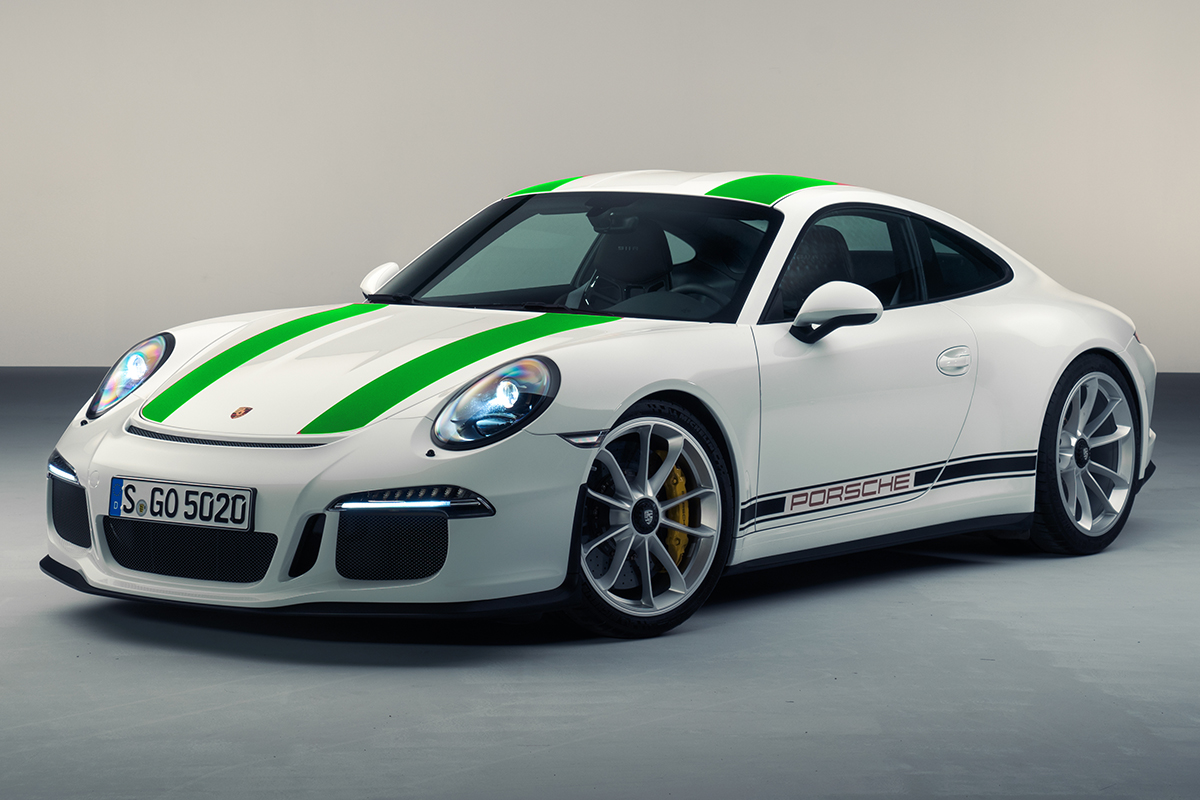
The all new Porsche 911R is one to forget for most Porsche would-be buyers, as Stuttgart continues to apply a policy of limited production range-toppers, which instantly doubles prices once the cars are flipped on to the used market by speculator purchasers.
Marketed as ultimate driver’s cars, the irony is that the majority of the nine-hundred and ninety-one 911Rs to be built will not be driven by their first owners. Most will either be mothballed on delivery and stuck in pension-fund car collections or sent straight back to market at up to £200k more than the UK cost new of £136,901.

Porsche 911R Factory Options
Obviously that cost new does not include the options that most buyers who manage to secure a build slot will go for. Choice of seats is standard (although there is really only one choice), as are the mechanical LSD, six-speed gearbox and ceramic brakes. But a quick look at the car configurator shows the other boxes likely to be ticked, based on the most common GT3 RS options out there (i.e. what Porsche dealers will advise customers to add), including:
- Wheels in Satin Platinum: £400
- Extended Leather: £2000
- LED headlights in Black: £2100 (or cheaper Black Xenon for £800)
- Lightweight Battery: £1500
- Single Mass Flywheel: £2024
- Front Axle Lift: £2024
- Sport Chrono: £1525
- Climate Control: £0
I pick the green stripe no-cost option, as any good Irishman should. Adding heated seats for early-morning starts means I would have to give up the 918 seats, which I wouldn’t do. So no 911R for me. Adding the DAB Radio means also adding PCM Navigation (no cost) and Telephone Module, so a £500 increase. The system won’t let you unhook Porsche Vehicle Tracking system at £1100, so your invoice total is now £147,000.
Porsche 911R Used Prices
Send in your deposit and finance the rest: don’t worry about interest. Sign your finance agreement when the car arrives at the dealership. As soon as the car is delivered, stick it in the Sunday Times at £350,000, which is the price 991 GT3 RSs were changing hands for when the first ones hit the UK and what my dealer friends expect ‘black market’ flipped 911Rs to fetch in the first weeks after delivery. Pay off your finance and buy the best 997 Carrera GTS you can find, as that is super fun to drive. Enjoy your free 911 and all that money for nothing.

What Porsche to buy if you can’t buy a 911R
Porsche must be happy for buyers to flip for profits: just look at the prices one-owner 911 GT3 RS models are selling for under the radar through its own dealer network. If Stuttgart was serious about building driver’s cars accessible to everyone, it would only make one less 911R than the market called for, and then we could all look forward to the day they depreciate to 997 Carrera GTS levels, which in my opinion currently offers the best mix of affordability, excitement and driveability in the 911 line up. I’ll have mine in white with green R stripes.
I would love to try a 911R with this six-speed transmission: no doubt the six-speed manual gearbox is huge fun in a 997 Carrera GTS and the seven-speeder is not great in a 991. By ignoring 991s and looking at Gen II 997 Carrera GTS instead, you really do not have to spend a fortune to buy the most enjoyable and guilt-free driver’s 911 of the VW-Porsche era.

by John Glynn | Mar 10, 2016 | Classic Porsche Blog, Market & Prices
Tomorrow is the Gooding & Co auction sale in Amelia Island, where noted Porsche collector, Jerry Seinfeld, is selling a number of his cars. Eighteen soon-to-be ex-Seinfeld cars including sixteen Porsche models will cross the auction block in this huge sale, which has just twenty-nine Porsches entered in total.
Talking to an American collector friend, this batch of cars is estimated to be circa ten percent of the complete Seinfeld collection. The famous comedian buys and sells many cars – I’ve driven some ex-Seinfeld machinery myself – but most previous sales have been well and truly under the radar. Dealers entrusted with Jerry’s cars who have tried to cash in on the Seinfeld kudos as part of their pitch have allegedly not had an easy ride afterwards, so it is no great surprise that an auction was chosen to dispose of this sizeable tranche, or that Gooding got the commission: the famous Amelia Island sale is the premier East Coast auction in the US and comes just as the market starts to gather pace following the lulls of winter. Many record Porsche prices have been achieved by Gooding at this sale.
Seinfeld shares Porsche Excitement
“The reason I wanted to bid these cars farewell in this way is really just to see the look of excitement on the faces of the next owners, who I know will be out of their minds with joy that they are going to get to experience them,” says Jerry. “Each one of these cars is a pinnacle of mechanical culture to me. Many are the best examples that exist in the world. I’ve loved being entrusted with their care, and I’m proud of the level to which we have brought each and every one of these wonderful machines. Honestly, if I had unlimited time, space and attention span I would never sell one of them.”
Situated in the north-east corner of Florida just inside the Georgia border, the almost perfectly named Fernandina Beach is finely dressed in Southern Victorian architecture and lined with more than thirteen miles of beaches. It’s a great escape for the rich and famous, but there will be no escaping market forces when twenty of Seinfeld’s own Porsche cars cross the podium from 11am tomorrow.
Classic Porsche Prices Market Trend
Prices at the very top end of the classic Porsche market have tailed off in recent months – at least for the cars you see at open sale. Sellers claim that many deals are done behind closed doors for stronger prices than seen in public, but even in these secret deals for the very best cars, buyers are applying pressure. Twenty percent off a $5 million car is a sizeable discount, so if the market is showing obvious softness, and both parties know it, there’s a poker game happening.
Doing eighteen poker deals behind closed doors, most likely through middle men, would be a long and expensive pain in the arse for Herr Seinfeld. Sending these cars to auction, with ten weeks of everywhere promotion, and a glitzy end-of-sale in prospect for Jerry, looking at the faces of buyers set to be “out of their minds with joy” is a reasonable recipe for respite from a high-end Porsche market that has consistently failed to deliver record-breaking prices since the middle of last year.

Affordable Classic Porsche prices remain steady
Further down the price range, our Porsche Valuations market price tracker is seeing continued health in the market for cheaper classic Porsches. Collectable RHD water-cooled 911s are in fine form, with low mileage Porsche 996 GT3s and GT3 RS models selling quickly. Good RHD Porsche 930s are still good sellers, as are RHD 911 3.2 G50 Carreras (especially the Club Sport) and 964 Carrera 2 models in top condition.
Seinfeld’s big hitters – the 550 Spyder, 718 RSK, and 917/30 – will fetch what they fetch and add to the existing market trend info, but more interesting will be the market for the Carrera GT prototype. Bought by Seinfeld directly from Porsche, and disabled before purchase from any possibility of being driven, this handmade CGT prototype has never been previously offered to the market. For some, it may be a potential jewel in the crown of a water-cooled Porsche collection, for others it is a pricey handmade paperweight. If any car were to illustrate prevailing price sentiment amongst serious Porsche collectors, then this should be it.
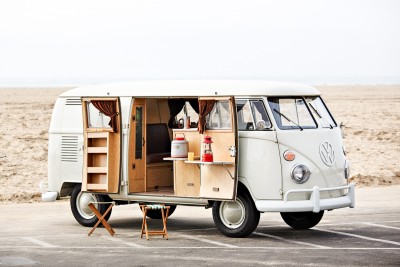
My favourites in the big Seinfeld sell-off are the Volkswagens: a 1964 Volkswagen Camper with less than 20k miles in simply perfect condition and a beautiful 1960 VW Beetle in original, unrestored condition, with just 15,500 miles on the clock. Of all these cars for sale, why sell this one? Assuming America turns out for Amelia, a top estimate of $55k on the Beetle could prove significantly behind the market. I would be keeping this car: it would be the last car I’d sell. Which means that Seinfeld has even nicer Beetles. Lucky man.
All images copyright and courtesy of Gooding & Company. 550 Photo by Mathieu Heurtault. Other photos by Brian Henniker.

by John Glynn | Feb 8, 2016 | Classic Porsche Blog
I was sad to hear of the death of Bob Watson yesterday. As one of the UK’s best-known independent Porsche mechanics, Bob Watson Engineering was for many years based in Middle Aston, which is where I met him and went on to spend quite a bit of time with him.
Born in March 1950, Bob’s Porsche life began in March 1975, when he took a job with Maltin Car Concessionaires in Henley-on-Thames. Owned by Chris Maltin with partners Rod Turner and Charles Holdsworth-Hunt, the business held franchises for Porsche, Ferrari and Lamborghini. I can imagine the twenty-five-year-old Bob rolling up for work at Maltin surrounded by seventies exotica – it must have been fantastic.
Back then, Porsche did all of its training at the factory. Three or four times a year, Bob and his UK colleagues would be sent to Stuttgart for one week studying engines and doing rebuilds, the next week’s visit would cover transmissions, then a week on brakes and suspension and so on. The training continued up to 1982, so it was no surprise to find that Bob was very hot on standard Porsche models from ’75-’82 including the Carrera 3.0, 911 Turbo 3.0/3.3 and, of course, the 3-litre 911 SC. He built some amaing cars, including Steve’s 3.5-litre 930 (below). But I’m jumping ahead of things here.

In September 1984, Bob decided to call it a day with Maltin and headed off to work for John Greasley at Dage Sport in Aylesbury. Greasley’s now famous Blue Coral-sponsored Porsches were a big deal in motorsport and Bob was well into racing. That brought him up the country and also put him at the back end of 935s, as Greasley was running a pair of them: one left hand-drive genuine car and a right-hand drive replica so the real one wouldn’t get damaged.
Porsche racing was a big deal in the mid 1980s. Though the Porsche Club was smaller than it is nowadays, the club was a big force in racing and the Giroflex-sponsored series drew big crowds and big name drivers. Many of the UK’s leading air-cooled specialists made their names around this time: Bob enjoyed a great rivalry with Neil Bainbridge’s cars in the Porsche Club series and other famous races including the Oulton Four-Hour Endurance.
Racing continued to be very important when Bob struck out under his own name. Photos hanging in Bob’s offices showed racing from all over Britain and of course at Le Mans (Bob also raced until the mid 1990s). From his workshop in Bicester and later Middle Aston, Bob Watson Engineering became a big name in UK Porsche. A quick search for Bob online will show just how many 911s he laid hands on: all sellers were delighted when they found Bob Watson history in an air-cooled car.
Bob took to Motec Engine Management early on and used it very successfully on a number of Porsche builds and others: I once watched him tuning a V12 Jaguar E-Type which he had fitted with Motec. The fastest air-cooled Porsche I can remember being driven in was a naturally aspirated 2.8-litre Motec-equipped 911 ST, which Richard Tuthill took me for a run in sometime during 2010/2011. Even on rock hard dampers and tyres, this was absolutely the quickest car: you simply would not believe a 911 could move that fast uphill. Not until I rode in the 997 GT3 Cup R-GT rally car on a wet tarmac stage was I so impressed again, and that’s not rose tinted glasses. Bob also built the famous hillclimb 911 of Roy Lane: another incredible Porsche.
I can’t remember when I first went to Bob’s, but it was early in my Porsche life, as he was only half an hour from my house. Back then, I had a 911 SC Cabriolet and had started writing for various Porsche magazines. I knew Bob had a dyno as Tuthills used it quite regularly: Francis would be clicking fuel pumps up and down notch by notch in typical Francis fashion, while Bob would shout above the fans: “for f**ks sake Francis, give it half a turn”, trying to speed up Fran’s progress. No one has ever succeeded in that, but Bob always gave it a good go. I took my SC down there for Bob to have a look and we spent an hour or more chatting, even though he had plenty of other stuff to do.
There was always a bit of craic going on at Bob’s and I don’t remember one conversation with him where I didn’t learn something. He was a font of knowledge so I organised an ImpactBumpers.com group visit to Bob’s one year – the only Porsche specialist we have ever visited as a group if I remember correctly. We spent so much time talking whenever I saw him, it is only now I need a photo of Bob that I realise I don’t have any: I have used a pic of Alan’s S on Bob’s dyno pending better photos (email me a pic).
Many air-cooled 911 owners were delighted to have Bob fettle their cars on the dyno. Including me, as Bob sorted me out with a run just after I got bought my Carrera 3.0 Coupe in 2007 and did a first dyno run elsewhere which suggested it was lean at the top end. He spent an hour with me on the rollers and wouldn’t take a penny for his trouble. He gave me great advice on what to do next – “just drive the nuts off it” – which of course I followed religiously.
Bob’s dyno was the benchmark for PCGB racing and for years he served as Technical Consultant for the 930 Register. Alan Drayson at Canford Classics was a big fan of Bob’s work and would tune all of his new engine builds on the Bob Watson dyno, including the stunningly restored RHD 911S we did a feature on together. When a partnership at the Middle Aston unit eventually went sour, Bob upped sticks and went to work down south with Alan. After that, we lost touch.
In recent times, he had returned to Oxfordshire and was still booking work until he passed away last weekend. Yesterday, I heard he almost came to build engines at Tuthills last year, but they had just taken a new engine guy on at the time. It would have been good to see Bob over there every week.
People who knew Robert Bailey-Watson much better than I did will write great tributes to Bob in the Porsche press and I urge you to read them. Bob had his detractors (don’t we all), but I always found him excellent company and being around someone with so much Porsche knowledge, shared with unstinting generosity, was a genuine pleasure. He only worked on my cars twice, but he made them better both times. RIP Bob: you will be missed.


