by John Glynn | Aug 30, 2014 | Classic Porsche Blog
I never met Björn Waldegård, but we spoke on the phone once. It was a memorable experience: everything you wish from your heroes.
“Luck plays a part in all of life,” Björn told me. “Not a great percentage, but it is there. Luck is not just your good luck, sometimes it is other people’s bad luck. How you prepare can lead to your luck.” Making one’s luck is the mark of a champion: the first-ever World Rally Champion.
Björn Waldegård and Porsche
Born into a farming family, Björn began winning rallies in his privately-run Volkswagen at the age of 19. Noting his ability, the Swedish Volkswagen importers put him in a professionally-built VW rally car, which he used to claim a few podiums.
Things hotted up when a Porsche 911 was purchased. Björn took second place on the 1967 Gulf London Rally and performed well elsewhere. 1968 brought a win on the Swedish Rally, almost half an hour ahead of second place. Monte Carlo brought a top ten finish: the following year, Björn won the race, and then won in Sweden again.
When the ST arrived at the start of 1970, Waldegård exploited its potential, repeating his wins from the previous year and adding the Alpine Rally. The list continues: let’s just say that he knew the 911.
Swedish Sixth Sense
More than the secret of 911 speed, Björn had a sixth sense of how much life was in a car. “A car is like a fuel tank,” he said. “You use its life up through the length of a rally. The perfect rally car falls apart as soon as you cross the finish line: nothing is left.”
Francis Tuthill once told me exactly the same thing about sitting next to Björn on a pre-Safari test in Morocco. “He has two sets of instruments: one set on the dashboard and one set in his head. His internal gauges clock up how much of the car he has used, where he can push and where he should hold off.” Francis co-drove for Björn on a rally one year – it may have been the Eifel Rally – and, while setting pace notes, Bjorn told Francis to mark one corner as “caution: keep to the inside”.
“I didn’t see it like that: it looked a fast corner to me,” said Francis. “But you always pay attention to Björn, so I did put it down on the notes. In the heat of the event I neglected to call it, but Björn was a wily old fox. Remembering the bend, he slowed down anyway and sure enough there was a group of cars off, stuck in the ditch on the outside. The road had frozen overnight and failed to thaw: he spotted it would on the recce. That was just what he was like: incredible intelligence and ability. Driving slowly was part of his secret.”
Laid Back, Straight Talking Björn
We have family in Sweden, so I have travelled all over that country. The Swedish are easy-going, straight talking people, and Björn was a perfect example. “I’m just a simple Swedish farmer”, is how he described himself to me, but we all know he was much more.
“When I retired, I thought my driving was over,” Björn told me. “But the energy of rally fans kept it alive. Soon historic rallies began to come up and my phone was ringing. But it was not manufacturers taking millions of pounds in promotional value from winning a rally, it was just rally fans, doing it for the passion. The events were no slower – Safari now is still just as fast as it was in 1970, and the roads are just as deadly. But when you know you are racing for passion, it is a very satisfying way to use a talent.”
Waldegård: Make Your Mark
We were working together on the Race4Change team, so I asked Björn about strategy: how would he approach the impending Safari? “Same as any Safari,” he said. “We will start by looking at the others: how ready they are, how hard they will start, how much confidence they have. Then we settle in and choose when to lay down our mark. And then we will see who is ready to rally.”
Lessons learned on Safari always transfer to life. Bjorn won the 2011 Safari in a Porsche 911: in total he won six Safari Rallies and the hearts and minds of rally fans everywhere. After an hour on the phone with him, I had a different perspective on my work. He was a great competitor and a true Porsche hero. I will miss typing his name, seeing more new pictures of that face and wondering what he is thinking.
RIP Björn Waldegård. Here’s to fast, flowing stages and the memories of genius.
by John Glynn | Jul 28, 2014 | Classic Porsche Blog, Race and Rally
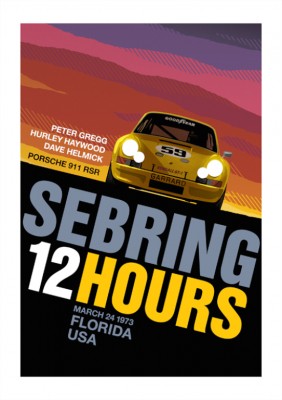
Ferdinand Magazine’s favourite digital artist, Guy Allen, has just released a new print for summer 2014. Celebrating a famous 911 win at the 1973 Daytona 12 Hours, Guy has created a striking Porsche 911 artwork that does justice to the hard-fought Sebring showdown.
Porsche 911 RSR Sebring 1973
Veteran race fans may recall how, in 1972, the Sebring 12 Hours was struck off the World Sportscar Championship calendar due to the state of the track. IMSA decided to include the circuit on its 1973 GT racing calendar and set the stage for a brutal test of survival.
A pair of Corvettes led from the start, but an unmerciful race pace around the airfield circuit took its toll. On lap 86, Porsche seized the lead. The Porsche 911 RSRs of Haywood/Gregg/Helmick and Minter/Keyser did battle to the flag, with Dave Helmick’s Light Yellow RSR coming home first.
Those lovely people at Gunnar Racing carried out a full restoration on the original RSR back in 2000 – see the Gunnar Racing 911 RSR restoration thread. At the time, it was owned by a gentleman living in Oxford, just down the road from here. No doubt this is an important 911: great to see it on a Guy Allen print.
Produced on archive quality heavyweight paper and available in a strictly limited edition of 100 prints, this is a large format A2 print: 594 x 420 mm. Each print is signed and numbered. Mine is number two – not sure where I’ll hang it yet, but it’s a really nice piece of work.
How Sebring Changed the Face of Racing
What I like about this story of the 1973 12 Hours of Sebring is how it changed the face of US racing. Gunnar’s website quotes Sebring historian Ken Breslauer’s summary of events around that time, following the FIA’s refusal to certify the circuit for 1973.
“For 1973, an upstart group known as IMSA added Sebring to its Camel GT series, and the race lived on, though radically different in appearance. The entire event was more informal, but no less competitive than previous years. In retrospect,the 1973 race was one of the finest gatherings of GT production race cars ever in North America. Entries totalled the second largest ever at Sebring.
“There was no race the next year, 1974, due to the OPEC oil embargo and resulting fuel crisis. Nevertheless, on the third weekend of March ’74, about 2,000 race fans showed up anyway. The Sebring tradition simply would not die.”
No race and a fuel crisis, but two thousand race fans “turned up anyway.” Way to go, America!

by John Glynn | Jul 22, 2014 | Classic Porsche Blog, Market & Prices
Another pair of low mileage collector Porsche 911 models has come up for sale. The prices have already started online tongues wagging, but that is no bad thing when the cars concerned are rare and ooze quality.
Porsche 996 GT3 RS Low Mileage for sale
If someone had told me this time last year that prices for 996 GT3 RS would touch £150,000 within twelve months, I’d have grown a second pair of eyebrows to raise in response. But this low mileage Porsche 996 GT3 RS now on sale is priced just off that.
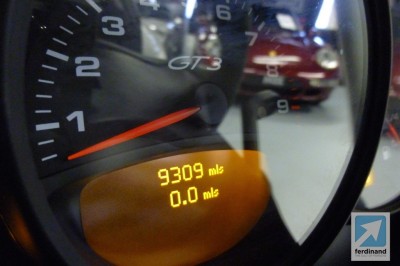
It’s brave pricing but, with just 9,300 miles on the clock and apparently no track use in its past, this could be a last chance for serious collectors to grab a mint RHD 996 GT3 RS in their ascent towards air-cooled 911 Carrera RS price levels in thirty years.
Before you slam the keyboard, I’m not saying the two are comparable or that 996 GT3s will ever hit half-a-million quid a piece: I’m just throwing it out there. I’m already dazed by current 911 Carrera RS prices, so who knows what is possible for the water-cooled classics.

Porsche 993 Turbo S Low Mileage for sale
In the same used Porsche showroom as the low-mileage Porsche 996 GT3 RS is this rare Porsche 993 Turbo S for sale. Amongst the rarest of the rare air-cooled Turbos, the black-with-tan Turbo S has done just 17,100 miles from new and is offered at a price I am scared to say out loud.
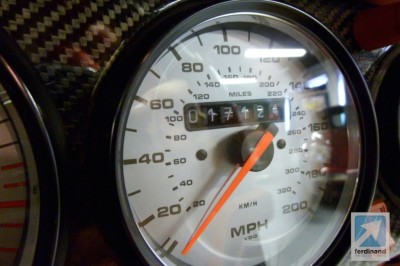
I like 993 Turbos – really like them – but they are one of those super-capable Porsche 911s where, no matter what you do, the car will generally sort your mess out. It is hard to hoon around in a 993 Turbo and seriously scare yourself. In any case, this 450 bhp Turbo S cannot be hooned or used to frighten the driver. The value is in its rarity and low mileage, so no point spending all that cash on a car to go crazy in.
That said, there is more money in the world that I can comprehend, so these two could be gone by the weekend.

by John Glynn | Jul 21, 2014 | Classic Porsche Blog, Project Cars
Some great pics and video have just arrived from Mark at EB Motorsport, who supplied many of the replica Porsche parts used on this Rennsport Porsche 907 recreation build by RMS Porsche in Theix, near Vannes, France.
As a big fan of Brittany, I’ve been to Vannes a few times: wish I’d known RMS were based there. A quick look at the RMS Porsche Facebook page shows some very interesting projects, including running Tom Dillmann at Le Mans in Porsche Carrera Cup France. Anyone into GP2 will know Dillmann: no slouch in a single seater.
Suffice to say that RMS know their stuff on Porsche racing, although this 907 build has me scratching my head a bit. Introduced in 1967, the 907 initially ran a Rennsport 2-litre flat six. Far from being underpowered, it could hit 190mph in a straight line. Porsche then added a 2.2-litre flat eight engine, which took the 907 to Porsche’s first-ever 24-hours win at Daytona in 1968.
Superceded by the 908 later that same year, the 907 was quite a rare build and is not too common in historic racing. One giveaway of the 907 body was the nose, which had a rectangular centre grill with oval slots either side. The 908 went to an oval centre intake with an oval to the left and a mousehole-shaped slot to the right.
This recreation has that mousehole slot in the nose, but obviously does not run a 908 3-litre flat eight engine. The naming may just be as simple as that: 907 can show with a flat six. The replica bodywork looks modelled on Porsche 908K – like Cameron Healy’s 1968 908K (below), which I enjoyed photographing at Rennsport Reunion in 2011.
The RMS guys have also made this video of the first start of their replica. Initially reluctant to fire, it soon gets going and sounds great through the megaphones. I am intrigued to see the car running: no doubt that flat six engine will be making great power and the chassis will weigh next to nothing. Nice job, RMS.
Ferdinand blogs my freelance adventure with Porsche at the centre. To support the blog or engage with me in other ways, you can:

by John Glynn | Jul 13, 2014 | Classic Porsche Blog, Modified Porsche Hot Rods
This Kremer Porsche 962 was a recent visitor to a friend’s service workshop. Despite my spending at least one day a week there, I missed it, but am working on future visiting rights.
Everyone knows about the Porsche 962: super successful Group C racer that claimed abundant silverware for owners with the nuts to drive them properly. However, a number of customers were unhappy with Porsche’s version of the 962 and decided to do things their own way.
Formula One of the time was breaking new ground with composite tubs, but Porsche stuck to single-skin aluminium monocoque. When Kremer drivers Manfred Winkelhock and Jo Gartner were both killed in 962s – Mosport 1985 and Le Mans 1986 respectively – Kremer contacted John Thompson in the UK and had him build a stronger aluminium honeycomb tub with composite inserts and bodywork.

Scratch-built Kremer 962s using Thompson’s much stiffer tubs were badged as 962 CK6s, and Thompson went on to build full composite 962 chassis’ for Brun Racing. Despite 962 variants running well into the 1990s, Jo Gartner was the last man to be killed at Le Mans until Allan Simonsen’s death last year.
Flying slightly blind here, I’m half guessing at this being Kremer 962 CK6 09, one of the last Kremer 962s built, although it could be chassis 05. Shown on the JZM Hunter chassis alignment ramp, it’s fitted with Volk Racing centrelock wheels, which were chosen by many 962 teams. CK6-09 enjoyed an interesting career. Built specifically for the Le Mans 24-Hours, it raced in 1991, ’92 and ’93, with a highest placed finish of 11th overall.
Manuel Reuter’s name can be seen on the door. While not a household word outside of Germany, Manuel enjoyed sportscar success, twice winning Le Mans and racing 962s for much of his career. The 1992 Interserie Division 1 champion in a Kremer K7, he also raced DTM for Opel and was a DTM TV commentator too.
How many Porsche 962s were built? Depends who you read and how you add up the numbers. Counting later derivatives, it is certainly more than three figures.


