Porsche friend Hans has just shared this video on Facebook. It’s a feature (in German) on the Porsche 956. Non German speakers, don’t let the language put you off – the video contains some great period footage of the 956 in build and at work. Well worth watching!
Derek Bell usually dominates 956 video. While I could listen to DB ’til the cows came home, it’s a nice change to have some new faces. Here we have the great Jürgen Barth,who won the ’76 Le Mans in the 936 with Ickx and Hurley Haywood, and finished third in 1982, sharing a 956 with Hurley and Al Holbert. Also interviewed are Harald Grohs and Hans Heyer.
Born in Essen, Harald is a veteran of fifty endurance races, and a former 935 & Carrera Cup racer. Former European Touring Car Champion, Hans Heyer will be familiar to anyone who followed DRM (Deutsche Rennsport Meisterschaft – German Racing Championship) back in the day, as his racing career throughout Europe was legendary. Hans drove just about every touring and sports car of note, up to his retirement from full-time racing in 1985.
Hans Heyer’s New Man Porsche 956 is above, from Rennsport Reunion IV last year. The interview looks to have been filmed at the Kremer works – rather apt as Heyer drove Kremer RSRs in his early years.
Anyway, enjoy the video. I seem to spending all of this afternoon on Youtube – been too long since I did that. Have discovered many wonderful previously unseen videos there (unseen by me) which I’ll share via the Ferdinand Porsche website and magazine over time.
The new Porsche 911 has been named World Performance Car 2012, with Volkswagen’s Up winning the overall World Car of the Year award.
An international jury panel of 64 automotive journalists from 25 countries votes on the awards: seven of whom are in the USA, where the Volkswagen Up is not sold.
Chosen from an entry list of nineteen vehicles, the 911 made it through a number of knock out rounds before being crowned the winner, beatoing the Aventador and McLaren MP4-12C to the crown.
There’s a particular serendipity to the 911’s win, given the loss of its devoted father yesterday. Butzi would be very proud of the team now maintaining his vision: well done to all.
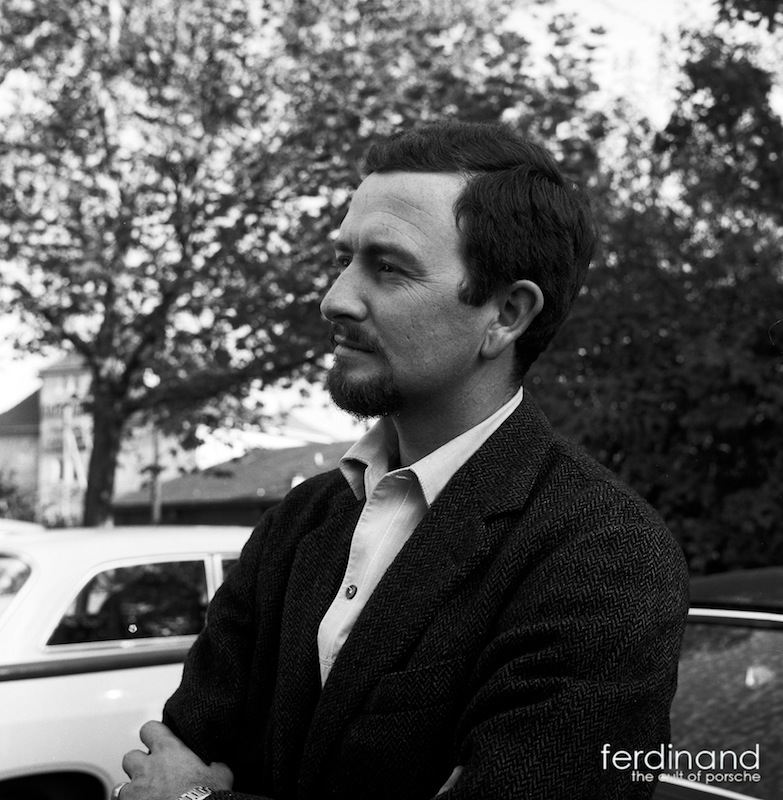
Porsche has just announced the death of Ferdinand Alexander Porsche and sent this summary of his life and career. The great designer had not been well for some time, but it is still a bit of a shock. Some time to absorb the news is required: more on this sad story later. Rest in Peace, dear Butzi.
Dr. Ing. h.c. F. Porsche AG, Stuttgart, is mourning Professor Ferdinand Alexander Porsche. The Honorary President of the Supervisory Board died on 5 April 2012 in Salzburg, aged 76. Matthias Müller, President and Chief Executive Officer of Porsche AG, paid tribute to Ferdinand Alexander Porsche’s services to the sports car manufacturer: “We mourn the death of our partner, Ferdinand Alexander Porsche. As the creator of the Porsche 911, he established a design culture in our company that has shaped our sports cars to this very day. His philosophy of good design is a legacy to us that we will honour for all time.”
Ferdinand Alexander Porsche was born in Stuttgart on 11 December 1935, the oldest son of Dorothea and Ferry Porsche. Even his childhood was shaped by cars, and he spent much of his time in the engineering offices and development workshops of his grandfather Ferdinand Porsche. In 1943 the family accompanied the Porsche company’s move to Austria, where he went to school in Zell am See. After returning to Stuttgart in 1950, he attended the private Waldorf school. After leaving school, he enrolled at the prestigious Ulm School of Design.
In 1958, F.A. Porsche, as he was known by his colleagues, joined the engineering office of what was then Dr. Ing. h.c. F. Porsche KG. He soon proved his great talent for design by sculpting the first model of a successor to the 356 model line out of plasticine. In 1962 he took over as head of the Porsche design studio, creating a worldwide furore one year later with the Porsche 901 (or 911). With the Porsche 911, F.A. Porsche created a sports car icon whose timeless and classical form survives to this very day in what is now the seventh 911 generation. However, in addition to passenger cars, F.A. Porsche also concerned himself with designing the sports cars of the 1960s. His best-known designs include the Type 804 Formula One racing car or the Porsche 904 Carrera GTS, now considered to be one of the most beautiful racing cars ever.
In the course of the conversion of Porsche KG into a joint-stock corporation in 1971/72, Ferdinand Alexander Porsche, along with all the other family members, stood down from the company’s front-line business operations. In 1972 he founded the “Porsche Design Studio” in Stuttgart, the head office of which was relocated to Zell am See in Austria in 1974. In the decades that followed, he designed numerous classic gentlemen’s accessories such as watches, spectacles and writing implements that achieved global recognition under the “Porsche Design” brand. In parallel, with his team, he designed a plethora of industrial products, household appliances and consumer durables for internationally renowned clients under the brand “Design by F.A. Porsche”. A strong and clear design concept typifies all product designs created in his design studio to date. The credo of his design work was: “Design must be functional and functionality has to be translated visually into aesthetics, w ithout gags that have to be explained first.” F.A. Porsche: “A coherently designed product requires no adornment; it should be enhanced by its form alone.” The design’s appearance should be readily comprehensible and not detract from the product and its function. His conviction was: “Good design should be honest.”
Ferdinand Alexander Porsche received numerous honours and awards both for his work as a designer as well as for individual designs. For example, in 1968 the “Comité Internationale de Promotion et de Prestige” honoured him for the outstanding aesthetic design of the Porsche 911 while the Industrial Forum Design Hannover (iF) voted him “Prizewinner of the Year” in 1992. In 1999, the President of Austria bestowed on him the title of Professor.
Ferdinand Alexander Porsche retained a close lifelong association with Porsche AG as a partner and member of the Supervisory Board. For example, even after stepping down from front-line business operations, he contributed to the design of Porsche’s sports cars over many decades and repeatedly steered the company in the right di-rection. This was especially the case for the difficult period Porsche experienced at the beginning of the 1990s. From 1990 to 1993, F.A. Porsche served as President of the company’s Supervisory Board, thus playing a major role in Porsche A.G’s eco-nomic turnaround. In 2005, he stood down from his Supervisory Board role in favour of his son Oliver and assumed the mantle of Honorary President of the Supervisory Board.
Ferdinand Alexander Porsche will be buried in the family grave at Schüttgut in Zell am See, attended by his immediate family. An official funeral service will be held in Stuttgart at a later date.
Porsche legend, Hans Herrmann, has been inducted into the Sebring Hall of Fame. Herrmann’s award came this weekend, during the 2012 12 Hours of Sebring.
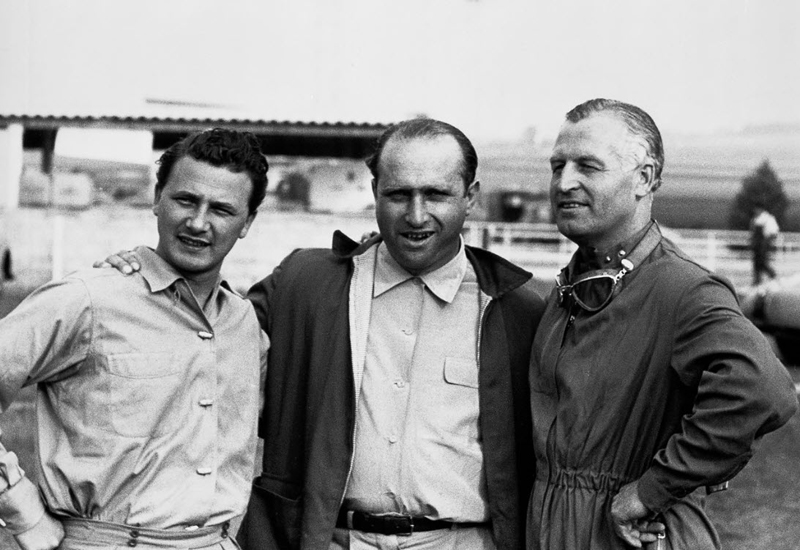
Hans Hermann, Juan Manuel Fangio, Karl Kling
2012 was the 60th running of the historic half-day race, an event Herrmann (seen above with Fangio and Karl Kling) won twice in his career. In 1960, he won at Sebring in a Porsche 718 RS 60 shared with Oliver Gendebien, winning the Targa Florio in the same year. Having raced in F1 with Maserati, Cooper and BRM, Hans also raced F1 for Porsche. Lack of success prompted a move to Abarth.
A few years later, Hans returned to Zuffenhausen. The team struggled with the 906 for a couple of seasons before finding their feet in 1968, with the awesome 908. Hans again won Sebring, this time alongside Jo Siffert.
The following year, Herrmann’s 908 missed a Le Mans win by a very narrow margin. In 1970, the baker from Stuttgart made up for it by clinching the first win for Porsche at Le Mans in the 917, alongside Richard Attwood. The car was one of just seven finishers in a race of total chaos.
Hans Herrmann was 42 when he won Le Mans: an age that many drivers of his era did not live to see. After the event, he retired from racing but continues to attend many European and US events.
Now the grand age of 84, Herrmann’s importance in the history of Porsche should not be underestimated. Nor should the affection he is held in amongst the Porsche cognoscenti: one chat with the major players at the Porsche Museum speaks volumes about how Stuttgart regards one of its all-time favourite racing sons.
Congratulations Hans! Well deserved, and many more besides.
Ferdinand blogs my freelance adventure with Porsche at the centre. To support the blog or engage with me in other ways, you can:
Porsche shared a link to nice little video today, featuring Klaus Bischof and the cars of the Rolling Museum at the Philip Island Classic. Bischof talks about 935/78 “Moby Dick”: the longtail 935 that won the 1978 Silverstone 6 Hours by a masterful seven laps, and went on to reach 235 mph on the straight at Le Mans.
“Moby Dick was just to show the technique of turbocharging,” says Klaus. “You need a lot of fuel in this car: I was a mechanic with Moby Dick and we had to refuel every 35 minutes, so for preparing and running at Le Mans you can’t sit down! But it’s a fantastic car and shows what you can do with a 911.”
Porsche celebrated 60 years in Australia by bringing some very special vehicles from the company’s museum in Stuttgart, Germany: a 1987 962, Moby Dick and the Carrera GT you see in the background here. Moby was also at Rennsport later in the year.
Eight-time Bathurst winner and all-round legend Jim Richards was patron of the Queensland meeting. As well as treating competition winners to rides in his new GT2 RS, Jim was given permission for takeoff in Moby Dick for a few laps around the track. “I won’t give it a hard time,” says Jim to Klaus, the old mechanic replying to take it out and give it the beans: i.e. 820 horsepower (some 935s had 845 hp on tap!).
The final edit doesn’t show the pace seen in some period footage, but you can’t blame Jim for taking it steady. As Klaus says: “there is only one real Moby Dick: all the others are replicas.” Wouldn’t look good on the CV to be remembered as the guy that harpooned Moby.
This website uses cookies to improve your experience. We'll assume you're ok with this, but you can opt-out if you wish.AcceptRead More
Privacy & Cookies Policy
Privacy Overview
This website uses cookies to improve your experience while you navigate through the website. Out of these, the cookies that are categorized as necessary are stored on your browser as they are essential for the working of basic functionalities of the website. We also use third-party cookies that help us analyze and understand how you use this website. These cookies will be stored in your browser only with your consent. You also have the option to opt-out of these cookies. But opting out of some of these cookies may affect your browsing experience.
Necessary cookies are absolutely essential for the website to function properly. This category only includes cookies that ensures basic functionalities and security features of the website. These cookies do not store any personal information.
Any cookies that may not be particularly necessary for the website to function and is used specifically to collect user personal data via analytics, ads, other embedded contents are termed as non-necessary cookies. It is mandatory to procure user consent prior to running these cookies on your website.