The first race of the brand new 2.0L Cup was held at Peter Auto’s Spa Classic event last weekend. A grid of almost forty pre-’66 2-litre 911s took to the circuit to do battle in an exciting first race, which ran for an hour (twenty laps) until torrential rain brought out the red flag.
Porsche Classic has joined the fray with Porsche GB’s 2-litre race car, which was last used in the 911 50th celebrations during 2013. The 1965 911 has an extensive programme of events ahead this season, with the Spa Classic just one of eight outings this year. The rest of its calendar looks like this:
May 18 – 20: May Peter Auto Spa Classic, Spa-Francorchamps, Belgium
June 17: HSCC Guards Trophy, Silverstone, GB
July 6-8: Le Mans Classic, Le Mans, France
July 20-22: Silverstone Classic, GB
August 10-12: OldTimer Grand Prix, Nurburgring, Germany
August 25-26: HSCC Guards Trophy, Oulton Park, GB
September 2: Porsche Classic Trophy, Brands Hatch GP, GB
October 21: HSCC Guards Trophy, Silverstone, GB
Anthony Reid paired up with former Porsche Carrera Cup GB Champion Josh Webster in the PCGB car for the 2.0L Cup race, but the duo were forced to retire on lap nine. Regular 2.0 racers Historika, Tuthill Porsche and EB Motorsport finished on the podium in that order after a great race. Led initially by the Duel Motorsport car, which set a top speed of over 203 km/h on the Kemmel Straight, the rest were 5 or 6 km/h slower on the Kemmel, but the fastest lap of 3:02.586 was set by Nigel Greensall in David Huxley’s Brumos Porsche-liveried 1965 911.
[metaslider id=20983]
“Thanks to both David and Richard Tuthill for such a terrific weekend,” said Greensall in an email with a link to the video below. “We have a really great team.” A proper 911 driver who has claimed many excellent results in SWB cars, the video shows a terrific scrap at the front from Nigel’s in-car camera.
Porsche 2.0L Cup racing costs
The technology involved in 2-litre Porsche 911s may look simple and the homologated spec is very straightforward, but getting these cars to run competitively and finish well is not easy or cheap. Proper 2-litres are expensive to build and expensive to run: a rebuilt set of the mandatory Solex carburettors costs twelve thousand pounds and a full-spec, plug and play 2-litre engine including carbs and exhaust leaves little change from £85k.
It’s good to see Porsche fielding a 911 prepared by its approved classic specialists amongst the 2.0L Cup cars. Looking back at the 911s results from 2013, Robertson/Horne finished third out of three 911s in the 2013 Brands Hatch Masters and their fastest race lap at Silverstone Classic was some five seconds slower than Greensall’s best of a 3:02.267 en route to coming home as first 911 in the International Trophy for pre-’66 GT cars.
Next event in the four-race 2.0L Cup is the Grand Prix de l’Age d’Or at Dijon from June 8-10. With Dijon some 600kms from the coast. I decided to save the miles on the RT and do something else instead, but let me know if you’re going.
Ferdinand blogs my freelance adventure with Porsche at the centre. To support the blog or engage with me in other ways, you can:
As April draws to a close and we put the first proper month of the season behind us, the shape of the 2018 classic Porsche market has begun to emerge. While high-end 911s with low mileage, low owners and all the right spec are still enjoying some demand, only the bravest observer would describe things as buoyant at the lower end of the market.
The long cold winter across Europe was definitely felt in Porsche showrooms and what little fever there was around air-cooled classics towards the end of last year has not increased. This has tempered sentiment towards the most populous production models including all turbocharged 911s. This trend is shared across the pond: bids on two apparently nice 93os offered at the recent Amelia Island sale fell well short of bottom estimate, but the cars were sold nevertheless. The softer demand also seems to have spread to average 996 and 997 Turbos unless very well priced or gifted with excellent spec.
Normally-aspirated air-cooled 911s have not escaped the softer conditions. While the number of late-eighties Carreras offered to market in recent months has been lower than expected, prices for average examples are off the boil. 911 SCs in A1 condition have been holding up well, as the numbers are lower and demand for chrome-trimmed ’70s 3-litres remains healthy when the cars are priced right.
A quick look on Pistonheads shows the state of supply in the UK right now. Searching for air-cooled 911s up to 1983 listed by UK sellers brings up 96 results. Roughly 20% of those cars are listed as POA, with several listings detailing cars coming up for auction in the next month or two. Looking specifically at cars offered below £50k, there are just eight air-cooled 911s available in the UK and only five of those are SCs.
Looking at 1984-1989 911 Carrera 3.2s on sale for less than £50k in the UK right now, there are 24 examples listed on Pistonheads, with prices starting from £25k for a project and ending at top whack for a 150k-mile 3.2-litre backdate. Twenty four cars is six times the number of SCs up for sale on this site in the same price range. Eight 3.2s are listed from £50-70k and there are a couple more over that, making more than thirty cars available.
Porsche 911 supply dictates price limits
Supply of these cars is a big part of price. When there are more cars than buyers, anyone looking to sell will have to be competitive on the condition of the car they are offering and its asking price. While buyers are still out there for the very best cars, air-cooled 911 owners considering a switch into water-cooled during 2018, or away from air-cooled 911s altogether would be well advised to sharpen their pencils and spend some money putting their cars beyond reproach.
Get a classic Porsche Valuation
Ferdinand blogs my freelance adventure with Porsche at the centre. To support the blog or engage with me in other ways, you can:
Confirmation of Singer Vehicle Design’s partnership with Williams Advanced Engineering became public several weeks ago, when computer mockups of the latest Singer Porsche DLS (Dynamics and Lightweighting Study), were shared on social media.
Some of my friends have been involved in the project since its earliest days, so I’ve been following progress from the sidelines for months. It is a interesting collaboration. Now that the bodyshells have entered production, Singer has started advertising for people to help assemble these cars in the UK. The jobs are here in sunny Northamptonshire and the accompanying text from the Singer website is below. You can also download the full Singer Porsche jobs PDF.
About Singer
Singer Vehicle Design was formed in 2009 to explore the creative possibilities within the vibrant world of the classic automobile. Singer is dedicated to the passionate study, preservation and optimisation of the world’s most respected high-performance vehicles. Our focus – indeed obsession – has been the pursuit of a meticulously restored and reimagined air-cooled Porsche 911. Our lofty objective is to distill, enhance and recombine the strands of greatness that have long marked the Porsche 911 as iconic. Today, the cars we restore to bespoke commission for our global clientele appear in the world’s most prestigious global automotive shows and publications.
Singer Porsche UK Jobs
Our latest endeavour on behalf of our clients is a Dynamics and Lightweighting Study “DLS” undertaken with Williams Advanced Engineering – part of the Williams Grand Prix Engineering Group. DLS encompasses a selection of restoration and modification services strongly oriented toward lightweighting and dynamic gains.
The restoration of cars for owners who select the Dynamics and Lightweighting Study will be carried out in the UK. As a result, we are looking for talented individuals to join our UK-based operations.
Job opportunities available Singer GB, a subsidiary of Singer Vehicle Design, will commence operations in February 2018 in Northamptonshire and is currently looking for:
Painters
Fabricators
Mechanics
If you are interested in finding out more about the Singer GB team and these positions please contact us: email info@singergb.co.uk
I went back to doing some magazine work earlier this year, with my friend Simon Jackson at GT Porsche magazine. Having run a few of my features through 2017, Simon asked if I fancied writing another regular column and I was happy to say yes, so the January 2018 issue has at least one page written by me.
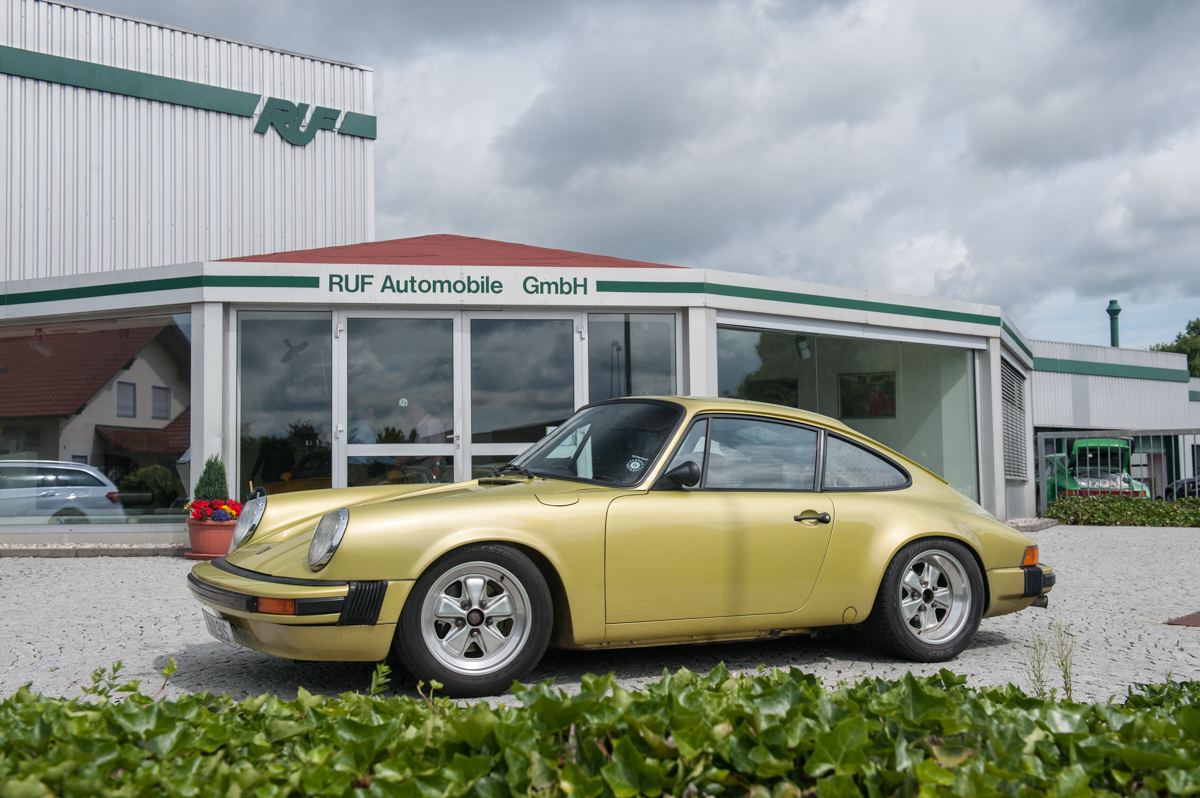
Elsewhere in the latest issue is the story of my road trip to Ruf Automobile Gmbh last July. I made the trip as a passenger in Jonny Hart’s Delphi Green 911 SC, to demo the Classic Retrofit air conditioning system and give Alois and team a tour of the other Classic Retrofit products. The visit was a great success: so much so that the stop-off at the Porsche Museum the following day was a slight anticlimax. When a genuine Porsche hero takes you to lunch, the experience is hard to beat.
Ruf CTR versus Singer/Williams
After our trip, Jonny became part of the project team on the new Ruf CTR and has been working away on the development of the heating and ventilation system for this incredible car. I’ve seen lots of progress photos and they are pretty exciting – such a brave project from Ruf. No chance to share anything for the minute, but they will all come out eventually.
Jonny is also working on the new Singer, as are a few more of my friends, and that is another quite interesting project. Comparing the two from a static driver’s seat is interesting. The Ruf is built on a completely new body shell, all in carbon and with slightly bigger dimensions from the original, while the Singer retains much of the 964 floorpan with additional composite elements. Having seen both up close and sat in the Ruf, the slight shifts in scale give a different feeling from one driver’s seat to the other and that will be interesting to compare on the road. I probably won’t get to drive either of them, but no doubt the big boys will have much to discuss.
GT Porsche: my Tyre Kicker column
I first started working with GT Porsche editor, Simon Jackson, back in 2009. At the time, Simon was running Retro Cars magazine and my creative partner of the time, James Lipman, had already done a few features with him. The three of us went on to do a few bits together and I really enjoyed being in that magazine.
Like all good editors, Simon is easy to work for: he is not shy about speaking his mind on certain contradictions in the world of classic Porsche and is happy to let his contributors just go and get on with it. I like what he is doing at GT Porsche, especially given the operational pressures all magazines face nowadays. Check out the latest issue if you run across it.
Ferdinand blogs my freelance adventure with Porsche at the centre. To support the blog or engage with me in other ways, you can:
I recently made the acquaintance of Nick Diggens in Victoria, Australia and his sweet 911 SC in Copper Bronze Metallic. The introduction came courtesy of fellow SC owner, Jonny Hart at Classic Retrofit. We’re all members of the period SC appreciation society, so Nick’s SC was worth sharing.
The first pic I saw was the one above, showing the newly-restored 911 on cookie cutter wheels, wrapped in 195/65 15 and 205/60 15 tyres front and rear respectively, which I thought sounded much bigger than standard. The day before, I had been swapping emails with another mate who has just bought a 911 SC Coupe at auction. He wanted to know what wheels to buy to replace the boat anchor 964 Cup replica wheels it came on, so Nick’s pic came at quite an opportune time.
The big question with wheel sizes nowadays is: what tyres can you get to fit the wheels? I have 7″ x 16″ front and 9″ x 16″ rear Fuchs on my car and finding tyres to fit can sometimes be a drag – I use Conti SportContacts – but the pain of 15″ rubber is even worse again. The ideal choice for 15s (7s and 8s) might be something like a 195/55 front and 215/55 rear, but try finding a matched set of those for sensible money.
You can get Toyo rubber, but the thin Toyo sidewall does the 911 no favours. I like the chunky side profile of the Pilot Sport Cup, but the holographic tread and short lifespan is not for everyone. Pirelli P7 Corsas are available in 15″, but they are not cheap. No one wants to put cheap-brand tyres on their old 911, but these are pretty much all the options for wider 15″ wheels.
This car shows an interesting choice of rubber for the SC. I expected the standard size rear tyre to be a 55 section at most, but going by original sales receipts, the 8″ rears had 215/60s as standard and they look pretty cool to me. Standard fronts were a 185/70 15, so quite a different look. If one was currently using a 205/55 on the rear, a 215/60 R15 tyre would be a just under one inch taller and less than 3mph faster at 70mph. So while it may seem that the rear tyres are substantially taller than a standard size, online tyre size comparators say otherwise.
I will share some more about this car later on. It is currently having Nick’s second Classic Retrofit air con kit fitted and has the full range of CR products already in place, including the fuse panels and CDI+ ignition unit. Nick’s mate, Rohan Little, runs an operation called Skunkwerks and looks after Nick’s cars: sound like they have quite a bit of fun with them. Victoria is currently enjoying ambient temperatures circa 35 degrees C, but the Electrocooler A/C is producing a steady 8 degrees at the vents. That is pretty impressive.
Ferdinand blogs my freelance adventure with Porsche at the centre. To support the blog or engage with me in other ways, you can:
This website uses cookies to improve your experience. We'll assume you're ok with this, but you can opt-out if you wish.AcceptRead More
Privacy & Cookies Policy
Privacy Overview
This website uses cookies to improve your experience while you navigate through the website. Out of these, the cookies that are categorized as necessary are stored on your browser as they are essential for the working of basic functionalities of the website. We also use third-party cookies that help us analyze and understand how you use this website. These cookies will be stored in your browser only with your consent. You also have the option to opt-out of these cookies. But opting out of some of these cookies may affect your browsing experience.
Necessary cookies are absolutely essential for the website to function properly. This category only includes cookies that ensures basic functionalities and security features of the website. These cookies do not store any personal information.
Any cookies that may not be particularly necessary for the website to function and is used specifically to collect user personal data via analytics, ads, other embedded contents are termed as non-necessary cookies. It is mandatory to procure user consent prior to running these cookies on your website.