
by John Glynn | Nov 8, 2017 | Classic Porsche Blog, Project Cars
I sent out a press release and did some blogging for Jonny at Classic Retrofit yesterday, telling the story of a German 911 enthusiast who had gone to the trouble of measuring the improvement in headlight output after fitting one of Jonny’s replacement blade fuse panels.
I just love the story: it is charming and simple and so down to earth. Perfectly suited to Classic Retrofit. Jonny’s clever replacement fuse panels for classic Porsche 911s have proven to be an exceptionally popular upgrade amongst owners who wish to add reliable modern blade fuse technology to their vintage air-cooled Porsches.
With several hundred of these plug-and-play Porsche fuse boards now in active service beneath factory fuse panel covers, one defining feature of the Classic Retrofit fuse panels is a pair of built-in headlamp relays.
The relays divert current for the infamously dim headlamps away from the column-mounted light switch, supplying the headlamps directly from the battery. Most of us who started in 911s many years ago fitted headlamp relays to improve light output – I have put them on all of my 911s – but Jonny’s boards go a step further, integrating the relays into the fuse panel and making the whole lot fit under the standard fuse panel cover.
Wolfgang’s Porsche 911 3.2 Carrera
Based in Potsdam, in the suburbs of Berlin, Wolfgang Nothnagel is the owner of a special edition US 1989 Carrera 3.2 in superb condition. Wolfgang keeps his car classic and looking as close to stock as possible, so his subtle mods to date include a stainless steel exhaust system, Osram ‘Nightbreaker’ street legal headlamp bulbs in standard light units and all new suspension rubbers underneath. With ‘everything stock’ as the mantra, Jonny’s upgraded blade fuse panels were the perfect low-key upgrade for the standard factory fuse panel.
“With the storm going over Germany, I used the time to finally fit the fuse panel,” said Wolfgang, who runs a lighting design and event staging company in Berlin. “Replacing the fuse board was done without issues in just forty-five minutes. On the incoming side, there was a need to redistribute one or two of the bundled wires, because the opening receptacles of the new fuse board are smaller. Other than that, the changeover was easy.

“To measure the light output, I used a Gossen Mavolux light meter from our workshop. I don’t claim that the measured output is the highest possible peak point, but the spot used for the measurement was more or less in the centre of the beam. Also, the sensor and car were not moved in between the process. So the delta in readings is valid to display the change in light output due to the relay circuit.
“To my surprise, I got a very different readout in between the original wiring style and switching to the new relays. There was an improvement of some 18%: just the right thing to have through the darker autumn and winter evenings. I am very pleased with the results!”
I have some panels to fit to my car and will get around to it eventually, but my favourite part of this story is a: that Wolfgang is such a cool character and b: that 911 people all over the world who run apparently stock examples still love to play with their cars. So much of the original technology in an old 911 has now been superseded, so it makes perfect sense to fit improved technology that doesn’t interfere with the look of the car, but will deliver more effective performance and improve the ownership experience. This is exactly where Jonny comes at all of his products from.
“As Wolfgang pointed out in one of his emails, the original fuse panels in his car worked for twenty-five years without major issue,” says the esteemed Mr Hart, “but upgrading to our fuse panels using the more available blade fuse type with LED blown fuse indicators and additional headlamp relays makes perfect sense. The project is easily DIY-able, our fuse panels for pre-73 and impact bumper 911s are very affordable and everything fits under the original covers.
“Kudos to Wolfgang for measuring the improvements and sharing his findings. It reminds us what we love about our work: so many great people!”
by John Glynn | Oct 30, 2017 | Classic Porsche Blog, Porsche People
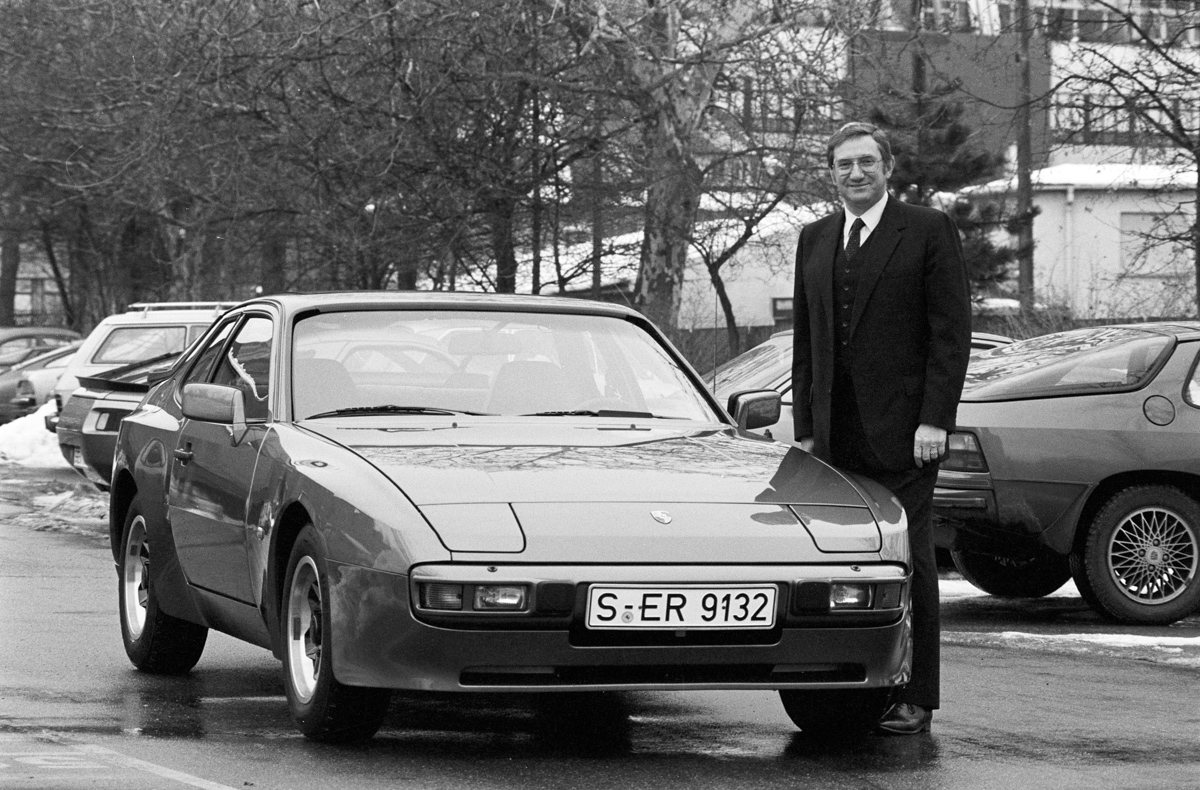
Very sad to hear that Peter Schutz has died. The 911 and its fans have Peter to thank for saving their bacon – he was the man who took over the loss-making Porsche as CEO in 1981 and famously walked into a product meeting where the 911 production graph on the wall stopped the same year. He picked up a marker and continued the line off the chart, over the desk, across the wall and out the door.
“Do we understand?” asked Peter. Those present must have got it, as the 911 subsequently went from strength to strength. The legend that is Ray Shaffer at Porsche Cars North America put some words about Schutz on his Instagram and I share them below. Ray knew Peter personally and he hits the spot nicely.
With his passing this weekend, we’ve lost a dear friend, father, husband, leader and mentor in Peter W. Schutz. He leaves this world a better place than the one he found, with his everlasting legacy and thoughtful teachings.
In the Porsche community, he was the man who invited Ferry Porsche back to his office in Stuttgart. He “saved” the 911 model and helped secure its future by championing the Cabriolet, Speedster and 959 developments and by listening to those around him – people like Porsche, Bott, Falk, Singer, Jantke, to name only a few. Peter also let the people of Porsche know their purpose by famously declaring: “as long as I am in charge of this company, we will never go to any race without the objective of winning.”
Peter was a great friend of the late Bob Snodgrass and the family of Brumos Porsche. When Bob passed in 2007, Peter was the first person to contact me. I will never forget the thoughtful letter of care and concern he wrote about how to keep the Brumos spirit alive. It became my “go to” reference piece that would serve me well during my tenure as general manager. But I was not alone. Peter was a mentor to many personally and through the pages of his excellent book, The Driving Force.
With thoughts and prayers for Sheila, Lori and the entire Schutz family. Godspeed, Peter.
Peter stayed with Porsche until 1987 and was 87 when he passed. From what I have read, he lived a great life and his work certainly had an untold impact on my career, in many ways bested only by Ferry himself. I cannot begin to describe how many lessons from Peter’s career have embedded themselves in my outlook. He was truly a unique individual.
RIP Peter: forever an unforgettable part of Porsche history.


by John Glynn | Oct 30, 2017 | Classic Porsche Blog, Modified Porsche Hot Rods
EB Motorsport has unveiled its latest Porsche project: a beautifully detailed recreation of the legendary Porsche 911R, built to celebrate the fiftieth anniversary of the R’s record-breaking 20,000-kilometre endurance speed run at Monza in Italy in 1967.
In October 1967, Porsche sent its 906 race car to Monza, to break endurance speed records. When the 906 proved unable to withstand the rigours of Monza over extended distances, a prototype 911R was called for. Driven on its own wheels directly from Stuttgart and fitted with a test engine which had already logged 100 hours of flat-out running, the lightweight R claimed five world records, including covering 20,000 kilometres at an average speed of 209 km/h. It was a memorable moment in 911 history.
“Porsche motorsport history underpins all that we do,” says James Bates at EB. “Having successfully campaigned our 3.0 RS and RSR race cars for many years before adding the SWB 2.0 race car, which then finished as first 911 home in the Spa 6 Hours, we were keen to explore the edges of lightweight Porsche racing, so the R was a natural progression.
“Our new 911R showcases everything that EB Motorsport can accomplish and is fascinated by. Built on a 1967-manufactured SWB 911 chassis, which was fully restored in-house and now tops the scales at 804 kilograms in Monza trim, our 911R is loaded with meticulous hand-finished details, from bespoke brake parts and 906-style inlet manifolds, to our lightweight doors and in-house exhaust system with megaphone soundtrack.
“We’re excited to unveil the R on such a special anniversary. Our plan is to film some souvenir footage with it before offering it for sale later this year. Many of its unique components will be also added to our historic Porsche parts product range, so people can build their own interpretations of this legendary 911.”
Having seen the EB Porsche 911R up close and personal, there is no doubting its quality. Many of the closest R recreations I have seen up to now have been a bit wavy and a little bit delicate – much like the genuine R prototype my car once shared a pit lane with at Silverstone. This one is a more substantial piece of engineering that looks every inch an all-steel 911, but shows a stunningly low number on the scales.
The 911R’s passed its MOT but has yet to be registered. As soon as the Letter of Origin arrives from Porsche, the boys will get some paperwork, tax it and then we can take it up over Snake Pass. I’m looking forward to having a spin.
Ferdinand blogs my freelance adventure with Porsche at the centre. To support the blog or engage with me in other ways, you can:

by John Glynn | Oct 28, 2017 | Classic Porsche Blog, Market & Prices
There’s been good interest in Porsche tractors at auction all year, so it will be interesting to follow this 18hp Allgaier Porsche tractor through the auction at Brooklands Historics on November 25th. Porsche tractors are a fascination to me and, while prices have still not gone crazy, their simple, honest and ego-free nature makes them a superb place to put a bit of cash in my view, especially if you have a bit of land to enjoy them on.
Having kicked off the people’s car concept with the VW Beetle, Porsche turned its focus to the land, creating a range of strong and reliable tractors for the masses. The first designs were registered in the early 1930s, but after WWII, only companies that had been making tractors before and during the war were allowed to produce agricultural machinery. So Porsche put its clever designs up for licencing and partnered with two companies: Allgaier in Germany and Hofherr Schrantz in Austria.
Produced as “Porsche System” products, more than 125,000 tractors were built under this arrangement from the 1950s until 1963. The old Zeppelin factory was used by Mannesmann, who took over Allgaier production from the mid-1950s.
The Brooklands tractor is an 18 hp, two-cylinder model from 1957. Originally supplied to an estate in the south of France, it eventually passed to a Belgian doctor in 2009, who restored it to immaculate condition and stored it in his drawing room. It was later sold to an historic racing driver and is now coming up for auction.
Brooklands estimate the tractor at £10-15k, which sounds about right to generate interest. The end result probably depends on how much activity it attracts amongst European buyers, so it could even go higher that that. I spoke to my friend, Michael Hodges, at Brooklands and got his take on the current classic market, which is broadly in line with how I am finding things.
“Things remain buoyant as far as historics are concerned, with a consistently high sales ratio. Last sale was a little down, but the market has hardened. As you know, the market has been high for a very long time. We find that classic Porsches remain good when realistically priced, but some sellers have unrealistic expectations.
“Some market commentary – generally from the less informed – is not helpful, nor accurate. Certainly, at the high end of the investment market, buyers are more cautious but it’s inappropriate to suggest that’s representative of the market as a whole.”
I am hoping to make it to Brooklands and watch the tractor go through. With 140 lots including 44 vehicles consigned for this sale, there are a few more interesting cars open for bidding, including a LHD Gen 1 GT3 in Viper Green with 39,500 kms, which is estimated at £115-140k. The sales results will make interesting additions to my Porsche Valuations database. More news from Brooklands later.
Ferdinand blogs my freelance adventure with Porsche at the centre. To support the blog or engage with me in other ways, you can:

by John Glynn | Oct 25, 2017 | New Models, Porsche News
Porsche has announced the new 911 Carrera T: a 911 that is 20 kilograms lighter than the regular Carrera, has a bunch of sporty touches and is sold in a range of bright colours. T stands for Touring, but the car is built with lightweight glass, RS-style pull loops in the doors and a shorter final drive ratio: all hallmarks of a sports purpose machine. The T badging is curious.
The Carrera S (S for Sport) does not come as standard with a shorter final drive, seven speed manual or limited slip differential, while the Carrera T (T for Touring) has all of those things. Twenty-seven litres of fuel equates to twenty kilograms. One could theoretically short fill a Carrera by 27 litres and have a car weighing the same as a Carrera T on full tanks.
The Touring Carrera also comes with less sound deadening (?), no rear seats and an unladen weight of 1425 kilograms. It has a chassis lowered by 10mm (four tenths of an inch), Sport Chrono but without the dash clock (which everyone loves and is sort of the point of Sport Chrono), a gearknob with red shift pattern, something else and some other stuff.
It has a power-to-weight ratio of 260hp per tonne. This is supposed to be viewed as exciting, and it probably is. But I have a twenty year-old BMW M3 sedan with full sound deadening and rear seats (seat belts for five people) that is not a million miles away from this figure. One could get the weight down pretty easily and stick a rocket up the power-to-weight, but that would defeat the point.
Yesterday, I drove a 911R recreation/celebration by the boys at EB Motorsport. It weighs 804 kilograms with a single seat, skinny R wheels and tyres, fully oiled up with a quarter tank of fuel. The twin-plug, 2-litre engine makes 220 horsepower, which gives a power-to-weight ratio of 275 horsepower per tonne (more on this car later).
OK, the Carrera T is £86k and the EB 911R is at least £100k more than that, but if you’re going to market something as lightweight, then it should not weigh the same as 23 people (average adult weight globally is 62 kilograms). The average weight of a (female) cow is 720 kilograms, which is two Carrera Ts. A five-foot Steinway ‘City’ grand piano weighs 252 kilograms, which means that a 911 Carrera T with some fuel weighs roughly the same as six Steinway grand pianos.
“Improved power to weight ratio delivers enhanced performance,” says Stuttgart, and no doubt the 0-60 time of 4.5 seconds – one tenth quicker than the standard Carrera – is quicker than a baby grand, unless the piano is travelling downwards in a straight line towards the pavement. I also like the cool range of colours including Racing Yellow, Miami Blue and Lava Orange: difficult to choose between those three. But something is not right with this T badge.
Everyone knows that the volume sellers are where Porsche makes its money: Macan, Cayenne and Panamera. The 911 remains a desirable car, but are these editions serious, or are they just preening for press releases? The truth is that, these days, if you really want a lightweight Porsche – and trust me, you do – you have to build it yourself. For the £85k cost of a standard Carrera T, one could easily build a lightweight air-cooled 911 and have enough left over to buy a nice grand piano or two. Now that’s an idea I can get with.
The new 911 Carrera T is available to order now from Porsche Centres in the UK and Ireland priced from £85,576.00 RRP inc VAT. First deliveries begin in January 2018, at which point, journos will be freaking out over the transformative effect of the shorter final drive and claiming this as a credible alternative to a GT3 Touring.
News update: my 1976 911 has a shorter final drive, as does every 911 rally car ever. When the national speed limit of 70mph is being ever more rigorously enforced, it is not rocket science to shorten the final drive and have more fun getting to a lower top speed.
I would like to drive this T: I suspect it actually will be rather more invigorating than a standard Carrera. Group test pitch for GT Porsche magazine: my 1020-kilo 3-litre 911 versus six grand pianos with 370 horsepower. Simon will love it.
Ferdinand blogs my freelance adventure with Porsche at the centre. To support the blog or engage with me in other ways, you can:


