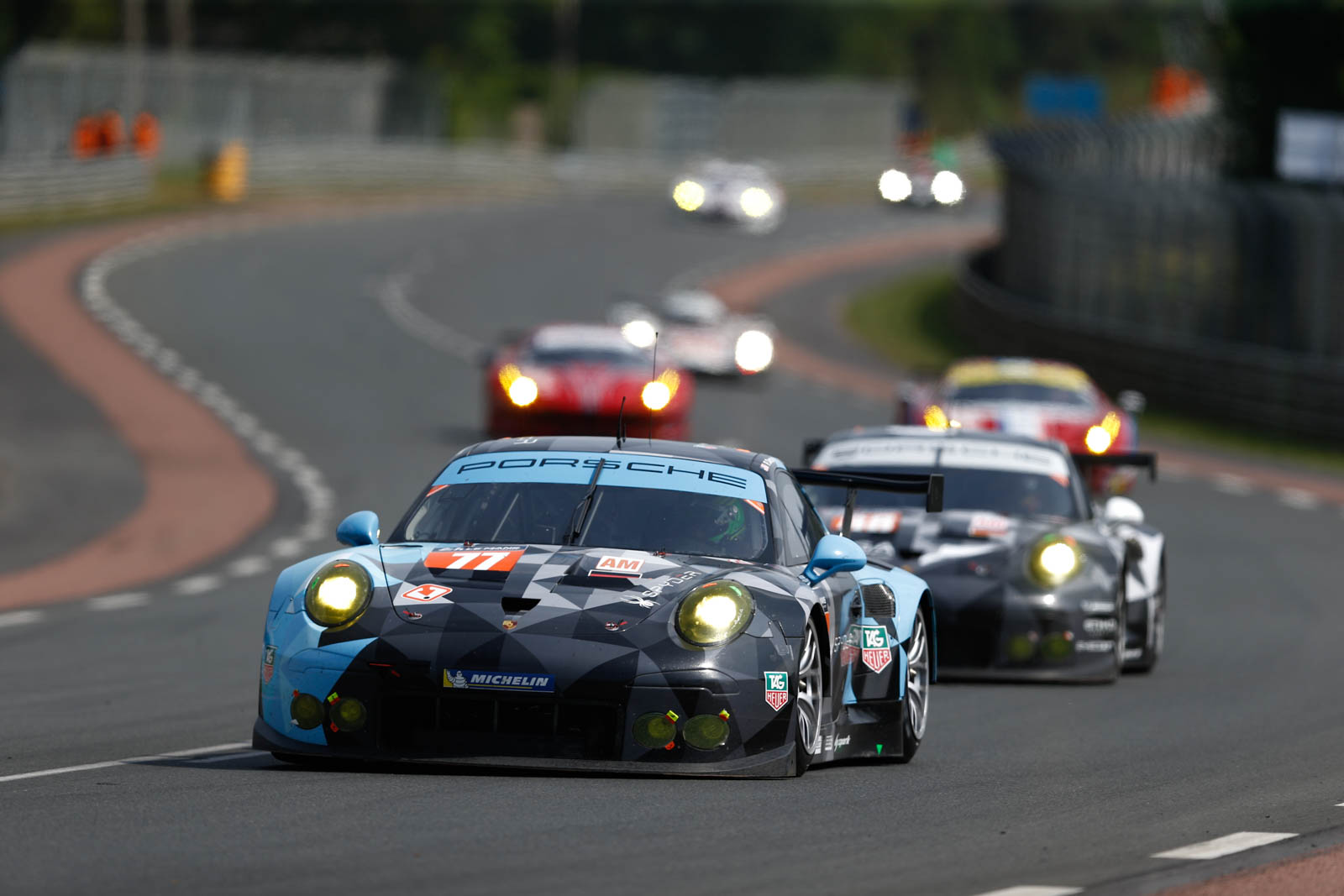
Following an incredible day of absolutely flat-out racing at the historic Le Mans circuit, Porsche claimed an emphatic win in the 2015 Le Mans 24 Hours. Perhaps most incredible of all was that the winning drivers were the three LMP1 rookies: Nico Hülkenberg, Nick Tandy and New Zealand’s Earl Bamber.
Hülkenberg was the man who took the chequered flag for Porsche. As rain descended upon the Circuit de la Sarthe for the final fifteen minutes of racing, hearts were held in mouths as we waited to see if the rain would increase sufficiently to require pitstops for rain tyres.
In the end, the most extreme precipitation came only from the eyes of works drivers, Porsche Racing team personnel and Dr. Wolfgang Porsche himself, who had joined Porsche CEO, Matthias Müller, in the 919 garage. Rounding Arnage with less than a minute remaining, Porsche number 19 slowed to a crawl to prevent another lap at racing speed in the mist, crossing the line in first place after 24 hours and 24 seconds of racing.
The emotions hit home as 919 LMP1 Hybrid number 19 rolled underneath the chequered flag to claim Porsche’s 17th overall win at Le Mans: Hülkenberg breaking into tears of joy over the radio in a moment that obviously resonated deeply for the F1 driver who had stuck his reputation on the line this weekend.
“I am speechless right now to be honest,” said Hülkenberg. “To come here on my first attempt and end up on the top step: I am super super happy and also very happy for Porsche. We are incredibly proud that Porsche is back at Le Mans. We couldn’t expect to come here on our first time and win this: the car was reliable, we made no mistakes and that is what got us the top prize this weekend.”
“I couldn’t think of two guys I would rather share this car with,” said a tearful Nick Tandy in the winners’ arena. “We’ve run here not just for 24 hours but we’ve done the test here, two weeks ago we did the complete practice; we haven’t put a mark on this car, all the guys have not made a single mistake.
“We’re stood here talking to you guys (Eurosport) because we’ve just won the biggest race in the world. I could retire from racing tomorrow and I could look back on today and I’m sure I’d be happy for the rest of my life: I can keep this video for all my family forever. Many people don’t get a chance to race in this event, let alone get a chance to come here and win. I’m very, very happy.” Tandy’s expression started wobbling here and I was starting to go also. What huge emotion and what a mega drive.
Earl Bamber, Nico Hulkenberg and Nick Tandy took their victory exactly 45 years to the day after Porsche’s first win at La Sarthe. This was a 1-2 for Weissach, as Bernhard, Hartley and Webber took second place in the number 17 919. Further behind the LMP1 cars, Patrick Dempsey, Patrick Long and Marco Seefried took second place on the podium in GTE-Am: an extraordinary achievement for the team.
“It’s hard to put into words what this means,” said Pat Dempsey, also welling up before getting on the podium. “What the effort was and the support we got from everybody to make it possible to be here. The team did a great job in all the pitstops, and Patrick and Marco drove beautifully through the whole race and into the night when it was really tough.
“Patrick’s been pushing me and coaching me all year and putting me in every kind of crazy car I could get into. It makes a big difference to be here and now, to be up there (eyes podium) is definitely a dream come true. This is what we were focusing on all year.”
This is all just sinking in at the minute: no doubt more details will emerge when the drivers get a chance to tell their stories. Can’t wait to hear from our heroes but until then, well done to the entire Porsche Racing team! This is a dream come true for us all. Here’s a Porsche video from the start of the race: who would have thought that the rookies could do it?!
A pair of Tuthill-built Porsche 911s is competing in the 2015 Trans-America Challenge: the SWB 1965 Porsche 911 of Gavin and Diana Henderson (above) and the LWB 1973 2.5-litre car of Peter and Zoe Lovett (below).
Rally news updates paint a promising picture. The Road to Mandalay Rally-winning Lovetts are in the top three, while the experienced Hendersons have already claimed their first regularity challenge win. Both cars are running reliably.
Also in the rally is a Tuthill joint project: the Porsche 912 of Mark and Colin Winkelman. The body and interior was built by Tuthills, with the drivetrain and final assembly put together by Hayden Burvill at WEVO in San Francisco.
I haven’t shared the cars here as yet, as my ear gets bent if I put all the good workshop stories on Ferdinand, but all three are perfect examples of the ox-strong resto-rally 911s with creature comforts that Tuthill Porsche puts together so well. I’ll sort some pictures out and share them here later.
2015 Trans-America Rally
Organised by the Endurance Rally Association, the Trans-America Challenge takes place from June 7-28, 2015. It is the second running of the Trans America enduro, following the inaugural rally in 2012. Today was a rest day after three days of driving that has taken the entrants as far as Quebec.
The route for the three-week event runs across North America. Starting from Nova Scotia on the Atlantic coast, forty five entrants from all over the world travel through Eastern Canada before crossing the US border and driving through Vermont, New Hampshire and upstate New York.
Once in NY, they approach the Great Lakes, briefly returning to Canada just south of Toronto before hitting Michigan, Wisconsin and Minnesota. The vast Dakotas are next (North and South), then the teams take in Wyoming, Idaho and sunny Nevada before landing in California, en route to the finish in San Francisco.
Porsche Trans-America Road Trip
I’ve done a Porsche road trip through New York, Vermont and New Hampshire. Our Rolling Stone Targa feature on Karl Donoghue’s cool R Gruppe Porsche 911 Targa and the Bethlehem Porsche 911 ST backdate story both came from that trip. The roads in this part of America are good fun to drive on, especially with mates alongside, and there is great character in the landscape. I’m interested to hear what the competitors say at the end, as it seems an interesting route across the continent: a journey I hope to make myself in a Porsche 911 on my half-century (not long now).
Game Girls Galore in Trans-Am
One other friend on this event is former McLaren team boss, Alastair Caldwell, of Porsche 912 on London-Cape Town rally fame. I recently bumped into Alastair at the Tuthill Porsche workshop with his SWB 912 rally car, but he decided against shipping the 912 to Canada. Instead, he’s running a beautiful 1963 Rolls Royce Silver Cloud II across America, with mum Dorothy as navigator.
Now a spritely 97 years old, Dorothy has competed in a number of previous rallies and thoroughly enjoys the experience: no doubt the craic is good in Canada tonight. AC reckons she has the best room at the palatial hotel they’re staying in for the rest day. Rightly so: she deserves it!
Pictures courtesy of Gerard Brown/Endurance Rally Association
Porsche Motorsport has launched the all-new Porsche 911 GT3 R at the Nürburgring 24-Hour. The new 991 GT3 R joins the current factory race car lineup of 919 LMP1 Hybrid and 991 RSR, and the customer 991 Cup, which is built on the Stuttgart production line.
Based on the 991 GT3 RS, the 991 GT3 R comes with a four-litre flat-six making 500bhp and costs an impressive €429,000 plus VAT: almost $500,000 plus applicable taxes, according to fxtop.com. In comparison, the 991 Cup (GT3 based) with 460bhp from its 3.8-litre engine costs just €181,000* plus tax. So what do you get for your half-million dollars?
“In developing the latest 911 race car, special attention was paid to lightweight design, better aerodynamic efficiency, reducing consumption, improved handling, further optimised safety as well as lowering service and spare parts costs,” says the Porsche press release.
That lightweight design starts with aluminium, carbon fibre and polycarbonate: all the glazing – including the windscreen – is now polycarbonate (EB Motorsport sells a similar polycarbonate windscreen for early Porsche 911s if you’re in the market). The roof, front panels, doors, rear quarters and tail section are all carbon fibre.
Lowering body and suspension weight across the 991’s longer wheelbase (83mm longer than a 997) means an ‘optimised’ centre of gravity has been achieved. I presume that optimised means lower and further forward than the 997: no doubt one of my race engineer friends will fill me in on this over a beer some night.
One big change on the new GT3 R is a move to a centre front radiator. Anyone who has watched Supercup racing at Monaco knows that even a small hit to one front corner can wipe out a radiator and then a race motor too, as the damaged car limps back to the pits with soaring engine temps.
Going to a centre rad (as seen on older Porsche 911 race cars with centrally-mounted oil coolers) helps airflow and aerodynamics too, allowing more control of the hot air beneath the front wings and around the front axle. The 991 GT3 R brings in the same front wing vents from the 991 GT3 RS to reduce front end lift, but then the 997 GT3 R also had front wing vents: not a great deal is different.
Brakes at 6-piston 380mm front/4-piston 372mm rear are the same as GT3 Cup, and the wheels are also the same 310mm width at the rear. Paddle shift of the six-speed sequential transmission, direct injection, variable valve timing, 120-litre fuel cell: it’s all as one would expect from a top-flight Porsche racing car costing £370,000 including VAT.
Deliveries start in December this year, so we won’t see the Porsche 991 GT3 R on race tracks before 2016. How competitive will it be? That depends on who decides to run it, and what the competition does in the meantime. See below for some Porsche video of the new 911 GT3 R in action.
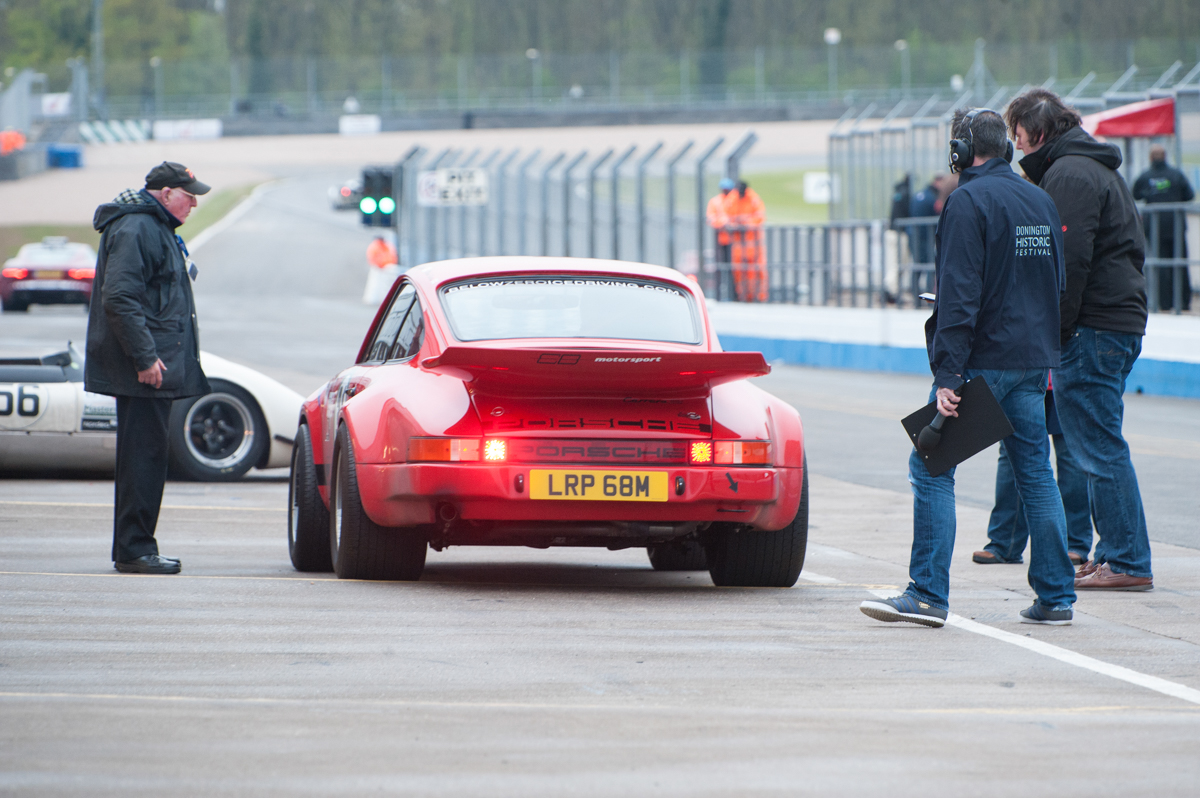
Had a great day at Donington yesterday with Mark and James Bates of EB Motorsport, who were racing their 3.0-litre Porsche 911 RS in the Donington 1000kms event. It was not the best day ever for Porsche motorsport on the whole (Spa 6 Hours thoughts to come), but we did enjoy an exciting, well-organised race at a great venue.
Historic racing is an expensive business. Forget about buying and building the cars for a moment: just to take part in a decent event costs upwards of £1000. This covers the entry fee for a car and one driver, but does not always include a second driver, garage space or catering. It does not cover tyres and fuel, it does not cover insurance and it definitely does not include wear and tear or breakages, which on older cars can be highly significant.
The Donington 1000kms was part of the 2015 Donington Historic Festival. Organised by the Swiss-based Historic Motor Racing, the race is one of a series of endurance events run by the company all over Europe. As the EB brothers are putting in a shorter race season this year due to work commitments, more Porsche projects and a new baby for James, the 1000kms schedule of ‘qualify in the morning, race in the afternoon’ was perfect: they could rock up early, get the car ready, qualify and chill out for a bit, then have two and a half hours of racing before heading home.
First job of the day was to scrutineer the car. Slight issue there, as someone forgot the Porsche 911’s FIA Historic Technical Passport. We had a word with the people in charge and, as the car still had its barcodes from the last event, the engine was FIA sealed and the 911 was running in an invitational class and would not score points, we were allowed to take part.
Porsche 911 3.0 RS vs Prototype Racers
Qualifying went well. On a grid packed with prototypes, the single exception – EB’s 911 – went 14th quickest on new post-historic tyres that have only been tried on the team’s yellow 911 RSR for a couple of races so far. While the compound might be a bit slower than previous rubber, the tyres are huge, so the increased width gave excellent grip. We were still almost ten seconds off the pace of the leading Lola T70.
Racing is a very social affair, so there was plenty of craic in the paddock between quali and the race. Our garage was shared with a Chevron B8, Elva Mk8 and a Lola T70 Mk3B. A Lola T70 for sale must be £750k now, Chevron B8 for sale would probably be £200k and similar money for an Elva. Despite there being well over a million quid parked in our garage, the atmosphere was just the same as if all were in cheap track day specials. People dropping in and chatting, bit of banter from previous track outings and one or two compliments for Mark, following his performance in EB’s SWB car at the 73rd Goodwood members meet. He will henceforth be known as “The Sultan of Slide”.
The race was slightly delayed, which gave time for the weather to change and the rain to move in. The boys split the race into two equal parts: James took the start on a slippery circuit and had brought the car up to seventh by the time of his pitstop. With 100 litres of fuel in the tank at the start and the lack of grip keeping speeds and fuel consumption lower than expected, Mark decided to gamble on that being enough to finish the race, avoiding the mandatory 3-minute minimum time for a fuel stop.
As Mark started his stint, the rain stopped and a dry line began to appear. The pace hotted up: 911 lap times falling from the high 1:30s in the wet to an excellent 1:17.9 at one point: quicker than qualifying. Ambient temperatures were very cold, so the rest of the track stayed damp and slippy, leaving a treacherous no-mans-land for anyone who had to go off line to make progress. After two and a bit hours of racing, Mark had no choice: he pitted for fuel and the three-minute stop to go with it. This cost us the best part of two laps and we were out of the top ten.
As the race entered its final lap, we had news that, while fighting for the lead, our garagemate – the beautiful Lola T70 (above) – had passed a backmarker on the damp part of the track through the fast downhill Craner Curves, lost traction and hit the wall at high speed. When the car was brought back, it was not the best sight, but owner/driver Leo was safe and well. At times like this, no one worries where they’ve finished: it’s just good to get home in one piece and live to fight another day.
Interesting story on Gizmag this morning about how Porsche has patented a new type of variable compression ration engine technology. Partnering Porsche in this venture is Hilite International, already a long-standing client at Porsche Consulting.
Variable Compression Ratio (VCR) is a prime candidate for the next big step in internal combustion engine efficiency. It is particularly suitable for turbocharged engines, and we know that all 911s will adopt turbocharged engines over the next few years, alongside the many turbocharged model variants in the Macan, Cayenne and Panamera ranges already produced by Porsche.
Compression ratio is critical to performance, and is of particular importance on turbocharged engines. Turbos work by compressing the intake charge of air and fuel before ramming it into the combustion chamber under pressure. Because a turbocharger is powered by exhaust gas, and therefore is not always running at peak boost, the amount of fuel/air mix entering the cylinder varies from low volume when the turbo is not spinning to maximum volume when the turbo is running at peak revs. Turbocharged engines must therefore run lower compression ratios, to allow that higher volume at peak boost. This costs them power.
Why use Variable Compression Ratio technology?
One way to increase the efficiency of a turbocharged engine would be to constantly adjust the compression ratio, giving higher compression off-boost, and reducing the compression as boost pressure rises, to prevent detonation. The Porsche system (top) is clever, planting the piston on an eccentric mount that is automatically adjusted by control rods, which swivel the piston up or down on the crankshaft connecting rod depending on oil pressure, thus controlling the compression ratio.
Compare this solution to the nicely engineered but complex solution developed by MCE over the last decade (above photo shared under ‘fair use’), and it is perhaps easy to imagine how this new patent might better suit volume manufacturing, delivering less risk to reliability. It is also highly licensable technology: something which Porsche has done very well from over its history. So, even if the technology never makes it into a Porsche, it could be shared commercially with a wide range of other end users.
Bravo Porsche engineering! We look forward to seeing a fully developed version of this system come to production, and to experiencing the benefits on the road.
To read more of my work, commission my valuation expertise or hire my content generation skills, you can:
This website uses cookies to improve your experience. We'll assume you're ok with this, but you can opt-out if you wish.AcceptRead More
Privacy & Cookies Policy
Privacy Overview
This website uses cookies to improve your experience while you navigate through the website. Out of these, the cookies that are categorized as necessary are stored on your browser as they are essential for the working of basic functionalities of the website. We also use third-party cookies that help us analyze and understand how you use this website. These cookies will be stored in your browser only with your consent. You also have the option to opt-out of these cookies. But opting out of some of these cookies may affect your browsing experience.
Necessary cookies are absolutely essential for the website to function properly. This category only includes cookies that ensures basic functionalities and security features of the website. These cookies do not store any personal information.
Any cookies that may not be particularly necessary for the website to function and is used specifically to collect user personal data via analytics, ads, other embedded contents are termed as non-necessary cookies. It is mandatory to procure user consent prior to running these cookies on your website.