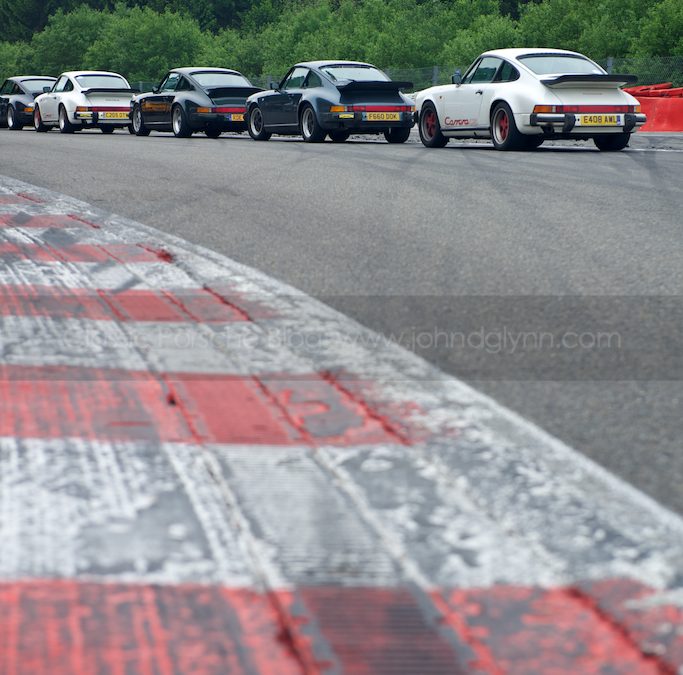
A lot of classic Porsche owners renew their insurance at this time of year, to coincide with MOTing the car and taxing it for the summer season. It’s no surprise that I’m currently getting a lot of emails about insurance valuations and a few more about personal pre-purchase inspections, to get the best idea possible of condition and value.
Some insurers will insist on knowing the valuer has inspected the car before giving an opinion. Check your insurer’s policy here: it’s one reason people sometimes use their servicing garage for valuations. Only problem with that is insurers usually insist the valuer is independent of the car, with no commercial links to its history.
I’m in the UK Midlands but valuations can still involve hundreds of miles, so I treat them almost as full pre-purchase inspections. I always advise that pre-purchase inspections are carried out at a Porsche specialist service centre, where an experienced technician can get a car on a lift in the dry and have a good poke around.
Specialist sellers sometimes get funny about letting another mechanic under their cars, and that’s usually when I get a call to go take a look. I report on general condition, have a drive and decide whether I think the overall purchase makes sense.
One inspection last year on a grey Porsche 964 was a good example of why to inspect before purchase. The seller’s premises did not inspire confidence, the car was in an unloved state and even broke down on the test drive! When I had to get out and push it away from a set of traffic lights, the guy who accompanied me stayed sitting in it.
Inside the car was soaking wet: it really was not nice. At the end of the drive, the seller asked what I thought. I asked about a much nicer car that was parked nearby. They were asking silly money for that, so I got straight on the phone to my Spanish-based client.
I’ve got over twenty five years in the motor trade, have written dozens of buyers’ guides based on my trade buying past and have a lot of experience looking at Porsche. Drop me an email if you need help with values, or a quick inspection to sense check a purchase. Do try to get a specialist Porsche garage to PPI your prospective purchases – most will do this for under £200.
Porsche 911 997 GT3 models with centre lock wheels built between February 2009 and April 2010 were recently recalled for an issue with the rear wheel hubs and bearings. Transport authority notices note that “in rare circumstances, the wheel hubs and wheel bearings on the rear axle may break. If the rear wheel hubs and bearings break, the driver may lose control of the vehicle and create a hazard to the driver and other road users.”
Porsche representatives have allegedly told other mags that hubs and bearings “don’t break” and are being replaced “to standardise the revision intervals”. But owners discussing this in a Rennlist thread note that Porsche Cars NA has been telling owners not to drive their cars until the replacement has been carried out.
A number of owners on GT3 forums have shared how their hubs did break, causing their cars to go out of control. Something else to check if you’re in the GT3 market and another big reason to buy from a Porsche 911 GT3 specialist. This video below shows what happened when one owner’s hub gave out at speed on the Nurburgring. Much harder treatment than the majority of owners will ever give their hubs, but still pretty scary when you know what is coming!
On my travels to Autofarm last week, Josh and I got talking about a 3.2 Carrera Club Sport that was sitting in the corner of a barn. I didn’t recognise the registration, but it looked a smart car: totally standard in very good nick.
“See if you can spot what’s wrong with it,” invited Josh. Having served my time as a buyer for retail car supermarkets and also for a major UK fleet company, I’ve bought more cars than most other folk I know so I was sure this wouldn’t take long. After two minutes looking around the outside, I couldn’t find much to whinge about.
“The driver’s door gap looks too good,” I offered. Turned out this was right: there was nothing wrong with it. The Club Sport is owned by Porsche author, Gordon Wingrove, and was famously featured in one of the mags as an accident repair on one side a few years back. Can’t remember who did the repair, but it’s flawless: as you would expect from a man who wrote a 3.2 technical book.
With just 27,000 miles on the clock, this is a special Club Sport. The model has its detractors, who love to point out it’s a basic Carrera 3.2 with a lighter interior and a blueprinted engine, but those who have driven one know there’s something else. Josh has heard all the Club Sport knockers but, as he asks: “What else is there from the 1980s? This is it.” I reminded him of the 5-speed 930, but essentially agree on the affordable/available 911 road car side. There’s plenty of front-engined Porsche stuff from that era I’m keen on, but they’re not rare-bird 911s and the SC RS and 959 hardly count.
Coincidentally, two days later I was asked to do an agreed insurance valuation on another 3.2 Club Sport, one I’ve seen a few times. I had talked money with Josh and he thought Gordon’s would be into the seventies. Not sure I would go that strong for January but I referenced his and a few more for mine.
What’s the forecast for Club Sport values? I think pretty steady, trending very slightly upwards to match the base model. There were circa 50 RHD ‘Clubbies’ made and standard Carreras in the very best condition are £30k+ now. So a factory hot rod in tip top notch has to be where Josh is pitching it. Try replacing a Club Sport after total loss: that’s not going to be pleasant.
Here’s one to watch for if you’re looking at Porsche 996s for sale: rust around the door latch mounting points.
This is a common problem on earlier cars, but I didn’t think was that bad on later cars with arch liners. But while older cars rust from the back of the latch to the front, starting inside the wheel well, these cars are rusting from front to the rear. It’s pretty common on the 996 and does tend to come from the front. Early 996s get it worst: on models pre-2000, prob 30% of them have this and some pretty badly.”
You could rub this particular case down and paint it, but if Porsche rust repairs are not done properly, they will always come back. The big question is where else is rusting? If it’s happening here, the rest is at risk, too. Put it on your checklist.
The second pic shows ongoing body repairs on a Porsche 964 bought by a customer as accident damaged, with new front wings replacing rusty ones and good quality second hand parts used in a few other places. Looks a bit patchwork at present, but is heading off to paint later on.
Googing & Company just brought a record price for a Porsche 718 RSK at their sale in Scottsdale, Arizona. Running Friday and Saturday, January 18 & 19, the auction got the year off to a flying start, with some excellent results in the sale hall.
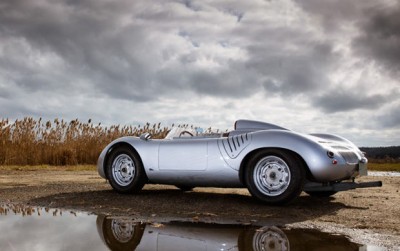
There was plenty of Porsche content scheduled. The most rarified Porsche on the programme was lot 112: a 1959 Porsche 718 RSK Spyder, chassis number 718-023. Number 023 is one of 35 RSKs built at Stuttgart, and is a matching numbers car with its original body. The history was unbelievable: huge detail available and most recently owned by a prominent New York collector.
Gooding wrote a terrific description and advertised the sale everywhere: likely instrumental in the impressive end result. Estimated at $2.8M to $3.2M, the car was greeted by some excited bidding, quickly shooting up from the early $2m mark to looking like a sale at $2.6M. But no – there was still life left at that stage and it went on to finish at $3.135M: a record price for an RSK at auction.
I love auctions and miss that sale hall buzz when watching Gooding’s excellent Internet stream. Gotta get to a few more sales this this year: I’m guessing Essen will be my first of the season.
This website uses cookies to improve your experience. We'll assume you're ok with this, but you can opt-out if you wish.AcceptRead More
Privacy & Cookies Policy
Privacy Overview
This website uses cookies to improve your experience while you navigate through the website. Out of these, the cookies that are categorized as necessary are stored on your browser as they are essential for the working of basic functionalities of the website. We also use third-party cookies that help us analyze and understand how you use this website. These cookies will be stored in your browser only with your consent. You also have the option to opt-out of these cookies. But opting out of some of these cookies may affect your browsing experience.
Necessary cookies are absolutely essential for the website to function properly. This category only includes cookies that ensures basic functionalities and security features of the website. These cookies do not store any personal information.
Any cookies that may not be particularly necessary for the website to function and is used specifically to collect user personal data via analytics, ads, other embedded contents are termed as non-necessary cookies. It is mandatory to procure user consent prior to running these cookies on your website.