After the week just finished, it was a relief to snatch a few hours off this morning and point our Porsche Cayenne’s nose towards Warwickshire, to collect another load of bricks for next year’s garage build. The way this thing hauls a trailer full of reclaim bricks is incredible, making century-old bricks my latest eBay obsession.
So far in November we’ve had a painful VAT return, slow going on the building front and a ton of catching up on copywriting, but Wednesday night took the biscuit, with a call from Mrs G to say someone had crashed into her sweet little CR-V. I drove to the scene to find a head-on smash between CR-V and builder’s van: CR-V destroyed and wife in some discomfort. The CR-V had done its job well, deploying ample airbags and absorbing a pretty big hit, but an ambulance ride and a long night in the emergency department followed.
She’s off work for a few days while aches and pains subside. We freelancers can’t stay home forever, so the next problem was what car to stick her in when she’s feeling up to it. The Cayenne has proved so good that I’ve sold my ‘spare’ cars: Subaru, MX5, M3 about to go and Landcruiser will be next. Obvious write-offs like this usually settle fast, so there seems little point in a courtesy car. Off to eBay I went, looking at alternatives.
Nothing good on eBay, so I decided to stick her in the M3 for a few days and buy another SUV when the insurance cheque arrives. That decision made, I spent Thursday evening in college a little burnt out, emerging back into the winter chill at 10pm to drive home. Sliding into the Cayenne, it started with a misfire. Not too unusual when damp, a slight misfire from cold usually clears. Ten miles later, the miss was just the same. I texted a Cayenne mate “Misfire. Coil packs?” Consensus this was likely culprit. I’d order a new one next day, as I couldn’t have another car go down.
Next morning was just as cold, and the miss was just as wrong. I ordered eight coil packs and a set of plugs. Dropped the kids at school and drove the fifty miles on seven cylinders. Still managed to top the ton, though. No limp-home mode on Cayenne. I stuck the Cayenne on a friend’s Porsche PIWIS, which showed cylinder number three was misfiring. Time to take some bits off.
Getting to Cayenne coil packs is not too tricky. Top engine plastics come off when the engine support is removed: it’s a bit of simple spannering. Number three coil pack had quite a long crack, and more than one other had the same. The plugs were not over tight and looked a bit worn, so new ones would give it a boost. I also ordered wiper blades – been meaning to for weeks.
The plugs and packs didn’t arrive until late afternoon, so it was dark by the time I was finished. My cross-country drive to avoid the Friday night motorway traffic was a revelation – transformed the Cayenne from an impressive 4×4 needing Tiptronic downflicks to press on, into a rev-loving mega beast, attacking all comers.
We ripped up more Tarmac than a truckload of road protesters and I’ve been looking for cane-it opportunities ever since. Pizza run last night, brick run today, failed brick run yesterday: all good fun. Tickover is now smoother than the aforementioned prom queen’s anatomy: everyone needs a Cayenne!
Apart from my wife that is, as I just bought her a bargain Skoda Fabia TDI estate to run around in while we’re waiting for the next thing. Turned out the seller also owned a 993 and was considering adding a Cayenne. It’s a small Porsche world, you know.
SHARE • EXPLORE • SUPPORT
Ferdinand blogs my freelance adventure with Porsche at the centre. To support the blog or engage with me in other ways, you can:
An interesting conversation tonight about WEVO’s 915 GateShift kit versus the classic WEVO shifter.
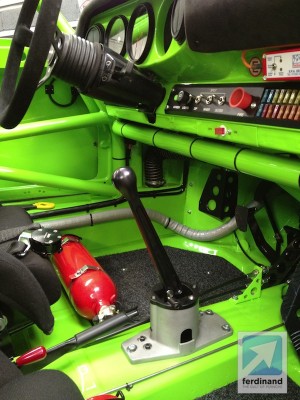
After years of using a WEVO shifter in my own 911, I recommend the beautifully engineered WEVO shifter as the number one upgrade on any impact-bumper Porsche 911 running a 915 transmission (seen below on a Tuthill rally build). Surprisingly, the man who invented, designed and manufactures both products says different.
“At Windrush, we say the best upgrade for the 915 is the internal gate of the WEVO GateShift kit”, says Hayden Burvill. “The internal architecture of the 915 is such that extra control of the shift rail mechanism can greatly reduce the risk of a potential missed shift.
“Chassis twist, drivers hanging on the shift lever and the unmanaged freedom of the internals of the 915 mean that you can mis-select gears without feeling any real tactile warning. The GateShift kit (below) installs a “spoiler” between the gear planes, creating an obstruction that will warn you that the gear you are heading for is not here! You stay in neutral, not selecting a potentially destructive ratio.
“The driver with a steady hand and smooth shifting style will hardly notice it is there. It’s dormant: only coming into effect when you inadvertently cut the corners of the shift pattern.
“For those who have driven with the GateShift kit, I believe very few would ever build another 915 without one. We drove ours for a long time with a completely stock shifter, only the stock coupler had new round hole aftermarket bushes. It was wonderful, we have since added a WEVO 915 Classic Shifter (base detail below), mostly for the reduced lever travel.”
Quite the revelation. Turns out you can also fit WEVO’s GateShift without removing the transmission. You learn something new every day! Despite Hayden’s wisdom, I still place my shifter at the top of the upgrade list, and have never felt the need for a GateShift. But, were money no object, I would have the WEVO lot!
SHARE • EXPLORE • SUPPORT
Ferdinand blogs my freelance adventure with Porsche at the centre. To support the blog or engage with me in other ways, you can:
I’ve had a good week of car sales, with my MX5 and Subaru Outback going to new homes quickly on eBay. I’m selling as too many cars and two home extensions eating cash! The MX5 needed a decent polish before departure, and I’d set today aside to get stuck into it. The weather was excellent, so I did it outside the back gates.
My M3 (above in MOT last weekend by Rob at Racing Restorations) was hurriedly polished after its respray last year and it looks crap. I had a few run-ins with the paint shop we used during and after the work, so I decided to sort it myself. I’m no stranger to polishers, having started my career as a valeter. I have an air-powered CP dual action sander/polisher, but air is a pain to polish with, so I went hunting for an electric machine.
I eventually nabbed an almost unused DAS Pro 6 dual-action polisher kit with Mezerna polishes on eBay and stashed it with a bunch of pads and other compounds in the garage. Not paint corrected the M3 as yet, but I dragged the DAS 6 Pro out for the Mazda this morning.
Our Miata is solid Mazda Red, so had oxidised quite a bit over the summer. It took about two hours to compound it using the dual action machine polisher, a foam pad and Meguiars Ultimate Compound, before finishing with hand-applied Zymol glaze. It came up an absolute treat: so good I felt like keeping it! The new owner will adore it for sure.
The MX is not leaving until next week, so I put that away under cover. The sun was still lovely, so I dragged out the hosepipe and washed the Cayenne, which has been doing sterling service shifting all sorts of building materials, with the trailer and without.
It’s the first time I’ve washed the Big Pig myself and it came up OK, but I was reminded of numerous marks in the paint. In its previous life, my V8 had vinyl signwriting over it, and there was still some vinyl adhesive and a lot of rub marks where solvent was used to shift glue. I’ve been meaning to sort this since buying it. It was time to hit the Cayenne.
I dried it with compressed air, a Meguiars water magnet drying cloth and some microfibre towels. I decided not to clay the paint, just wiped the panels down with Autoglym Intensive Tar Remover, which also removed the last bits of vinyl adhesive. It’s good stuff.
I had forgotten what a relief it is to abandon the phone and Internet and just escape into cleaning a car, so the job was quite enjoyable. I tried a few different polishes on the Basalt Black metallic paint, eventually settling on Menzerna Fast Gloss FG500 with a hard foam polishing pad as the best combination.
I used Farecla G3 scratch remover on a separate hard pad for the longer scratches down the NS (from hedges down our country lanes), and also for fingernail scratches around the tailgate release and driver’s door handle. The tar remover did a good job taking wax off where the DA caught the edge of plastic trim: no need to mask off the edges etc as I wasn’t going too hard and the dual action polisher is quite safe.
I didn’t go all-out for a perfect finish – I was working outside with just an afternoon’s worth of light and no clay treatment, so not much point – but the Fast Gloss on a moderate polisher speed gave a great finish quite easily. Once buffed with some microfibres, I topped it off with hand-applied Dodo Juice Blue Velvet hard wax, specially made for dark paint. Just put it on with your hands and wax off with a soft terry cloth.
I’m not going to turn this into a Detailer’s World anorak photo fest: you’ll have to gauge the shine from my iPhone pics. I’m really delighted with the result: thumbs up for the DAS 6 Pro Dual Action polisher and having a load of different polishes to try. Excellent!
SHARE • EXPLORE • SUPPORT
Ferdinand blogs my freelance adventure with Porsche at the centre. To support the blog or engage with me in other ways, you can:
“Oh John, it’s not a real one”, called 911 rally mechanic Adam as I ran off for the Cayenne on a recent Tuthill Porsche shoot. I needed something to stand on and, in the absence of a stepladder, an SUV roof would do.
More than ten years after the Cayenne’s debut, Adam’s teasing is typical of many Porsche fans, but for sure this car is a real Porsche. It might share a platform with the Volkswagen Touareg, but then most modern cars are built using shared platforms.
Is a Golf less Volkswagen for sharing platforms with Audi and Skoda? Cheaper cars share more components than Touareg and Cayenne, but no one gives the Golf a hard time, or knocks the A3 for costing three to five grand more. Bits shared between Volks and Porsche on the big SUV platform are inconsequential. Air con ducts, ABS sensors, some airbags, seat belts, door latches. Who cares about this stuff? The heart and soul of this Big Pig is what matters, and V8 Cayenne has got it going on.
I recently picked up a copy of the book “Porsche Cayenne” by Clauspeter Becker and Stefan Warter. Dating back to 2002, it’s a glorified brochure, telling the story of Cayenne development using previously unseen pictures from the Porsche library. Some of the text reads straight from press release, but the pictures are really excellent: well worth my £8 on Amazon versus £45 on eBay.
The book zooms in on Porsche engineering and pre-release testing for the shared platform, of which there was plenty. Engine development gets its very own chapter. The Cayenne V8 was developed from scratch by Porsche to suit SUV purposes, so it’s compact – less than 600mm long for a 4.5-litre V8 – and powerful, with a mega-flat torque curve running maximum torque of 420 Nm all the way from 2,200 rpm to 5,500 rpm.
Count me impressed by the three-pump oil system, which is designed to work on inclines of 100 percent. Sit the car on the tailgate and the engine will keep running: try that in lesser machines. The closed-deck engine block features additional cast iron bottom-end bearing seats as developed for the 928, which also make the engine smoother and quieter. Lots of quiet engineering in this car.
The Cayenne’s cylinder heads follow classic 911 design. The heads are two-part: lower is the water-cooled combustion chamber and intake/exhaust ports, while the top houses the camshaft and tappet guides. The camshafts run with variable timing: hydraulic controllers shift the inlet cams by up to 50 degrees versus crankshaft rotation.
Timing chain diagrams are pretty amazing: a huge duplex chain running four overhead cams, with a second single-row chain driving those three oil pumps. It would be interesting to see timing chain ramp wear after 150,000 miles or so. I’ll be watching for that opportunity, but have already driven a 250,000-mile Cayenne with a silent V8 engine, so not holding my breath.
The Cayenne V8 engines are built in Stuttgart-Zuffenhausen before shipping to Leipzig for installation. Cayenne not a real Porsche? Makes me laugh!
SHARE • EXPLORE • SUPPORT
Ferdinand blogs my freelance adventure with Porsche at the centre. To support the blog or engage with me in other ways, you can:
Finally managed to synchronise my amigos in sunny California, and had my project 1976 Porsche 912E roller moved to its new home for the next few months at Porsche specialists, The Stable in San Francisco.
Formerly owned by Alan Klingen, The Stable is now managed by our good friends and long-time Porsche technicians, George and Brian. The guys have widened the range of Porsche servicing to include Boxster and 996 as well as the 356 and all classic air-cooled 911, which The Stable at 1700 Pine Street has long been renowned for.
The Stable offers Porsche owners in this glorious city by the bay a wide range of services, one of which is storage. My 912 is downstairs amongst very good company: I couldn’t be happier that the boys have it tucked away safe and sound.
Obviously this project is a LONG way off, but the idea is to capitalise on the 912E’s slimline rear quarters and build something longhood. Currently liking the idea of a black standard body early car, or a Conda Green ST using EB Motorsport Porsche 911 backdate parts and body panels. Engine will be a 3.6, and a friend of mine just told me he has one of those for sale…
SHARE • EXPLORE • SUPPORT
Ferdinand blogs my freelance adventure with Porsche at the centre. To support the blog or engage with me in other ways, you can:
This website uses cookies to improve your experience. We'll assume you're ok with this, but you can opt-out if you wish.AcceptRead More
Privacy & Cookies Policy
Privacy Overview
This website uses cookies to improve your experience while you navigate through the website. Out of these, the cookies that are categorized as necessary are stored on your browser as they are essential for the working of basic functionalities of the website. We also use third-party cookies that help us analyze and understand how you use this website. These cookies will be stored in your browser only with your consent. You also have the option to opt-out of these cookies. But opting out of some of these cookies may affect your browsing experience.
Necessary cookies are absolutely essential for the website to function properly. This category only includes cookies that ensures basic functionalities and security features of the website. These cookies do not store any personal information.
Any cookies that may not be particularly necessary for the website to function and is used specifically to collect user personal data via analytics, ads, other embedded contents are termed as non-necessary cookies. It is mandatory to procure user consent prior to running these cookies on your website.