
by John Glynn | Jul 15, 2013 | Classic Porsche Blog, Project Cars
Ferdinand’s Porsche 924 Turbo project is finally being painted. I spent all day yesterday stripping the body for the prep guy to start on it this week.
Rob Campbell and I dragged the car out of storage at Rob’s Racing Restorations in Pershore, pulling it into the workshop and 30-degree heat. Not the best day to do the job, but the only spare day either of us have in the next few weeks.
A flat battery was no surprise, so we ran jump leads from my M3 to the 924 Turbo and it fired straight up. I finally drove my first few metres behind the wheel of the silver 924. This runs well and ticks over nicely: I was suitably impressed.
There are quite a few bits on a 924 body but it all came off easily enough. I’ll have to fit some new side window and tailgate rubbers and still not decided on pulling the windscreen: I think we should but we’ll see what the prep guy says. The tailgate stays on until the really dusty stuff is done.
We’re estimating four days to bare metal the car and get it ready for paint next weekend in original L97A Diamond Silver Metallic. Looking forward to seeing it done and will be back over there during the week to take more pics. Only rust on the whole car is this bit by the aerial: I am redoing it as standard so leaving the roof aerial on. We will chemically remove that surface rust and prep thoroughly to prevent recurrence.
There’s a small chance I will sell this later in the year as I have no time to use my cars at the minute and storage is not my favourite! Get in touch if you’re interested. It’s a left hand-drive 1980 Series 2 Turbo, no sunroof, lower than average miles and there is no rust underneath.
The mechanicals seem in good shape, so could make a terrific rally car! Not looked at German 924 Turbo prices for a while, but I will price it in line with what’s happening in Europe.
SHARE • EXPLORE • SUPPORT
Ferdinand blogs my freelance adventure with Porsche at the centre. To support the blog or engage with me in other ways, you can:
by John Glynn | Jul 10, 2013 | Project Cars, Porsche Cayenne
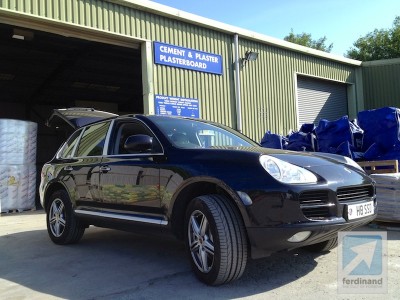
It’s a week since I picked up my new Porsche Cayenne S and started using it as a daily driver. Week 1 has been interesting, and not at all bad.
Mine is a 2004 V8 Cayenne S with 117,000 miles. It was owned by a friend for four years, so has been well maintained. Fuel carries prodigious taxes in the UK, so I was expecting most people to ask “what does it do to the gallon?” first. Surprisingly few people have asked what it does on fuel and everyone asks what I paid! Clearly some ownership aspiration for Cayennes out there.
First test for the Cayenne was what would the kids think. I took Ciara (middle, aged 11) with me to collect: she jumped straight into it and wouldn’t come out. Eliza (eldest aged 14) immediately called it “Eliza’s car”, and asked if she could take her test in it. Orla (youngest, aged 8) squealed when I told her it had a DVD player in the back. Cayenne claimed top marks with the kids.
Second test was Mrs Glynn’s reaction. She has her own cars so I am not letting her burn my Cayenne’s petrol for a while, but the verdict from the passenger seat was “I hope it’s not an expensive indulgence” and “what is up with this air conditioning?”.
The air con struggled to keep up with thirty degrees C ambient temps on our first drive in the car. The volume of air coming from the vents on full tilt was deeply unimpressive! I stripped off some panels and found the rather small cabin air intake was over an exhaust manifold – clearly not a great idea. A quick check on the Rennlist Porsche Cayenne forum found others complaining of the same issues.
Playing around with different techniques in this warm weather all week, I’ve found the easy solution is to do a mile or so with the windows open to blow out the warm air inside, set the temp to LO, recirculate when the car is at its hottest and keep it ticking over close to LO using face and floor vents. So far so good.
One other niggling problem is with intermittent reversing sensors, which I will look at some day. I’ve already crunched it into a post: not the best start. Front sensors are handy as it is hard to judge that nose. They don’t like the very narrow drive to my office, but I’m used to the terrified bleeping now.
On the first night the Cayenne was outside the house, some little shagger nicked the centre caps off the wheels. I’m assuming they are now on some lowered VW, but what a pathetic thing to do. I bought two sets of cheap repro caps on ebay and superglued the replacements to the rims. The spares are there for when these get torn off by tyre fitters. One seller also sent me Porsche logo’d valve caps for free, which I’ll offer as a Ferdinand prize some day.
Other issues which I will probably blog separately included DVD settings (sorted) and condensation in one rear light unit. I’ve got an aftermarket towbar, but a genuine Porsche tow hitch – need to find a hitch ball that fits, so I can tow with this.
The radio on my Porsche PCM 2 struggles with weak performance from the standard diversity aerial in marginal reception zones. Radio 2 strength is not great around here and Chris Evans on the school run is quite an intermittent affair. Not a bad thing, some of the time. I only listen to 6 Music (digital station), so haven’t used any of the other audio or nav bits. I’m half tempted by a Dension 500 kit to plug an iPod into, but really all I need is a handsfree phone kit. Maybe I’ll just swap the Parrot 9200 from the Subaru.
Other things that niggle: no place to put keys up front without them rattling, front cupholder insert missing, one rear plastic trim on the centre console is broken. The central air vents have lost their rubberised coating and the vent flaps are all detached internally, but I bought a replacement part from an eBay breaker which I’ll fit some day soon.
Does any of the above matter? No. What matters with any Porsche is how it drives.
If you’ve only ever driven a few miles in a Cayenne and thought “argh, this tank is way too stiff” or “I cannot get on with this gearbox”, welcome to the club. My first miles in the car were spent wondering what I should stick it up for on Pistonheads. One week and 500 miles in, I love it. When you stop thinking about it like a 4×4 and just drive it like a Porsche, it is the most amazing thing.
Turn-in is fantastic. Turn the wheel and the front just goes – no body roll out of the turn, no sloppy steering, no massive understeer. It just flicks in and holds any line you want. I’d love to do a track day in it.
To really keep that engine cooking, drop a gear or two as you brake for corners, then hold a steady throttle and squeeze it on when past the apex. Waiting for the gearbox to wake up once the bend has been despatched is when seconds are lost going nowhere and frustration builds with Tiptronic. Same thing going up hills, as it sticks in D5 or D6 for ages before dropping down. Get on the buttons and whack it into fourth for some fun.
My biggest niggle at the minute is the thing is too quiet! We need to release a few decibels. I’ll post some more in a bit on fuel economy as that has been REALLY interesting.
SHARE • EXPLORE • SUPPORT
Ferdinand blogs my freelance adventure with Porsche at the centre. To support the blog or engage with me in other ways, you can:

by John Glynn | Jul 4, 2013 | Project Cars, Porsche Cayenne
I’ve just bought a 2004 Porsche Cayenne S to add to the Ferdinand fleet. In Basalt Black with black leather and 117,000 miles on the clock, it’s a nice example with plenty of life left in it.
I’ve had the Cayenne itch for a while. Part of me thinks Ferdinand Magazine and my little social media agency should run a Porsche day-to-day and, with building in full swing at home so plenty of big stuff to move around, school runs to do and my insistence on four-wheel-drive on a daily driver, it was really the only choice from the Porsche lineup.
What Cayenne to buy was pretty easy – something under £8k was the first deciding factor. Respect to my Cayenne brothers running the V6, but I didn’t want a six-pot. Kudos to Turbo owners, but Cayenne Turbos are still pricey and not my bag either. Liner problems aside, the V8 is pretty reliable once the coolant pipes are sorted. The previous owner has done the aluminium coolant pipe upgrade on this car, and it’s got new-ish tyres, recent brakes and drives a treat. No sunroof and no heated seats a minor downer, but it rides on steel springs, which I was also pretty keen on.
Of course there are a few snags on my list – most of it trim wear and tear – but that’s to be expected for the price. Having good Porsche independents as clients will make sorting out the trim and other small issues easy to do.
So far I’ve done just over a hundred miles and all good. The fourteen year-old wants to take her driving test in it and Mrs Glynn won’t give back the keys. A good start – we’ll see how long the honeymoon lasts.
SHARE • EXPLORE • SUPPORT
Ferdinand blogs my freelance adventure with Porsche at the centre. To support the blog or engage with me in other ways, you can:

by John Glynn | Apr 9, 2013 | Classic Porsche Blog, Porsche News, Project Cars
Had some nice feedback on my latest 924 Turbo maintenance piece: thanks for that. I finally heard back from Porsche GB on getting a build date for the car, so I sent off my £65 for a Letter of Origin. Should be enough to register it here once it’s MOTed.
While writing the cheque for Porsche Cars GB, it occurred to me that Italy must have a HPI system for its cars, so I googled that and found the Automobile Club d’Italia (ACI) website. It’s the only source of info for Italian cars, and looked great. If you speak Italian and have a Codice Fiscale (Social Security number), you can find out anything you want about a car for a modest fee.
Much as I love Italia, I have neither the language nor the residency to go all the way with ACI, but Google Translate helped me find a section of the site to check tax status on a car registered in Italy. My 1980 924 Turbo carries the reg prefix RA, which is Emilia-Ravenna district, but the tax site showed it as last registered in Sardinia. The ragu thickens.

Amongst the nondescript paper shrapnel pulled from the car, I did find a stack of business cards from a bodyshop in Cagliari, capital of Sardinia. I emailed them a few months back but heard nothing in return. It’s obvious that they painted it, many moons ago.
The paint is now shot to pieces, but at some stage it probably looked OK. This led me to searching 924 Turbos in Cagliari and finding more Italian 924s with these Fisher-Price indicators on the front wings. I’m probably taking them off mine when we paint it: wonder who at Porsche Italy thought they were the right way to go.
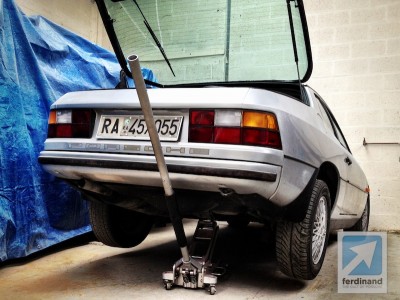
Anyway, Sardinia Car Tax Online says this car was registered 1/1/1980, so I am guessing there was no official production date put forward when it was registered there. I could try to register it using the paperwork I gleaned from the ACI site, but I’ll wait to see what £65 buys me from Porsche: I’ll be cross if they also say 1/1/1980.
At least I’m now sure that rust-free chassis is because it lived in the sun for ages. I know it’s nothing special to most people, but I really like this car.

by John Glynn | Apr 8, 2013 | Classic Porsche Blog, Project Cars
Just watched a terrific Storyville on BBC4. Entitled “From the Sea to the Land: Beyond Britain’s Coast on Film”, the programme gathered up 100 years of archive footage, to tell the story of 20th Century Britain’s relationship with the sea that surrounds it. With a thought-provoking soundtrack playing in accompaniment, it was spellbinding television.
The most impressive part for me was a shipyard section filmed in the 1960s, with amazing cinematography showing the scale of some of the vessels being built, when the UK still made the world’s greatest machinery. Deeply impressive on a multitude of levels.

The age of great British fabrication was briefly revisited on Saturday, when I finally managed to strap best mate Rob Campbell at Racing Restorations to his lathe for long enough to make a bush for my 924 Turbo’s steering rack. The 924 car failed its UK MOT on steering play, ascribed to a track rod but wound up being the bush in the end of the steering rack: those bumpy Italian back roads roads taking their toll.

I was happy to go and track down the part, but Robert insisted he could easily make it. Sorting this is the penultimate job before registration: all I need now is a set of tyres fitted, a retest on the MOT and official confirmation of date of construction, and it’s off to the DVLA with some paperwork.
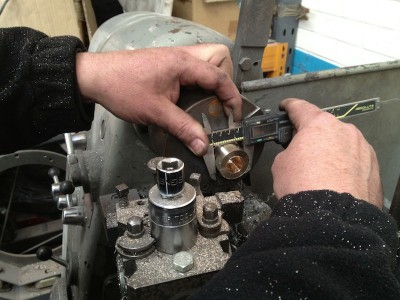
In true OTT John & Rob style, the plastic bush I pulled out out of the Volkswagen steering rack – worth about 50p on a good day – was replaced with something that took rather more expense to manufacture. Robert turned it out of solid brass, giving me an hour’s entertainment and something good to blog about.

If you’ve ever seen brass being machined, you know it goes everywhere in splinters. But all metal is amazing to watch in transformation. Careful measuring throughout Operation Overkill meant the rack all went back together with no big dramas. I’ll get it back in the car sometime next week.


