by John Glynn | Jul 28, 2014 | Classic Porsche Blog, Race and Rally
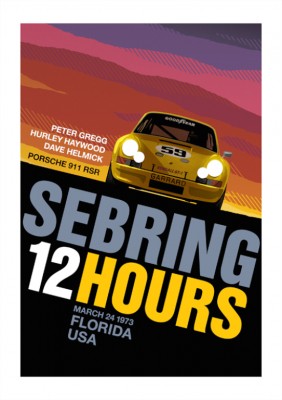
Ferdinand Magazine’s favourite digital artist, Guy Allen, has just released a new print for summer 2014. Celebrating a famous 911 win at the 1973 Daytona 12 Hours, Guy has created a striking Porsche 911 artwork that does justice to the hard-fought Sebring showdown.
Porsche 911 RSR Sebring 1973
Veteran race fans may recall how, in 1972, the Sebring 12 Hours was struck off the World Sportscar Championship calendar due to the state of the track. IMSA decided to include the circuit on its 1973 GT racing calendar and set the stage for a brutal test of survival.
A pair of Corvettes led from the start, but an unmerciful race pace around the airfield circuit took its toll. On lap 86, Porsche seized the lead. The Porsche 911 RSRs of Haywood/Gregg/Helmick and Minter/Keyser did battle to the flag, with Dave Helmick’s Light Yellow RSR coming home first.
Those lovely people at Gunnar Racing carried out a full restoration on the original RSR back in 2000 – see the Gunnar Racing 911 RSR restoration thread. At the time, it was owned by a gentleman living in Oxford, just down the road from here. No doubt this is an important 911: great to see it on a Guy Allen print.
Produced on archive quality heavyweight paper and available in a strictly limited edition of 100 prints, this is a large format A2 print: 594 x 420 mm. Each print is signed and numbered. Mine is number two – not sure where I’ll hang it yet, but it’s a really nice piece of work.
How Sebring Changed the Face of Racing
What I like about this story of the 1973 12 Hours of Sebring is how it changed the face of US racing. Gunnar’s website quotes Sebring historian Ken Breslauer’s summary of events around that time, following the FIA’s refusal to certify the circuit for 1973.
“For 1973, an upstart group known as IMSA added Sebring to its Camel GT series, and the race lived on, though radically different in appearance. The entire event was more informal, but no less competitive than previous years. In retrospect,the 1973 race was one of the finest gatherings of GT production race cars ever in North America. Entries totalled the second largest ever at Sebring.
“There was no race the next year, 1974, due to the OPEC oil embargo and resulting fuel crisis. Nevertheless, on the third weekend of March ’74, about 2,000 race fans showed up anyway. The Sebring tradition simply would not die.”
No race and a fuel crisis, but two thousand race fans “turned up anyway.” Way to go, America!

by John Glynn | Jul 28, 2014 | Classic Porsche Blog, Porsche News
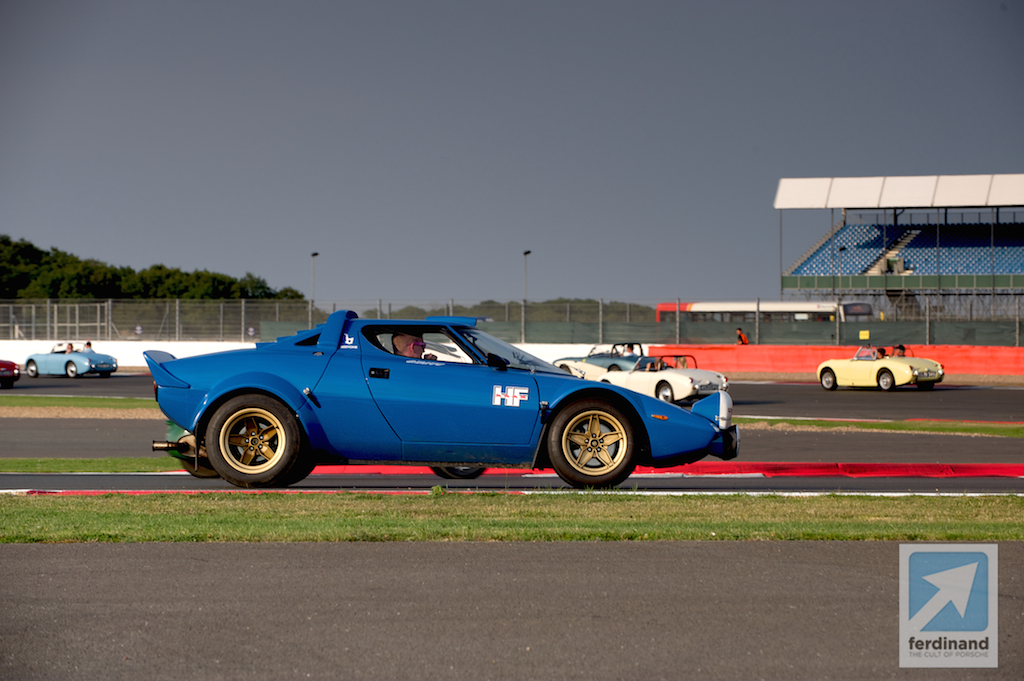
The sun has set on another great Silverstone Classic: an event that is maturing into a laid back petrolfest of epic proportions.
Silverstone is local to me: only fifteen minutes from home. I’ve never previously considered local events as being world class, and I am not alone. Talking to some Le Mans locals at a previous Le Mans Classic, they viewed Goodwood Festival of Speed as a better event. Away from cars, when we visited Venice, the locals said Florence was more impressive. As Joseph Addison put it: “when a man becomes familiar with his goddess, she quickly sinks into a woman.”

My issue with Goodwood is it’s all a big car show. Fine if you like looking at cars, not so great if you want competitive action. Le Mans Classic has plenty of racing, but there’s a feeling of exclusion in the field. If you haven’t got something ACO approves of, stay home. That long course is great for the drivers who can be bothered to lean on the loud pedal, but spectators hardly see the older cars, each lap is so long.

Silverstone Classic Porsche
Silverstone is a different affair. A huge mix of cars go racing on the 3.6-mile GP circuit: everything from early F1 to ’90s GT cars. There is not too much properly old stuff – and what old stuff there is runs a reasonable lap time and is absolutely terrifying to watch, let alone drive. I watched an early GP car in practice on Friday and, every time it braked into Luffield, the rear wheels bounced up and down at least a foot off the ground for three or four seconds, driver sawing away at the wheel but getting straight back on the throttle as soon as it turned in. Hardcore!

Yes, much the same faces win every year, the later F1 cars will always go quickest and nothing can touch a Lola T70. But, behind the front runners, everyone else is racing hard too. The EB Motorsport 911s fought a range of other machinery this weekend: Ferrari Daytona, Corvette and Chevron. A classic McLaren raced that gorgeous Ferrari 512M, and GT40s had a proper grudge match in the thirty-degree heat. With track temps past forty degrees, the old cars worked like ovens all weekend.

Still the drivers thrashed on: a quick walk around the paddock showed some serious racers. Big motorhomes and race transporters parked up next to single-trailer set-ups with tents and barbeques everywhere. Hoorah Henrys seemed less prolific than in previous years, although I did see a punch-up between drivers in the paddock.

A bit silly maybe, but no doubt these guys take the racing seriously, as they should. It’s the most serious racing this side of Oldtimer GP and the Spa 6 Hours. There is no doubt the FIA Masters Historic Sportscars race could have run longer: most drivers I spoke to wanted to race on for at least another hour (the race was sixty minutes). It will be interesting to see how the programme develops over the next few years.

Good fun to have a concert at the venue too. Coming into the circuit at 4pm one evening, loads of old cars were leaving but lots more people were coming in to share the music and atmosphere. As I left the track at 10pm on Saturday, the place was packed, and rocking to the sounds of Bonnie Tyler. Not my kind of music, but it was still a great weekend. Congratulations to Silverstone on another sterling effort, and many thanks to whoever is organising this weather!
Edit: RIP Denis Welch. Just heard via Octane’s David Lillywhite that the respected Healey specialist has died in hospital from injuries sustained in a crash this weekend. Sad to hear the news: at least he went out doing what he loved.
by John Glynn | Jul 18, 2014 | Porsche People, Race and Rally
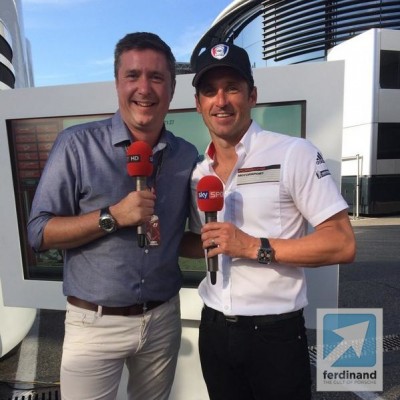
Normally, nothing clears my living room like the sound of Formula 1 engines from the Sky Sports F1 channel. Yet I watched Sky’s F1 show tonight with wife and oldest daughter in attendance. Why? Because Patrick Dempsey Porsche Supercup.
This weekend is the German Grand Prix, and Dempsey has a seat in Porsche Supercup. I know many groan at the celebrity circus of McDreamy in racing but, away from the hype, his racing is serious.
“I am so grateful to Porsche and delighted to be here in Supercup,” Dempsey started off with David Croft, Grand Dame of Sky’s F1 coverage. “Never mind all that, what is happening in Series 11?” demanded Crofty, apparently a fan of Gray’s Anatomy. Dempsey warmed to the kickoff and was most entertaining.
“I get the feeling that you’re not going to be in this next series a lot, because you’re now a proper racing driver, and that’s why you’re here in Hockenheim?” asked Croft.
“I’m having a lot of fun here this weekend,’ said McDreamy. “Porsche Supercup has some of the world’s finest GT drivers, so to be here racing on an F1 weekend is a lot of fun. Although it’s very, very warm this weekend, so lack of grip through the twisty last sector is giving us quite a lot of understeer.”

“Struggling overall? Do you think your lap times will be good enough to give you a decent race on Sunday?”
“I don’t know: we’ll see how we qualify. You know it’s gonna be great [whatever happens]. It’s my first standing start, so I’m looking forward to that. I hope I have a good run; I hope I have someone out there to run with.”
Patrick Dempsey Porsche Supercup
That this is Dempsey’s first grid start is quite a revelation and shows how few competition miles he has clocked up in racing, at least here in Europe. As he’s such a huge part of Porsche’s Le Mans coverage, I forget how new Patrick is to racing, but it’s easy see how Le Mans drives him on.

“Le Mans is it for me really, that’s my dream,” smiled Dempsey. “We’ve come close now the last few times and I really want to win that race in class. It is so competitive – especially this year – that I just need to be training more, which is one reason why I’m over here. I enjoy being around all the drivers who are in the Supercup and have been incredibly supportive, and all my sponsors have been helping out, so I just need to be in the car. I need seat time and I need to be driving with the best drivers in the world to really improve my speed.”
Eurosport did a great documentary series following three drivers through Le Mans this year. Dempsey was one of them, and I really switched on to his focus. Supercup is a brutal barometer – packed as it is with incredible professional talent, all driving very similar cars – so I hope it treats him kindly. I don’t doubt Dempsey can finish up the field a bit, as long as he can navigate the Hockenheim GP circuit. It’s a super tricky place.

by John Glynn | Jul 14, 2014 | Classic Porsche Blog, Porsche News, Race and Rally
A nail-biting finish on the 2014 Midnight Sun Rally yesterday, as the 911 legends at Tuthill Porsche claimed another European rally victory, this time by just six seconds after three days of hard fought, flat-out rallying.
Even more impressive was that driver, Patrik Sandell, was on his first ever rally in a Porsche 911, and catching some very experienced drivers ahead of him despite zero pace notes, their supreme local knowledge and proven speed as previous winners. Also the fact that he was driving a 3-litre Tuthill 911 normally found on the Below Zero Ice Driving school! Awesome job all round.
Sandell started the day over forty seconds down on the leader, with just forty kilometres of stages remaining. So Sandell needed to take a second a kilometre out of previous rally winner and former WRC driver, Kenneth Bäcklund, in a very quick Escort RS. As anyone who has rallied will tell you, this is almost impossible.

“Second place is infinitely doable, but to win we will need others to face misfortune. However, the completion rate at this level is very high,” said a cautious Richard Tuthill at the start of day three. The Tuthill mechanics had made quite a few setup changes overnight, so would the car be quick enough? We were about to find out.
The first stage of the day was SS13 Ramsjöhult: a nine-kilometre thrasher. Sandell won the stage, finishing 8.8 seconds faster than the leader. The day was off to a proper start. “I’m in love with this car right now! It’s close to perfect,” said Patrik at the end of stage thirteen. Next stage was Vallavägen at 8.8 kilometres. Sandell was five seconds faster than the next quickest Porsche, but only six-tenths up on Bäcklund.

Then came Viggaren: 13 kilometres long. Bäcklund held nothing in reserve, but Sandell was first, six seconds quicker than Kenneth. The next stage was Forssjö, five kilometres long. Sandell took a further eight seconds off the leader and with two stages left was just fourteen seconds down.
Penultimate stage was by far the longest of the two remaining: Härad at 6,240 metres long. Over six kilometres, Sandell stuck to his second-a-kilometre rhythm and finished the stage just under nine seconds down on the Escort. Heading into the last stage, a win was looking unlikely. Semi-resigned to finishing second, which would still have been a great Porsche debut for the Red Bull Global Rallycross winner, Patrik left the start with all guns blazing for the 1.5 kilometre stage.
Then, who knows what happened – a burst of nerves, a slippy clutch foot, a distraction in the corner of his mind – but Bäcklund blew the start. False starts earn a ten second penalty: one more than Sandell needed to win. Bäcklund finished eight seconds down, and Sandell finished on top.

“I had a fantastic weekend with Tuthills and the car was awesome to drive,” said Patrik (above, right) at the finish. “The car gave me great feedback all weekend, and I don’t think people understand the speed you can get from a historic Tuthill Porsche. The team have been so professional the whole race and we have really worked together to get this win!”
I know how delighted everyone in the team is to see a fresh face take to the car and bring it home undamaged, on top of the podium. Tuthill Porsche has a groundbreaking rally project coming out soon – it could be amazing if they can get Sandell in that. I will be there to cover it!
Pics courtesy of Midnattssolsrallyt/Fotogubben

by John Glynn | Jul 13, 2014 | Classic Porsche Blog, Modified Porsche Hot Rods
This Kremer Porsche 962 was a recent visitor to a friend’s service workshop. Despite my spending at least one day a week there, I missed it, but am working on future visiting rights.
Everyone knows about the Porsche 962: super successful Group C racer that claimed abundant silverware for owners with the nuts to drive them properly. However, a number of customers were unhappy with Porsche’s version of the 962 and decided to do things their own way.
Formula One of the time was breaking new ground with composite tubs, but Porsche stuck to single-skin aluminium monocoque. When Kremer drivers Manfred Winkelhock and Jo Gartner were both killed in 962s – Mosport 1985 and Le Mans 1986 respectively – Kremer contacted John Thompson in the UK and had him build a stronger aluminium honeycomb tub with composite inserts and bodywork.

Scratch-built Kremer 962s using Thompson’s much stiffer tubs were badged as 962 CK6s, and Thompson went on to build full composite 962 chassis’ for Brun Racing. Despite 962 variants running well into the 1990s, Jo Gartner was the last man to be killed at Le Mans until Allan Simonsen’s death last year.
Flying slightly blind here, I’m half guessing at this being Kremer 962 CK6 09, one of the last Kremer 962s built, although it could be chassis 05. Shown on the JZM Hunter chassis alignment ramp, it’s fitted with Volk Racing centrelock wheels, which were chosen by many 962 teams. CK6-09 enjoyed an interesting career. Built specifically for the Le Mans 24-Hours, it raced in 1991, ’92 and ’93, with a highest placed finish of 11th overall.
Manuel Reuter’s name can be seen on the door. While not a household word outside of Germany, Manuel enjoyed sportscar success, twice winning Le Mans and racing 962s for much of his career. The 1992 Interserie Division 1 champion in a Kremer K7, he also raced DTM for Opel and was a DTM TV commentator too.
How many Porsche 962s were built? Depends who you read and how you add up the numbers. Counting later derivatives, it is certainly more than three figures.