Porsche friend Hans has just shared this video on Facebook. It’s a feature (in German) on the Porsche 956. Non German speakers, don’t let the language put you off – the video contains some great period footage of the 956 in build and at work. Well worth watching!
Derek Bell usually dominates 956 video. While I could listen to DB ’til the cows came home, it’s a nice change to have some new faces. Here we have the great Jürgen Barth,who won the ’76 Le Mans in the 936 with Ickx and Hurley Haywood, and finished third in 1982, sharing a 956 with Hurley and Al Holbert. Also interviewed are Harald Grohs and Hans Heyer.
Born in Essen, Harald is a veteran of fifty endurance races, and a former 935 & Carrera Cup racer. Former European Touring Car Champion, Hans Heyer will be familiar to anyone who followed DRM (Deutsche Rennsport Meisterschaft – German Racing Championship) back in the day, as his racing career throughout Europe was legendary. Hans drove just about every touring and sports car of note, up to his retirement from full-time racing in 1985.
Hans Heyer’s New Man Porsche 956 is above, from Rennsport Reunion IV last year. The interview looks to have been filmed at the Kremer works – rather apt as Heyer drove Kremer RSRs in his early years.
Anyway, enjoy the video. I seem to spending all of this afternoon on Youtube – been too long since I did that. Have discovered many wonderful previously unseen videos there (unseen by me) which I’ll share via the Ferdinand Porsche website and magazine over time.
Porsche legend, Hans Herrmann, has been inducted into the Sebring Hall of Fame. Herrmann’s award came this weekend, during the 2012 12 Hours of Sebring.
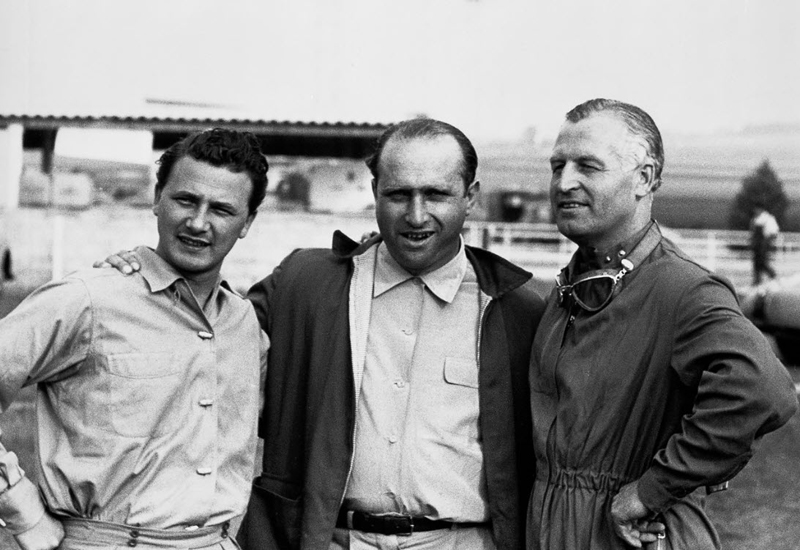
Hans Hermann, Juan Manuel Fangio, Karl Kling
2012 was the 60th running of the historic half-day race, an event Herrmann (seen above with Fangio and Karl Kling) won twice in his career. In 1960, he won at Sebring in a Porsche 718 RS 60 shared with Oliver Gendebien, winning the Targa Florio in the same year. Having raced in F1 with Maserati, Cooper and BRM, Hans also raced F1 for Porsche. Lack of success prompted a move to Abarth.
A few years later, Hans returned to Zuffenhausen. The team struggled with the 906 for a couple of seasons before finding their feet in 1968, with the awesome 908. Hans again won Sebring, this time alongside Jo Siffert.
The following year, Herrmann’s 908 missed a Le Mans win by a very narrow margin. In 1970, the baker from Stuttgart made up for it by clinching the first win for Porsche at Le Mans in the 917, alongside Richard Attwood. The car was one of just seven finishers in a race of total chaos.
Hans Herrmann was 42 when he won Le Mans: an age that many drivers of his era did not live to see. After the event, he retired from racing but continues to attend many European and US events.
Now the grand age of 84, Herrmann’s importance in the history of Porsche should not be underestimated. Nor should the affection he is held in amongst the Porsche cognoscenti: one chat with the major players at the Porsche Museum speaks volumes about how Stuttgart regards one of its all-time favourite racing sons.
Congratulations Hans! Well deserved, and many more besides.
Ferdinand blogs my freelance adventure with Porsche at the centre. To support the blog or engage with me in other ways, you can:
More great Porsche Rennsport Reunion video has just gone up on Youtube. Some of it is from Friday practice, some from Saturday and Sunday racing. All of it is COOL.
Check the skids, and the height that 911 inside front wheels get to when they’re sliding down the Corkscrew! Awesome!
Porsche Rennsport Reunion Video
About Porsche Rennsport Reunion:
Laguna Seca Raceway hosted Rennsport Reunion IV, the fourth installment of the world’s largest classic Porsche motorsport gathering. Rennsport Reunion is sponsored by Porsche Club of North America, and brings together automotive enthusiasts, owners and collectors of significant Porsche race cars, past and present.
A great orange RSR hillclimbing video has been doing the rounds of the ad-packed ‘German Car Scene’ blogs lately. It shows the Porsche 911 of Swiss hillclimb driver, Willi Jenni, competing on a number of national championship rounds. This is it:
My orange 911 Carrera 3.0 came from Switzerland, and was maintained out there by former Swiss hillclimb champion, Alain Pfefferle, who won the title in a Porsche 935. Here’s Alain driving Bergrennen Oberhallau 2010 in the car: note this is a real one!
Also note just how tidy these boys are on track: there’s very little opposite lock. Sideways might look fun, but tyres hooked up and pushing the car forwards is the fastest way to go.
Oberhallau 2011 will be held at the end of this month: 27/28 August. You can follow live web timings on the Bergrennen Oberhallau website here. I’m going to have to get myself to one of these events one day: they look absolutely superb.
No matter how many horror stories you hear about the Swiss speed camera obsession, Switzerland is a great place to go mountain climbing in a 911. The drive that little brother Sammy and I enjoyed at the start of the 2010 Bergmeister Tour was absolutely unforgettable. The fact that it was totally illegal might have had something to do with it, but who can tell with hindsight?!
I just finished a piece on the Falken Tyre Porsche 911 GT3 R, and the team’s experience at the recent Nürburgring 24-Hour race. Suffice to say this awesome event tested the team to extremes.
Much of my focus in the short (2,000 word) article for Total 911 magazine was relatively new-to-Porsche racer Peter Dumbreck, and a quick overview of his weekend. Dumbreck is obviously a gifted driver, but I was righteously impressed with how hard he could push the GT3 R: Peter’s lap times in the 911 were on a par with all of his very respected Porsche expert team mates, including factory driver Wolf Henzler and factory man in training, Martin Ragginger.
“So what?” you ask. “So this,” I reply. The video below is Henzler around the Nürburgring. You see 16 minutes – the car does 24 hours. When it keeps going.
Peter and the Wolf are my newest heroes, and this is my favourite video of the year so far. The full feature text is below.
When 24 Hours Go Sour
Flat out for a day around the Nürburgring adds an entirely new dimension to 24-hour racing. John Glynn gets inside a gripping event.
The freeze-dried face behind Flybe’s Birmingham Airport customer service desk is ignoring my question. I flew Flybe to Amsterdam a few weeks ago, and carried my camera bag on board, so why is it suddenly a few centimetres too big?
Her robotic response is unwavering. “It doesn’t fit in our frame, sir. You have to check it in, or you can’t fly.” Knowing how hold baggage gets treated, and envisioning the cattle class that awaits beyond security, I abandon the Flybe awfulness. I’m going home, to get my Porsche.
Back at Glynn Towers, I buy a ferry ticket, fire the bags in the car and hit it. The 150 miles to Dover takes me two hours: I’m on schedule for the 12 o’clock boat. When we dock in Dunkirk, I’m fed and rested. Thank you Flybe: you did me a favour.
Nothing can stop me reaching the Nürburgring. I’m off to watch Falken Team Europe run their 911 GT3 R in this year’s 24-Hour race. The Falken drivers are Porsche works pilot Wolf Henzler, Martin Ragginger, Sebastian Asch and Peter Dumbreck.
Henzler has been a works driver since 2008. Last year, Henzler and Ragginger (Raggi to his friends) won the Spa 24 Hours in GT2. Having driven 911s to GT2 wins in ALMS overall and the Sebring 12 Hours, Henzler is a Porsche driver par excellence.
Raggi won last year’s FIA “Talent of the Year” and is a factory driver in training. Sebastian’s father, Roland, remains the winningest driver in Porsche Cup racing, and Asch junior is a chip off the old block. This year, Sebastian is running ADAC GT Masters in a GT3 R. These three are serious players, but Dumbreck is the one I’m most interested in.
If Jackie Stewart had never existed, Peter Dumbreck might embody the canny racing Scotsman. Karting from the age of 11, Dumbreck rose through the ranks of Jim Russell’s Donington race school, before joining Stewart’s Formula Vauxhall team and winning the 1996 championship.
Staying with Stewart for 1997, Peter moved to Formula 3, taking a win in his rookie season. The following year, he raced for the works Toyota team in Japanese F3, and won the series in record style, also winning the renowned Macau Grand Prix.
Mercedes Motorsport spotted Dumbreck’s obvious ability. In 1999, Peter raced for Mercedes at Le Mans, while still competing in Formula Nippon: the Japanese equivalent of Formula 3000. The Le Mans Mercedes drive made history for all the wrong reasons. While chasing the leading Toyota, Dumbreck’s CLR-GT1 lifted off, pirouetting end over end in mid-air before ploughing backwards into the trees. Amazingly, Peter escaped unharmed.
After Le Mans, Dumbreck raced for Mercedes and Opel in DTM, before returning to Japan in 2005 for the domestic GT championship, as well as Le Mans 24-Hour drives with Spyker. Japanese Super GT saw the start of Dumbreck’s association with Falken. Peter has raced with the Japanese tyre manufacturer since 2007, dovetailing various 24-hour drives with a GT1 World Championship campaign. Despite a flat-out racing career, on and off the track, Peter’s not done much in 911s.
“We had a 911 when we had money, before the kids arrived,” says Claire Dumbreck, director of Falken’s UK PR firm and wife of the globetrotting racer. “It was a 996 Turbo: an incredibly quick car. Peter likes Porsches.” Porsche like Peter too. With some of their favourite 911 drivers in Falken’s squad, Stuttgart has vetted and approved Dumbreck’s participation.
Sitting in the Falken tent in the Nürburgring paddock on Saturday morning, I’m convinced I can hear the tension ratcheting up. The noise is rain. While the heavens open as 99 Porsche racers prepare for the historic hour-long Carrera World Cup race, Peter and I take our seats in front of the TV screen showing footage from around the track.
Watching the race with Dumbreck, I ask about the circuit. What does he like about it, how well does he know it? Were he racing in this weather, would he know where to watch for standing water? Concentrating on the screen, his answers are succinct. “I like getting to the straight at Döttinger Höhe, and having time to think at the end of a lap! The uphill stretch from Karussell is impressive in a quick car.”
Despite the rain, these 911s are super quick around the Nürburgring. “A 9 minute dry lap, ten minute wet is going some,” according to Dumbreck. “I like driving Porsches: very different to front-engined cars. You’ve got to focus on turn-in weight transfer if you want to clock the times.” Peter’s lap times have been on par with his team mates, so he’s clearly enjoying the chassis. Qualifying for the 24-Hour has not gone entirely their way, but all the drivers are optimistic for the race.
“Porsche have been treating this satellite team like a works extension,” says Claire. “They’re studying the data carefully. Something was spotted in the transmission log, so they asked: “which driver does this particular action? It may be an issue over 24 hours.” The team discussed the feedback before changing the transmission for an all-new unit, and running it in through qualifying. Fingers crossed we’ll make up some places early on, and then reliability and clean running should start to play their part. “
Two hours before the start, Claire and I head off to get a decent seat at Falken hospitality, high in the Mercedes Benz grandstand at the end of the start/finish straight. It’s worth the effort: the view is outstanding. As the warm up lap begins, the field rolls patiently right through turn 1, then snaps left into turn 2. Wolf is starting: Peter won’t be too upset about that. After a tense ten-minute wait, helicopters reveal the leaders’ approach. A blaze of lights crests the hill, and dust, spray, steam and exhaust roars like a mushroom cloud around the pack as it charges into turn 1. Incredibly, everybody makes it.
One lap later, Henzler is nowhere to be seen. After an awesome opening charge on intermediate tyres, the Porsche has had some contact, so Wolf has pitted for a safety check and fresh rubber. Immediately clocking a quick time on slicks, many teams follow his example, but don’t all go as fast. A container full of bespoke Falken rubber and the engineers to chose which compound to use is proving useful around the ‘Ring.
For three hours, our vantage point is perfect. The ADAC iPhone app and big TV screens give an excellent overview of proceedings, and Falken are doing well. With driver changes timed at 90-minute intervals, Dumbreck has done the second stint and the car is up from 85th to 14th place. I envisage a happy ending to this version of Peter and the Wolf, and we head back toward the pits.
Walking into the Falken tent, the fairytale ending disintegrates. We enter the driver area to see a screen full of Porsche number 44, parked on the grass at far away Schwalbenschwanz. “On my last lap, there was a vibration,” says Peter. “We thought it was just old tyres, but obviously it was more.”
Half an hour later, the car is back, surrounded by a sea of spectators. Having studied the data while the car was being recovered, Porsche engineers determine the new transmission has failed. The team decides to change the engine at the same time.
At 19:58hrs, the car goes up on its air jacks. An hour later, the new drivetrain goes in. At 22:00hrs, I’m standing on the balcony of the Porsche lounge on the pit straight, when the Falken 911 rejoins the race. It’s in 176th position.
While Falken have been fixing their “Hawk of the ‘Ring”, the rest of the field has had its ups and downs. The number 206 BMW has flown from the track, ramped off a kerb and gained enough air to go straight into the forest. When it eventually comes back to the paddock, it’s crumpled like a crisp packet. Suddenly, a transmission fail doesn’t seem too bad.
The Manthey-supported Porsche 911 R Hybrid has also suffered some indignity. Power reduced by the organisers, the handicapped Hybrid eventually takes the lead, before differential flange failure sends it back to the pits for an hour. As the Falken flies by beneath us, and the Hybrid enters the pits for another unscheduled stop, Porsche archivist Dieter Landenberger and I discuss the cutting edge racecar.
“Absolute power is reduced,” says Dieter, “but torque is still strong. In damp conditions like earlier, having extra drive to the front wheels is a real advantage, and electrical energy is available instantly.” He’s not wrong. Watching the hybrid in the early laps from the Mercedes grandstand was an education: its cannonball speed out of slow corners like Turn 2 was unmistakable.
The petrol-electric Porsche fits perfectly into the Nürburgring 24-Hour. This atmosphere is electric, and not just due to thunderstorms. An estimated 250,000 fans have gathered in the Grand Prix circuit and the woods surrounding the 25 kilometre-long track to witness this year’s race. With some 200 cars and 700 drivers, the 24-Hour is allegedly the largest motor sport event in the world. I’m amazed at how much I’m enjoying it.
Chatting with other journos and Porsche enthusiasts around the paddock, everyone feels the same. “I have no idea who’s in front, and I’m not sure the organisers do either,” says one leading light of motorsport reporting, “but it’s brilliant racing. Similar cars pushing absolutely at the limit, on a track that forgives nothing.”
The unforgiving Nordschleife is the ultimate attraction for spectators, and the ultimate challenge for competitors. Manthey’s decision to retire one of their cars after two hours, to concentrate on a single entry, didn’t make much sense in Porsche’s first interim press release, but it’s paid off in practice. Manthey’s number 18 RSR takes the lead at 23:30hrs, headlights blazing along the pit straight as it charges past us into P1, en route to a win.
With just two hours’ sleep on the night before my drive and four more hours last night, the eyelids get heavy at 2am. Ice cream, Red Bull and copious amounts of coffee are having less and less effect, and photographers returning from the woods speak of two-hour tailbacks, so I retreat to the hotel to get my head down. Ten miles and two hours later, I eventually crawl under the duvet.
Sunday dawns dry and bright. A quick check on the ADAC app shows we are still running and the times look good. I check out and head back to the track.
The mood in the Falken tent is positive. Night running has been reliable, and current driver Sebastian is flying: his times are in the top five of the entire weekend.
I grab an early lunch and watch the race on screen. As I eat, the three resting drivers arrive and do the same. There’s a spoon of resignation with a sprinkle of frustration, but a determination to see it through and get the best result. The boys manage smiles all ‘round for a junior autograph hunter.
“The most painful thing is we’re driving a top ten car. It’s got a podium in it on the right day,” says Dumbreck. “Everyone connected with it is of the highest calibre, and the lap times now are seriously quick. The race didn’t quite work out for us, but at least we can show our potential.”
An hour before the finish, hitchhiker Claire and I break for Dunkirk, to avoid the end-of-race tailbacks. A blissful blast back to Banbury awaits. His weekend finished, Peter is off to Spain with FIA GT partner, Richard Westbrook, to test their GT World Championship car. All of us agree it’s been an incredible event.
Monday’s press releases allude to the weekend’s drama, but nothing sums it up quite like one quote from Team Falken. “The breakdown at the beginning made us drivers so mad, we literally beat the car through hell after that,” says Sebastian. “I have never pushed a car this much. It was absolutely crazy.”
Porsche. The Green Hell. Excitement. Exhilaration. Desperation. The Nürburgring 24-Hour is a truly magnificent event. Put it on your calendar!
Ferdinand blogs my freelance adventure with Porsche at the centre. To support the blog or engage with me in other ways, you can:
This website uses cookies to improve your experience. We'll assume you're ok with this, but you can opt-out if you wish.AcceptRead More
Privacy & Cookies Policy
Privacy Overview
This website uses cookies to improve your experience while you navigate through the website. Out of these, the cookies that are categorized as necessary are stored on your browser as they are essential for the working of basic functionalities of the website. We also use third-party cookies that help us analyze and understand how you use this website. These cookies will be stored in your browser only with your consent. You also have the option to opt-out of these cookies. But opting out of some of these cookies may affect your browsing experience.
Necessary cookies are absolutely essential for the website to function properly. This category only includes cookies that ensures basic functionalities and security features of the website. These cookies do not store any personal information.
Any cookies that may not be particularly necessary for the website to function and is used specifically to collect user personal data via analytics, ads, other embedded contents are termed as non-necessary cookies. It is mandatory to procure user consent prior to running these cookies on your website.