by John Glynn | May 11, 2012 | Classic Porsche Blog, Porsche News
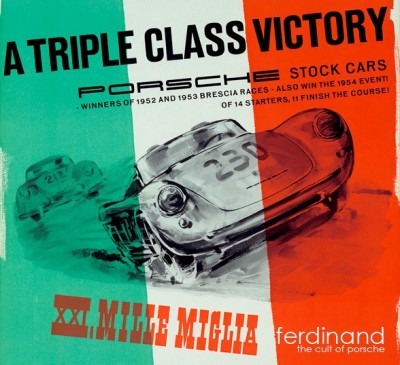
Porsche Classic on the Mille Miglia is rich in shades of 1953’s “downright phalanx”. Mille Miglia – literally a thousand miles – is for cars approved by the FIA or FIVA that would have raced in period, so up to 1957, when the 24th and final Mille was run.
From the press release, it sounds like the Porsche museum is sending two Porsche 550 Spyders, 356 Speedster 1500, 356 Speedster 1600, 356 Speedster 1600 S and 356 Coupé, the so-called “Knickscheibe” (bent windscreen).
Hats off to Stuttgart if it really is sending all that precious metal. Entry fees for the Mille Miglia are €7260 per car, for three nights B&B, some parking and a road book. Single beds, additional stickers or road books for support crew, and parking for transporters while the race is going on are all extra. Times that by six cars, plus drivers and navigators, plus transport, plus support, plus PR, plus staff costs and I guess you are knocking on €200k, for three days driving around Brescia to get some promo pics. Heavy duty!

Of course, for some people, it’s a proper race: 1,600 kms in three days. A few years ago, I pitched a story idea to Porsche, to follow his highness Gijs van Lennep in the State of Art 550 Spyder around the Mille Miglia in a Boxster Spyder. Got big thumbs down on that one, but one of the days I will follow the race in a Boxster: the only modern Porsche worthy of the jaunt.
Before I leave, back to that fabulous word. In ancient Greece, phalanx was a military formation, made up of heavily armed troops in tightly packed ranks. The soldiers stood shoulder-to-shoulder, several rows deep, often with shields interlinked. It was a formidable force that was difficult to match. At the turn of the 20th century, a Munich art cluster including Bauhaus legend-to-be, Wassily Kandinksy, formed a group known as Phalanx “to oppose old-fashioned and conservative viewpoints in art”.

Combining the two interpretations, I doubt there is a better collective noun for racing Porsches than ‘phalanx’. An impenetrable group of conquering soldiers, opposed to old fashioned concepts in art? That’ll do nicely, phalanx.
![Porsche Production up 15%: 911 Sales up 40%]()
by John Glynn | May 3, 2012 | Market & Prices, Porsche News
Between January and March 2012, Porsche produced a total of 36,067 vehicles: 15% up on last year. Leipzig plant now makes 450 Cayennes and Panameras per day.

Porsche’s 2012 financial year is off to a flying start. Worldwide sales are up almost 30%, and revenue is up a bit more, at 32%. Operating profit hit €528 million, 18% more than Q1 2011. The company took on 725 new people in the same period and now employs over 16,000.
President and CEO of Porsche AG, Matthias Müller, says this success comes from focus on sustainable growth. “The youngest and most efficient model range of all time gives us an outstanding platform on which to sustain this course throughout 2012.”

New 911 has lifted sales of the icon by almost 40%, and new Boxster has strong interest. This year, Porsche brings nine more models to market – from new 911 derivatives to the Cayenne GTS.
In Q1 2012, Porsche saw increased demand in China, the German domestic market and in the USA. Biggest increase came from Panamera: up almost 60% and very strong interest in the six cylinder (tax law changes or good lease deals somewhere maybe). Thirty percent more Cayennes were delivered to customers worldwide in Q1 2012.

Porsche has set itself ambitious business targets with “Strategy 2018”. The intention is to boost sales to approximately 200,000 vehicles by that point, so Porsche is investing in rejuvenating and expanding the entire model range. New 911 is part of that, new Cayman (perhaps the real sports car of the range) and Macan will bolster the effort. Macan will be built at Lepizig from 2014 onwards.
![Porsche Production up 15%: 911 Sales up 40%]()
by John Glynn | Apr 29, 2012 | Porsche News, Race and Rally
British media channels are obsessed with the 2012 London Olympics at present, but British athletes continue to impress beyond the Olympic microsphere. Good examples can be found in motorsport, such as Porsche Carrera Cup racing.

English driver Sean Edwards (below) had a cracking start to the 2012 Carerra Cup Deutschland season at Hockenheim this weekend, narrowly missing out on a weekend whitewash. Edwards is the master in a racing 911, and this first race was proof of that.

Starting race one from the pole, Edwards was second early on but quickly recaptured the lead. A measured pace out front looked like a guaranteed victory, until a lap six puncture put him out. Team-mate René Rast took over the lead, eventually winning the race with his usual determined style of driving. P2 went to Nicolas Armindo, with rookie wheelman Michael Ammermüller finishing third on his debut Porsche Deutschland event.

Ammermüller’s excellent podium finish, from eighth on the grid at the start stamped his class on a second Porsche championship, after an electric performance in Bahrain last weekend on the Porsche Supercup series. Bahrain is an exceptional track that shows 911s at their most exciting.

Race two start positions were set by qualifying lap times. Edwards again took pole, initially pulling out a lead on Estre and Rast. While his challengers managed to catch up eventually, Sean never conceded the position. The win (above) was well-deserved, but René’s third place means he maintains the championship lead. The driver standings show Rast out front on 36 points, followed by Armindo on 27, then van Lagen third with Ammermüller fourth on 23.

Could this be the year a rookie wins Carrera Cup Deutschland, once Michael Ammermüller (above) has the car how he wants it? Rast and Edwards had better watch their mirrors: we’re in for an exciting Porsche racing season. The Porsche Carrera Cup Germany is really an incredible race series: all Porsche motorsport enthusiasts should check this series out.

by John Glynn | Apr 28, 2012 | Porsche News
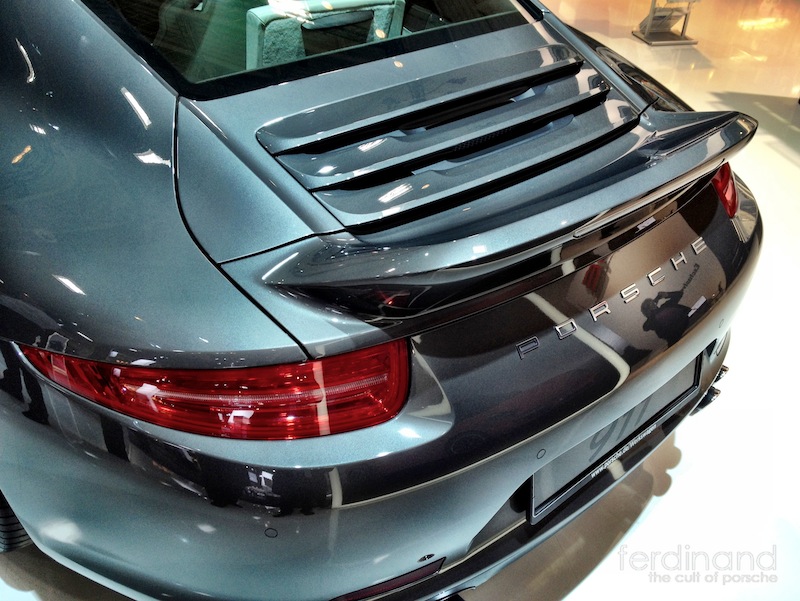
Spotted this 991 Carrera with a duck tail on the Porsche stand at Essen. I was not entirely mesmerised by Porsche’s stand at this year’s Essen Techno Classica. Previous stands felt better as the heart of the action in Hall 3 with the rest of the Porsche World, rather than in amongst the VW-Audi Group offerings.
There were some nice Porsche cars on the stand, but all felt lonely surrounded by unrelated product. Maybe that’s just me. One thing I did like was this 991 Coupe with the duck tail spoiler: seemed to work well on the new shape 911.

The Porsche sales guys present couldn’t tell me much about the ducktail, apart from it would form part of an options pack. There was no information on said options pack, though they thought it might cost around €4,000 for the front and rear bumpers and this ducktail.

Fit and finish was perfect so I presume this was not a prototype – the plastic looked very productionised. The Porsche folks couldn’t tell me if it was factory fit, so maybe your dealer will have to paint it for a cost on top of that. You can see from the pics that it is static: the flap above opens up to check oil and – yes – water. Not much else to see, really.

The front end looks good and I like those wheels, but wonder how it would look with 19″ or 20″ Fuchs instead. Those wheels are coming: keep in touch with UK Fuchs dealers for more info on the bigger Fuchs.


by John Glynn | Apr 21, 2012 | Porsche News, Race and Rally
Reading Porsche’s press release from the first round of the 2012 Supercup, it’s tempting to think “procession”: a race led from start to finish, with a follow-me-home podium. In-car shots of winner René Rast en route to victory might help that impression, but footage screened on Eurosport from the on-car cameras tells a different story.
Starting from the clean side of the track, pole man Norbert Siedler lost out to Rast when the lights went out: the canny two-time champion held the line from his dusty grid slot to the first corner turn-in, sticking his 911’s nose ahead of Norbert (below).

Siedler stayed close, punting Rast up the rear at one stage, but René was inch-perfect with track position, leaving no open doors. As Siedler’s tyres howled protest as early as lap two, Britain’s Sean Edwards stuck it up Siedler’s inside and kept his tyres together, eventually finishing P2: two and a half seconds behind René.

Tyre management was the story of this ten-lap torture. Track temps for the Formula 1 qualifying were in the mid-40s, so the Supercup Michelins were worked hard from the start. The F1 teams are all complaining of heavy tyre degradation here, and TV pictures show chunks of rubber being flung from front tyres at various parts of the track. Five laps in, the Porsches were sliding all over the shop, clearly demonstrated by the rear-facing cameras of cars out in front.

The differing fall-off in tyre performance led to some great battles down the field. Christian Engelhart and Michael Ammermüller (above) had a terrific scrap over fourth: Ammermüller’s rookie energy urging him on. Michael’s eventual move on Christian into tricky turn ten took some balls. Up front, Edwards showed style to stick with the winner. It’s early doors yet, but a smart man into his 911s might stick a few quid on Sean for the title.
Race two is tomorrow, with plenty mixed-up grid positions. The race will be shown on Eurosport and Sky around 11 AM. If I find race one online, I’ll share the link.
by John Glynn | Apr 14, 2012 | Porsche News, New Models
Porsche has announced that it will take over the test facility at Nardò in southern Italy from next month. Take over means buy: Porsche Cars GB confirmed to me that that the company has bought the facility.
Nardò has been at the heart of European auto testing programmes for many years, and it sounds like that will continue. This will be a relief to the travelling technicians from many marques who like testing prototype cars and vans in the Italian sun! Some good Porsche friends among them.
The Proving Ground is famous for its 12.5-kilometre high-speed bowl, site of many Porsche speed tests over the years. One of the most impressive was the 200 mph run by the TechArt Cayenne Turbo in 2010. Equipped with 680 horsepower and a TechArt aerodynamic kit, the Cayenne was probably doing a true speed of closer to 215 mph, losing some of it through tyre scrub on the banking.
Nardò’s banking is designed so that there is no lateral force up to 240 km/h, almost 150 mph. Running at this speed in the outside lane of four, the steering wheel does not need to be turned. Interestingly, this is as fast as tests are allowed to be run unless the facility has been booked for exclusive use.
The stable climate at the facility, which is situated slightly inland from Italy’s southeast Mediterranean coastline, means the site can be used all year ’round. When Porsche takes over next month, the priority will be to update some of the facilities before opening the place for proper Porsche business, and making it available to other manufacturers. I look forward to visiting the place myself one day.