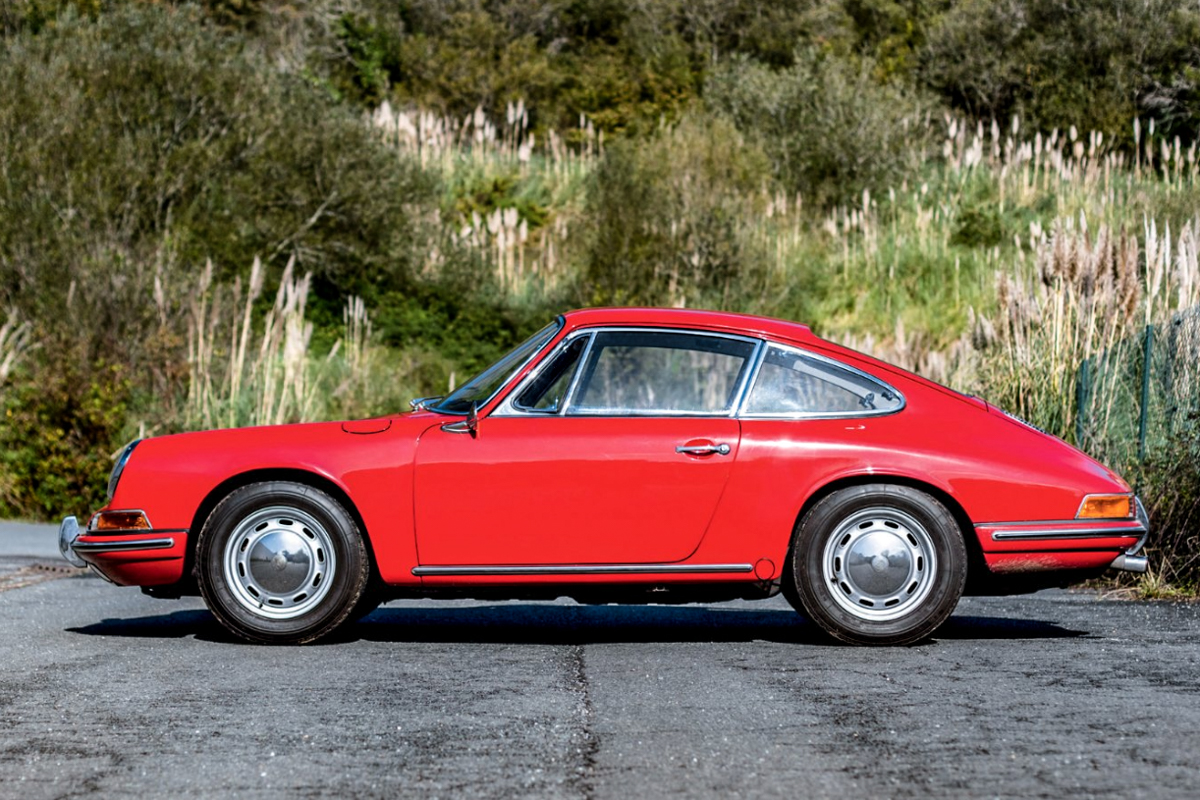
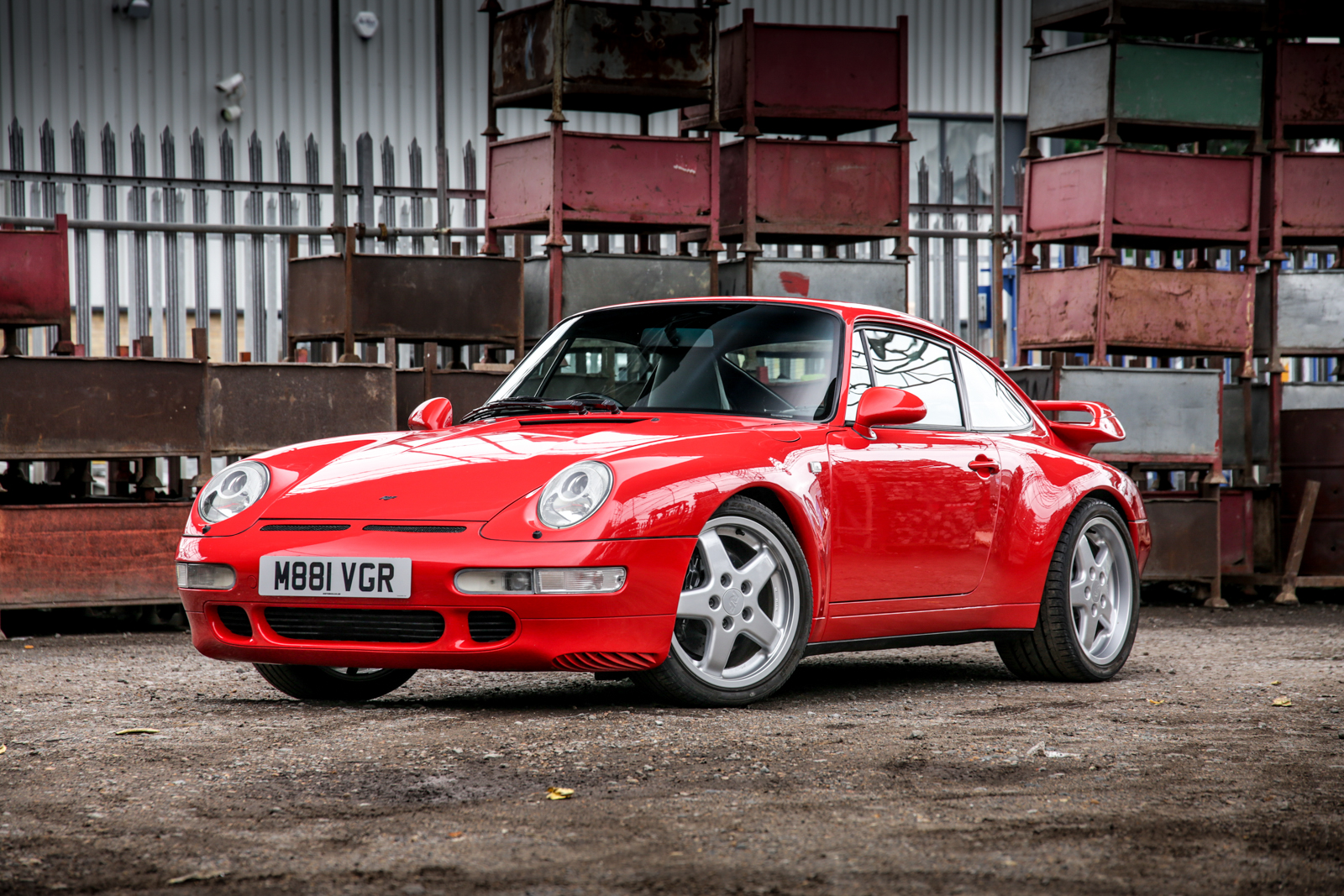
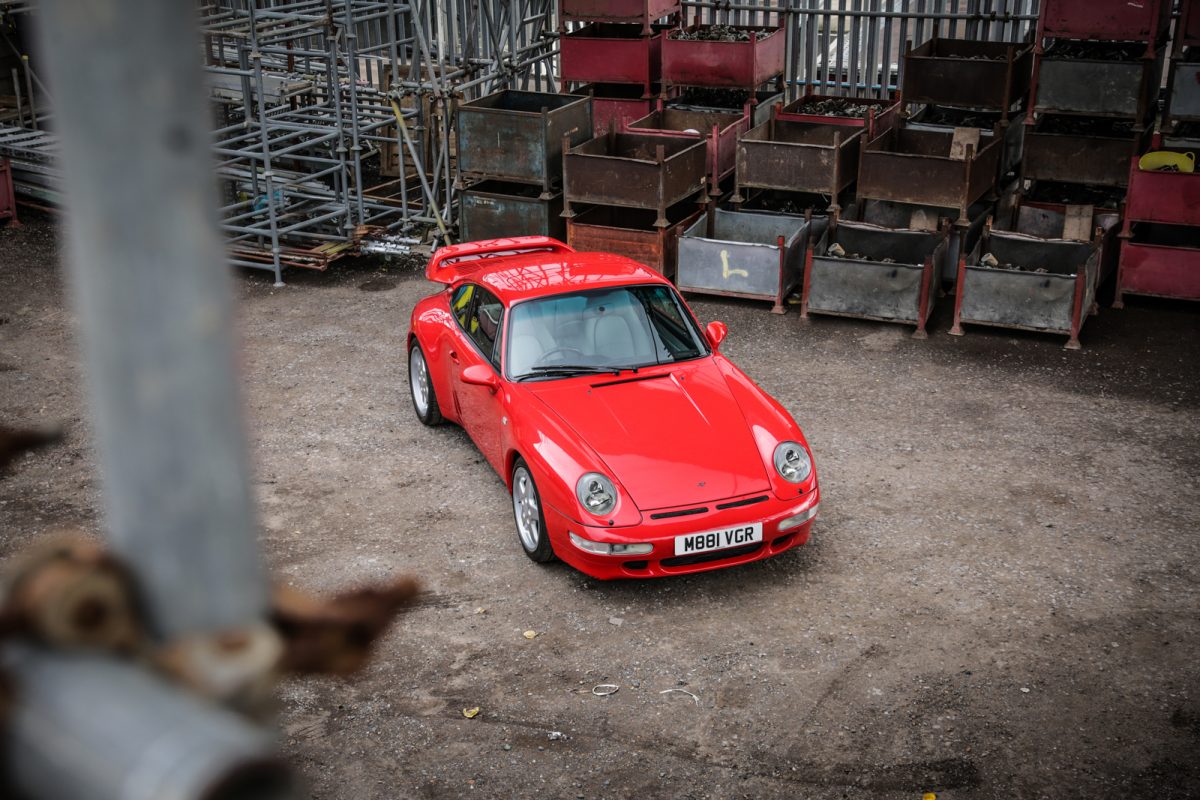
Ten years ago today, photographer Jamie Lipman and I drove 60 miles from Ventura in California to Mulholland Drive in Los Angeles. It was my first trip to LA and I was driving my own 911: an SC Coupe that I had bought on Craigslist a few months before.
Our destination was the Bel Air Presbyterian Church: a vast structure built in the mid-fifties on a ridge overlooking Burbank Airport, the San Fernando Valley and Hollywood. The view was entirely appropriate, as we were en route to meet a new star.
RGruppe hot rodder and owner of what was then the world’s coolest early 911, Rob Dickinson, had emailed a few weeks previously, asking if Jamie and I would do the first story on his brand new creation, presenting it to Porsche enthusiasts before it was launched to a wider audience. I was well up for that and arranged a magazine cover. I found some space in the schedule for a run to LA and waited for the day to arrive.
We spent a few days shooting various Porsches in and around San Francisco before driving to Ventura for the Porsche show there. The hotel and showground was packed out with RGruppe friends and family, and everyone wanted to talk about our date with Singer. Most people had an opinion and it was not all complimentary. But they all loved Rob.
The Zuffenhaus boys (who had supplied the wheels) and Harvey Weidman (master wheel refinisher) were also in town showing their RSR brakes and steering wheels. They shared great insight on the attention to detail that went in to getting the stance just right.
The designer had put a lot of thought into his creation and I was looking forward to seeing it. I was also excited that we’d been given the first proper feature: many big-name journos have covered it since, but we had been covering the underground in an interesting way and Rob was one of the taste makers. So getting this story was cool.
How to shift a culture
If you want to shift a cultural mindset, the best place to start is where people are open to shifts. I’m Irish, Jamie’s English and we expressed our ideas in an anglocentric way. We did sell our work overseas, but the primary outlets were British titles. Rob is obviously British and was steeped in the culture. The country that had birthed Monty Python and Punk was likely to click with where he was coming from.
Selling my output across the world, I’ve found that there’s a big difference in how ‘British’ car writers are regarded: look at Chris Harris and Henry Catchpole’s subscriber counts and read the feedback on their work to see the evidence of this. A lot of the people around Singer are British or some way Anglophile and the latest cars have had a lot of engineering in Britain. We will revisit this another time, but, to me, there is a clear public perception of a link between British creatives and a taste for new things.
From 2008-2012, our work covered (mainly RGruppe) modified cars in what up to then had been a sea of conservative content. RGruppe was widely regarded as mould breaking and this marked us out as a fit for Rob’s work. We didn’t have the reach of the big boys – it took me very little time to reject that path – but we were exploring and reporting the fringes of Porsche culture in an authentic way, had an idea of market tastes at a certain level and were likely to provide a warm welcome for the mould-breaking 911.
Three Types of People
In a Seth Godin podcasts called “Anthems, Pledges and Change”, the marketing thought leader explores how there has been substantial pushback over the years in response to certain interpretations of the American national anthem. Seth cites the examples of Aretha Franklin and Jose Feliciano: popular stars of their day who were vilified when they took the national anthem off piste. His podcast gets right to the heart of it.
“There are three kinds of people in every community: three kinds of people in every area of interest: at every event. One kind of person doesn’t want things to change. They’ve been sitting in the same seat at Yankee Stadium since it was built. They go to the baseball game because baseball doesn’t change.
“The second kind of person – the masses – they want to do what everybody else is doing. And the third kind of person is the early adopter: the neophyte, the neophiliac. They’re looking for something that’s new. One way we can define a cultural touchstone – a place, an event – is by the percentage of the three that are in the room.
“So, if you go to the Consumer Electronics Show in Las Vegas, it is filled to the top with people who want to know what’s new. But if you listen to America’s Top 40 on the radio, or watch CBS, you’re probably going to see a programme director who is obsessed with the masses. The reason you are listening or watching is to see what everybody else is seeing.
“And then you’ve got events and organisations and moments where most of the people there are laggards: they want it to stay the same. And it turns out that anthems and pledges are a really good place to find this sort of person.”
Anthems and pledges play a big part in American society, and in mainstream Porsche culture. The fear that what one is doing will be regarded by so-called peers as freakish or culturally unacceptable is what paralyses so many potential cultural shifts. Things that are initially mould breaking are often later paralysed by rampant conservatism as the masses move in.
Control of the Narrative
When Aretha Franklin was scorned for her rendition of the American national anthem, it was laggard-linked masses dictating the narrative. Those people did not want change. A fearful percentage wanted the status quo to prevail, their noise via letters and phone calls was interpreted as a majority and fear of destruction within media platforms dictated the coverage.
The same thing playa out on a grand scale in mass media coverage of social upheavals. Fearful masses swing towards the way it has always been and the mass media coverage follows accordingly. Defence against all discourse that might force social change begins with control of the narrative: look at 1930s Germany, what is happening in Turkey or the tone of mainstream British media in recent years. Look at how racism or oppression in parts of a country can be perpetuated by parents and grandparents: control of the narrative is key.
The interesting thing I see in Singer ten years ago – and I think a large part of how it turned the Porsche world on its head – was not its philosophy or styling, but the founder’s awareness of narrative. This was before he ever had media professionals involved. Nowadays, Singer feels carefully manicured, but this was just Rob on his own.
An early career in creativity – writing and recording music – and an understanding of how his work had been reported and reviewed gave Rob a valuable media consciousness. He placed his first product where he felt the change would be received impartially and given a chance. Starting at the fringes, it worked towards the centre. Building support amongst neophytes first, it infiltrated modified consciousness and became the masses’ gold standard.
At the core of the “we do it like this – we have always done it like this” Porsche sensibility, the arrival of Singer was controversial. Ten years later, it’s still a bit thorny. A lengthy disclaimer at the foot of the Singer home page testifies to some of the grief it went through at launch. But, as with anything that fights to exist for a decade, the brand has become a default.
For some, it is the default aesthetic for a hot rod Porsche: not amongst diehard enthusiasts, but without doubt for swathes of the masses. The cultural energy unleashed by Singer proved more than enough to power a movement and turned a culture on its head, shifting the way people looked at air-cooled 911s.
Singer: the catalyst
In 2009, the idea that Porsche would wrap its arms around a backstreet hot rodder like Magnus was highly unlikely. Thoughts that an £8k 911 SC would one day be worth five or six times that would have been ludicrous. When the 4-litre RS was launched in 2009, a tripling in price after launch was something that no one could imagine. Certainly I couldn’t see it and I was up to my neck in this stuff.
An awful lot changed in a short space of time. The bank crash put asset investment back on the map and classic Porsches were interesting. They were increasingly marketed as hand-built, time-warp artefacts. Now part of Volkswagen, Porsche was selling mostly SUVs, but the marketing value of the origin story and passion amongst grassroots enthusiasts began to materialise. If you had an interesting origin story, the media wanted to hear it and masses began to lean into it. Porsche began to lever grassroots passions to remind SUV buyers of sports car traditions and associated characters reinforcing that story became more important.
If one looks back at how this trend developed, it is impossible to discount Singer as a significant part of the catalyst. As the cultural shift began to take hold, partly centred on what Singer was doing, people who came to the brand with some media experience took over its origin story, designers amped up the style, the builders eventually sorted the dynamics. All these combined to deliver a compelling narrative. The confluence of its ingredients told a unique story and so it remains.
If you want to own a Singer (or, as legals prefer to call it, a Porsche 911 reimagined by Singer), you can’t build one in your shed: either you buy one or have something else. Only Aretha could sing the anthem like that and only Singer can build you a Singer. Today, that sounds obvious, but it took ten years to get here. Where will we be in another ten years?
Two red Porsche 911s caught my eye in the catalogue for the upcoming Aguttes sale in Lyon, France on November 9th. Values for both models soared when the Porsche market exploded but, as Orwell said, some pigs are more equal than others. Their potential selling prices are poles apart.
1966 Porsche 911 2-litre
Estimated at €180-200,000, this Polo Red SWB Porsche 911 – chassis number 304392 – was supplied through Sweden in May 1966 to a racer from Trollhättan. Built with triple Weber carburettors instead of the usual Solex, it lived in Sweden right up to the turn of the century, until it turned up in Germany.
Porsche 911 2.0 auction – photo by Aguttes
The car then sold to a museum in Austria and, when that closed, it passed through keepers in Switzerland and on to Normandy in France. By this stage it needed some money spent: the 2L market was buoyant in 2014 so it was fully repainted in the factory colour and restored to period spec.
Prettied up, it sold to another French collector and was sent to the racing mechanic, Pierre Modas, for an engine and transmission rebuild. Porsche dealers changed a few other bits and in total over €30,000 was spent on the mechanical restoration. The same work in the UK would probably cost a bit more, which perhaps suggests there was not much to do at the start or there may be a bit more to do now. Webers take less restoration than Solex, for sure.
1966 Porsche 911 2.0 interior – photo by Aguttes
The auctioneers claim this is an authentic example, but who can know without inspecting. A lot of 2-litres passed through various specialists while the market was freaking out and some work is better than others. The history is certainly interesting: particularly the Swedish angle.
1976 Porsche 911 Carrera 3.0 at auction
The other car in the catalogue that caught my eye was a 1976 Porsche 911 Carrera 3.0 Coupe. Estimated at €45-65,000, chassis number 9116600485 is a matching numbers example, first supplied by Dieteren in Belgium, that has been refinished in Guards Red/Indian Red from its original grey.
1976 Porsche 911 Carrera 3.0 – photo by Aguttes
Restoration or replacement of bits including half-floors, front crossmember (likely front pan) and the bumper mounts suggest the car was used well from new, or perhaps even caught a bit of damage somewhere, so the speedo reading of fairly low kms for the year may not be verifiable.
It has also had a new fuel tank (pretty standard for impact bumper cars of this era) and the suspension, brakes and steering have apparently been refurbished. The gearbox is also said to have been overhauled, though there is no mention of the engine or K-Jet being stripped. The car comes with bills for over €40k and plenty of photos for bidders to check.
1976 Porsche 911 Carrera 3.0 interior – photo by Aguttes
Owned by the current owner since 2010, this car was entered in the Hotel de Ventes sale at Monaco in July 2017 with an estimate of €60-80k at the time. It failed to sell for whatever reason and so returns to the sale rooms with a lower price tag attached. The drop of €15k on low estimate is where I see the market for a nice C3 right now: if I owned a car like this (assuming it is all as described) and if it didn’t fetch €45k, I would probably keep it. In a market as tough as this one has been through 2019, they could have done better pics to get interest going.
Porsche Colour Change vs Market Price
The factory colour is always what people get hooked on, but it is hard to say whether this 1976 Carrera 3.0 Coupe would offer a better sales prospect in original ‘grey’. Red is rare and looks good on early impact bumpers. The car also retains its original 5-bladed fan and has the 15″ Fuchs, which are more correct than 16s on a ’76. It’s starting pretty cheap for a C3 at €45k, so we’ll see how it goes on the day.
1976 Porsche 911 Carrera 3.0 engine – photo by Aguttes
My interest in this one is obvious – the effect of colour change on a Carrera 3.0 Coupe. My ’76 C3 was repainted in Continental Orange from the original Copper Bronze Metallic and, while I like the colour a lot, it will have to be redone at some stage. The option to refinish in the original or something completely different will therefore be mine somewhere down the road and more information may help make a ‘better’ decision.
Prices only matter when you sell and that is not something on my radar right now. Never say never, though. The clock is ticking and my kids won’t want it.
Ferdinand blogs my freelance adventure with Porsche at the centre. To support the blog or engage with me in other ways, you can:
My last four-hour flight to Lanzarote was a breeze, thanks to a great chat with Joe, a spritely seventy year-old parked alongside. After early retirement from an engineering career, Joe dived into volunteer work before joining a local friend’s burger van business. They threw themselves into growing the business and now run the bars at some of the world’s biggest music festivals and sports events.
What struck me most was not the stories my seat neighbour told, or his success, but the enthusiasm and energy that shined when he spoke about life. He was still pushing hard. The meeting put me in mind of another energetic 70 year-old that I’d read about: former Porsche CEO, Arno Bohn, interviewed by Keiron Fennelly for a story in Panorama magazine.
Born in Rheinfelden in March 1947, Arno Bohn was Porsche boss from 1990 to 1992. While CEO, he famously wrote a letter to Ferdinand Piëch suggesting that Piëch (grandson of Ferdinand Porsche) should retire from the Porsche supervisory board. This was in response to a letter from Piëch calling on Ferry (son of Ferdinand Porsche) to resign, as the company was verging on bankruptcy. The interview contained several insights into Porsche culture of the time, including factors behind the mission creep which sent costs spiralling on projects like the 959, the cancelled 984 (924 replacement) and 989: the aborted four-door 911.
Bohn’s predecessor, Peter Schutz, extended the 911 line and presided over 944 development, while his successor, Wendelin Wiedeking, oversaw the combined Boxster/996 platform (developed by Horst Marchart, according to Bohn) and the launch of Cayenne. Bohn was the bridge between the two trajectories: not an easy or comfortable role.
‘The car that saved Porsche’
Porsche retrospectives have a tendency to rate CEOs and the cars they help launch on the grand scale of company saviours, but that’s not how I see it.
Running your own business is all about ups and downs. When things are up, you reinvest, ploughing resources back in to product development, training new people and adding new capabilities. The cost of this work takes a balance sheet down – often close to breaking point – but the rewards of clever investment pay off in the long run. Keeping said “long run” to the absolute minimum is part of the role of a good CEO.
There are countless assertions as to how the 924 and Boxster saved Porsche, but it was largely the work that went into these cars that caused the balance sheet falls which were later reversed when the cars came to market. These projects start long before the CEOs credited with the product successes. One could say that there are no ‘cars that saved Porsche’. Instead, Stuttgart ploughed profits into these cars to widen its reach and build a better corporate future.
Arno Bohn’s Porsche legacy
Recruited from the IT industry, Bohn was used to quick product development times and tried to push the same through at Porsche, but his hands were apparently tied by longstanding inertia and in-house politics: no surprise to anyone who has studied the company’s story.
While Bohn was not an experienced car-making man, he’s said to have been a very good listener and that letter to Piëch – a powerful figure who helped bring him to Porsche – shows he was true to himself and brave when it mattered. The politics may have stitched him up a bit but, as commander-in-chief through a critical period, and the last CEO to leave Porsche as a fully independent operation, he’s earned a place in history.
Bohn is the link between Schutz and Wiedeking and his experience through the final years of Porsche independence is a fascinating window into what was going on. Bohn notes that Ferry was keen to build a four-door Porsche and, while some 989 prototype angles make it look like the unholy union of a Ford Mondeo with a 911 Carrera, there is perhaps is a slight regret that the project never took off.
Last year, I sold a Porsche Panamera V6 PDK for a friend of mine: a 2010 model in perfect condition with less than 50k miles. It took a few weeks to find a new home and eventually went for just over £20k: a bargain for the quality and engineering contained. Turns out that Arno Bohn also now drives a Panamera.
Had Bohn managed to introduce the 989 and helped to find it a place in the luxury market, giving the Panamera a slightly earlier start point and more engaging origin story, his legacy and that of Panamera might be rather more strident. In any case, he merits remembering as more than Weideking in waiting.
A version of this story first appeared as my column in GT Porsche magazine, February 2019. I now write a column in BMW Car magazine.
Ferdinand blogs my freelance adventure with Porsche at the centre. To support the blog or to engage with me in other ways, you can:
RM Sotheby’s end-of-year London sale takes place this Thursday at Olympia in Kensington. Fifteen Porsche cars are amongst the lots on offer and half of those cars are being sold without reserve. Here’s a look at three of the no-reserve Porsches that caught my eye.
1965 Porsche 356C LHD Coupe – estimate £50-60k
Chassis number 221132 is a Porsche 356 C 1600 Coupe. Finished in Light Ivory, Sotheby’s website doesn’t offer too many clues, but the car had previously sold at Goodwood Revival in 2008, so I dug out those details.
This ‘65 C Coupe began its life in California, where it was sold to a policeman from El Cerrito. In 1971, it passed from one policeman to another and stayed with him until it sold to the third owner in 1996. The third owner brought the car to the UK and kept it until 2008. It is offered for sale by the fourth owner.
The history includes an engine rebuild with 1700cc barrel and piston set at 112k miles, a transmission overhaul at 114k miles and a bare metal respray in its original colour, which was carried out in the UK. MOT history shows that the car has not been MOT’d since 2008, when it passed with a list of advisories including oil leaks and split CV boots. Interested parties should therefore proceed with caution, but a potentially solid 356C with sensible ownership since new and sold no reserve is worth a second look.
Porsche 911 Turbo Cabriolet – estimate £80-130k
Chassis number WP0ZZZ93ZJS020221 is a 1988 Porsche 930 Cabriolet with two owners from new. Presented in Diamond Blue Metallic with Cashmere Beige leather trim, the odometer shows 26k miles but, as Sotheby’s description doesn’t mention the mileage, assume it’s unwarranted.
I put this four-speed Turbo Cab on my watch list, not because it is a great example of the breed, but because 930 prices are an important benchmark for air-cooled 911s and the market has been a bit shaky.
The 930 had the highest cost new in period and open sale prices for these cars highlight real-time premiums for turbocharged vs normally aspirated 911s. The 930 market has been under pressure since the high water line of 2015, so this unrestored car in an elegant colour mix offered with no reserve will lay down a useful data point.
1992 LHD Porsche 968 Club Sport ex-factory press car – estimate £35-50k
The car I am most keen to follow is chassis number WP0ZZZ96ZPS815075: a left-hand drive 1992 Porsche 986 Club Sport in Speed Yellow. This 968 has a super interesting history that was recently shared in 911 & Porsche World magazine. The auction entry may have been encouraged by enthusiasm around the piece and that enthusiasm could be rewarded on Thursday.
Detective work by the current owner with assistance from the Porsche archive revealed that this 968 Club Sport was the factory press car used in several notable articles on the model. Walter Röhrl drove the car in a four-way road test printed in Auto Zeitung and called it ‘the best handling car that Porsche makes’. The history is very well documented and includes several Porsche factory service stamps, a top-end rebuild, clutch and flywheel at Parr and a huge list of work carried out by its current custodian over almost two decades.
I have a side interest in cars like this one that passed through the hands of well known racer and dealer, Nick Faure, as my early 944 Lux is one of those cars. Faure is a true devotee of the transaxle Porsches and those who love these cars tend to love them for life. I adore the 924, 944 and 968 models and there can’t be too many 968 Club Sports with such enjoyable provenance.
The light blue 930 has a fairly bullish estimate at £80-130k given the condition seen in the photos, while this apparently perfect 968 Club Sport at £35-50k feels relatively conservative in comparison. I suspect it may do slightly better: everything depends on who’s in the room when the cars come over the block in Kensington and whether there’s any hangover from the Type 64 debacle in Monterey. I would love to be there in person, but the dentist is calling…
Pics by Tom Gidden, Dirk de Jager and Adam Warner for RM Sotheby’s
Ferdinand blogs my freelance adventure with Porsche at the centre. To support this blog or to engage with me in other ways, you can:
Details have just arrived for a rare 1995 Porsche 993 Ruf BTR 2 that will be offered at Brooklands’ Historics auction sale on Saturday, November 23.
Ruf chassis number W09TB0367SPR06006 is one of five 420hp RHD BTR 2s produced. First delivered to Top Marques in Singapore and sold to a local businessman, that aspect of provenance could make it quite an attractive prospect for re-importation into a famously locked-down export destination where Porsches command serious prices.
The original car was finished in Aventura Green, but a later owner refinished the body in Guards Red. Personally, I love dark green cars but red is quite rare and suits the 993 shape. Somewhere down the line, the engine was also rebuilt by a New Zealand specialist. The original Ruf EKS automatic clutch system (think Sportomatic-ish) has been replaced by a more conventional arrangement.
The Guards Red 993 came to the UK in 2015 and sold to a retired engineer who took it to his place in France and maintained it in-house. It is now back in the UK. The sales description says it has been MOT’d but the MOT database says the last test expired in 2016, so crossed wires somewhere. The mileage is low at less than 30k from new.
Offered for sale with history including the original book pack, the auction’s pre-sale estimate is £68-84,000. We’ll have to see what the market is like at the end of November and how the changes to the Pfaffenhausen spec – including a colour change and non-Ruf engine rebuild – affect the car’s desirability.
A factory 993 Turbo with less than 30k miles would be pretty good news, even in the current slow market. What’s the price jump (up or down) from a Ruf BTR 2 to a factory Porsche 993 Turbo, and what’s the net effect on that number of diluting the original Rufness through later modifications to an already modified car? Will we be able to look at the eventual auction result and say ‘that’s the correct answer’?
The last RHD BTR 2 to come through a UK auction was a one-owner example with 68k miles that was offered in September 2018 but failed to find a home. The market has been on a bit of journey since then, so it will be interesting to see how this one gets on.
This website uses cookies to improve your experience. We'll assume you're ok with this, but you can opt-out if you wish.AcceptRead More
Privacy & Cookies Policy
Privacy Overview
This website uses cookies to improve your experience while you navigate through the website. Out of these, the cookies that are categorized as necessary are stored on your browser as they are essential for the working of basic functionalities of the website. We also use third-party cookies that help us analyze and understand how you use this website. These cookies will be stored in your browser only with your consent. You also have the option to opt-out of these cookies. But opting out of some of these cookies may affect your browsing experience.
Necessary cookies are absolutely essential for the website to function properly. This category only includes cookies that ensures basic functionalities and security features of the website. These cookies do not store any personal information.
Any cookies that may not be particularly necessary for the website to function and is used specifically to collect user personal data via analytics, ads, other embedded contents are termed as non-necessary cookies. It is mandatory to procure user consent prior to running these cookies on your website.