Today’s activity at the Japanese Grand Prix is cancelled due to Typhoon Hagibis hitting Suzuka. Watching videos of the drivers making plans for their gift of free time, I feel like I’ve also been gifted some time and I’m spending that gift in the garage.
I’m currently waiting for the postman to deliver a steering head bearing for one of my BMW R1100R motorcycles and will get that pressed in when it arrives. I’m then going to ready the rest of the bike for an MOT test later this week. Youtube has no videos of R1100 steering head bearing replacement, so I might shoot something on that. Either way, I’m looking forward to doing the work.
Saturday is garage day for me and that time is closely guarded. When one is young and working Monday to Friday, free time can seem like a given. Time in general, but free time particularly. One of the great dangers of freelancing is taking on so much work that one works seven days a week. This is especially true of freelancers who work doing what they love.
I was very guilty of this when I first went full-time freelance back in 2010. Having handed the company Prius back to my motor trade publisher employers and gone solo a little ahead of time, the great fear was cashflow, so I took on everything that was offered. I was writing for two mainstream motoring magazines, several specialist Porsche magazines, many private PR clients and picking up other work, including bizarre jobs like writing a tourist brochure promoting adrenalin sports in Bedfordshire and oddball topics for in-flight magazines.
I rented an office in a village nearby and would go straight there after the school run. The working day started at 9:30am and frequently finished after midnight. No school at weekends meant I could start work at 7am and work through to the early hours of the following morning. Workaholic doesn’t begin to describe life at that time: if I wasn’t asleep for my usual four hours a night or running my three daughters to school, I was sitting in front of a Mac and trying to come up with the next big idea that would encourage clients not to drop me the following month.
The Freelance Fear
It took a long time to overcome the idea that every client phone call was the one that would end our relationship, and I was in good company. Derek Bell told me that he felt the same way when working for Ferrari. “Every time someone told me that Mr Ferrari wanted to see me, I was sure this would be the day he would tell me he’d finally figured out that I wasn’t that good and could I please leave the building.”
While freelancers all look at other freelancers and wish for their confidence, “freelance fear” is universal. Derek Bell eventually left Ferrari when he nearly burned to death in one of its cars and I had a similar epiphany in 2012. After two years of manic freelancing, I was making great money but putting on weight and becoming lethargic. The early years with my kids were drifting away at the expense of clients, most of whom would have left me to burn if my world caught fire and hired someone else in a heartbeat.
What was going on in my head was the same thing all of us face: mortality. Seneca’s letter “On the Shortness of Life’ expresses this perfectly. “You will hear many men saying: “After my fiftieth year I shall retire into leisure, my sixtieth year shall release me from public duties.” And what guarantee, pray, have you that your life will last longer? Who will suffer your course to be just as you plan it? Are you not ashamed to reserve for yourself only the remnant of life, and to set apart for wisdom only that time which cannot be devoted to any business? How late it is to begin to live just when we must cease to live! What foolish forgetfulness of mortality to postpone wholesome plans to the fiftieth and sixtieth year, and to intend to begin life at a point to which few have attained!”
Seneca wrote this over two thousand years ago. The meaning of life, or “What should time be about?” is the question we’ve considered since the earliest days. As it is definitely not about selling your life to people who do not truly care about you, I started taking my time back.
Magazines were the first to go, as they never paid on time and were all pushing for more work for less money. I kept one magazine, as the editor is such a great friend and I have continued to work with him, mostly for free. My childhood ambition was to write for the car magazines I lost myself in from my earliest days and keeping that outlet is incredibly important to me: it honours a brave young man who got on a bus to London with his favourite music, £65 in his pocket and the desire to be published alongside his heroes.
As I retreated from jobs that any writer could do, I began to focus on the work that challenged me to keep learning and developing my marketing skills. I went back to college and studied photography. I teamed up with people starting new businesses: the classic Porsche risk takers. I made myself affordable for those guys, as their passion was infectious and our life stories often ran parallel. We understood each other without talking and breathed the same freelance air. Working with risk takers is always going to be at the centre of what I’m about.
Next year will be my tenth year as a full-time freelancer, and I look back on that decade with great fondness and respect. My kids are now starting to make their own lives and I know who they are: they are wonderful people and a great source of pride to their parents. Since taking more time for my health and wellbeing, I’ve lost thirty-five pounds and suffered no serious illnesses – touch wood. I’ve learned to cook quite a bit and enjoy time with Ted the Jack Russell and with my cars, bikes and friends. I continue to work with classic Porsche risk takers and they are a constant source of joy and inspiration.
Porsche as a centre of life
It’s hard to believe that Porsche as a brand sits at the centre of this most rewarding decade. Having always read voraciously, these cars are part of my story and bookmark chapters in my life much more than people or places. My earliest Porsche memory is as a young Irish boy sitting in a field, watching my first 911 pass by and sensing something important. Touching my first 911, driving my first one, buying my first: these are all moments when goals were achieved that reset my vision of life.
Less being more is a core Porsche philosophy, but Porsche did not invent the idea. The founders, designers and those who were attracted to the tribe connected with the importance of what was, and is, important. As we are all ultimately in search of the meaning of life, what better conduit to consider these questions than a classic Porsche? Simple, beautiful, highly emotional but humanly flawed. Every Porsche represents human imperfection.
We can read the daily press releases talking up the future – today it is Porsche’s new flying car partnership with Boeing – and get sucked into chasing what’s next, but the future is all about your time running out. Do not forget the importance of now. Learn from the great minds that have already passed: slow down and think of your time. One day it will be over, as this inscription on a Scottish gravestone so wisely reminds us.
“My glass has run Yours is running Be wise in time Your hour is coming”
Has your Porsche help you to put metaphysical life into context? Tell me about that: in comments or in confidence.
p.s.: As I pressed “publish” on this blog, the steering head bearing dropped through the letterbox. Flow is how life works when we embrace what is truly important. Enjoy your weekend.
To learn more about my work and commission my valuation expertise or content generation skills, you can:
The most irritating thing about watching Youtube on a smart TV with a slightly clunky UI is scrolling past endless suggestions from promoted channels. Five things new motorbike riders don’t know, top five disturbing church videos, top five lowest jet fighter flypasts and so on. Porsche also latched on to top fives a while back and, while this format is not my favourite, they have buried some nuggets in there.
The last Top Five feature on the Porsche Youtube channel was Wolfgang Porsche’s Top Five Porsches. Filmed in the bright, spacious garage at Zell am See, the programme follows Ferry’s youngest son (above, with Hans Klauser and his dad at Le Mans 1956) through five of his favourites. The garage is packed with special cars, but his choices seem very authentic, rather than a list from some corporate PR type. Forgive my ever-present inner cynic.
Porsche 993 Turbo S
Dr Porsche’s first choice is a 993 Turbo S. 345 Turbo S models were built from 1997 onwards, with just 26 examples made in RHD. The Turbo S had a 450bhp twin-turbo flat-six and shot from 0-60 in 3.6 seconds. Distinguished by several features including air intakes in the rear quarters, yellow brake calipers and a unique rear wing, all Turbo S models were built by the Exclusive department. The cars feel pretty special inside and have become highly desirable.
Wolfgang Porsche 993 Turbo S
“The 911 was the successor to the 356,” says Wolfgang. “All the diehards who drove a 356 said “How awful, what kind of a new car do you call this? This can’t be right.” The 911 has now proven itself in fifty years and has forever been undergoing further development. The diehards quietened down and there are many who now drive a 911 instead of the 356.
“My brother Ferdinand Alexander created the aesthetic design and always insisted that it should be a puristic design. He was always the one who said that cars shouldn’t have many frills. The family green was my father’s favourite colour: he had almost all his cars in green.
“The 993 Turbo S is one of the last to have an air-cooled engine. And for this reason it also has a good sound. It’s a good car in any case.”
Wolfgang’s body language when he talks about the sound – a broad emerging smile and a quick glance to the top left – speaks volumes. Big smiles are hard to fake and looking up is a sign of thinking. Looking up and left is said to show information being processed and related to a past experience or emotion. Watch for this when someone talks about a car or a bike they are trying to sell you. If they never look up and left, they really didn’t like this machine. It’s one clue that you can do some damage with your bids!
As an opening choice, the 993 was a good one. I liked the dig at the 356 crowd: socially correct Porsche banter. Hang around 356 boys long enough and you’ll learn that they all love a bit of 356 vs 911 chat: Wolfgang has clearly spent plenty of time in both camps.
The next choice is a Carrera GT and the third is a Panamera Hybrid. “My father would surely have wanted this car because he always said “the newest car is always the best.” Whenever I added an old car to my collection, he always said “why are you driving such an old car? The newer one is always the better one.””
Cars four and five get to the real meat in the sandwich. Four is the America Roadster. Finished in Stone Grey (akin to the Chalk colour chosen for the Panamera Hybrid), the 1952 America Roadster has a 70 horsepower in just 600 kilograms of aluminium bodyshell. “It’s a proper sports car from the ’50s.”
1962 Porsche 356 Carrera 2000 GS
The final car chosen is a 1962 Porsche 356 Carrera GS: Stuttgart’s ultimate performance car of the time. Fitted with the 130 bhp 2-litre four-cam engine, the Carrera 2 cost a fortune when new and just over 400 were manufactured. The cars are now highly desirable: good examples can fetch $350-400k or more at auction.
The Carrera 2 had the Type 578 engine, which had a bigger bore and stroke compared to the earlier 1.5-litre Type 547 Fuhrmann four-cam. The new engine offered more torque but it was also much larger than the earlier motor and hung down lower in the chassis.
“Underneath the skin is a proper sports car,” says Wolfgang. “The ‘Carrera’ in the name means that it’s a very sporty car from this model range. It’s got 130 hp and, in my eyes, it’s a wolf in sheep’s clothing because you don’t realise how powerful it is at first sight.
“The only thing that gives it away is the low-slung exhaust and this tail piece: that’s why this car is also nicknamed ‘the pregnant cat’. This car has a fantastic sound – the exhaust is simply great and the power is great. The Irish Green is one of my favourite colours.”
The Porsche Top Five videos are a slightly off-kilter explosion of brash graphics, choppy edits and Hollywood voiceover, but there is no mistaking Wolfgang’s obvious delight in the cars and what it means to own and enjoy these things: it’s all right there in one cheeky grin when he drops the pregnant cat.
Wolfgang Porsche 356 Carrera GS – Enstall Classic 2017
To me, it seems like the 356 Carrera might be his actual favourite. He’s used it on at least one Enstall Classic (above) and it is right at the point where the 911 kicks in. Perhaps no 911 could ever be as special to one of Ferry’s sons as the ultimate road-going expression of one of their father’s original cars. I can sort of understand that, if it’s the case.
Watch the video below and check out what else is hiding in the garage: 904, 959 and a row of 356 Roadsters. A sports car guy, for sure.
https://www.youtube.com/watch?v=RCzrSaaWd_0
Wolfgang Porsche: Top 5 Porsches
SHARE • EXPLORE • SUPPORT
Ferdinand blogs my freelance adventure with Porsche at the centre. To support the blog or engage with me in other ways, you can:
Ferdinand Piëch (above right with his grandfather, Ferdinand Porsche) has died at the age of 82. Justly famous for many successes across a glittering automotive career, Piëch was a polarising character. I can’t think of one other person – certainly not in the world of engineering – who provokes such extremes of delight and derision.
The French writer, André Gide (1869-1951) wrote: “It is better to be hated for what you are than to be loved for what you are not.” Winner of the Nobel Prize for Literature in 1947, Gide lived this idea to its absolute maximum and Piëch was also in tune.
Born in Vienna in 1937 to Louise (Porsche) and Anton Piëch, Ferdinand graduated from the ETH Zurich in 1962 with a degree in mechanical engineering. His thesis was on the subject of developing a Formula 1 engine. That same year, Porsche built an F1 engine (designed by Hans Mezger) and put it in the 804, the body of which was designed by Piëch’s cousin, Butzi Porsche. The car won the 1962 French Grand Prix.
After joining Porsche in 1963 – the year Butzi was feted as the designer of the Porsche 911 – Piëch was appointed Head of R&D in 1968 and became Porsche’s Technical Director in 1971. This did not sit well in some quarters. A year later, the infighting at Porsche became so overwhelming that Ferry passed a boardroom resolution stating no family member should be involved with day-to-day Porsche operations. The second generation was exiled.
Though Piëch is best known for post-Porsche achievements at Audi and Volkswagen, his first freelance engineering assignment kept him in Stuttgart. Mercedes-Benz chief, Joachim Zahn, brought Piëch in to work on the 3-litre five-cylinder OM-600 diesel engine that debuted in the 1975 W115 240D. The oil burner earned a reputation as one of the greatest engines ever developed. Stock OM 5-cylinders have covered over 1 million kilometres without major repair and tuned OMs can make more than 1,000 horsepower.
After Mercedes, Piëch took the pivotal decision to join Audi as a special projects engineer in 1972. My best friend at school was the son of a Volkswagen/Audi dealer and I vividly remember early-seventies Audis being notably run-of-the-mill. Piëch would change all that.
Turning his gift for technical innovation up to eleven, Piëch personified what was later trademarked as Audi’s brand motto: “Vorsprung durch Technik” (advancement through technology). He led development of the first-ever five-cylinder petrol engine, before adding a turbocharger and building the perfect platform for it: the all-conquering Audi Quattro.
Few products can match the Quattro’s effect on the meaning of cars: the ones that come close usually had Piëch’s involvement (hello Veyron). Launched in 1977, the Quattro was the equivalent of a punk rock band hijacking a bus full of car engineers. For rally fans like me, the greatest motorsport moments of the late 1970s and early 1980s are photos like this:
Piëch’s hits kept coming, with the first turbodiesel engine. TDI became the power of choice for decades. He repeated the Quattro effect by building the perfect home for the TDI engine: the C3 Audi 100. Keeping the car’s innovative aerodynamics a secret by developing the styling away from Audi HQ, Piëch’s slippery 100 set new benchmarks, including a drag coefficient of just 0.30. Completely out of character for a three-box saloon, everything about the car – from the door handles, to the seats, to the feel of the switches – turned Audi’s brand image on its head. I had a much-loved 100 Avant and the 200 Turbo Avant of that era remains one of the most exciting cars I have driven. The later Audi 80 TDI was also fantastic to drive.
In 1993, Piëch joined Volkswagen. The carmaker had just posted the greatest loss in its history, but Piëch had a plan. He introduced single platforms to underpin models across individual brands that could be restyled or redeveloped to suit individual brand characters. The concept brought incredible economies of scale: two-thirds of the parts in each platform-based model were shared across brands. This revolutionised profit margins. During his nine years as CEO (before a further fifteen years as VW Chairman), Volkswagen went from losses of €1 billion to profits of €2.6 billion and became an automotive empire of twelve brands including Scania, Bentley and, most controversially, Porsche.
“Of course I am proud of my grandfather (Ferdinand Porsche),” said Piëch in his autobiography. “But I never felt it my mission to uphold his greatness, nor could I do anything about media suggestions that I suffered from an inferiority complex.”
An inferiority complex would have been fairly low maintenance compared to what actually happened. Piëch’s engineering prowess was matched by an appetite for political intrigue and dramatic events. “It is not possible to take a company to the top by focusing on the highest level of harmony,” is how he put it.
Father to thirteen children by four different women, including Marlene Porsche (his cousin Gerard’s wife of the time), if Ferdinand wanted something to happen, it got done, regardless of consequences. “First and foremost, I always saw myself as a product person, and relied on gut instinct for market demand. Business and politics never distracted me from the core of our mission: to develop and make attractive cars.”
Porsche and VW Tributes
Even those Piëch battled appreciate his achievements. “A gifted car and engine developer whose attention to detail is limitless,” said former Porsche CEO, Wendelin Weideking. “Nothing left the production line that Piëch had not personally closely inspected. However, Piëch was not consistent: it was always a high risk gamble to guess if you had his support.”
“There is not enough time here to sufficiently pay homage to him,” said Hans Dieter Pötsch, Piech’s successor as VW chairman. “The short version is personally I think Ferdinand Piëch set unforgettable milestones in automotive industry and he played a material role in the existence of the Volkswagen Group in its current state.”
“The life’s work of my brother goes above and beyond the companies he worked for,” said Dr. Hans Michel Piëch, Deputy Chairman of the Supervisory Board of Porsche SE. “He shaped the German car industry more than any other. And he was closely related to the employees of the Volkswagen Group, in both good times and in bad. Our thoughts are with his wife Ursula and his children. We mourn with them as we mourn with the employees of the Volkswagen Group and all car-enthusiasts, whose lives Ferdinand K. Piëch enriched with his passion.”
RIP Ferdinand Piëch
This morning’s papers all carry obituaries for Ferdinand Piëch and the usual perspectives are present: genius engineer, egomaniacal oligarch, destructive drama queen and the rest. I never met the man, so can only go by what I know: his products. From the air-cooled racing spaceship: the Porsche 917, to the five-cylinder Audi engines, Quattro, the Audi 100 and the Volkswagen XL-1, which was inspired by his 1-Litre-Auto, the products of Ferdinand Piëch are an eternal delight. I will continue to enjoy them and the connection they afford to one of the great minds in automotive history.
Ferdinand Piëch’s talent for technical innovation was fuelled directly by his grandfather’s legacy. The ideas that flowed into production as a result brought twentieth century automotive engineering to an entirely new level. The passing of Ferdinand Piëch is literally the end of an era: our collective futures will miss his unique contribution.
Fallout from the failed sale of the so-called “First Ever Porsche” – the 1939 Volkswagen Type 64 – at RM Sotheby’s in Monterey continues to unfold across the Internet. If you missed it, the car crossed the block fairly late in the sale and bidding in the packed tent began at an eye-watering price. A series of errors then followed.
Auctioneer Maarten ten Holder is said to have opened by saying that Sotheby’s had a bid at $30 million. The screens were duly set to this. As Maarten called out the bids, the numbers on the screens (facing away from the auctioneer) went up in $10 million increments until the podium displays read $70 million, at which time the auctioneer said the bids were in fact at $17 million and the numbers should be corrected, blaming his Dutch accent for the confusion.
From videos of the sale, it seems clear to me that Maarten is going up in increments of $500,000 from a start point of $13 million, and not ten million from a start of $30 million. However, the main fallout has come from claims of shill or chandelier bidding, where the auctioneer is calling increasing numbers with no bids actually received. Auction watchers are pointing the finger at dishonourable conduct.
Bid Running at Auction
I am not presuming any guilt here, and I’m not affected one way or the other, so there is no issue at my end. But anyone who thinks that ghost bidding is unusual conduct at auction needs a reality check. The best auctioneers all make their reputations through generating a fever and driving bidders to ever-greater heights: the practice is known as running the bids. Having bought hundreds of cars at auction in my career as a retail car buyer, I have had the bids run on me more times than I care to imagine. It is part of the auction experience.
I don’t remember one auction from the hundreds I’ve attended over more than thirty years in the motor trade where something that clearly was not worth the space it was taking up went for a higher price than expected. I have written several magazine columns about this crazy phenomena.
It usually happens when a private buyer comes along who has never been to auction before and the bids are run up to private sale money for a car sold as seen without prior approval. While it makes no sense to buy a car at auction without any sort of test drive, and pay the same price as one would from a bona fide private seller with a test drive before purchase, the practice is just as commonplace today as it ever was. Car auctions are not the best place to learn how to bid.
One type of auction where bid running was less common back in the pre-Internet days was disposal sales, where the auctioneers were getting a fixed price, regardless of whether items sold or not. This included Police and Lost Property sales held all over London and trade disposals, such as the old sales hall at Dingwalls in Croydon; probably now demolished to make way for a retail distribution centre. I bought a stack of cheap cars at London disposal sales in the late 1980s and early 1990s and they came at exactly the right price.
Contrast this to a job lot of cars I bought at a well-attended Colchester sale around the same time. This was a job lot of ex-Tesco fleet cars in the colours of the Tesco logo (all non-metallic red, white and dark blue) and I paid well into book for all of them. They were all presented in good condition, ready to be sold, so I knew I could make a profit on the lot, but the auctioneer made it bloody expensive for me. I never went back there again.
“Once bitten, twice shy” is likely to affect some reputations for a while, but all auctioneers will feel Maarten ten Holder’s pain. The car was already cooling off after Porsche took the unusual step of publicly denying any special Porsche provenance for the Type 64, over and above its undeniable importance as one of the early VW-based racing cars built by Ferdinand. It was down to ten Holder to do his job and get things cracking in the hall and he had a good go. The problem with the numbers turned things into a bit of a joke, but did he really get the bids?
Before the sale started, the car had already been offered to everyone who was likely to buy it and all had refused at the asking price. Bids supposedly went to $17 million in the tent, but the car is still listed as being for sale. It is clearly worth buying, just apparently not at that price.
The car now sits in storage in California, where its market value has been described as “f**ked” by people who should know a bit better. The truth is that good collectors are switched-on investors who get into this for the long term. Their experience and love of a deal makes then savvy and open to taking a risk. There is no doubt in my mind that the vultures are already circling above the Type 64.
The scandal surrounding the car and its first trip across the block has added to its story and therefore its appeal in certain quarters. Commentators who put a pre-sale value of up to $5 million on it may eventually learn that the car has changed hands privately for more than this: it would not surprise me one bit. It depends on the mindset of the owners: if there’s a lawsuit pending, then all bets are off.
I would put a bit more than $5 million on it and, if I had the money, I would be making enquiries. It’s an interesting story and perceived long term value of these things is all about the story. If you don’t know this about the human condition, you will never make a good auctioneer!
California is set to reassert its credentials as the epicentre of the classic Porsche universe this August, when RM Sotheby’s offers what it is calling the first-ever Porsche for sale at the Monterey weekend.
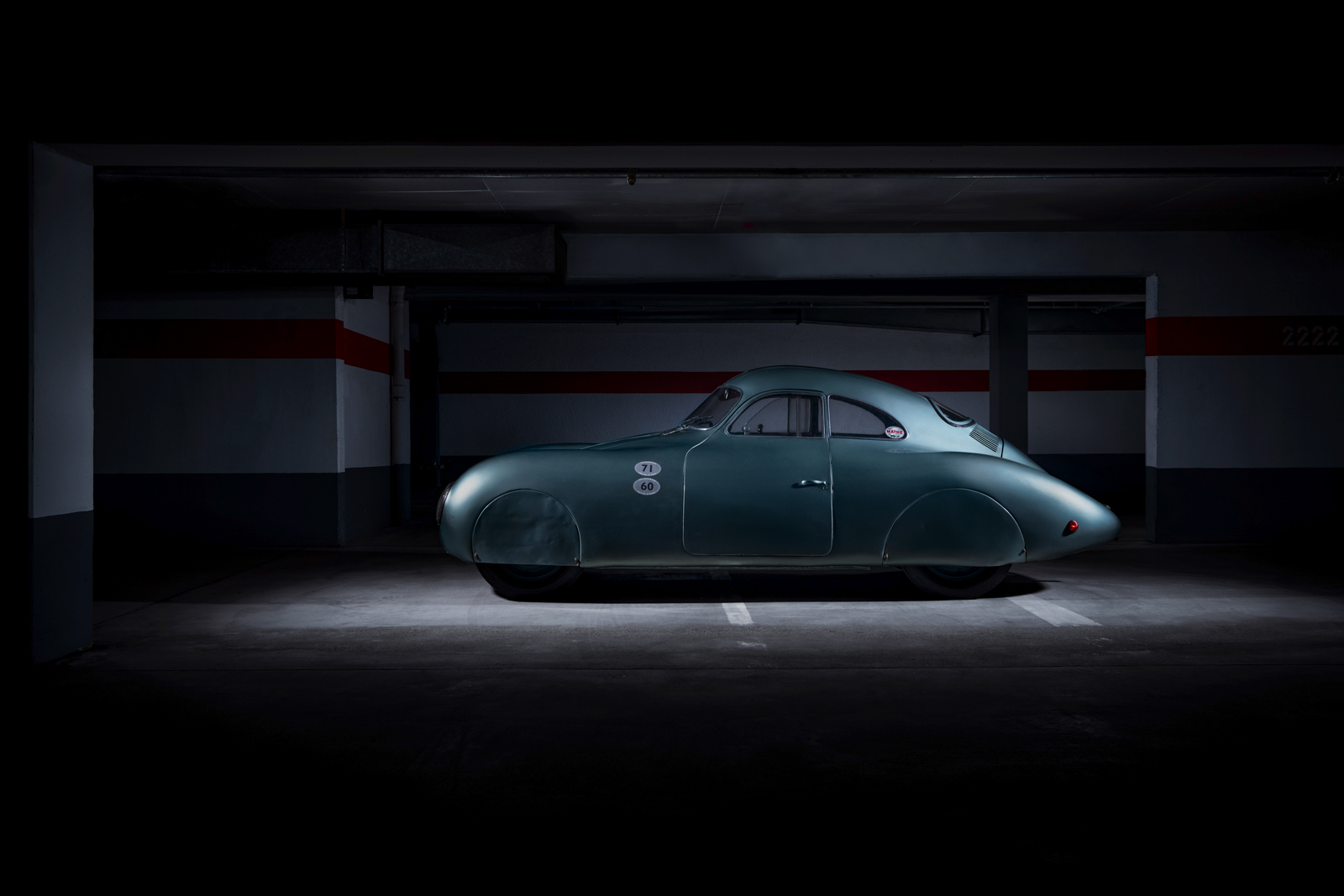
Sotheby’s refers to the car as “the only surviving example of the Type 64 Porsche and the personal car of both Ferdinand and Ferry Porsche,” but the honorary title is at odds with respected Porsche historian and friend of the Porsche archives, Karl Ludvigsen, who describes this car and its stablemates as Type 60K10s rather than Type 64s. This car is noted by Ludvigsen as one of three 60K10s built in preparation for the Berlin-Rome race, which was planned to run in September 1939. The historian explains things as follows:
“When, in 1941, Porsche compiled a book covering the activities of its first ten years, it conflated the Types 64 and 60K10 under the “Type 64″ heading. Understandably, this has led to confusion for later historians. This author prefers to maintain a clear distance between the two projects, which were in fact distinctly different and played contrasting roles in the Porsche sports-car saga.”
Type 64 Origins
The origin of the Type 64 Volkswagen is well documented. Ludvigsen’s must-have work ‘Origin of the Species‘ describes how, in 1937, “Porsche designers sketched the specifications of another member of the VW family, the Type 64, listed in the Porsche annals as VW-Rekord (Sport)”. However, circumstances surrounding the Type 64 plans were difficult.
Building one-off sports cars didn’t suit the PR tastes of the German Labour Front, overseers of the KdF-Wagen (Volkswagen) project that the Type 64 was based on. Nor would the organisation sell KdF parts to Porsche for the design house to build its own Type 64s. As Porsche could neither obtain the parts or the funding to take the project further, no Type 64s were ever built.
Enter the KdF 60K10
When the first Autobahn was opened from Berlin to Munich, a race was planned for Autumn 1939, to highlight the feat of civil engineering. After sprinting south through Germany along the new highway, the competitors would continue through Austria to the Brenner Pass before racing closed roads, all the way to Rome.
With deliveries of the new Volkswagen/KdF-Wagen scheduled for early 1940, the race was tailor-made for PR. A racing car built on the Volkswagen was now an entirely different proposition, and the Labour Front was now all in favour. Ferdinand Porsche decided that the cars should be built on the standard Type 60 VW chassis with a special aluminium body hand built by Reutter.
Much of the engineering for Type 64 was integrated into the Type 60K10, allowing a short development cycle. The first of three cars was finished in August 1939, with the second completed a month later. The race was officially shelved after Germany invaded Poland the following month, but one more car was finished in June 1940. Based on the damaged chassis of car number one, that is the car being offered for sale.
First-Ever Porsche: The History
Sotheby’s press release tells how “the third Type 64 was retained as a personal family car and driven extensively by Ferry and Ferdinand Porsche. When the company was forced to relocate headquarters to Gmünd, Austria from 1944-1948, it was kept alongside No. 2 at the family estate in the picturesque lakeside town of Zell-am-See. No. 3 was the only example to survive the war, and Ferry Porsche himself applied the raised letters spelling out ‘PORSCHE’ on the nose of the car when he had in registered in Austria under the new company name in 1946.
“In 1947, restoration work was commissioned by Porsche and completed by a young Pinin Farina in Turin, Italy. Nearly one year later, Porsche demonstrated the Type 356 roadster, no. 1, on public roads in Innsbruck, with the Type 64 by its side. Austrian privateer driver Otto Mathé completed demo laps in the Type 64 and fell in love, buying it from Porsche the following year. He enjoyed a successful racing career with the car in the 1950s—the very first to do so in a Porsche product—and kept it for 46 years until his death in 1995.
“In 1997, the Type 64 changed hands for just the second time in six decades and appeared at a handful of vintage racing events with its third owner, Dr. Thomas Gruber of Vienna, including Goodwood and the Austrian Ennstal Classic. Dr. Gruber is the author of the renowned Carrera RS book and one of the most respected Porsche specialists worldwide. Delightfully patinated, the streamlined 1939 Porsche Type 64 is now offered in Monterey from the long-term care of just its fourth owner, who acquired the car more than a decade ago, and is accompanied by many original spare parts, as well as extensive period images and historic documentation.”
Previous efforts to sell the Type 64
Instagram threads on this car throw up a few stories regarding previous efforts to sell it privately. One commenter on the RM thread suggests that Mathé’s guys may have altered a chassis number back in the day (quite common on older Porsches) and classic Porsche dealer, Maurice Felsbourg, commented that “The Otto Mathé car has been for sale by owners for years now. Each time asking price was met, they either raised it or changed their mind. They play golf with Piëch & Porsche, they surely won’t buy it. I hope bidding stalls at €5m.”
Sounds slightly like sour grapes you might think, but it is true that the car has previously been offered to specialists. One contact showed me an email from 2014, when he was offered the car at €12 million. Plenty of people will know about recent efforts to sell and that will influence some bidders. It if often the case that collectors reject the opportunity to buy in open market when the seller has made things difficult behind closed doors.
Whether you call this car a Type 64 or a Type 60K10, assuming the car all checks out, this is the most significant VW-Porsche to come up for sale since the last time it changed hands. Sotheby’s press release says that it could get up to $20 million: we’ll see how that goes.
This website uses cookies to improve your experience. We'll assume you're ok with this, but you can opt-out if you wish.AcceptRead More
Privacy & Cookies Policy
Privacy Overview
This website uses cookies to improve your experience while you navigate through the website. Out of these, the cookies that are categorized as necessary are stored on your browser as they are essential for the working of basic functionalities of the website. We also use third-party cookies that help us analyze and understand how you use this website. These cookies will be stored in your browser only with your consent. You also have the option to opt-out of these cookies. But opting out of some of these cookies may affect your browsing experience.
Necessary cookies are absolutely essential for the website to function properly. This category only includes cookies that ensures basic functionalities and security features of the website. These cookies do not store any personal information.
Any cookies that may not be particularly necessary for the website to function and is used specifically to collect user personal data via analytics, ads, other embedded contents are termed as non-necessary cookies. It is mandatory to procure user consent prior to running these cookies on your website.