by John Glynn | Apr 26, 2010 | Classic Porsche Blog
Juggling the day job and preparations for the US trip has left little time for blogging in the last week or two. Here’s part 1 of my Essen pics – I took quite a bundle. Hopefully you’ll find them interesting.
First up is the 917K, brought from Stuttgart for the show. I must have taken 50 pictures of this over the three days I was there. But is it really Dickie Attwood’s 1970 Le Mans-winning car? Definitely the real deal? Not according to some people I spoke to. But beautiful.
Mittelmotor’s Micheal Wittke always brings amazing things to look at. This is his 914 build a la Sonauto: Le Mans 1970 all over again. Within a stone’s throw of each other, these two (above and below).

Classic Motorsport’s supertasty RSR shell. The fit and finish of the panels was exceptional. But, as Aaron said, not quite sure what the story was with the rear suspension and swaybar mounts. Nice though – very nice.

Beautiful little Carrera 2 from Steenbuck Automobiles. Always a selection of incredible 356s from these guys at Essen.

I am swooning over loads of 914s at the minute: got a real thing for them. I’ll have to get myself one soon (a hot rod, obviously). This 914/6 would be a perfect base for a hot rod build if it wasn’t so MINT! Loved this immaculate example.

Porsche 356 Carreras are one thing, but a nice little 1600 Super motor is pretty sexy too. Not sure about the shiny coil but the rest sure looked good. You can’t beat teastrainers for retro intake kudos!

Here’s a Speedster conversion on a 356 B; very nicely done. What about the €55k price tag? Any thoughts from the 356 crowd?

Never seen this colour trim in such good condition on a 911 before and I’ve seen a few 911s. Rich Brown leather with leather dash, leather armpulls: the lot. Absolutely superb at GT Classics (local boys).

Was wandering through the parts hall on my way to another schnitzel when I spotted this tray under yellowing plastic. The stallholder let me play around a bit with my little Leica, so I bought a nice old Matchbox 930 from him: Emerald Green with Tan/Cork interior. My perfect 930 spec ‘in true life’, as the kids say.

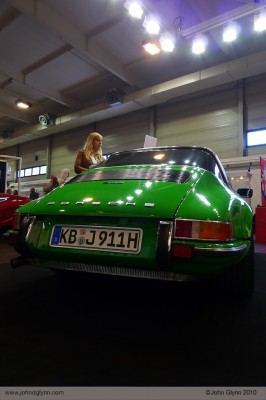
I call this one ‘Blonde with Viper Green Targa’.
You’d think Chocolate Brown on an SC would be kinda wrong. Instead, it is so right. If I owned this, I’d be sponsored by Lindt.

Finally for Part 1: a Kiln Red 911 SC Targa, fresh off the boat from America and wearing nice soft paint. €28k euros to you! But a great colour nonetheless.


by John Glynn | Apr 15, 2010 | Classic Porsche Blog, Modified Porsche Hot Rods
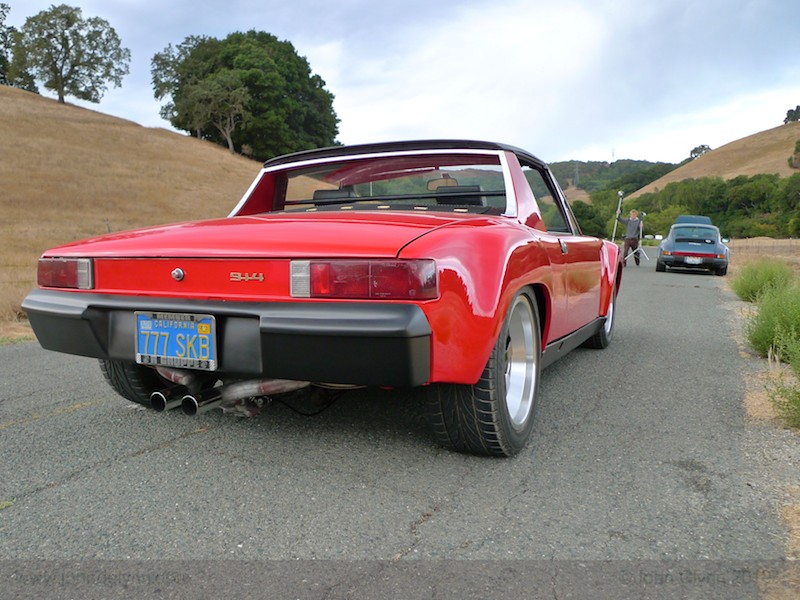
This pretty little Porsche might look like a factory hot rod, but it hides a guilty secret. John Glynn went to California to find out more.
Engine transplants have been the backbone of hot rodding since Moses was a boy. Nothing is more renegade than running an excessive engine in a chassis that was never designed to handle tons of torque. Overdosing on power-to-weight, and then making that package work is what custom car construction is all about.
When Bob Marx took the temporary motor from his 454 Chevrolet Chevelle SS, to refit the rebuilt original powerplant, he was gifted a great-running V8 with nowhere to go. Later that week, while cruising a friend’s E36 BMW M3 Cabriolet down to a Silicon Valley car show, the thought occurred that building an open-topped European vehicle with all-American power might be kind of fun.
Spotting a Porsche 914 at the show, Marx took a closer look at the engine bay. He was convinced that the spare V8 would fit in the mid-engined location. The hunt began, almost immediately uncovering this car just a few miles from Bob’s home in Pleasant Hill, on the outskirts of San Francisco.

Marx’s machine began life as a 1700cc 1972 914.“A rust-free California car was what I was looking for,” recalls Bob, “and the owner assured me it was exactly that, so I went and had a quick look. I noticed a few things I didn’t like, but we agreed a deal and I brought it home to get to work. As I began stripping back to the bare tub, I uncovered more and more rust, along with some shocking hack jobs on things like the wiring. It was not the best of starts.”
Although classic Teener rot spots, such as the hell hole (the area under the battery tray), front floorpan and rear luggage space needed nothing bar a quick wire brushing, extensive corrosion was uncovered in the sills, floorpans and battery tray. Bob cut out the rust and welded in new repair panels, before taking the exterior down to bare metal and welding on the steel GT arch pack, key to the look of this car.
Sold new with mid-mounted 1.7 or 2.0 litre engines, cooking versions of the 914 were never intended to take the power of a small-block Chevy motor. Strengthening the chassis was essential to deliver a safe, confident drive. To achieve this, Bob welded in the longitudinal and rear arch stiffening kits, to minimise rear flex under power, which would ultimately have cracked the back end. He also ensured that the factory stiffening was still working as it should.
Porsche had only ever fitted air-cooled engines, so work was needed to house the water cooling required by the incoming Chevy. A custom rad was fitted in the nose, with homemade ducting to direct cold air through it. Lightweight Gates hoses carry coolant back and forth. The front valance was modified to let the air in and then painted satin black. At the back, a bi-folding engine grille was built, again for better airflow. Both look great. The reflection of the grille in the rear glass, set between the side buttresses, is a really sweet aspect.

With the chassis work now just about complete, Bob sent his wide-arched shell off to be blasted with baking soda. Once this was done, the attractive bare-metal bodywork was returned to Bob’s workshop, for final parts fit before the whole thing was painted in Porsche Guards Red. The colour looks perfect in this California light: not too brash and not too boring.
The engine is a 1968 327 cubic inch V8, built in Detroit and originally fitted to a Corvette. 327 cubic inches is 5.4 litres: over three times the size of the original. Prior to installation, Bob rebuilt the motor with some trick parts. The block received a light hone before Keith Black 10:1 pistons were slid into the bores. An Edelbrock intake manifold, topped with a 610 cfm carburettor from the same manufacturer was securely fastened to the top end. Stock Chevy headers flow into sexy, GT40-style exhaust pipes. Power is an (under)estimated 345 bhp.
The 901 gearbox is a Porsche classic. Though never built with 350 bhp in mind, it’s a strong, reliable unit which, driven considerately, is nicely suited to the lazy torque of a big V8. The 901 is often seen in historic 911 rally cars, and normally requires no more than a strengthened sideplate and new crown wheel and pinion to make it bulletproof. But that’s with a hundred fewer horses stampeding their way through the transmission. Though this application is more car show and less Tour de Corse, it’s still a big ask.

The 901’s weak point is the dog-leg first gear, located left and back on the shifter. Too much power can twist the separate first gear shaft away from the rest of the internals, so Bob uses the engine’s humungous torque to pull away in second. I do the same in my 911s – it’s no big deal. Thanks to a parts wait, the tail shift mechanism is still fitted to the transmission. Meanwhile, Bob has switched to the slicker side-shift setup, to get the best out of swapping ratios. Future plans feature a more robust 911 Turbo transmission install.
Stance is everything on a hot rod and this one hits the spot. Sports cars sold in the USA have long suffered from vertigo, induced by the towering statutory ride heights that resulted from Ralph Nader’s safety campaigns of the 1960s. Returning the car to European ride height is a popular mod amongst US Porschers.
Tuning the suspension of a chassis that’s had its power tripled overnight is a tricky business, but Bob reckons he’s got things under control. Considering the stock front anti roll bar is thinner than an anorexic stick insect, and there’s no bar fitted to the rear, this sounds hard to believe, but it all looks flat as we follow the car to our photo location. The front is held up by torsion bars and controlled by Bilstein Sport dampers, with Bilstein coilovers and 200 lb springs at the rear.
Hiding behind those 7 and 8” replica Fuchs rims, wrapped in 225 and 245 Fusion ZR1 rubber, are front brakes from a 911 SC, and stock rears. Doesn’t sound like much with the power that’s on tap, but then this car is light, and the brakes have been fully refurbished with a new master cylinder, flexible hoses, caliper seals and the rest. The suspension has also been overhauled, with new bushes and joints all round.

Inside, the classic Porsche-designed cockpit has been left alone, with a three-spoke steering wheel and supplementary gauges the only new additions. Sitting into the car for the first time, I strap the harness tight and brace myself for action; this could be quite a ride.
Turning the key is cause for celebration. The Chevy cranks quickly into life and settles into that classic V8 fast/slow/fast tickover rhythm, which adds a dash of urgency to the low-slung seats and go-faster view along the sleek bonnet. I’m properly excited and we haven’t moved yet. Slipping the lever forward into second, I add a drop of gas and let out the clutch. The car slips from the kerb in a civilised fashion, encouraging me to try another gear.
Rolling on an ocean of torque, the Teener pulls effortlessly; normal speeds in third are a whole heap of fun. As we hit a stretch of smooth dual carriageway, I throw open the throttle and let the V8 sing. The Fabulous Fourteen unleashes like a cartoon Roadrunner, pouring hyperspace between us and the cars behind. This thing is more addictive than chocolate-covered coffee beans.
The direct gearshift and dependable brakes work well together. Thanks to the wider track, the steering feels fantastic. Although the front end ride is perhaps a little stiffer than I would prefer over rough roads, it’s early days for this car’s development: Bob’s only recently got it fully on the road. At the minute, he is concentrating on maximising the miles and just driving. Can’t say I blame him; it’s a wicked little grin machine.
A few days after we arrive back in the UK, I get an email from Bob about the car’s first show appearance. It’s gone down well, with lots of positive comments and face-wide smiles from those who don’t initially spot the V8 in the back. It’s all the validation needed to justify the blood, sweat and tears that went into making it.
My hat comes off to guys like Bob, who can take a concept, add weeks of work and almost single-handedly see it through to completion. This sweet little missile strikes a direct hit for men in sheds everywhere.

by John Glynn | Apr 13, 2010 | Classic Porsche Blog, Project Cars, Road Trips
Since our first visit to the Essen Techno Classica back in 2006, I have always wanted to drive my own car over. The sight of all those great old classics on show and for sale made me miss my 911, and Dusseldorf city centre seemed an ideal place for a cruise around amidst ancient German money. For 2010, I vowed to get to Essen using classic Porsche power.
With Eurotunnel booked and the Barclaycard ready to take the brunt of the fuel bill, at 3.30 last Wednesday morning, I set off for Essen.
First stop was Banbury, for a fill up for car and driver (iPhone pic above). 24 hour latte on tap is a lovely idea, especially when you’ve only had two hours sleep! Costa’s Raspberry and Almond bakes are the perfect accompaniment. My car runs the billet Airflow cupholders, which have paid for themselves in satisfying my 911+caffeine addiction many times over. With coffee and cake on board, and iPod shuffle piping through the Autocom intercom headphones, we headed for Folkestone.

Just before Junction 9, the sign said ‘M40 Closed; Junction 4 to 3’. Pain in the bum as there is no real alternative after J9 unless you want to go miles around via the A34/M4. I had also just passed the logical link from M40 to M1.
I came off at J9 and ran the A41 all the way through Aylesbury and out the other side, eventually hitting the M25 (above). The detour was a nuisance, but it was a great drive. The M25 southern section was soon dispatched, and I headed onto the M26/M20 (below), stopping for fuel at the last-chance services and arriving at Eurotunnel just as dawn was breaking.


I was sitting on a kerb taking this picture of the pink dawn sky over the terminal building, when a guy got out of a car on the other side of the hedge behind me. He called to his son: “Look, look! Look at this old Porsche! Oh WOW!” Then he must have seen the back of me sitting there being a camera geek, and British reserve kicked in just as his son came bundling out of their car and wowing excitedly, just the same. “Shush,” he said, “it’s only a car.” Made me smile.

After my first proper run in the Orange for almost 21 months (since July 08), caning along an empty A41 and then a good old blast around the M25, I thought to myself “Yes, it’s only a car. But what a car!”


The tunnel crossing was a chance to rest. Loved their note about opening sunroofs and vents seeing as I don’t have either. We rolled out the other side into beautiful sunshine and I put pedal to metal again, knocking on 160 km/h all the way to Antwerp. I stopped there to grab a bite:

Two hours later, I was checking in to Essen’s Hotel Petul. Once upon a time, I’d have downed a double espresso and shot straight on down to the show. With days of sleep deprivation catching up with me, I decided to grab a nap instead. There’s only so long a candle can be burnt at both ends!

by John Glynn | Apr 2, 2010 | Classic Porsche Blog, Project Cars
I picked up my orange 1976 Porsche 911 Carrera 3.0 Coupe from its latest visit to Tuthill Porsche today. The boys dropped the worn steering rack out and swapped my Turbo tie rods over to a good used rack I supplied, fitting their re-machined rack spacers/lock stops at the same time. These allow a decent sized spanner to be used on the tie rods, rather than the teaspoons the original pieces leave room for.
The front anti-roll bar bushes were perished, so those were changed for polyurethane ones. Then the rack assembly was refitted and the tracking was set. Total cost: 4 hours labour, plus parts, plus VAT: £275.
Tuthills couldn’t road test Orange, as the front tyres are below the legal tread depth (it’s on temporary Michelin Pilot Sport Cup track tyres and the fronts are almost slick). So I got to road test it first. The road was wet, and the worn Michies do pull down on the front a bit, but how nice to have a car that went where it was pointed! Baby’s-bum Michelin R-Compound rubber is not a huge problem in the wet: these are amazing tyres. I’ll put my road wheels on over the weekend – Kumho rubber on 8×16 and 9×16 inch Fuchs as in the pic below – and see what it feels like. Pretty sure it’s gonna be good.

It’s booked for an MOT on Tuesday. Hopefully we can pass that, ready for the annual trip to the Essen Techno Classica on Wednesday. I was going to take advantage of a free crossing with Norfolk Line Ferries, but the outbound weather looks a bit grim, so I’ve just booked the Chunnel instead. Cost was £104, which I didn’t think was bad for a short notice ticket over Easter.
An early start is required to get to Essen for the afternoon preview, meaning the 400 km drive on the other side should be pretty pacey. I can hear the engine’s characteristic 4500rpm buzz already.

by John Glynn | Mar 26, 2010 | Classic Porsche Blog, Project Cars
My orange 1976 911 Carrera 3.0 is due for an MOT, but there’s been play in the steering rack for a while now. As I am exceedingly time poor at the minute, I dropped the car down to Tuthills at lunchtime to get them to do it.
I hadn’t run the car since August 14th last year, so would the Odyssey 680 battery still have enough juice on board to start it? I needn’t have worried. Knock on the battery master switch, turn the key and into life at the first crank.
Arriving at Tuthill in Wardington was pretty hectic. The guys were getting ready for the Bulldog Rally this weekend, fabrication was busy, paint shop was busy, engine workshop flat out tuning a Belgian rally car. All sorts of stuff going on.
I had my D700 and the 50mm prime with me so I shot a few pics.
Oli Wheeler’s 3.2 Carrera with the Jenvey throttle bodies (covered by Jamie Lipman and me for 911 & Porsche World magazine) was in for servicing. Here’s Oli’s and mine with the new service van behind.
This is a very faithful ST replica that’s about to start racing:

Steve Troman’s perfect little Martini SC, just back from the East African Safari Classic Rally:

Here’s a build the guys have just finished. Nothing revolutionary, just a rust-free US import 911, rebuilt and repainted in Jaguar Green in a 3.0 RS-style. The finish is excellent: I love Minilites on a Porsche. The motor is a 3.2 with 964 cams , SSIs and a Dansk two out. Sounds great and I don’t usually go a bundle on 3.2s or the 2-out Dansk boxes.

Also grabbed a nice pic of Mark and Martin putting the driveshaft back into a Boxster S in for a service:

Inspired by all the activity and some very beautiful cars, I asked Paul to get the boys to do the rack and then drop the engine and gearbox out, as I have some long-overdue jobs to get through on the Carrera 3.0 motor and I feel like taking a day or two off to get these parts on the car. I’m going to get a list together and see what we can make happen while it’s all on the floor.
Came home in my Audi 80 Avant, which has been sitting there waiting to be picked up for weeks. Tuthills do Volkswagen and Audi servicing also, so I had left the 80 (a 2.6 manual with 150k on but in generally tidy condition) in with them for scary wear in the front suspension. They changed all the front end bushes, including new wishbones and strut top mounts, then retracked the car. It drove really well, albeit with a little bit of a knock up front still, due to wear in the struts themselves. Got my eye on eBay for some bargain replacements.
I’ve not had the Audi bill yet, but it’s bound to be chunky. No idea what the 911 will cost either, but the stuff needs doing and no sign of my being able to get to it in the next 8 weeks. Better to have these things ready to use or sell, than sitting in a garage gathering dust!