by John Glynn | Nov 8, 2014 | Classic Porsche Blog, Project Cars
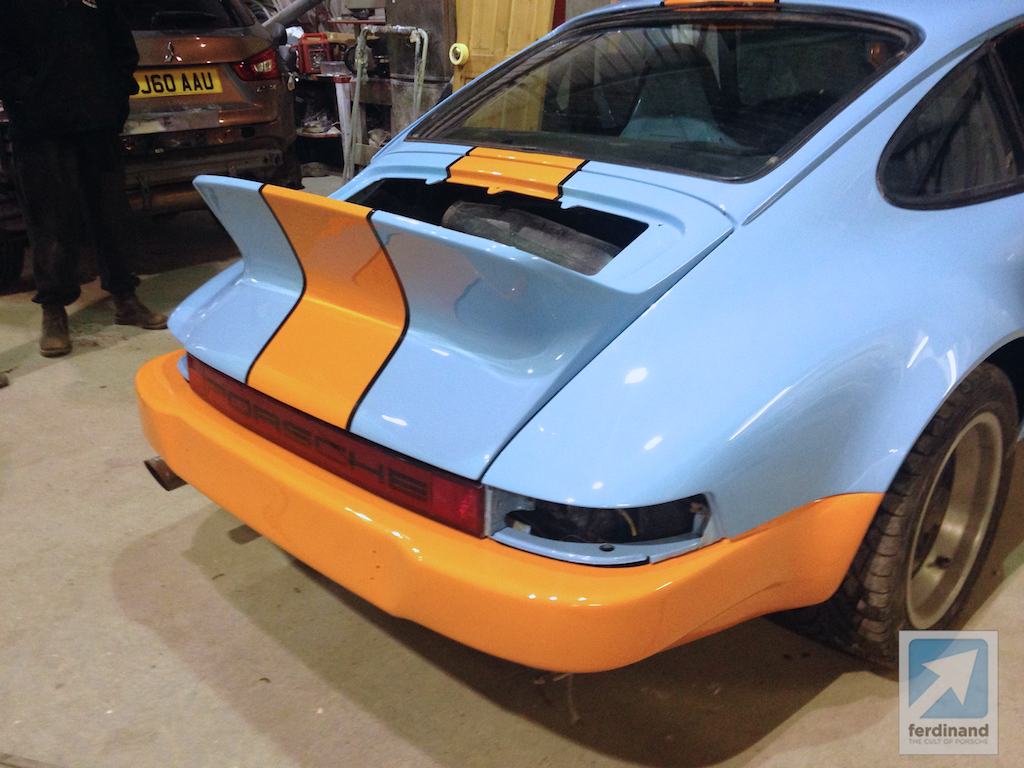
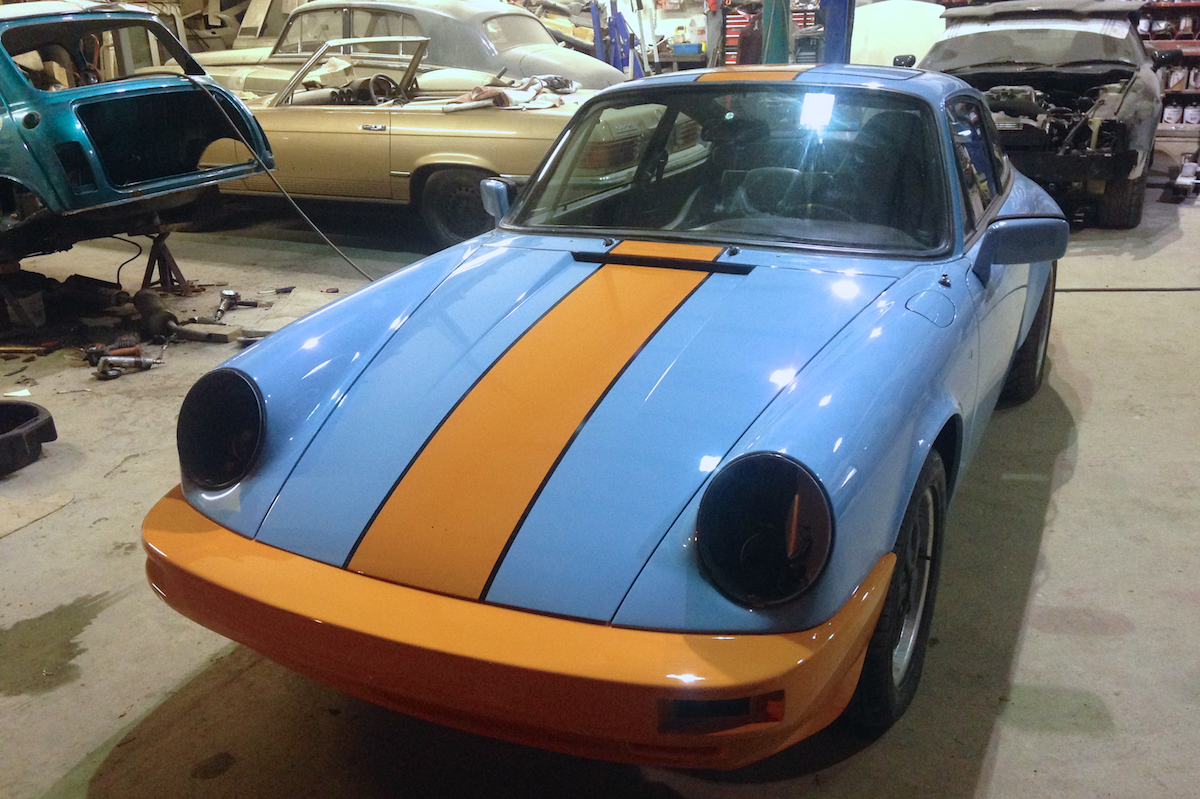
I’ve been swapping emails with friends at McLaren regarding Jenson Button’s future (not that they know anything) but another man at the Woking F1 team has a different connection to Ferdinand. Richard owns this Porsche 911 SC hot rod, which recently went back on the road after a long laid-up period.
I’ve been following the project for a while, after meeting Rich via EB Motorsport. The Porsche fan bought some of Mark’s Porsche 911 SC RS bumpers for narrow-body 911 models including the SC, and added a ducktail for fun.

“I was very happy with the EB Motorsport parts,” says Rich. “The ducktail engine lid fitted straight on with no issues, and the bumpers were good as well. I modified the smile at the front to make a centre bracket, which looks good and supports the front edge over the whole width.”
Gulf Porsche 911 SC
The 911 has just come out of paint and Richard has shared some new pics of the project. Normally, the Gulf tribute schemes involve light blue all over with orange stripes running from under the bumpers across the cars: it’s a look I’m normally not that sure about. Richard’s decision to go orange with the bumpers and carry a modified stripe theme is a good one: the car looks very cool.

“I’ve owned this Porsche 911 SC for more than 18 years. This is rebuild number three! It’s a pretty standard 3-litre SC engine, that has carried us more than 100,000 miles so far. Interior is RS-like, with 993 GT2 seats.
“Last painted eleven years ago, it came off the road for a few years when an oil leak required the engine out to repair. My wife was then ill with cancer and, after she passed away a year ago, my mates got me sorted with a barn with lift and it’s been keeping me occupied ever since.
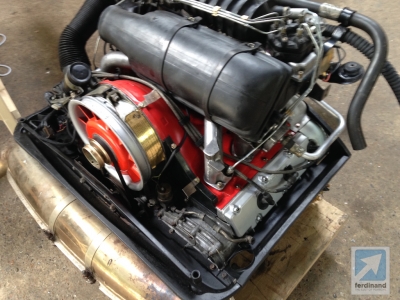
“The engine was a filthy mess when I dropped it out, but we’ve done what it needed and tidied it up. It’s running very well: just needs lots of super unleaded!”
It’s always sad to hear stories of loss, but the aftermath of these traumatic events can be motivational, as we seek to cope with the loss and make sense of what comes next. My brother-in-law, David Bolger, was claimed by cancer over a decade ago: that was my wake-up call to share the Porsche love. What I do today is closely linked to his passing, and I think of him often.
Kudos to Rich for a car that looks good! It cheers all of us up to see long-owned air-cooled cars modified nicely, not just put back to standard and shoved on the market. A good way to move on: and well done to your mates for helping out too.

by John Glynn | Oct 31, 2014 | Classic Porsche Blog, Project Cars
The lightweight Porsche 911R race car in build at the EB Motorsport workshop has almost reached the end of its bodywork journey and is now being prepared for paint. Earlier this year, EB added another metal fabricator to their engineering business, who was also experienced in restoration. The new man has extensively rebuilt the rust-ridden chassis, replacing the huge amount of corrosion in the base chassis with nice clean metalwork.
Pictures I received of the project in progress made it look very nicely done. More shots just shared by Mark at EB Motorsport show the 911 with EB’s light composite body panels (handbuilt in the same workshop) attached, including front wings, doors and rear quarter panels. The roof is still steel, which begged the question why the guys didn’t use the EB Motorsport fibreglass roof panel to replace the original metal panel.

“Simple answer is that the lighter EB roof panel is perfect for replacing sunroof holes on cars originally equipped with a sliding roof,” says Mark at EB. “On a car without a sunroof, we would be putting a lot of work in to save two kilograms, so we’ve opted to leave things as they are and look elsewhere for weight savings.”
EB Motorsport reports a number of 911R kits sold to satisfied customers. I know a few people who have opted for a 911R conversion on their challenging SWB 911 restorations, using EB’s lightweight Porsche 911 doors and aluminium hinges, full front wings with built in sidelights, 911R tail light conversion and composite rear quarter panels. Target weight for the EB 911R is circa 860 kilograms: that would be quite an exciting achievement.

Also in the EB project stable is the 2.1-litre RSR “Baby” Turbo replica, which now looks little short of insane. Mark has been working on the flat fan conversion prototyping and recreating the magnesium oil cooler housings as per original race cars. He is also building a new front end for his Harley chopper. So much stuff going on up in Yorkshire: kudos to the guys there.

by John Glynn | Oct 29, 2014 | Project Cars, Porsche Cayenne
Anyone interested in buying a Porsche Cayenne who’s been researching their purchase via forums is forgiven for massive paranoia regarding propshaft failures. The truth is that propshaft or cardan shaft failure is going to happen to any Cayenne you buy. Propshafts or driveshafts are maintenance items on any vehicle: especially 2-tonne 4wd SUVs.
Porsche Cayenne Centre Bearing Mount
Prime suspect of a Cayenne propshaft issue is the centre bearing mount. The bearing supporting the CV joint in the middle of the two-piece propshaft is mounted in rubber. Like all rubber mountings, it eventually wears out. The vibration from a failing centre CV joint will often kill the bearing. It is under a heavy 4wd car in all weathers, so do not be surprised about this: the part cannot be expected to last indefinitely.
I just had to sort this ‘cardan shaft’ centre bearing mount failure on my Cayenne S. The centre bearing mount failed two weeks ago and I have been driving it around ever since, in the process of sorting it out to my satisfaction. If you’re easy on the throttle you can keep driving it a bit. I am now on my second shaft this week: a brand new OEM GKN Spidan propshaft.
I went a slightly long way around this issue, as the usual suppliers wanted the original prop shaft in exchange and I wanted to keep it for rebuild. I bought a recon propshaft from eBay and fitted that to the car, but as soon as I drove it it was obviously wrong. So I ordered a new shaft and fitted that last Thursday morning. I’ve got a miniscule vibration above 80 mph: more a sound than a sensation, but it still needs sorting out.
Porsche Cayenne Cardan Shaft Propshaft
My old shaft had apparently been on there for 135k miles. The car has been maintained by a Worcester specialist since 60k miles and we know they have never done it. I very much doubt that it had ever been apart: it took me ages to split the shaft off the diff input flange. In the few days I ran it with a less than perfect centre bearing mount, the centre CV joint was seizing until it warmed up, which could easily have caused the rubber mount to fail.
Taking the second (supposedly recon) propshaft off the Cayenne, no doubt the centre bearing has been replaced on this, but the centre CV joint is just like my own one: sticky and recalcitrant. The new shaft feels totally different.
Speaking to a few propshaft experts this week, all agree that the problem is tied to the centre CV joint. The complete shaft has three CV joints for maximum smoothness, but the centre one takes most abuse, is the most exposed and will eventually seize up and fail. That wears out the rubber bearing mount, but most people just swap the bearing and don’t sort the CV, which causes the same problem soon after.
Although I have a new shaft on the Cayenne now, I plan to send my old shaft to a specialist who was very helpful this week and obviously knows his stuff. He will refurbish it before balancing at the highest RPM. I plan to refit that to the vehicle in due course and see where we go from there. This is a key part of the transmission, so I want it perfect.
Cardan Shaft/Propshaft/Driveshaft
A Cardan Shaft is a propshaft is a driveshaft. The original concept to adapt ancient Chinese gimbals into a universal joint to use in transmitting power came from the Italian mathematician, Girolamo Cardano, in 1545. It’s been called a Cardan Shaft in mainland Europe since becoming common in the early 1900s. It’s a prop shaft/propellor shaft here in England, thanks to common use in the industrial revolution. A driveshaft is the same thing, normally smaller.
So, don’t think Cardan Shaft is Porsche’s fancy name for this. Cardan shaft, prop shaft, drive shaft: same thing.
Ferdinand blogs my freelance adventure with Porsche at the centre. To support the blog or engage with me in other ways, you can:

by John Glynn | Oct 22, 2014 | Classic Porsche Blog, Porsche Cayenne, Porsche News
While writing a Porsche Cayenne Buyers Guide for 911 & Porsche World magazine the other day, I came across an interesting story around the genesis of the Porsche Cayenne.
The Cayenne has long been marketed as a Porsche/VW partnership vehicle right from the start, similar to the 914, 924 and more, but the first Porsche SUV was apparently set to be based on the Mercedes ML. When Mercedes asked for shares in Porsche to cement its joint venture, the agreement between the two companies came to an abrupt end.
Porsche was already working on an SUV concept for Volkswagen, so chased the Volkswagen boss – Porsche family member and shareholder, Ferdinand Piëch – for a space alongside Wolfsburg on their posh 4×4 project. Rather than using all-Volkswagen sourced engines, Porsche’s drawing board already had Panamera sketches on it, so Stuttgart decided to build its own V8 to power the SUV plus one other. So much is down to the marketing.
Britain’s Steve Murkett led the Cayenne design team. Early reviewers felt that the reshaped front end on a van-like Touareg bodyshell didn’t communicate much style, but I disagree: I think it’s quite a stylish car nowadays and stands out from the crowd. If they didn’t know that the two were related, a casual observer would be unlikely to draw a line between Cayenne and Touareg.
As for comments that the X5 was more stylish, perhaps the market has the answer with slightly higher residuals for the Porsche. As for what we could have had – a Porsche/Mercedes ML – I am happy with things just as they are.
Porsche Cayenne Buyers Guide
Regarding the Cayenne Buyers Guide, the start points for a 2004 Porsche Cayenne S V8 like mine are quite simple.
- Check no engine ticking noises: could be coils, a failing water pump or cylinder scoring
- All gearshifts smooth and controlled: no bangs or rattles
- Check plastic coolant pipes in the V have been changed for aluminium
- Check no wandering steering – front control arms wear out fast
- No tired brakes, no past-it tyres
- No warning lights from the air suspension if fitted
- Check for damp under carpets: leaky sunroof tubes or split rear washer pipe in A-pillar
As for the rest, you’ll have to buy Porsche World next month!

by John Glynn | Oct 17, 2014 | Classic Porsche Blog, Porsche News
Out looking at Porsche cars for sale with a mate last Sunday, we found ourselves close to Mercedes-Benz World in Weybridge, Surrey and decided to drop in for a coffee. The coffee shop is great and worth a visit on its own.
I used to work around the corner from Mercedes World and the huge facility alongside Brooklands was usually deserted: I could never understand how it paid for itself. On this particular Sunday, the place was absolutely packed. With the queue for coffee more than twenty people deep, we opted for a quick scoot around the exhibits before getting back on the road.

MB world used to house many classic models in its beautiful interior, but there are fewer classics now and plenty of new cars. We had a good look at the SLs on show – of course I thought my SL was nicer than their R129 – and then whipped through the technology part on the top floor. Inside was the 1996 Mercedes F200 concept from 1996 (above). This spellbinding car with double-joystick technology and cutting edge ideas for the time is still a handsome machine: recognisably Mercedes.
Porsche Prototype Exhibition
Seeing the cool Mercedes concept reminded me of an exhibition currently running at the Porsche Museum in Stuttgart. Featuring a number of Porsche development mules and work-in-progress prototypes, the “Project: Top Secret” show running until January 11, 2015 opens a door into the workings of Porsche engineering development.

Sixteen Porsche cars form the core of the exhibition, including concept cars, camouflaged test beds and one-off experimental vehicles. Notably, these are development survivors, as most test cars and working prototypes get scrapped when their work is complete: common practice amongst manufacturers.
Cars I would most like to explore in detail include the 964 Targa, chopped up to disguise the mid-engined chassis layout of the original development Boxster, and the 984 Roadster development car. The display also includes a rear-engined Porsche 965 project, and the four-door 989 family sports car, which set the design tone for later models. The 918 rolling chassis seen in many Youtube videos is also on show.

The Porsche Museum is open from 9am-6pm Tuesday to Sunday. Admission is €8 for adults. More information at www.porsche.de/museum.