
by John Glynn | Mar 2, 2014 | Classic Porsche Blog, Project Cars
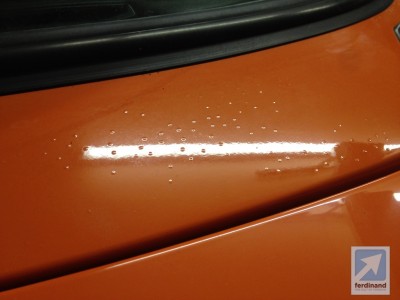
Been meaning to uncover my Carrera 3.0 for a while and stick the battery on charge. Did it this evening and found a big surprise hiding under the cover. The roof, rear arches and scuttle are peppered with microblisters. What a pain in the arse!
It’s not a huge deal, as the guys at Racing Restorations have some Porsche rust & bodywork repair work to do for me: repairing the dents I made over the driver’s door in Monaco, and sorting a bodged repair from before my time on an offside rear quarter replacement. So we’ll have to paint lots of the the car anyway, as matching this custom Continental Orange mix won’t be easy.
While we’re chopping about, I might get them to make a nicer job on the oil cooler nose box (done before me), and change an inner rear wing where it’s been hammered out in the past, so they might cut the rear quarter panel off for that. I’ll find Rob’s boys some other stuff to do: maybe chop the sills open to look for any rot. Tuthills have some nice carbon 935-style mirrors coming through on a new build, so maybe I’ll switch to those too. And fit a Safari roof vent! (might be just kidding)

I suppose this only really bugs me as there was nothing wrong with the paint when it went under cover, and the cover is not some cheap blanket affair: it’s a supposedly breathable genuine Porsche Tequipment accessory.

But I’m not blaming the cover and I don’t blame the car. I’ve neglected the Orange for long enough, so will just get it fixed. First thing to do is drag it out and run it to for an MOT when the battery’s charged. That’ll clean the mildew off the throttle.

by John Glynn | Feb 23, 2014 | Classic Porsche Blog
The name Ferdinand comes from an old Spanish conjuncture of faro, meaning journey and nano, meaning brave. Brought to Austria by the Habsburg dynasty, it spread from there to France, but the origins of Ferdinand are rooted in Iberia, as a traditional name in the house of Castile. In Spain and Portugal, the name is Fernando.
Of course we always have Ferdinand in mind, but we remember a different Fernando today. He is Adolf Ferdinand (Fernando) Roy Stock (above, in the shades): Portugal’s first ever rally champion, finished third in the Tour of Europe and was an Iberian champion in Porsche and Mercedes. Born February 23, 1914, Fernando was celebrated by his family today. Brother Jose sent me a note for his anniversary, and so we remember him too.
Seen here on the 1953 Monte Carlo Rally, Fernando was given the number one plate as lead car on the event. One of 112 participants to depart for Monaco from Lisbon, Fernando and co-driver Pinto Basto drove their early 356 1500 Coupe as one of a record 404 total starters and a highly appropriate 356 finishers.
For all the appropriateness of the finishing tally, Monte Carlo ’53 was not kind to the Porsches. Several of the 356s entered were excluded for being 2cm too low overall, the subsequent furore compounds the mockery earned by Monte organisers over the years. Remember the Mini Coopers.
So many people confuse great Porsches with pristine, ultimate speed machines. But real Porsche is here in these pictures. It is hope and ambition, struggle and risk, joy and pain. Motorsport teaches us highs and lows: don’t forget that all Porsches are born of racing.
Obrigado Fernando, and all those Porsche pioneers. Still a big part of our family!

by John Glynn | Feb 23, 2014 | Classic Porsche Blog, Market & Prices
The market for used Porsche cars of all ages continues to exceed most expectations. I say ‘most’, as I assume someone out there expected this, but I certainly didn’t. Air-cooled classics are still flying along, and collectable water-cooled models are also doing well. Internet asking prices tell one story but less well known are the cars that sell behind the scenes, without ever being advertised.
Scarcely a week goes by without an email offering to buy my Orange 1976 Porsche 911 Carrera 3.0 Coupe, or asking for help finding a well priced project, be it 911 or 944 Cabriolet (just had one of those mails). When I’m offered a project, or asked for advice on where to sell project cars, I point people towards eBay, as I believe in the market and that is where the market decides, or where you get the offer that leads to an early sale.
Away from the exposure of eBay is a different market, fuelled by collectors leveraging networks to find the real gems. I’m not talking silly-money Carrera RS, but slightly closer to normal. The 993 RS and 996 GT3 seen here are good examples of sought-after Porsches, recently sold without being advertised. If I was building a collection for the future, both of these would have been on my list, as would the 964 Turbo which also sold to the 993RS buyer.

If you’re watching the classifieds looking for a bargain collectable, you might be wasting your time. Try emailing those with good connections to a wide range of trade and private contacts. Yes, you’ll give some margin away to a dealer to buy off-radar, beyond reach of the market, but if you pay 5% over the odds and the market jumps 20% between here and the end of 2015*, then so what?
These “private trade” sales are where independent dealerships score big-time over official Porsche centres. Don’t be afraid to discuss your intentions with respected independent specialists. Ask for personal recommendations and find the really good ones: don’t accept everything you read on forums. Do your own research and use common sense.
*note: this is not a market prediction!
by John Glynn | Feb 22, 2014 | Project Cars, Porsche Cayenne
The original Volkswagen Touareg and Porsche Cayenne may not share an engine, but earlier models do share a transmission: the Aisin AW TR-60SN/09D.
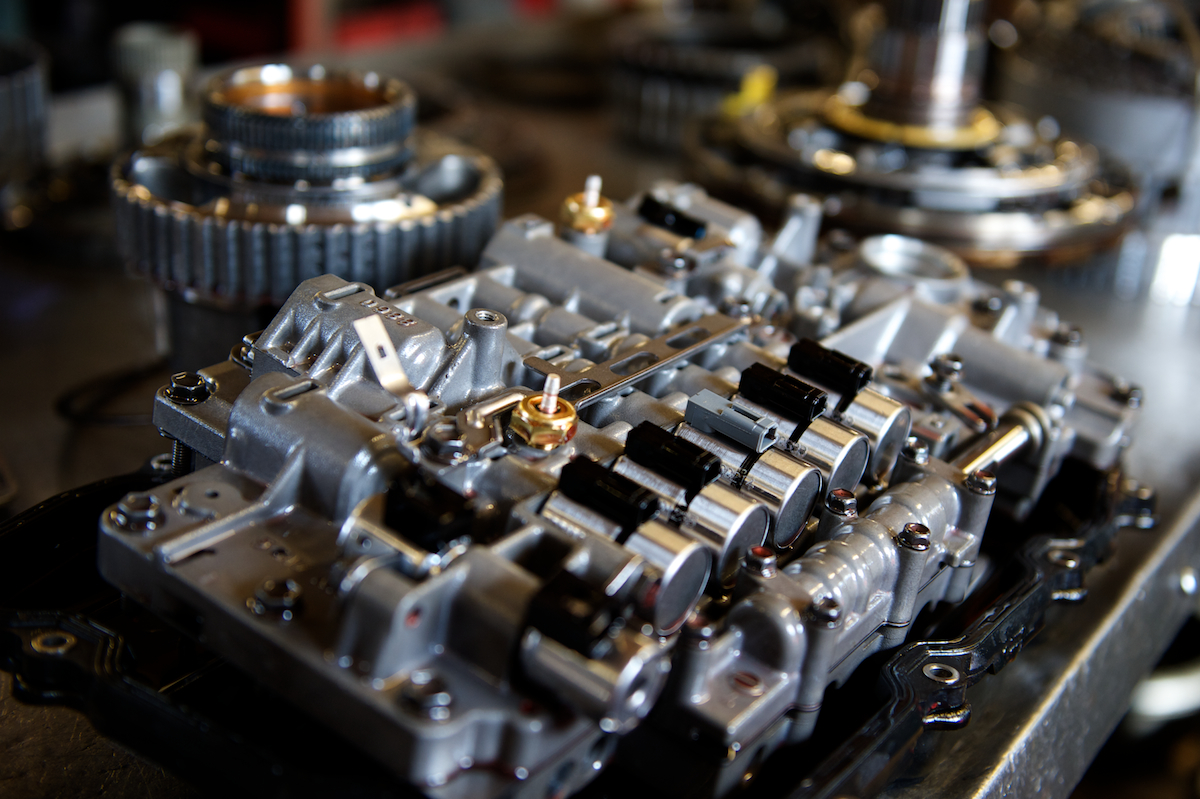
This six-speed transmission is generally reliable, but develops problems with the valve body: the hydraulic fluid control assembly that regulates gear and clutch engagements. The classic valve body symptom is a hard shift from fourth to fifth. “It feels like you’re going through the windscreen,” is how one Porsche tech friend described his first experience of the problem.
I’ve been having gearbox problems with my Cayenne for a while now, with the valve body the prime suspect. My 2004 Cayenne S never had a huge problem changing gear: it was much more a clutch control issue, where the car would drop out of gear while waiting to pull out of a T-junction or onto a roundabout and leave you stranded at first, but suddenly find second, tearing off with a highly undignified bang. Cue eyeliner streaks on back-seat teenage cheeks.
The experience was most unbecoming, so I decided to fix it. The Internet provided two firms in the UK known to repair Cayenne valve bodies (mine shown above) by reaming the worn valve passages out and inserting bigger valves, and refurbishing solenoids where required. The cost was less than half that of a remanufactured Porsche part, said to solve the problems discovered in the earlier Cayennes.
I emailed the first firm. The owner answered a couple of my messages but stopped when I asked for a few more details on the process for a magazine article. The other firm’s contact was more amenable and sounded like he knew his stuff. We stripped the valve body out of the car and sent it away. It came back refurbished, we refitted it and the car hasn’t worked since.
We’ve tried two different valve bodies, both supposedly testing fine on the bench but not working in the car. I can get gears 1, 2 and 3 ok, but when it hits the shift to fourth, the display says it has shifted but the car drops out of gear, as if you’ve stepped on the clutch. It will rev away doing nothing, then it throws a gearbox fault and limp mode follows.
I’ve bitten the bullet and ordered the Porsche replacement valve body at £1030 plus 20% VAT. Plus another round of trans fluid changes and work time lost, and whatever bill I get for these unsuccessful valve bodies (one my original, the other going back). You can be sure of small claims repercussions there.
Learn from my mistakes. If you’ve got a reliable Subaru, stick with it. Do not buy a used Porsche Cayenne! Add this to the classic Cayenne problems of coil failures, coolant pipe failures, control arm fails, screenwash leaks and ECU destruction and so on and it gets very expensive to run a used Cayenne. Not to mention what happens when your engine fails – as many V8s and Turbos do.
Anyone well versed in auto gearboxes with some thoughts on the 4-5-6 issue, kindly drop me a line. We have triple-checked wiring connections, fluid levels, filters, pressures, gearbox operating temps and it works fine in first through third, if not as smooth as original. Very disappointing not to have the car outside the door, but we will sort it out eventually.
Update to this post – I sorted the problem by rebuilding the transmission. The 4/5/6 clutch pack was gone. The specialist I was using at the time did not diagnose the issue correctly, but a transmission expert sorted it in a couple of days. Cost was £1500, including removal and refitting of the transmission (that price included a discount of their normal valve body refurb cost as mine was done). Moral of the story: not all Porsche specialists are equal – I didn’t need to buy the Porsche valve body as the original refurb was done by the guys the transmission specialists usually used!
SHARE • EXPLORE • SUPPORT
Ferdinand blogs my freelance adventure with Porsche at the centre. To support the blog or engage with me in other ways, you can:

by John Glynn | Feb 21, 2014 | Classic Porsche Blog, Project Cars
Another fun email exchange this week was with Jim in Down Under, concerning his 1967 Porsche 911 Soft Window Targa.
“The Targa is almost complete: all very good gaps, road registered and all electrics work. Only real problem is bad rust in a difficult spot around the pedal box area, fiddly to fix but will happen. Interior is so good that I plan to detail it to within an inch of its life and leave as is.

“About the only thing missing is the ash tray and they are a bit hard to find unfortunately (email if you can help – JG). Even the Targa top which needs full restoration is absolutely complete. The early cars had a lot more thin metal detail trim than later cars and they would be impossible to find and a nightmare to make, so good that it’s all here on my car.”

The left-hand drive Porsche came to Australia from the US (left hand drive cars over thirty years old are OK in Australia) and sat in a barn for twelve years. Jim bought it from the importer and send it to Autohaus Hamilton for recommissioning, with instructions not to disturb the patina. Hamiltons flushed the fuel tank, cleaned the lines and rebuilt the carbs, sorted some failed bushes, a dud master cylinder and brakes, and it was ready to go.
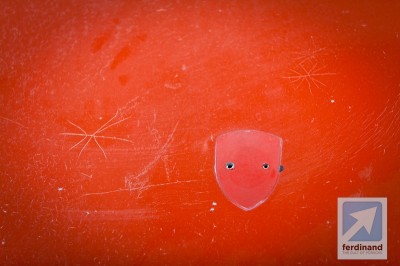
Too many people would sand and repaint this car, without savouring it as it came. Kudos to Jim for sticking with his patina-rich classic 911 Targa: it snaps, crackles and pops!
Got a Porsche project you want to share with the world? You know what we like to feature: doesn’t have to be a 911. Send us some pics and a couple of words: mail@ferdinandmagazine.com.


