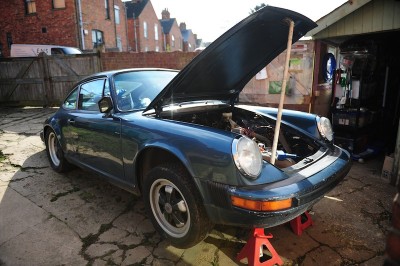
My orange 1976 911 Carrera 3.0 is due for an MOT, but there’s been play in the steering rack for a while now. As I am exceedingly time poor at the minute, I dropped the car down to Tuthills at lunchtime to get them to do it.
I hadn’t run the car since August 14th last year, so would the Odyssey 680 battery still have enough juice on board to start it? I needn’t have worried. Knock on the battery master switch, turn the key and into life at the first crank.
Arriving at Tuthill in Wardington was pretty hectic. The guys were getting ready for the Bulldog Rally this weekend, fabrication was busy, paint shop was busy, engine workshop flat out tuning a Belgian rally car. All sorts of stuff going on.
I had my D700 and the 50mm prime with me so I shot a few pics.
Oli Wheeler’s 3.2 Carrera with the Jenvey throttle bodies (covered by Jamie Lipman and me for 911 & Porsche World magazine) was in for servicing. Here’s Oli’s and mine with the new service van behind.
This is a very faithful ST replica that’s about to start racing:
Steve Troman’s perfect little Martini SC, just back from the East African Safari Classic Rally:
Here’s a build the guys have just finished. Nothing revolutionary, just a rust-free US import 911, rebuilt and repainted in Jaguar Green in a 3.0 RS-style. The finish is excellent: I love Minilites on a Porsche. The motor is a 3.2 with 964 cams , SSIs and a Dansk two out. Sounds great and I don’t usually go a bundle on 3.2s or the 2-out Dansk boxes.
Also grabbed a nice pic of Mark and Martin putting the driveshaft back into a Boxster S in for a service:
Inspired by all the activity and some very beautiful cars, I asked Paul to get the boys to do the rack and then drop the engine and gearbox out, as I have some long-overdue jobs to get through on the Carrera 3.0 motor and I feel like taking a day or two off to get these parts on the car. I’m going to get a list together and see what we can make happen while it’s all on the floor.
Came home in my Audi 80 Avant, which has been sitting there waiting to be picked up for weeks. Tuthills do Volkswagen and Audi servicing also, so I had left the 80 (a 2.6 manual with 150k on but in generally tidy condition) in with them for scary wear in the front suspension. They changed all the front end bushes, including new wishbones and strut top mounts, then retracked the car. It drove really well, albeit with a little bit of a knock up front still, due to wear in the struts themselves. Got my eye on eBay for some bargain replacements.
I’ve not had the Audi bill yet, but it’s bound to be chunky. No idea what the 911 will cost either, but the stuff needs doing and no sign of my being able to get to it in the next 8 weeks. Better to have these things ready to use or sell, than sitting in a garage gathering dust!
Spring has finally sprung in the UK. The weather here was a balmy 12 degrees this afternoon, so I took the opportunity to get stuck back into the jobs on my Varmint Porsche 911 SC after two months with no activity.
The last thing I touched on this car was the fusebox. The fuel pump relay wiring looked a little scary, as well as some very corroded main terminals on the battery, and some melted insulation in the ECU loom (the US cars run a little ECU). Today was all about repairing and digging a little deeper.
First job was to repair the fuel pump loom. I chopped out the solder blobs and installed DuraSeal connectors, with a few soldered joints here and there. Rough-looking wiring was replaced with matching genuine Porsche cable. The beauty of breaking a 924 and a 944 (and stripping out all the wiring) is I now have a lifetime’s supply of proper copper. I also took the fuel pump relay apart and found the contacts pitted and slightly bent. I cleaned and realigned all that and then resealed the cover.
Fusebox refitted, I got to sorting out the ignition switch feeds from the positive battery terminal – they were in a right state. To do it properly, I pulled the (huge) battery out completely and was relieved to see the tray and surrounding metal work absolutely rot free. This car is so tidy! I cut these out and replaced the lot.
Finally for today, I boiled up the battery earth lead to rid it of verdigris, dried it with heat and drowned it in switch cleaner. I tidied up the battery posts and terminals with my cool new battery tool, fitted a Dis-car-nect for safety’s sake and stripped all the earth points back to bare metal. Everything went back together a treat.
There was nothing much wrong with the way the SC worked before I took it apart but, as the pics show, it has a bit of classic old Porsche wiring syndrome going on, so it all needed doing. Hopefully I am adding reliability: if I can get it registered this week, then I am considering taking it to Germany for the Techno Classica in Essen in ten days’ time. Fingers crossed!
I’ve had a longhood Porsche 911 T for a while now and have been to and fro on selling it or keeping it. My business plans for the next two years leave almost no project time, so I’m getting close to selling and letting someone else have the fun of building it up.
A friend of mine is looking at building a period competition car and has been in search of inspiration. It seems to me that a good way to go with the RS-arched T would be towards a Carrera RS, an ST or Le Mans GT category car, like the version successfully raced by Porsche devotees Raymond Touroul and Andre Anselme at Le Mans in 1971.
I know Touroul’s was white, but I would keep the Gemini Blue base and apply some wild race paint – like the Audemars car we all drooled over at the 2008 Classic Le Mans.
I love the look of short wheelbase 911s but, as Paul Frere rightly points out, the long wheelbase B series has always been a much better proposition for competition tuning. My car, a ’71 T, has a 2.2E engine in unknown fettle but with MFI and allegedly rebuilt not long ago. That is a nice base to start with. Alternatively, the rules also allow carbs to be used, so it could run Weber 46s. OK, neither way is easy or cheap but with 10.3 compression it’s pretty hot.
The engine would be the dearest part of the work. Some bits can go but some can stay and that helps keep costs manageable. The cars used by Larousse and Waldegard to 1-2 the 1970 Tour de France are another inspiration, particularly as they are/were punchy but mega light (250/260 bhp in under 800 kilos) with plastic front ends. I love these pics by Larousse himself (borrowed from the Sportcar Racing Website). Again I think Gemini with silver, green and purple Tour de France-type graphics would look top notch.
Suspension and brakes were relatively standard on these cars and to be honest I have no idea what is fitted to mine but the underpinnings are pretty easy to come by. That is another plus.
I would get the 7s and 9s the car needs to look right made by Harvey out in the US – I prefer Fuchs to the Fuchs front/Minilite rear looks most people use. Although the famous ‘sunroof ST’ is rather gorgeous.
The only problem with pics of the Sunroof ST and the also very famous French ST (below) is that they are both superb colours! It’s tough not to rip all the Gemini paint off and go with them. That said, if you are taking off RS arches and welding on ST versions, then the paint is coming off anyway.
I think it’s worth going to town on stiffening the shell as much as possible, with seam welding and a welded cage (like Lex’s car below), but I think it is probably possible to build a nice car for sensible money and then go have some fun. Thanks to working my butt off on freelance jobs since the recession kicked in, my hobby finances are in ever-improving shape, so I may yet do the job myself.
We’ve moved the car to Racing Restorations workshop now, so I guess it’s time to go look at Gemini and get a proper idea of what is possible. And how much it’s going to cost.
Singer Vehicle Design first showed its restyled 911 at a California concours. Singer’s Rob Dickinson gave the exclusive first full article to Ferdinand Magazine owner, John Glynn. See the behind-the-scenes story of our Singer Porsche feature and read the full article below.
John Glynn meets the Singer Porsche 911 prototype and its English designer, to find out whether the car is the ultimate 911, or the ultimate ego trip.
I remember the summer of 1993. My girlfriend was promotions manager for Warner Bros records, while I played in a band that was doing OK. Travelling to and from gigs, we’d listen to her recent releases. One night, it was ‘Chrome’, by Catherine Wheel. The album’s intense opening track: ‘Kill Rhythm’ is still one of my favourite driving songs. It was a pleasant surprise to learn that songwriter Rob Dickinson had a passion for early 911s.
Seeing Dickinson’s ‘69 911E for the first time was a real eye-opener. The car featured sports purpose references alongside original design ideas, such as a drilled plexiglass engine grille, a sweet mix of tan body, yellow stripes and green graphics, and orange surrounds to 911R rear lights. Throaty tailpipes hung beneath the 69 POR licence plate and screamed rock and roll. Its owner had once again struck exactly the right chord.
It’s been five years since I first saw that E online. Today I’m standing next to it, in a car park off Mulholland Drive: home of the infamous LA street races of the late ‘70s and early ‘80s. It’s just before sunset, and Rob and I are waiting for his latest project to arrive. The Singer Vehicle Design 911 is almost an hour late, but it’s hard to be upset when our Hollywood Hills location offers such an unbeatable view of the city below.
“You have to love this place,” declares Dickinson. “It’s all about positivity and making things happen.” Born in England, Rob came to America in 2000 to make his way in sunnier climes. Though he claims to miss “pubs and cynicism”, it’s clear that California car culture has had a major effect on his mindset. When the trailer bearing Rob’s pride and joy suddenly bursts into view, there is a tiny explosion of joy in our midst.
The Singer incorporates influences from almost every era of air-cooled 911 history: from the earliest factory prototypes through to the most contemporary R Gruppe hot rods: cars such as the trailblazing 3.6-engined early 911s built by Jeff Gamroth at Roth Sport, and Steven Harris’s sublime ‘SHtang’, built by Hayden Burvill at Wevo.
As Singer technician John Bowmanprepares the car for unloading, my eyes gorge themselves on this shape, subtly different from the original in so many places. The custom front bumper and valance are first to catch my eye; deeper and more purposeful than the original, with an additional air dam under the wide central oil cooler intake signifying serious intent.
My eyes skate along the bodywork. Gone are the horn grills and old-style headlamps, replaced by bespoke front light bodies with integrated front fog lights, and clear polycarbonate headlamp lenses over brand new bi-xenon lamp units. The central fuel filler cap is functional sculpture, floating in a pool of liquid bonnet.
The scuttle panel features the 993 wiper arrangement, while inside the ‘screen sits a ‘65 rear view mirror. The parts work well together. The driver’s mirror is a Singer design, mounted through the quarterlight. The custom housing hovers zen-like in its transparent surround, simultaneously suggesting lightness and technical prowess. One look at this car tells you it was not built by an amateur.
Before leaving to become a rock star, Rob spent two years studying vehicle design at the renowned Coventry University. He then worked for a short time at Lotus Cars in his native Norfolk, before emigrating to the USA. Here’s a guy with an eye for detail and an irresistible urge to create.
After such exciting initial impressions, it’s disappointing to discover that the Singer is not yet ready to be driven in anger. As a prototype display model, built to a tight schedule for California’s summer car show season, it’s still very much in development. This is the car’s first trip on a public highway. The engine bay is stunning – tea strainers on Jenvey throttle bodies look superb – so it’s frustrating that we can’t jump in and try the 3.8 Jerry Woods/Colin “Ninemeister” Belton motor, as further fettling is required.
The front compartment is also unfinished, hence the lack of pictures, and there are many other areas still to be sorted, but none of it seems a big deal right now. As every 911 guy knows, you can forgive this shape just about anything. Good job too, as minor mechanical hiccups cause our already late photoshoot to go from bad to worse. In the end, photographic genius, stunning views and this gorgeous car come together to carry the day.
We arrive in California a week before we see the Singer, and our upcoming shoot is a hot topic amongst Porsche guys. One thing many ask is: why? What purpose does this car serve? Do Singer seriously believe they can do a better job than Porsche did over 30-plus years of development? I put the question to Rob.
“This is not about us outdoing the original. Air-cooled cars were perfect for their time, and still work well; I use my ’69 every day and love it. But in today’s environment, they’re a sizeable compromise. There are no creature comforts, and the minimal technology is old hat. There’s a hefty power deficit versus modern sports cars and, even if you freshen the look by adding ST arches and wider Fuchs, it’s still an old car that can be challenging to drive daily.
Our car comes from a different set of wants and needs. It retains that iconic profile, but the rest of the car is painted with modern-day tools; contemporary design containing an elevated degree of sophistication. Every Singer is bespoke, as every owner is unique.”
One thing is likely to be common to most prospective Singer owners: rich in money, poor in time. They will have the financial wherewithal that renders compromise unacceptable, but with a schedule prohibiting the intense process of building the ultimate daily-driving early 911 via a bodyshop or Porsche specialist. They will appreciate the ability to turn up, tick the options boxes and come back to the finished product a few months later, without having to take on a car that will still need development, months after it has been delivered.
This is why some early 911 enthusiasts will view the Singer and its raison d’être as despicable. What is an early 911 without pain? Where are the trials, the hardships, the blood, sweat and tears involved in creating a special early car? You mean they can just turn up and drive it away? That is so not right – all the fun is in making the car happen in the first place!
But should we all find it fun, trawling the forums for factory information, endless early-morning swap meets to find the right mirrors and multiple attempts at remapping new-build engines before the car begins to run right? Why not just bypass all that and jump into the perfect daily-driving early 911, with power and presence right from the word go? I can see where Rob is coming from.
The Singer is not just one man’s work. To realise his dream, Rob assembled a team focussed on delivering a credible, compromise-free classic. Starting with the bodywork, Dickinson spent 9 months at Singer’s Sun Valley HQ with Tesla car designer (and fellow 911 guy) Radu Muntean, developing a fresh, heritage-inspired exterior.
Once the look was set, the car was taken to Aria, a protoyping and design facility in Irvine, where expert clay modeller, David Harris, perfected and balanced the bodywork, and prepared it to take moulds for the production car’s carbon fibre body panels. The Singer retains only the steel doors from the original car; all other body panels are composite.
“Most car manufacturers and vehicle designers have studios in California,” notes Rob, “so the automotive community is well versed in prototyping concept car parts. This vehicle could never have been built in the UK.”
Knowing that the car would run 17” Zuffenhaus forged alloy Fuchs (9” front and 11” rear) and Michelin tyres, most of the work went into perfecting the line of the arches over the wheel and tyre combination, whilst retaining the ideal stance. Singer also experimented with a variety of wheel offsets, courtesy of California Fuchs-meister, Harvey Weidman.
The Pilot Sport Cup rubber currently fitted to the car has a very wide tread, resulting in a sidewall that protrudes well beyond the wheel rim. This is an R-compound rubber cheat, to get the widest contact patch possible on a given rim width. The pro is exceptional mechanical grip, the con is a slightly cartoonish look to the rear end from some angles. This effect will be tempered when the car is fitted with standard Pilot road tyres.
The finished wheel arches are quite different to Porsche’s own. The furthest reaches up front have a distinct flat edge, which runs down through a similar edge on the front bumper and into the ‘chops’: the vertical outer edges of the air dam. Similar treatment occurs at the the rear.
The familiar rear lights are a new part, harking back to the short wheelbase cars, where a plain lens sits in a chrome surround, moulded as part of the light body. The number plate panel is bookended by wider, chrome-plated composite bumper guards. I flick between the Singer and an iPhone picture of the rear of a ‘73 RSR in Signal Orange, with the one-piece rear bumper and black-rimmed light lenses. The Singer rear end treatment seems slightly tidier to my heretical retinas.
The race-inspired side oil filler location has been optimised to suit the aesthetic. The sills are deepened, with an almost imperceptible black strip along the bottom edge, which carries through to and around the rear bumper, invisibly rounding off the rump. Looking closely, I notice that the silencer is the same width as the space between the back lights. Excited, I check the RSR picture. Porsche did it the same. Admiration swings back in favour of the original.
Opening the door, the dark green chosen for the retro trim couldn’t be more perfect. Leather weave covers the door panels, seat and dash centres. The seats are built from 3.2 sports seats (the best chairs Porsche ever put in a car), with low backs and ‘peanut’-style headrests. The interior also features a classic-style roll hoop and, though I like the look, the thought occurs that a Ruf-like cage, tightly fitted and then trimmed over, might have been worth considering.
The rear seat treatment shows real design flair. Leather covers the seat wells, and there’s a pull-down compartment on the firewall housing rolled-up harness straps fixed to the chassis, leaving space for a fire extinguisher and other touring equipment. If imitation is the sincerest form of flattery, this area should prepared to get extremely flattered.
Slipping into the comfortable seats, the dash is an old friend, with the all-important air conditioning controls disguised amidst factory switches. Face vents seem missing, but clicking down on the dashtop speaker grille causes a centre vent from a late 3.2 Carrera to lift into place. If they can get this working in production, I’ll be seriously impressed. A Sirius radio and GPS unit are part of the interior package, as is the delicate three-register clock.
While studying the modified Momo steering wheel, I spy a bit of cheeky English humour. In true Spinal Tap style, the tachometer goes to 11, and there’s a certain singer’s face emblazoned across the dial. I understand the reference, but to me it upsets the authenticity. A self-effacing grin from the designer confirms that the options here are entirely up to the client.
In our two Singer photo sessions, up on Mulholland and on the Malibu stretch of Pacific Coast Highway the following day, countless people stop to take pictures for their loved ones, or to see it for themselves in the heavenly California light. This car has had huge online exposure, and enjoyed an extremely positive reception. I hope the target audience take to it with the same enthusiasm as Joe Public. This will probably depend on the price.
As the Singer is still a prototype in the process of development, official retail prices have not been set, as full build costs are not yet known. Singer expect to start at around $240,000 for the entry-level 300 bhp car, rising up through the 360 bhp model and rounding off with the ‘ultimate’ 425 bhp version at circa $300,000.
The price point is certainly rarified, but the extensive development going into this car is not cheap. The forthcoming power steering, handling and ride quality development programme, to be conducted with with the suspension experts at Smart Racing, is expected to cost over $100,000. Rob believes the prices reflect the work involved.
“One look at the specification shows this is an expensive car to construct. The final price will attempt to strike a balance between making the car attainable and allowing us to recoup some of the enormous development costs.
It became clear very early on that, were we serious about producing our vision of an ultimate 911, price could not be an obstacle. The mantra was, if any car on the planet deserved the highest standards of design, componentry and development, it was the air-cooled Porsche 911. So unfortunately, it’s going to be expensive and not for all.”
As someone who believes everyone should turn their car into whatever they feel is right for them, I find it impossible to bear a grudge against the Singer, the vision that created it, or those who aspire to ownership. That said, were I ever in a position to afford one, I’m not entirely sure I’d write the cheque, as I enjoy the compromises that early 911s force a man to make. This may all change when we return to drive and review the car in more technical detail early next year.
While I sympathise with those who feel Singer money would be better spent on an original early car or two, I believe that, rather than substituting for early 911 ownership, the Singer is likely to complement it. Singer say that most people who have so far expressed an interest in the finished product already own a number of classic 911s. You could say that this car is preaching to the converted.
The development team’s next challenge is to ensure that the driving experience does not fall short of expectations created by the appearance. Knowing the people and the parts involved, I have little doubt that they will succeed in delivering a very special vehicle for those who can afford it.
I love Fuchs wheels. No other alloy wheel suits a Porsche 911 like the classic lightweight Fuchs forged alloy rim. Smooth and simple, it neither overpowers the classic 911 shape nor underdelivers in its visual impact. A Fuchs rim is the perfect Porsche wheel, so remember that the word is pronounced ‘Fooks’ and is the same whether single or plural.
I have a few Fuchs in my collection now. Nothing outrageously wide, just the regular stuff in 15″ and 16″ diameter. I have tried some of the UK Fuchs refurbers, which has worked out OK but never really stunning. So there was only one man to talk to about a set of 15″ Fuchs for my orange Carrera 3.0, in 7″ and 8″ rim widths, done in the classic RSR finish. That man is Harvey Weidman in Oroville, California. This is his anodised RSR finish on a pair of 9×15 Fuchs:
Harvey is a 911 fan. His Martini 911 (below, shot by Bob Tilton) is a regular on R Gruppe events in Northern California, and his laid back style and late night car park conversation is a real crowd puller. Well, it pulls me anyway.
Weidman’s Wheels have been playing with Fuchs since Moses was a boy. Harvey tells some great stories of ordering the rarest rims brand new from PCNA many moons ago, at prices to make us weep today. Suffice to say that if Harvey doesn’t know it about Fuchs wheels, then nobody does.
I bought a few sets of 15s in the States last year and not all of them were immaculate. I recently pieced together some RSR candidates by way of a set of 7s and 8s, and sent them to Harvey via some helpful Norcal buddies who were headed up to drop some rims, shoot the breeze and take some pics. They came back with a few cool shots, which I thought might be nice to share. The first is of some uber cool Ronal rims for a widebody project one of the guys is working on. Love these babies:
Here you can see just how wide we are talking! The hunt is on for the centre gaskets on these.
Here’s the Ronals in use on one of the Belga cars from Ypres 1985. Look at the width!
Next is a rim being altered for a buddy running a very widebody 911 RSR down in Southern Callifornia. Playing with rim widths and offsets is a Weidman speciality; not heard of a fail myself yet.
Finally, here’s some RS Carrera wheels that have just been finished in the original green. Note the perfectly sized template for the mounting face under the bench – we don’t want paint in between the wheel and the hub. Amazing how many refurbishment ‘experts’ get this wrong:
Needless to say, I’m looking forward to seeing the finished products in a few months’ time. The Carrera 3.0 is a special little car and Fuchs are special rims. The combination of 15s, Continental Orange 911 and Harvey’s stylish hands should be pretty amazing stuff. More pics as we get them!
Contact details for Weidman’s Wheels are below. If you like Fuchs like I like Fuchs, then it’s well worth getting in touch. Harvey also refurbs Minilites (tricky things to do right) and magnesium centrelock wheels.
Weidman’s Wheels
1675 Wyandotte Avenue
Oroville, CA 95966
This month’s 911 and Porsche World magazine features a story on Derek Bell and his 928 Club Sport, written by me with photos by my partner in crime, James Lipman. Thanks to Derek’s hectic so-called retirement, the job took me a few months to set up, but it was well worth the wait: it was a truly fantastic experience from start to finish.
Porsche at Weissach built a small number of tweaked 928s for the works drivers. At the time of shooting, the car was owned by Justin Pressland, but it has since sold to a Belgian enthusiast and well known collector of important Porsche cars. Partly a shame as Justin was the perfect owner: an outright aficionado of the model, who regularly used and enjoyed the car. The 928 is now in good hands, however, and I expect to see it out and about on the European classic Porsche scene in 2010.
As for Derek Bell: what hasn’t already been said? As a five-time Le Mans winner, Derek is obviously a driver par excellence, but behind the glamour of racing, Derek is an intelligent, engaging conversationalist and a very entertaining man to spend time with. He is certainly deserving of his revered status within the Porsche community.
Here’s a brilliant bit of video illustrating the genetic connection between man and machine. This is Derek Bell in the Porsche 956 at Le Mans in 1983. The 24-Hour Le Mans race went right to the final lap, between the number three Porsche 956 of Al Holbert and Bell’s number one car.
Entering the final stint one lap down on Holbert, the number three car began to slow as a blocked radiator generated engine damage. Bell unlapped himself and charged on. On the very last lap, the Holbert car’s engine seized and then stalled. Holbert managed to get it running again but crossed the line just 17 seconds ahead of Bell. What a story!
Observe and absorb the awesomeness of that speed along the Mulsanne Straight: it was a privilege to work with this legend of Porsche. We had lots of fun with Mister Bell and hope to work with him again in the future.
This website uses cookies to improve your experience. We'll assume you're ok with this, but you can opt-out if you wish.AcceptRead More
Privacy & Cookies Policy
Privacy Overview
This website uses cookies to improve your experience while you navigate through the website. Out of these, the cookies that are categorized as necessary are stored on your browser as they are essential for the working of basic functionalities of the website. We also use third-party cookies that help us analyze and understand how you use this website. These cookies will be stored in your browser only with your consent. You also have the option to opt-out of these cookies. But opting out of some of these cookies may affect your browsing experience.
Necessary cookies are absolutely essential for the website to function properly. This category only includes cookies that ensures basic functionalities and security features of the website. These cookies do not store any personal information.
Any cookies that may not be particularly necessary for the website to function and is used specifically to collect user personal data via analytics, ads, other embedded contents are termed as non-necessary cookies. It is mandatory to procure user consent prior to running these cookies on your website.